Why Pay $15,000 for a Stamping Die When Custom Sheet Metal On-Demand Costs 73% Less?
Why Pay $15,000 for a Stamping Die When Custom Sheet Metal On-Demand Costs 73% Less?
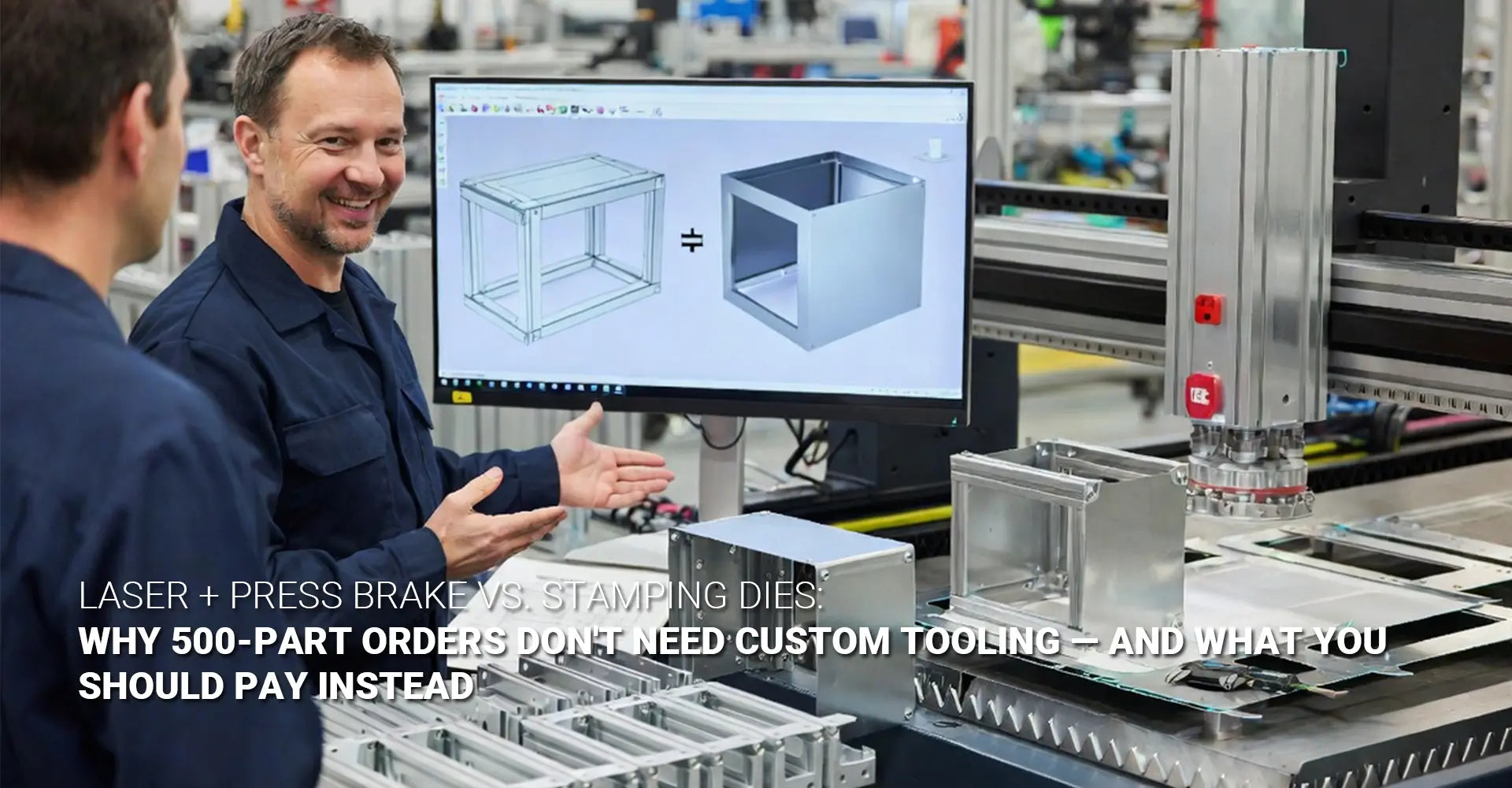
Getting a quote for 500 custom brackets can feel like a punch to the gut. Right there in the fine print sits a $15,000 tooling fee, and that's before you even pay for a single part. So what if you never had to pay that fee at all? Custom sheet metal on demand skips the stamping die completely. Instead, your parts get cut and bent to size using flexible machines that need no hard tooling. That means lower upfront costs, faster delivery, and no risk if your design changes later.

Quick answer: This method uses laser cutting and press brake bending instead of custom stamping dies. A flat pattern gets cut straight from your CAD file, then bent into shape using programmable tooling. For orders under 2,000 to 5,000 parts, this route is usually cheaper and faster than building a die.
But how much money can this actually save you? And when does a stamping die still make sense? This guide breaks down the real numbers, walks through the two-step process, and gives you the exact questions to ask your supplier before you sign a purchase order.
Table of Content
- What Is Sheet Metal Laser Cutting Services Combined with Press Brake Bending?
- How Much Does On-Demand Sheet Metal Fabrication Really Save Compared to Stamping?
- When Should You Choose On-Demand Fabrication Over Custom Stamping Dies?
- What Questions Should Procurement Managers Ask Before Choosing a Sheet Metal Process?
What Is Sheet Metal Laser Cutting Services Combined with Press Brake Bending?
Building a bent enclosure or bracket normally takes two steps. First, a flat pattern is cut from sheet stock. Second, that flat piece gets bent into its final shape. Sheet metal laser cutting services handle the first step, and Hotean's sheet metal fabrication line puts both steps together under one roof, so no custom tooling is needed at all.
In short: a laser cutter reads your CAD file and cuts the exact flat shape you need, including every hole and cutout. Then a CNC press brake bends the flat piece into a finished 3D part, using standard V-dies instead of a custom mold.
Many fabricators now offer an NCT laser combination machine, which pairs a laser cutter with a turret punch on one platform. This setup makes custom enclosure fabrication faster, because flat parts move straight from cutting to forming without extra handling in between. The real advantage, though, is press brake bending without tooling. Standard V-dies and punches work for almost any bend angle, so you never pay for a custom mold. Accuracy stays high too. A fiber laser holds hole positions within ±0.1mm, which matches what you'd get from a stamping die. Bend angles stay within ±0.5°, so your enclosure walls line up correctly every time you run a new batch.
How Much Does On-Demand Sheet Metal Fabrication Really Save Compared to Stamping?
Numbers tell the story better than opinions do. So let's run the math on a real 500-part order, comparing a stamping die against a no-tooling approach.
Quick answer: A stamping die costs about $15,000 upfront, plus $1.50 per part. For 500 parts, that totals $15,750. Skipping the die and paying a higher fabrication cost per part — about $8.50 — brings the total to just $4,250.
73% savings — over $11,000 back in your budget on a single 500-part order.
This savings comes down to one simple idea: tooling cost avoidance. When you skip the die, you skip its price tag completely. But the math changes as volume grows. Every stamping die has a break-even point, calculated as die cost divided by the price difference per part. In this example, that's $15,000 ÷ $7.00, or about 2,143 parts. Below that number, on-demand wins on laser cutting vs stamping cost every time. Above it, the stamping die starts paying for itself. Hotean's quality assurance checks confirm every batch meets the same tolerances either way, so you never trade savings for consistency.
When Should You Choose On-Demand Fabrication Over Custom Stamping Dies?
Cost is only part of the decision. Order size matters just as much. Flexible sheet metal manufacturing works best for smaller batches, while stamping dies make more sense once volume climbs high enough to spread out that upfront cost.
In short: if your order sits under 2,000 to 5,000 parts, low volume sheet metal no tooling is almost always the smarter choice. Once you pass that range, a stamping die usually becomes cheaper per part.
Lead time makes the choice even clearer. On-demand parts ship in one to two weeks. A stamping die alone takes four to six weeks to design, build, and test before a single part comes off the line. That gap matters for industrial machinery builders working against tight installation deadlines, and it matters just as much for automotive suppliers managing frequent design changes. If your design still might change, or your schedule is tight, skipping the die keeps you moving.
What Questions Should Procurement Managers Ask Before Choosing a Sheet Metal Process?
Getting the right process starts with the right questions. A good supplier should walk you through both options honestly, not just push whichever one earns them more money.
Quick answer: Ask your supplier to quote both routes side by side — flexible fabrication with no tooling, and stamping with tooling cost shown separately. Then ask for the exact break-even quantity where stamping becomes cheaper.
A few more questions round out your checklist:
- What finishes are available? Powder coating, plating, and anodizing all work the same way, no matter which forming method was used.
- What geometries are off-limits? Deep-drawn shapes and extremely high-volume runs still favor stamping.
- Can I test my design first? If your design is still evolving, rapid sheet metal prototyping through Hotean's rapid prototyping service lets you test changes on a small batch, well before a die ever gets built.
Conclusion
A $15,000 stamping die only makes sense when you have the volume to spread that cost across thousands of parts. For most low and medium volume orders, skipping the die delivers the same finished quality for a fraction of the price and in a fraction of the time. Before your next order, ask your supplier for both quotes side by side. Compare the real numbers. Then pick the process that actually fits your production run, not just the one your supplier prefers to sell.
Related Resources:
[Custom sheet metal on demand][^1]
[sheet metal laser cutting services][^2]
[on-demand sheet metal fabrication][^3]
[laser cutting vs stamping cost][^4]
[press brake bending without tooling][^5]
[flexible sheet metal manufacturing][^6]
[^1]: Protolabs Network / Hubs – online sheet metal cutting and bending service. Upload parts for a free instant quote and production in under 5 minutes. Laser cutting supports sheet thickness 1–6mm with tolerances of ±0.00787″ (0.2mm). Materials include aluminum 5052/5754, stainless steel 304/316L, mild steel 1018, and copper C110[reference:3].
[^2]: Protolabs (US-based) – metal laser cutting service with lead times as fast as 1 day, standard 3-day lead times for quantities under 50. ISO 9001:2015 and ITAR certified. Fiber optic lasers handle thicknesses from 0.024″ to 0.250″ (0.609mm–6.35mm) with tolerances of ±0.005″. Materials include aluminum 5052-H32/6061-T6, steel CRS/HRPO, galvanneal, galvanized, and stainless steel 304/316[reference:4].