7075 Anodizing Turned Yellow? Here's How to Pick the Right Aluminum Alloy for 5-Axis Machined Enclosures?
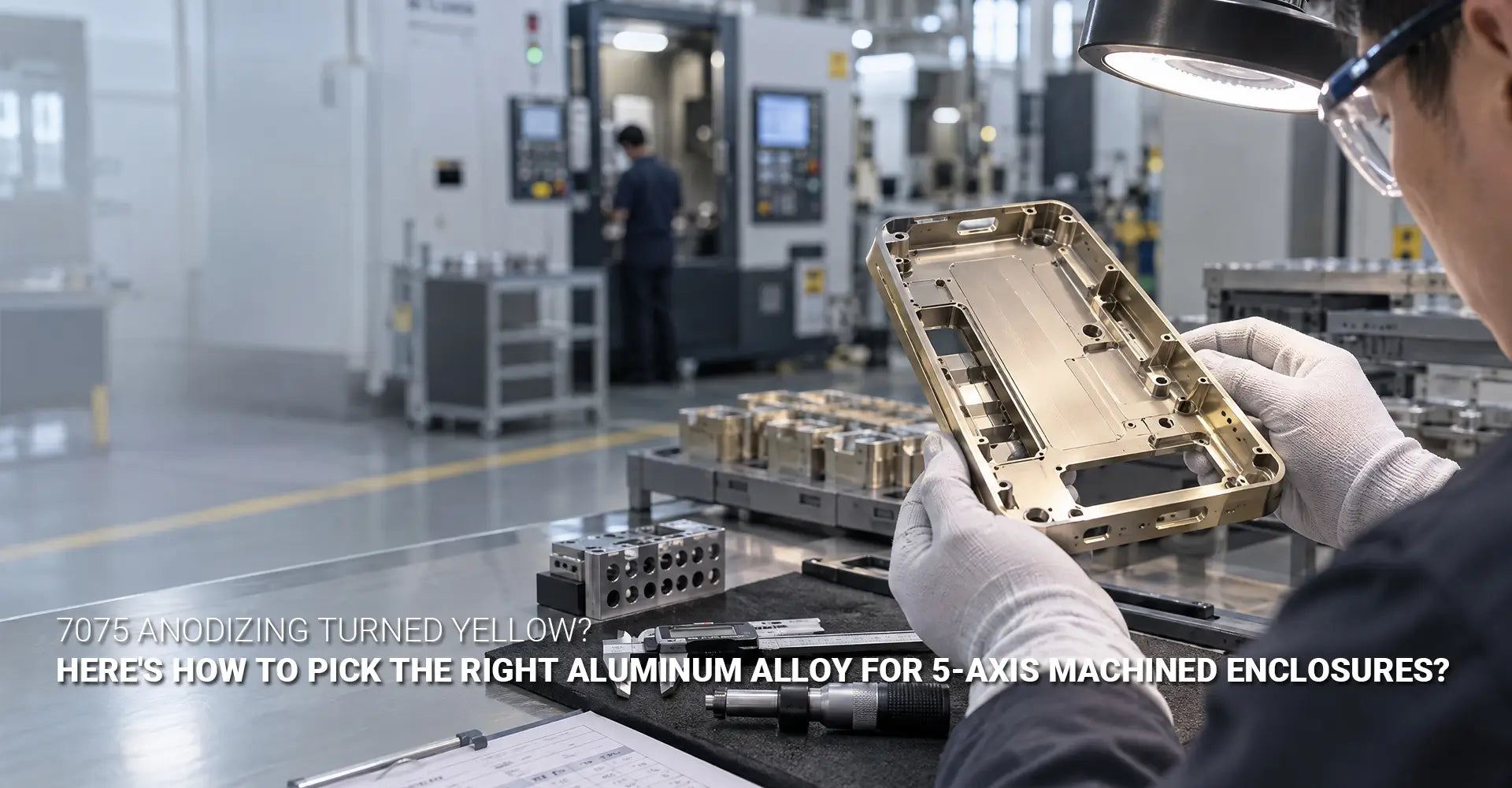
7075 Anodizing Turned Yellow? Here's How to Pick the Right Aluminum Alloy for 5-Axis Machined Enclosures?
You sent your enclosure parts out for anodizing. The samples came back, and something looked off. Instead of a clean, even black or silver, the surface had a yellow or brown tint. If this has happened to you, you are not alone. Many procurement teams pick an alloy based on strength alone. Then they get surprised when the finish does not match the sample they approved. This is one of the most common — and most avoidable — mistakes in 5 axis aluminium machining for cosmetic parts.
This guide compares three of the most common aluminum alloys used in consumer electronics midframe machining: 6061, 6063, and 7075. Each one behaves differently under a five-axis cutter, and each one reacts differently in the anodizing tank. You will learn which alloy machines fastest, which one anodizes the most evenly, and which one to avoid if a bright, consistent finish matters. If you want a deeper primer on how aluminum behaves in general machining setups, our guide on aluminum in CNC machining covers the basics before we go further here.

Quick Answer
If you only have thirty seconds, here is what matters most:
- 6063 gives the brightest, most even anodized finish. It is the top choice for visible cosmetic parts.
- 6061 is the balanced pick. It machines well, anodizes decently, and holds up structurally.
- 7075 is the strongest alloy, but it often causes uneven color and yellowing during anodizing. It is best kept for hidden, load-bearing parts.
In short, do not choose an alloy by strength alone. Match the alloy to the job it needs to do, and always ask for anodized samples before you commit to full production.
Now, let's break down why this happens, and how you can build a simple decision process around it. We will walk through the machining side first, then the anodizing chemistry, and finish with a practical framework you can use the next time you are sourcing enclosure parts.
Table of Contents
- Why Does 7075 Aluminum Turn Yellow After Anodizing?
- How Do 6061, 6063, and 7075 Compare for 5-Axis Machining?
- Which Aluminum Alloy Gives the Best Anodized Finish?
- How Do You Match the Right Alloy to Your Consumer Electronics Enclosure?
Why Does 7075 Aluminum Turn Yellow After Anodizing?
Anodizing is not paint. It is a chemical process that grows a layer of aluminum oxide right on the surface of the part. Because of this, the outcome depends heavily on what is mixed into the metal itself. This is exactly why picking the right aluminum alloy for anodizing matters so much before parts ever reach the finishing line.
Quick answer: 7075 contains zinc and copper as its main alloying elements. These metals do not anodize cleanly. During the process, they can cause the oxide layer to pick up a yellow, brown, or smoky tint, even when every step is done correctly.
Here is the deeper reason why this happens. Aluminum alloys are grouped into series based on their main added element. The 7000 series, which includes 7075, is built around zinc for strength. Zinc and copper both react with the anodizing bath in ways that pure aluminum does not. As a result, the oxide layer that forms is less uniform. Under clear anodizing, this shows up as anodized 7075 yellowing, and it can vary from batch to batch, or even across a single part.
Dyeing the part a dark color, like black, can hide some of this unevenness. However, it does not fix the underlying problem. If you look closely, or view the part under bright light, uneven tone can still show through. This is why any drawing calling for 7075 with a cosmetic finish should include a note like "color match to approved sample," along with a requirement for first-article anodized samples before mass production begins. You can read more about how different finishing methods affect appearance and durability on our surface finish page.
There is one more wrinkle worth knowing. The copper content in 7075, which is higher than in most other aluminum alloys, reacts with the sulfuric acid bath used in standard Type II anodizing. This reaction can leave behind a smoky or brownish residue that is hard to strip fully, even with careful rinsing. Some finishers try to work around this with modified bath chemistry or shorter dwell times, but results still vary by supplier and by batch. As one experienced anodizer put it during a supplier audit:
"Anodizing does not hide a bad alloy choice. It reveals it."
That is a fair summary of what happens with 7075 under clear anodizing. The alloy is not defective. It was simply never designed with cosmetic finishing in mind.
How Do 6061, 6063, and 7075 Compare for 5-Axis Machining?
Machinability and anodizing appearance often pull in opposite directions. The alloy that anodizes best is not always the easiest one to cut, and the strongest alloy is not always the prettiest one. Since most enclosure parts are cut on a 5-axis CNC aluminum enclosure program, it helps to know how each alloy behaves under the tool before you commit to one.
Quick answer: 7075 cuts fast and clears chips well. 6063 is soft and tends to stick to the tool. 6061 sits comfortably in the middle, which is why it shows up in so many general-purpose parts.
Let's go through each factor one at a time.
Cutting forces and tool wear. 7075 is known for high-speed machining aluminum work because it cuts cleanly and produces short, manageable chips. 6061 behaves similarly, though slightly softer. 6063, on the other hand, is a gummier alloy. It was designed more for extrusion than for heavy cutting, so it can be a little unpredictable on a mill.
Chip control and built-up edge. This is where 6063 struggles the most. Because it is soft, material can smear onto the cutting edge instead of shearing away cleanly. This is a classic case of built-up edge aluminum trouble, and it leads to poor surface finish if left unmanaged. Sharp, polished tools, higher rake angles, and steady coolant flow all help reduce this problem.
Thin-wall deformation. Many enclosure walls are thin, sometimes less than one millimeter in spots. Thin-wall deformation control becomes critical here, since thin sections can flex or bow as the tool removes material and internal stress is released. 7075 tends to carry more residual stress from its heat treatment, so it is more prone to warping. 6061 is moderate. Extruded 6063 stock, when it has not been heavily machined, tends to hold its shape a bit better, though machined billet behaves differently than extrusion.
Surface finish as-machined. 7075 and 6061 both leave a cleaner as-cut surface than 6063 in most cases, simply because they resist the smearing effect that soft alloys can produce.
Here is a simple side-by-side summary of how the three alloys stack up:
| Factor | 6061 | 6063 | 7075 |
|---|---|---|---|
| Machinability | Good, predictable | Prone to smearing and built-up edge | Fast cutting, clean chips |
| Deformation risk | Moderate | Low in extrusion, higher in machined billet | Higher, due to residual stress |
| Raw strength | Good | Lower | Highest of the three |
| Typical cost per part | Middle of the range | Often the lowest as extrusion stock | Usually the highest |
No single alloy wins in every row, and that is exactly the point. The right pick depends on which row matters most for your specific part.
Our team runs these comparisons regularly across different part geometries. If you would like to see how your specific enclosure design performs across these three alloys, our CNC machining service page has more detail on our process and equipment, and our custom CNC milling services page walks through how we handle five-axis programming for complex, thin-wall parts.
Which Aluminum Alloy Gives the Best Anodized Finish?
Once the part is machined, the next question is how it will look after anodizing. This matters most for parts people actually see and touch, like phone frames, laptop chassis panels, or visible housing components.
Quick answer: 6063 gives the brightest, most uniform anodized color of the three. 6061 comes in second, with a slightly grayer tone. 7075 carries the highest risk of uneven or yellow-tinted results, especially under clear anodizing.

Why does this happen at the chemistry level? Anodizing works best on alloys with fewer alloying elements getting in the way of a clean oxide layer. 6063 has a simple composition built mainly around magnesium and silicon, which is part of why it is often chosen for architectural and cosmetic aluminum products that need anodizing color consistency. 6061 has a bit more silicon and other trace elements, which slightly dulls the finish but still produces a reliable, even gray-toned anodized surface. 7075, as covered earlier, is the outlier because of its zinc and copper content.
There is also a practical side to this. Anodizing type matters as much as alloy choice. Type II anodizing produces a thinner, more decorative layer and tends to show alloy-related color variation more clearly. Type III, or hard anodizing, produces a thicker, harder layer, often used more for wear resistance than looks, though color consistency still varies by alloy underneath.
Batch consistency is another factor procurement teams often overlook. Even within the same alloy, small differences in the raw material supply chain can shift the final tone slightly from one production run to the next. This is normal and expected within a tight tolerance band. However, it means that a single approved sample is not always enough. For large orders shipped over several months, it is worth asking your supplier to retain a physical reference chip from the first approved batch, so later runs can be checked against it directly rather than against memory or a photo alone. This small step catches drift before it becomes a returned shipment.
For any part where appearance drives the purchase decision, treat anodizing as part of the design spec, not an afterthought. Specify alloy, anodizing type, thickness, and color on the drawing, and always request a physical sample before greenlighting full production. This single step catches most of the problems that show up with cosmetic anodized aluminum parts long before they reach a warehouse full of finished units.
How Do You Match the Right Alloy to Your Consumer Electronics Enclosure?
By now, you have seen how each alloy behaves under the cutter and in the anodizing tank. The next step is turning that into a simple decision you can apply to your own project.
Quick answer: Choose 7075 for hidden, structural parts where strength matters more than looks. Choose 6063 for visible parts where a clean, even anodized finish is the priority. Choose 6061 when you need a reasonable balance of both.
Let's put this into a few real scenarios. For a phone or tablet, smartphone midframe material selection often comes down to how much of the frame is visible versus hidden inside the assembly. A visible frame edge that will be anodized and touched by the user leans toward 6063 or 6061. An internal support bracket that never sees daylight can safely use 7075 for its strength advantage.
For laptop or tablet chassis panels, where large flat surfaces are anodized and inspected under bright showroom lighting, 6063 is often worth the slower cut time because the finish consistency pays off in fewer rejected parts. For structural brackets, hinges, or internal frame members inside broader electronics enclosure projects, 7075's strength usually outweighs any cosmetic concern, since these parts are rarely seen after final assembly.
A simple rule to remember: if a part will be photographed or held, prioritize anodizing appearance. If it will only ever be seen by an assembly technician, prioritize strength and machining speed instead.
A hybrid approach is common, too. Some designs use 7075 for an internal structural skeleton and 6063 or 6061 for the visible outer shell, bonded or fastened together. This lets each material do the job it is best suited for.
Before placing an order for custom aluminum CNC parts, it helps to ask your supplier a short list of questions:
- Which alloy do you recommend for this specific application, and why?
- Can you provide anodized samples before full production runs?
- What is your process for controlling thin-wall deformation on this geometry?
- How do you manage tool wear and built-up edge when a softer alloy like 6063 is specified?
- What is the expected aluminum machining cost difference between these three alloys for this part?
Suppliers who can answer these clearly, without hesitation, are generally the ones who have handled this exact trade-off before. If your enclosure is part of a broader electronics assembly, our electronics manufacturing page covers how we support full builds beyond just the machined housing.
Conclusion
Choosing the Right Aluminum Alloy Comes Down to the Application, Not Just Strength
Strength numbers on a spec sheet only tell part of the story. As this guide has shown, the alloy you pick for a 6061 vs 6063 vs 7075 aluminum decision also determines how the part behaves under a five-axis cutter and how it looks after anodizing. 7075 wins on raw strength and cutting speed, but it carries real risk of yellowing and uneven color. 6063 wins on anodized appearance but asks more of your machining process to avoid built-up edge and deformation. 6061 sits in the middle, which is exactly why it remains the default choice for so many general enclosure parts.
The fix is simple, even if it takes a bit more upfront planning. Match the alloy to the job. Ask whether the part is seen or hidden, structural or cosmetic, and whether appearance consistency is worth a small trade-off in strength or machining speed. Then confirm your choice with real anodized samples before committing to a full production run. This one habit prevents most of the finish problems procurement teams run into after the parts already exist.
It also pays to loop in your machining partner early, before the drawing is finalized. A shop that has run all three alloys through five-axis programs before can flag deformation risks, tool wear concerns, and anodizing pitfalls before a single part is cut. That kind of early input, paired with a physical sample review, is usually the difference between a smooth production ramp and a costly rework cycle a few weeks later.
Related Resources
[6061 vs 6063 vs 7075 aluminum][^1]
[aluminum alloy for anodizing][^2]
[5-axis CNC aluminum enclosure][^3]
[thin-wall deformation control][^4]
[^1]: RivCut (USA) – a comprehensive aluminum grades chart for CNC machining that compares 12 alloys side by side. It includes a direct comparison table showing 6061-T6 (45 ksi tensile, 95 HB), 6063-T6 (35 ksi tensile, 73 HB), and 7075-T6 (83 ksi tensile, 150 HB), with machinability ratings and common uses, positioning 6061-T6 as the best all-around grade for most machined parts.