H13 vs. Dievar Tool Steel: Which One Actually Lowers Your Aluminum Die Casting Tooling Cost Per Part?
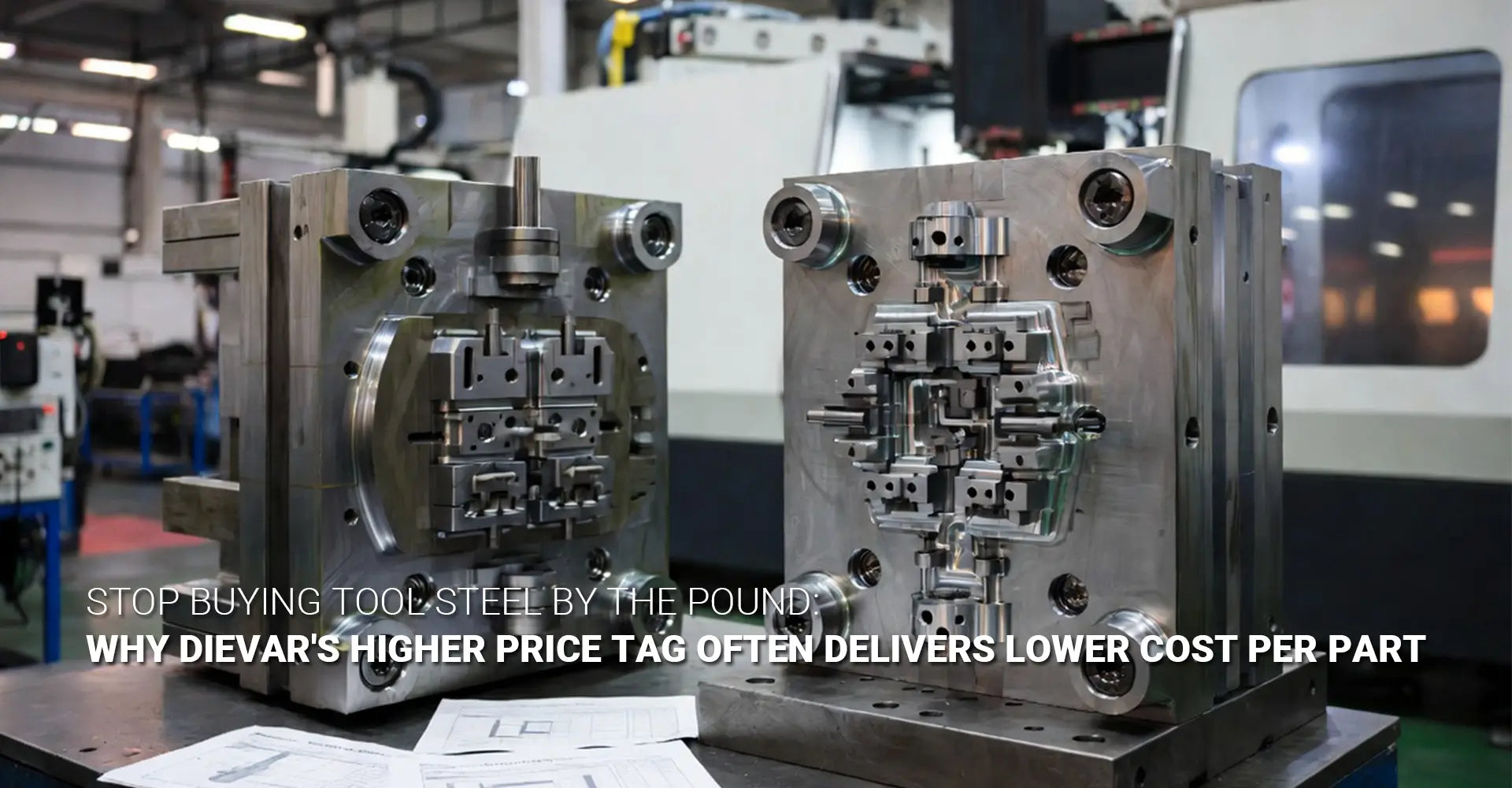
H13 vs. Dievar Tool Steel: Which One Actually Lowers Your Aluminum Die Casting Tooling Cost Per Part?
You requested a quote for a die casting mold. One supplier said $15,000. Another said $25,000. The part drawings are identical. So which quote should you choose?
If you picked the $15,000 mold, you may have just made the more expensive decision.
Aluminum die casting tooling cost is almost never what the invoice says. The real cost is what you pay per part — across the entire life of the tool. And that number depends heavily on one decision: which tool steel goes inside the mold.
This guide breaks down the H13 vs. Dievar comparison with real amortization math, documented scrap rate data, and a clear selection framework for procurement managers.

Quick Answer: H13 vs. Dievar at a Glance
| Factor | H13 | Dievar |
|---|---|---|
| Typical mold cost | $1,800 – $12,000+ | 30–70% premium over H13 |
| Expected tool life | 100,000 – 150,000 shots | 200,000+ shots |
| Cost per shot (example) | $0.15/part | $0.125/part |
| Thermal cracking resistance | Moderate | High |
| Best for | Runs under 100k shots | Runs over 150k shots |
| ESR-refined? | No (standard grade) | Yes |
Bottom line: The mold with the higher price tag often delivers the lower cost per part. The math below proves it.
That table gives you the headline answer. But procurement decisions at this level require more than a summary. The sections below walk through every cost layer — from raw steel to unscheduled downtime — so you can make a defensible, data-backed tooling decision.
Table of Contents
- What Is Aluminum Die Casting Tooling Cost — and Why Does the Quote Range So Much?
- H13 Tool Steel: What Does the Industry Workhorse Actually Deliver?
- Dievar Tool Steel: When Does the Premium Price Tag Pay Off?
- The Amortization Math: How to Calculate Your Real Tooling Cost Per Part?
- Conclusion & Selection Framework
What Is Aluminum Die Casting Tooling Cost — and Why Does the Quote Range So Much?
Walk into any sourcing conversation for a die casting mold and you will likely see quotes that vary by 3x or more — for what looks like the same part. A simple bracket might come in at $3,500 from one supplier and $9,000 from another. Both are quoting H13 steel. Both promise a 100,000-shot tool life. So why the difference?
The answer is that tooling cost breakdown in die casting is layered. The raw steel is only the starting point. Most of the price gap comes from machining complexity, heat treatment quality, and cooling system design — factors that also determine how long the tool actually lasts.
Key Cost Drivers
| Cost Component | Share of Total Mold Cost | Notes |
|---|---|---|
| Raw tool steel | 5 – 15% | Smallest line item |
| CNC / EDM machining hours | 45 – 60% | Complexity drives this up fast |
| Heat treatment & surface treatment | 10 – 20% | Vacuum hardening vs. salt bath |
| Cooling system design | 10 – 20% | Straight-line vs. conformal cooling |
| Assembly, polishing, trials | 5 – 10% | Often underquoted |
The raw steel grade — H13 vs. Dievar — shifts the material cost by roughly 30–70%. But because steel is only 5–15% of total mold cost, that premium spreads across all other cost layers. What the steel grade actually controls is die casting mold life and thermal stability. A better steel, properly machined and heat-treated, holds tighter tolerances longer. That means fewer maintenance shutdowns, lower scrap rates, and more parts produced before the mold is retired.
This is also why a mold quoted at $1,800 is likely a simple single-cavity bracket with straight-line cooling and standard heat treatment. A quote of $12,000+ for what looks like "the same mold" usually reflects complex EDM work, vacuum heat treatment, and a more capable steel grade. Neither price is wrong. They are answering different production problems.
For context, Hotean's die casting services span aluminum, zinc, and magnesium alloys — and tooling recommendations are matched to the specific alloy, wall thickness, and production volume before a mold price is confirmed.
H13 Tool Steel: What Does the Industry Workhorse Actually Deliver?
H13 is the default choice for aluminum high-pressure die casting (HPDC) tooling worldwide. It offers a proven balance of hot strength, toughness, and thermal fatigue resistance at a mid-range cost. For most production scenarios under 100,000 shots, it remains the logical starting point.
Key Specs
| Specification | H13 (Standard Grade) |
|---|---|
| Typical mold cost range | $1,800 – $12,000+ |
| Expected tool life | 100,000 – 150,000 shots |
| Hardness (production) | HRC 44 – 48 |
| Thermal conductivity | ~25 W/m·K |
| ESR-refined? | No |
| Best application | Runs under 100k shots, moderate complexity |
Die casting mold life at 100k shots is achievable with H13 — but only with proper heat treatment, disciplined maintenance, and controlled cycle times. Shortcuts on any of those three shorten tool life significantly.

H13's weakness is thermal fatigue. In aluminum HPDC, every shot cycle drives a sharp thermal spike — molten aluminum enters at roughly 620–680°C, then the mold cools rapidly. H13's microstructure contains minor alloy segregation zones: small areas where the distribution of chromium, molybdenum, and vanadium is uneven. Under relentless thermal cycling, those zones become crack initiation sites. The surface develops a network of fine cracks called heat checking. Early heat checking is cosmetic. Advanced heat checking compromises part surface quality, causes flash, and eventually leads to catastrophic insert failure.
For aggressive production schedules — thin-wall parts, large projected areas, short cycle times — H13 often falls short of its rated 100,000–150,000 shot life. That is where H13 vs Dievar tool steel becomes a financial question, not just a technical one.
Dievar Tool Steel: When Does the Premium Price Tag Pay Off?
Dievar is a premium hot-work tool steel produced by Uddeholm via electroslag remelting (ESR). The ESR process yields an exceptionally uniform microstructure — extremely low sulfur and oxygen content, no alloy segregation. That uniformity is what makes Dievar behave differently under thermal stress. Thermal cracking resistance is not a marketing claim for Dievar; it is measurable and documented in thermal fatigue test data.
Key Specs
| Specification | Dievar (ESR-Refined) |
|---|---|
| Typical cost premium over H13 | 30 – 70% higher |
| Expected tool life | 200,000+ shots |
| Hardness (production) | HRC 44 – 48 |
| Thermal fatigue resistance | Significantly higher than H13 |
| ESR-refined? | Yes |
| Best application | Runs over 150k shots, high-complexity parts |
Documented case studies show Dievar delivering roughly double the tool life of H13 under identical production conditions — the same hardness, the same cavity geometry, the same alloy.

The ESR process eliminates the micro-segregation zones that make H13 vulnerable to crack initiation. Dievar also maintains its core hardness and yield strength at elevated operating temperatures more effectively than standard H13. In thermal fatigue tests, H13 ESR develops significantly deeper surface cracks compared to Dievar at the same cycle count.
This matters most for aluminum die casting mold materials used in demanding applications: automotive structural parts, electronics enclosures, and thin-wall industrial components where dimensional stability across 200,000+ shots is a production requirement, not a bonus.
For parts going into electronics applications, the dimensional consistency that premium tooling provides directly affects downstream assembly yield. Hotean's electronics manufacturing capabilities depend on die casting tooling that holds tight tolerances across high-volume runs — which is exactly where Dievar pays for itself.
What about intermediate options? Modified H13 grades like Uddeholm 8407 or H13X sit between standard H13 and Dievar in both price and performance. For production volumes in the 100,000–200,000 shot range, they are worth evaluating as a middle ground. They offer improved microstructural cleanliness over standard H13 without the full cost premium of Dievar.
The Amortization Math: How to Calculate Your Real Tooling Cost Per Part?
Die casting mold amortization is the calculation that determines whether a $25,000 mold is actually cheaper than a $15,000 mold. The formula is straightforward:
Tooling cost per part = (Mold Cost ÷ Expected Shots) + (Scrap Rate × Part Cost) + (Downtime Cost × Maintenance Events)
Most buyers stop at the first term. The full picture requires all three.
Scenario Comparison
Scenario A: $15,000 H13 Tool
| Variable | Value |
|---|---|
| Mold cost | $15,000 |
| Expected shots | 100,000 |
| Tooling cost per part | $0.15 |
| Projected scrap rate | 7.2% |
| Maintenance shutdowns | Higher frequency |
Scenario B: $25,000 Dievar Tool
| Variable | Value |
|---|---|
| Mold cost | $25,000 |
| Expected shots | 200,000 |
| Tooling cost per part | $0.125 |
| Projected scrap rate | < 1.5% |
| Maintenance shutdowns | Lower frequency |
The cost per shot die casting difference of $0.025/part compounds to $5,000+ in savings over 200,000 parts — before accounting for scrap and downtime.
The Real Three-Year Decision
The $0.025/part difference is only the tooling amortization gap. The scrap rate differential is where the financial case for Dievar becomes decisive.
Three-Year Total Cost Comparison (Documented Case)
| Factor | Basic H13 Tool | Premium Tool (Dievar-class) |
|---|---|---|
| Mold cost | $18,400 | $47,200 |
| Tool life | 65,000 shots | 240,000+ shots |
| Scrap rate | 7.2% | < 1.5% |
| Total cost over 3 years | $214,000 | $118,000 |
The premium tool was 2.6x more expensive upfront. It was 45% cheaper over three years.
That is the core of HPDC tooling ROI: the mold price is a one-time capital expense. Scrap and downtime are recurring operational costs that compound over every production month.
The TCO Formula in Full:
Total Cost = Mold Cost
           + (Total Parts × Scrap Rate × Part Cost)
           + (Maintenance Events × Avg. Downtime Cost per Event)
           + (Remachining Costs if tool life is exceeded early)
Hidden costs that procurement managers often miss:
- Unscheduled downtime — a cracked insert in an H13 tool can shut down a production line for days. Premium steels with higher thermal fatigue resistance reduce this risk significantly.
- Scrap rate differentials — premium tools routinely run under 1.5% scrap. Basic H13 tools under aggressive conditions can exceed 7%. On a 200,000-part run at $2.00/part, that 5.7% scrap gap represents $22,800 in wasted material alone.
- Surface finish downstream — heat checking on H13 tools eventually transfers to part surfaces, requiring additional surface finishing operations that add cost and lead time.
- Maintenance frequency — more maintenance events mean more production interruptions, especially relevant for industrial machinery components where delivery schedules are tight. Hotean's industrial machinery manufacturing customers often cite downtime risk as their primary driver for specifying premium tooling grades.
The Procurement Manager's Selection Framework
| Production Volume | Recommended Steel | Rationale |
|---|---|---|
| Under 50,000 shots | H13 (or P20 for prototypes) | Full amortization at low cost |
| 50,000 – 150,000 shots | Evaluate both; H13 often wins | Run the TCO formula with your scrap data |
| 150,000+ shots | Dievar (or equivalent ESR grade) | TCO almost always favors premium steel |
Questions to ask your die caster before approving a mold quote:
- What tool steel grade are you specifying, and can you provide the mill certificate?
- What is your projected tool life for this part geometry and production rate?
- What scrap rate do you expect over the first 50,000 shots?
- What heat treatment process do you use — vacuum hardening or salt bath?
- How do you handle unscheduled maintenance and insert replacement costs?
For complex part geometries or CNC-machined secondary features, also review the tooling philosophy against your CNC machining requirements — sometimes the most cost-effective path combines a premium die casting tool with precision CNC finishing rather than trying to achieve everything in-mold.
What about mold steel selection for non-aluminum alloys? The H13 vs. Dievar framework applies primarily to aluminum HPDC. For zinc (Zamak) alloys, operating temperatures are lower and H13 typically suffices even at high volumes. For magnesium, documented cases show Dievar outperforming H13 substantially — a magnesium instrument panel tool in Dievar lasted twice as long as the H13 equivalent, with significantly reduced maintenance costs.
Conclusion: The Tooling Decision Is a Financial Decision
The initial mold quote is the least important number in the die casting tooling decision. The number that matters is cost per part over your full production volume.
Here is the framework, summarized:
- Mold amortization = Mold Cost ÷ Expected Shots. Run this first.
- Add scrap cost = Total Parts × Scrap Rate × Part Value. This often doubles the real cost gap.
- Add downtime cost = Maintenance Events × Avg. Shutdown Cost. This is where H13 tools lose ground fastest.
- Under 100k shots → H13 is typically the right choice. The premium steel doesn't have enough cycles to pay back.
- Over 150k shots → Dievar (or ESR-equivalent) almost always wins on total cost of ownership.
- Always request mill certificates, projected tool life, and scrap rate projections — not just the mold price.
A $47,000 tool producing 240,000 good parts at 1.5% scrap costs $118,000 over three years. An $18,400 tool producing 65,000 parts at 7.2% scrap costs $214,000 over the same period. The "cheap" tool was $96,000 more expensive.
Never let the initial mold quote be the only number in the decision. Run the full TCO math — and ask your supplier to do it with you.
External Links & Further Reading
[H13 vs Dievar tool steel][^1]
[die casting mold amortization][^2]
[thermal cracking resistance][^4]
[aluminum die casting mold materials][^5]
[^1]: A case study from ASSAB (a leading tool steel manufacturer) directly comparing H13 and Dievar in a magnesium die casting application. Both steels were run at HRC 46-48 hardness with 20,000 shots between maintenance. H13 achieved 100,000+ total tool life, while Dievar achieved 200,000+ total tool life—**twice the tool life of H13**[reference:8]. The extended tool life significantly reduced maintenance costs, downtime, and overall cost-per-part[reference:9].
[^2]: A die casting glossary entry from the North American Die Casting Association (NADCA) defining amortization as the method of deferring tooling cost by including it with casting production on a prorated basis, with a clear example: a $100,000 tool with a 100,000-shot life results in a $1.00 per-part amortized cost[reference:0].
[^3]: A detailed 2026 cost breakdown for automotive aluminum die casting showing tooling amortization at $1.37–2.06 per unit, based on a $171,400 mold cost amortized over 500,000 cycles, with tooling amortization representing 8–12% of total part cost[reference:1][reference:2].
[^4]: A Foundry Magazine article discussing Uddeholm Dievar tool steel, which provides "the perfect balance between toughness and heat-checking" for high-pressure die casting. It notes that H13 dies for powertrain parts last 80,000–150,000 shots, but structural parts can drop below 75,000 shots, with some shock-tower dies failing under 30,000 shots[reference:3].
[^5]: A product page from BÖHLER for W360 isobloc, an ESR-melted 5% chromium tool steel specially adapted for high hardness levels (51–57 HRC). It offers very high wear resistance, toughness, thermal resistance, and machinability, making it the perfect choice for smaller die casting components such as mold inserts, cores, core pins, and ejector pins.[reference:7]