Why One Clamping on a Dual-Spindle, Dual-Turret Lathe Cuts Your CNC Turning Cost Per Part by 25%?
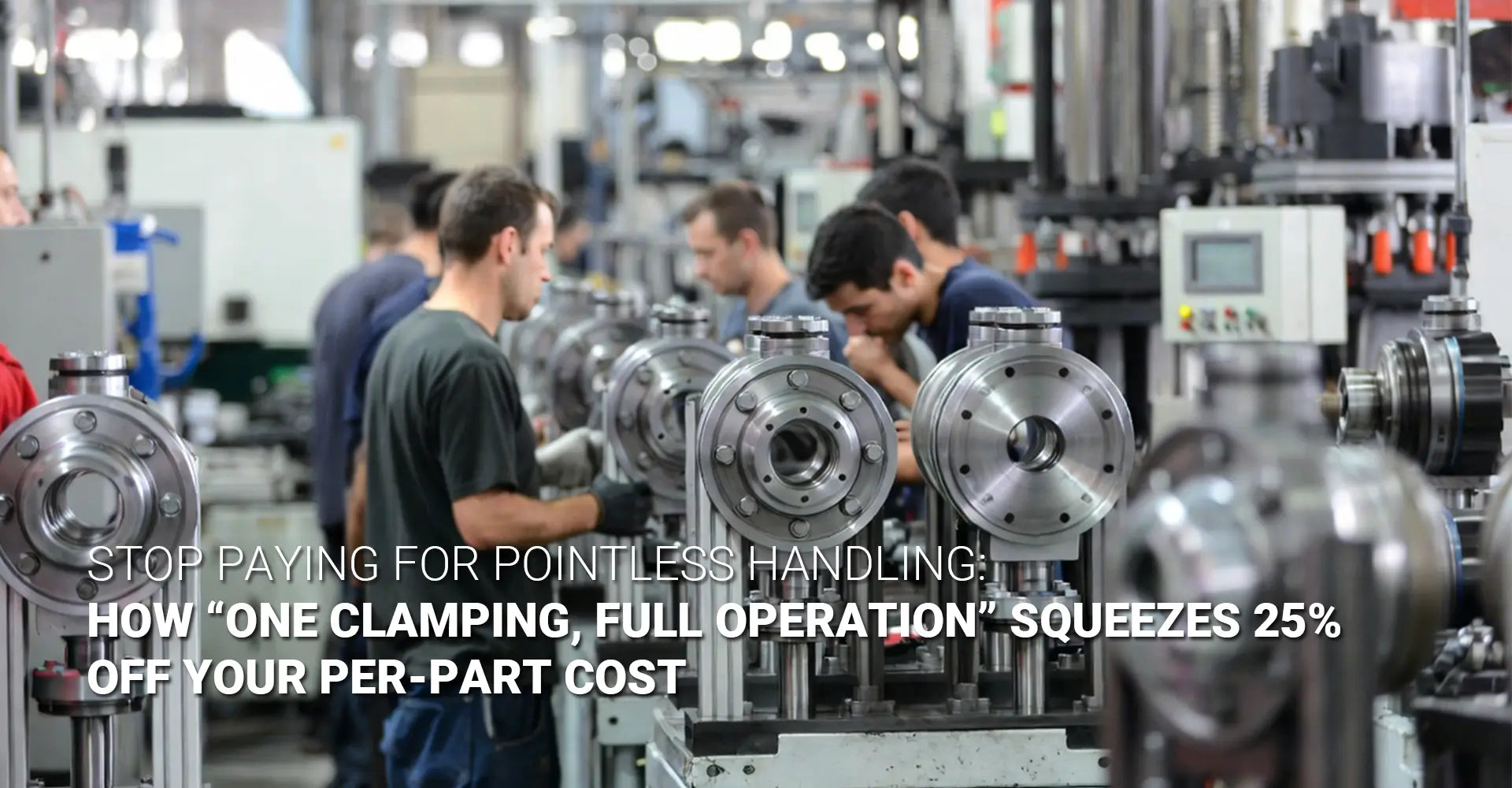
Why One Clamping on a Dual-Spindle, Dual-Turret Lathe Cuts Your CNC Turning Cost Per Part by 25%?
Most buyers focus on the hourly machine rate. But that number alone tells you almost nothing about what you actually pay per finished part. The real cost driver hides in a place most procurement managers never look: secondary handling, second setups, and queue time between machines.
This article breaks down exactly how one setup change — complete machining in a single clamping — reliably cuts your per-part bill by 25% or more. You will see the math, a real step shaft case study, and the questions to ask your supplier before your next RFQ.

Quick Answer: How Much Can One-Setup Turning Save You?
| Process | Total Time Per Part | Cost at $100/hr | Cost at $150/hr (twin-spindle) |
|---|---|---|---|
| Two-lathe conventional route | ~25 min (machine + handling + queue) | $41.67 | — |
| Dual-spindle, one-clamping route | ~12 min (load + full cycle + unload) | — | $30.00 |
| Savings per part | 13 minutes | — | ~$11.67 (~28%) |
| Savings on 100-part batch | — | — | ~$1,167 |
Bottom line: A dual-spindle machine with a higher hourly rate still produces a cheaper finished part — because it cuts continuously instead of waiting for an operator to move parts between machines.
So where does the money actually go in a conventional two-lathe process? And how does a twin-spindle machine eliminate those costs entirely? Let us work through it step by step.
Table of Contents
- What Is the "Handling Tax" — and Why Is It Silently Raising Your CNC Turning Cost Per Part?
- How Does a Dual-Spindle, Dual-Turret Lathe Actually Achieve Complete Machining in One Clamping?
- Heavy Step Shaft Case Study — Does the 25% Per-Part Cost Saving Hold Up in Real Numbers?
- Higher Hourly Rate, Lower Total Bill — Why the "$150/hr vs. $100/hr" Comparison Misleads Procurement Managers?
What Is the "Handling Tax" — and Why Is It Silently Raising Your CNC Turning Cost Per Part?
Every time a part moves from one machine to another, your shop floor collects an invisible toll. This toll is not listed on any quote. It does not appear on any invoice line. But it accumulates into real money on every batch you run — and for most buyers, it represents the single largest opportunity to eliminate secondary handling cost and reduce what they pay per finished part.
The 3-Step Hidden Cost Chain
Here is what actually happens in a conventional two-lathe turning process for a step shaft:
- Step 1 — First lathe: Load part (2 min) → machine front end (10 min) → unload (1 min) = 13 minutes
- Step 2 — Queue: Part sits in a bin waiting for the second lathe. This could be hours or days.
- Step 3 — Second lathe: Operator locates part, re-indicates it (5 min) → machines back end (4 min) → unload (1 min) = 10 minutes + wait time
Total active labor and machine time: ~23 minutes. Plus unpredictable queue time between operations.
"Second setup = second queue = second inspection = second chance for error."
That is three additional failure points — none of which exist when you machine a part complete in one clamping.
The Math Behind the 25% Savings
Let us put real numbers on this. At $100/hour, a 23-minute process costs:
23 ÷ 60 × $100 = $38.33 per part (not counting queue time)
Add 2 hours of queue time between operations — common in any busy shop — and the effective cost rises further because the part is tying up WIP (work in progress) capital.
Now consider the dual-spindle route: load once (2 min), run a complete cycle on both ends (10 min), unload (1 min) = 13 minutes total. At $150/hour (a higher-spec machine):
13 ÷ 60 × $150 = $32.50 per part
That is already cheaper. And the queue time drops to zero. For a batch of 100 parts, the difference reaches $580 to $1,300+ depending on your queue length.
This is how one-setup turning cost reduction works in practice — not through lower hourly rates, but through eliminating idle time entirely. If you need more context on how CNC machining services price their work, understanding this gap between cycle time and total elapsed time is the first step.
How Does a Dual-Spindle, Dual-Turret Lathe Actually Achieve Complete Machining in One Clamping?
A dual spindle dual turret lathe looks like a conventional CNC lathe from the outside. Inside the cycle, it operates completely differently. Two spindles face each other. Two turrets — each loaded with tools — can cut simultaneously or in sequence. The part never leaves the machine between operations.
Chuck-to-Chuck Transfer in Plain Language
The chuck to chuck transfer is the moment that makes one-setup turning possible. Here is what happens:
- Main spindle grips the raw part. The first turret machines the front end — diameters, shoulders, chamfers.
- Sub-spindle advances. It grips the finished front end of the part and synchronizes rotation with the main spindle automatically.
- Main spindle releases. The sub-spindle pulls the part back, presenting the unfinished back end to the second turret.
- Second turret completes the back end. The part is fully finished and drops into the chute — in one continuous cycle, with no operator intervention.
The part never loses concentricity. It never waits in a bin. It never needs re-indicating on a second machine.
Simultaneous Machining and Live Tooling
This is where a multi-tasking turning center with live tooling adds another layer of savings. Many dual-spindle, dual-turret lathes also carry live tool stations on one or both turrets.
That means:
- Turned diameters on both ends — done in-cycle
- Milled flats — done in-cycle
- Cross-drilled holes and tapped features — done in-cycle
A complex part that previously required three separate machines (lathe → second lathe → machining center) can be completed in one clamping, one cycle, one unload.
For industrial machinery components — where part complexity is high and tolerances are tight — this multi-operation capability is the most powerful cost lever available. The savings on those parts can exceed 40%, because you are eliminating two handoffs instead of one.
Heavy Step Shaft Case Study — Does the 25% Per-Part Cost Saving Hold Up in Real Numbers?
Step shaft turning is the clearest example of where dual-spindle machining pays off. A step shaft has features on both ends. It is often long relative to its diameter. It requires facing, turning multiple diameters, and sometimes threading or grooving on each end. In a conventional shop, that means two machines, two setups, two chances for error.
Side-by-Side Cost Comparison
Here is a real-world comparison for a 300mm step shaft, mild steel, medium complexity:
| Step | Two-Lathe Route | Dual-Spindle Route |
|---|---|---|
| Load / fixture | 2 min | 2 min |
| Front-end turning | 10 min | 10 min (main spindle) |
| Unload, move to second machine | 3 min | — |
| Queue at second lathe | 60–240 min | — |
| Re-indicate / second setup | 5 min | — |
| Back-end turning | 4 min | 4 min (sub-spindle, overlapping) |
| Final unload | 1 min | 1 min |
| Total active time | 25 min + queue | 13 min |
| Cost at machine rate | $41.67 (at $100/hr) | $32.50 (at $150/hr) |
| Per-part savings | — | ~$9–12 per part |
| 100-part batch savings | — | ~$900–$1,200 |
$120 per part drops to $90 per part. That is 25% off — and the number holds up when you run the actual minutes.
Where the Savings Actually Come From
The per-part cost savings twin spindle delivers come from four distinct sources:
- Eliminated second setup labor — no second operator time for indicating and fixturing
- Zero queue time — WIP does not sit between operations; cash flow improves
- Better concentricity — both ends machined from the same datum; grinding stock requirements drop
- Fewer part mix-ups — one bin, one part number, one unload point
That third point matters for automotive parts and other high-tolerance components. A part turned in two separate clamping operations accumulates datum shift between the front and back end. A dual-spindle part does not. This means less material removed in downstream grinding, fewer grinding passes, and a better-quality blank arriving at the next operation.
For step shaft turning on components over 300mm, many dual-spindle lathes also support programmable steady rests or a live center in the sub-spindle. This provides mid-shaft support without breaking the one-clamping principle. The sub-spindle acts as a tailstock during front-end machining, then transitions to a gripping chuck for the transfer.
To explore the range of metals and materials compatible with this process, visit CNC metals and plastics for material-specific guidance.
Higher Hourly Rate, Lower Total Bill — Why the "$150/hr vs. $100/hr" Comparison Misleads Procurement Managers?
Here is the single most common mistake in sourcing turned parts: comparing quotes by hourly machine rate. A dual-spindle machine quotes $150/hr. A single-spindle shop quotes $100/hr. The procurement team picks the lower hourly rate — and ends up paying more per finished part. This happens every day, across thousands of RFQs.
The Utilization Advantage
The key metric is not hourly rate. It is cutting time as a percentage of total time.
| Machine type | Cutting time per cycle | Total elapsed time | Utilization rate |
|---|---|---|---|
| Single-spindle (two-lathe route) | ~14 min cutting | ~25 min active + queue | ~50% or lower |
| Dual-spindle (one-clamping route) | ~14 min cutting | ~13 min total | ~90%+ |
The dual-spindle machine is cutting for almost every minute it runs. The single-spindle process burns nearly half its elapsed time on handling, setups, and idle wait.
When a machine cuts 90% of the time instead of 50%, a higher hourly rate still produces a lower cost per finished part. Always ask for "per-part finished cost" — not just hourly rate.
How to Use This Knowledge on Your Next RFQ
The cycle time reduction turning delivers only translates into savings if your RFQ asks the right questions. Here is a practical checklist for procurement managers:
Questions to ask your CNC turning supplier:
- "Do you have a lathe with two spindles and two turrets — such as a Nakamura Tome, DMG MORI NTX, or Mazak QTMS?"
- "Can you transfer parts from main to sub-spindle for back-end work on parts over 300mm?"
- "Do your turrets support live tooling for milling and drilling in the same cycle?"
- "Will you quote a finished per-part cost including all operations — not separate setup fees for each end?"
A shop that answers yes to all four and can show you a video of a similar part running is genuinely delivering the one-setup advantage.
A shop that says "we send the back end to another machine" is not a dual-spindle solution — regardless of what their brochure says.
For surface finish requirements on your turned parts, including Ra tolerances and post-machining treatments, see surface finish options to understand what is achievable within a single-clamping cycle.
To learn more about the full range of CNC turning capabilities available — including maximum part diameter, length capacity, and sub-spindle bore size — that page is the right starting point before you write your next RFQ.
Conclusion
Key Takeaways
The math is clear. One setup on a dual-spindle, dual-turret lathe consistently outperforms a two-machine conventional process — not because the machine is cheaper per hour, but because it cuts continuously and eliminates every source of idle cost.
Here is what to remember:
- The handling tax is real. Moving a part between two lathes adds 10–25 minutes of labor and queue time per part — often worth $10–$20 at standard shop rates.
- Chuck-to-chuck transfer removes the second setup entirely. Both ends machine in one continuous cycle, from one datum, with no operator intervention between operations.
- Hourly rate is a misleading metric. Per-part finished cost is the only number that matters. A $150/hr dual-spindle machine beats a $100/hr single-spindle process because its utilization rate is nearly double.
- The 25% saving is real — and often conservative. For complex parts with live-tool milling and drilling added in the same cycle, total savings can exceed 40%.
- Small batches benefit too. Even at 50 parts, eliminating the second setup fee alone often offsets the higher machine rate.
Your Action Item
On your next RFQ for turned parts, add this one line:
"Please quote complete machining in one clamping, with dual-spindle capability for both-end turning. Provide per-part finished cost including all operations."
That single sentence will filter out shops that cannot deliver the savings — and give you a direct comparison against your current supplier's total cost.
External Links & Resources
[CNC turning cost per part][^1]
[dual spindle dual turret lathe][^2]
[one‑setup turning cost reduction][^3]
[eliminate secondary handling cost][^5]
[^3]: A detailed case study from *American Machinist* (December 1999) showing how a Hardinge Twin Turn 65 CNC turning center finishes complex parts requiring six operations in a **single setup**, cutting lead times by one‑third and lowering machining costs by **40 to 60 percent** through eliminated handling, reduced labor, and a two‑year ROI.