Stop Losing 2 Weeks to Part Handoffs: Is Your Die Caster Delivering Finished Die Cast Components Under One Roof?
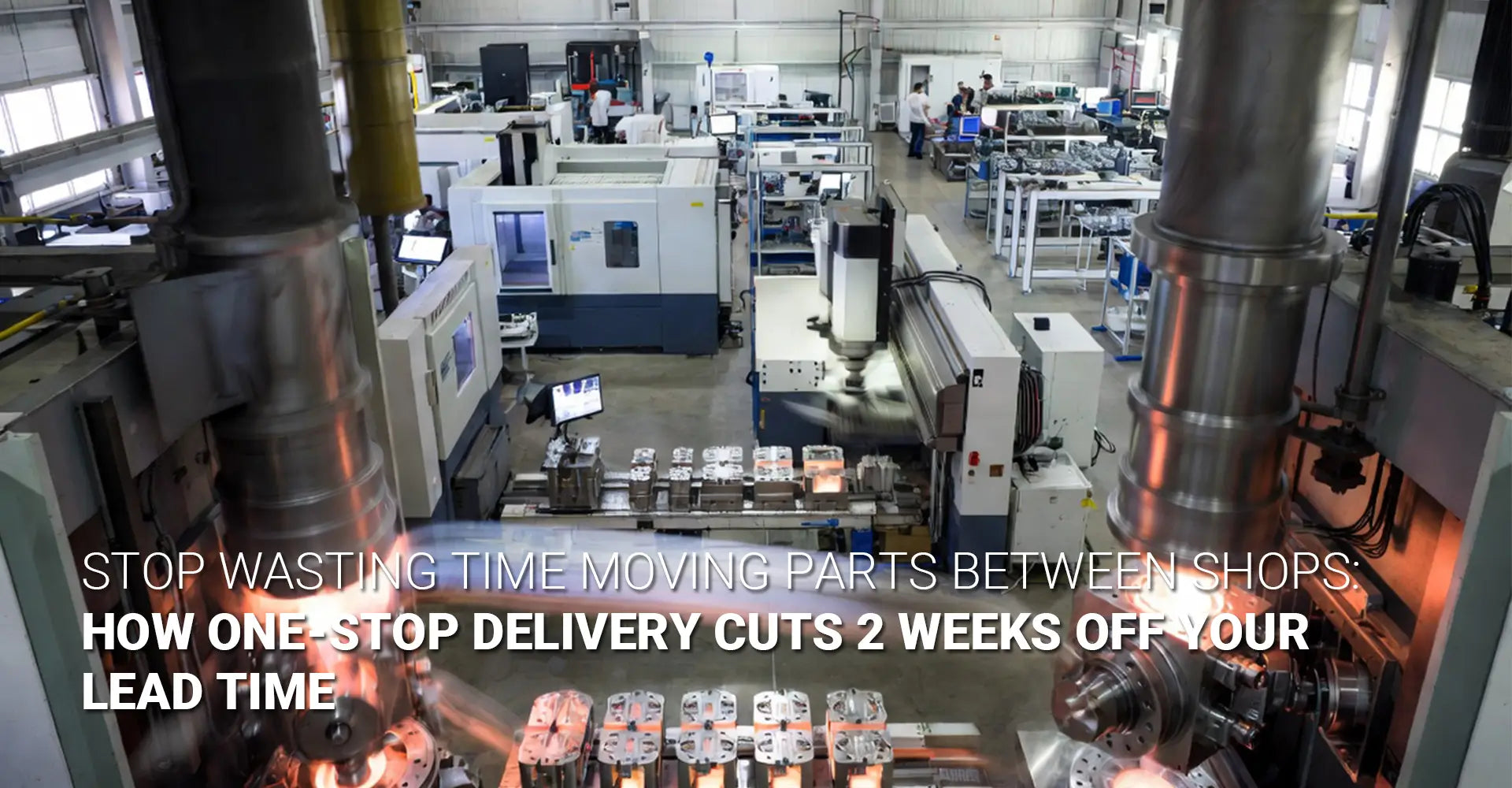
Stop Losing 2 Weeks to Part Handoffs: Is Your Die Caster Delivering Finished Die Cast Components Under One Roof?
Every day your casting sits in a shipping queue is a day your competitor gets ahead. Most procurement managers believe a "2-week lead time" means parts arrive in 14 days. In reality, the handoffs between a casting shop, a machining shop, and an assembly line quietly steal 10 to 15 extra days — every single order. This article breaks down exactly where those days go, how much they cost, and what a smarter sourcing decision looks like in 2026.

Quick Answer (Snippet): Finished die cast components are castings that have been fully machined, deburred, surface-treated, and assembly-ready — delivered from a single supplier without the buyer coordinating between multiple vendors. Choosing a one-stop supplier eliminates transit, queue, and setup delays that typically add 10–15 days to every order.
Sourcing die castings used to mean managing two or three vendors, chasing shipping updates, and hoping tolerances survive the handoff. But procurement professionals in 2026 are rewriting that playbook. The new standard is supply chain consolidation casting — one supplier, one quote, one delivery of parts ready to go straight to the production line. Here is exactly how it works, what it saves, and what to ask before you sign your next purchase order.
Table of Contents
- What Is the Traditional Two-Shop Nightmare?
- What Is the "Handoff Tax" Costing Your Supply Chain?
- How Does One-Roof Integration Work for Cast, Machine, and Assemble?
- What Quality and Cost Advantages Come With Integrated Die Casting Services?
- What Should Procurement Managers Look for in a One-Stop Die Casting Partner?
- Conclusion
What Is the Traditional Two-Shop Nightmare?
Most buyers inherit a sourcing workflow that looks logical on paper: find the best casting shop, then find the best machining shop, then coordinate assembly. It sounds like specialization. In practice, it is a scheduling disaster waiting to happen. Each handoff creates a gap — a moment when your parts are sitting still, waiting for a truck, waiting in a queue, or waiting for someone to answer an email. Those gaps compound fast.
The 15-Day Lie: How a "2-Week Lead Time" Really Takes 4 Weeks
Step What the Casting Shop Promises What Actually Happens Casting complete Day 7 Day 7 ✅ Parts packed & in outgoing queue Same day +2 days ⏳ Transit to machining shop 1 day +1–2 days ⏳ Machining queue (behind other jobs) "Immediate" +5–7 days ⏳ Machining complete + outgoing transit Day 9 +2 days ⏳ Assembly or final inspection Day 14 +2–3 days ⏳ Total hidden idle time 0 days 12–16 days The casting shop met their lead time. You still waited 4 weeks.
The core problem is that each vendor optimizes for their own schedule, not yours. When the casting shop finishes your order on a Friday afternoon, those parts sit in their outgoing area until Monday. The trucking carrier picks them up Tuesday. The machining shop logs them in Wednesday — then puts them at the back of their existing job queue. By the time machining starts, it is day 12 or 13 of a quote that promised 14 days total.
This is not a failure of any one supplier. It is a structural flaw in the multi-vendor model. Every additional vendor you add creates another queue, another transit window, and another communication gap. For buyers managing dozens of part numbers, those gaps multiply into weeks of chronic lateness.
What Is the "Handoff Tax" Costing Your Supply Chain?
Time is the most visible cost of multi-vendor sourcing. But the financial costs are just as damaging — and much harder to see on a purchase order. Procurement teams often compare unit prices between a one-stop shop and a two-vendor arrangement, then choose the lower-looking number. That calculation almost always ignores the real total cost.
The Hidden Handoff Tax — Line by Line
Cost Category Typical Impact Trucking & freight (casting to machining) $0.30–$1.50 per part (or flat $80–$200 per shipment) Second vendor setup fee $300–$800 per order Queue delay at machining shop 5–7 lost production days Damage in transit (scratch, dent, contamination) 1–5% rejection rate; rework cost varies Administrative time (PO, invoice, tracking) 2–4 hours per order per vendor Finger-pointing on tolerance failures Unquantified, but real rework and re-sourcing cost None of these costs appear on the casting shop's unit price quote.
Part handling elimination is one of the most underrated savings in integrated manufacturing. Every time a cast part is packed, loaded, shipped, unloaded, inspected, and re-fixured at a new facility, there is a risk. Parts get scratched in transit. Protective packaging traps contamination. A machinist receiving parts from an unknown caster must re-establish datums — sometimes discovering the casting ran slightly out of spec in a way the original shop never flagged.
When something goes wrong, the casting shop blames the machining shop for mishandling. The machining shop blames the casting shop for dimensional drift. You are left managing a dispute between two vendors while your production line waits. A single integrated supplier carries the full responsibility. There is no one else to blame — so they build their process to avoid problems in the first place.
For automotive components where tolerances are tight and traceability requirements are strict, this single-point accountability is not just convenient. It is often required by quality standards.
How Does One-Roof Integration Work for Cast, Machine, and Assemble?
The phrase "one-stop shop" gets used loosely in manufacturing. Some suppliers say it and mean they will broker your machining to a partner facility down the road. True one-stop die casting means the casting press, the CNC machining center, and the assembly station are in the same building, under the same quality management system, operated by the same team. That distinction is everything.
Real Example: 10,000 Parts from Raw Melt to Packaged Assemblies in 14 Days
Here is how a vertically integrated facility handles the same order that takes 4 weeks in a two-shop model:
- Days 1–2: Tooling setup and first-article inspection
- Days 3–8: High-pressure die casting at full production rate
- Days 8–10: Parts move directly from trim press to CNC cell — same day, no packaging, no transit
- Days 10–12: In-house CNC finishing, deburring, and surface treatment
- Days 12–14: Assembly, leak testing, final inspection, and packaging
- Day 14: Shipment to your facility
Every step happens in sequence, with no idle time between operations.

Vertical integration die casting works because the process designers can optimize every step with the final machined part in mind. When the casting engineer knows exactly how the part will be fixtured on a CNC machine, they can design the gate location, runner system, and draft angles to minimize stock allowance and maximize datum reliability. When the CNC programmer knows how the part was cast, they can write tool paths that account for the material's grain structure and typical shrinkage pattern.
This is one‑stop die casting and machining working as a closed-loop system — not two separate disciplines that happen to share a purchase order.
Die casting process capabilities at leading integrated facilities now include aluminum, zinc, and magnesium alloys, with wall thicknesses as fine as 0.8mm and part weights from a few grams to several kilograms. When these capabilities connect directly to in-house CNC and assembly, the buyer receives a genuinely complete product — not a semi-finished casting that still needs two more vendors.
What Quality and Cost Advantages Come With Integrated Die Casting Services?
Speed is the headline benefit of integrated sourcing. But quality and total cost tell an equally compelling story — one that often matters even more to engineering and finance teams who are reviewing supplier scorecards. When casting and machining happen under a single quality management system, the data flows in ways that simply cannot happen across two separate companies.
Three Advantages You Cannot Get from Separate Specialists
1. Single Quality System One ISO 9001 (or IATF 16949) certificate covers casting, machining, and assembly. One non-conformance report. One corrective action. No inter-vendor blame loops.
2. DFM That Actually Feeds Back The machining team can tell the casting team: "This boss is causing chatter at 4,000 RPM — add 0.3mm of stock." That conversation happens in 10 minutes across a shop floor, not across a 6-week design revision cycle.
3. Lower Total Cost No secondary vendor markup. No freight between operations. No duplicate setup fees. Most buyers find the total landed cost 8–18% lower than managing two vendors — even if the hourly machining rate looks slightly higher on paper.
Quick turn die cast parts are only possible when quality checks do not require re-inspection at a second facility. In a two-vendor model, the machining shop receives castings and must perform incoming inspection — checking that the castings meet the dimensional requirements their CNC program assumes. This adds a day. If they find a problem, they stop production and call the casting shop. The casting shop disputes it. Production halts.
In an integrated facility, the casting cell and the CNC cell share live SPC data. If casting dimensions drift, the machining department flags it before the batch moves. The problem gets fixed the same shift — not two weeks later after a shipment and a dispute.
Surface finishing services, including anodizing, powder coating, and shot blasting, are also often available within an integrated supply chain. When surface treatment happens in-house or through a closely managed process, the finished part arrives with consistent appearance and corrosion protection — ready for your customer's shelf or production line without further processing.
For industrial machinery components, where dimensional precision and surface integrity directly affect machine performance, this closed-loop quality system is not a luxury. It is the difference between components that work and components that cause field failures.
What Should Procurement Managers Look for in a One-Stop Die Casting Partner?
Knowing the benefits of integrated sourcing is one thing. Finding a supplier who genuinely delivers it — rather than just claiming to — requires asking the right questions before you issue a purchase order. Many suppliers will describe themselves as "full-service" while quietly brokering your machining to a partner facility. Here is how to tell the difference.
2026 Procurement Checklist: Qualifying a True One-Stop Die Casting Partner
✅ Owns its CNC machines — Ask for the make, model, and axis count. A real integrated shop can name their machines.
✅ CNC is in the same building as casting — Request a virtual or in-person facility tour. Same building, same roof.
✅ Quality system covers all processes — The ISO 9001 or IATF 16949 scope statement should explicitly include "casting, machining, and assembly."
✅ Can quote from your final drawing — Send the finished part drawing (with all machined features). A true one-stop supplier quotes the complete finished part, not just the raw casting.
✅ Has assembly experience relevant to your application — Ask for examples: insert installation, press-fit assembly, leak testing, sub-assembly.
✅ Single point of contact for quality issues — One person, one company, one corrective action process.
✅ Testimonials mention "ready-to-use" or "assembly-ready" parts — Not just "good castings."

Assembly ready components are the ultimate test of a supplier's integration. Any shop can cast a part and hand it to a machinist. Only a truly integrated supplier can deliver a component that goes directly from the receiving dock to your production line — with all machined features in spec, all inserts installed, all surfaces treated, and all assembly steps complete.
When evaluating suppliers, look beyond their website's marketing language. Ask specifically: "Do you outsource any part of the machining or assembly process?" If the answer involves "partner facilities" or "trusted local vendors," they are not a one-stop shop — they are a casting broker with value-added reselling on top.
The cast to assembly lead time on your next RFQ should be a single number from a single supplier. If you are adding up lead times from three different vendors and hoping they align, you are carrying all the scheduling risk yourself. A genuine integrated partner carries that risk for you.
For specialized applications like kitchen appliance components, where aesthetic surface quality and dimensional precision must coexist, integrated suppliers are especially valuable. They can balance the casting parameters and the finishing process in real time — something no two-vendor arrangement can match.
Conclusion
The math is simple. Every handoff between vendors adds idle time. That idle time adds days. Those days add cost, risk, and frustration. The two-week quote that takes four weeks to arrive is not a vendor performance problem — it is a sourcing model problem.
Here is what to do differently on your next die cast component project:
- Send one RFQ for the complete finished part — casting, machining, surface finish, and assembly — to a supplier who can do all of it under one roof.
- Ask for a facility tour to confirm that the CNC machines are in the same building as the casting presses.
- Require a single quality system that covers all operations. One certificate, one audit, one corrective action process.
- Compare total landed cost — not hourly rates. Include freight, setup fees, transit days, and administrative time in your comparison.
- Measure cast to assembly lead time as a single metric from a single supplier. That number should be shorter than what you are getting today.
"Stop thinking of casting and machining as separate purchases. Specify finished, assembly-ready components and require a single supplier to deliver them. The lead time savings alone will make you look like a hero to your production planners."
Procurement professionals who make this shift in 2026 are not just saving days on individual orders. They are building a supply chain that is structurally faster, structurally more reliable, and structurally less expensive — because the delays are designed out, not managed around.
🔗 External Links & Further Reading
[Finished die cast components][^1]
[one‑stop die casting and machining][^2]
[cast to assembly lead time][^3]
[integrated die casting services][^4]
[vertical integration die casting][^6]
[^1]: A precision finishing operations page from Dynacast, an international die casting manufacturer, detailing a full suite of secondary operations including CNC machining, CMM inspection, drilling, milling, grinding, polishing, assembly, and salt spray testing that deliver high-quality, ready-to-use die cast parts with strict dimensional accuracy and surface finish requirements.
[^2]: A corporate blog article from Leech Industries describing how consolidating multiple processes in-house (including die design, production, tapping, machining, deburring, plating, powder coating, and assembly) provides finished zinc die cast components as a one-stop solution, simplifying supply chains and reducing lead times.