Coffee Grinder Static Reduction: Which Anti-Static Surface Treatment Works on Aluminum Chutes?
Coffee Grinder Static Reduction: Which Anti-Static Surface Treatment Works on Aluminum Chutes?
Fine coffee powder loves to stick. It clings to chutes and exit ports, and then it builds up. Soon the flow slows, the mess grows, and customers start to complain. Coffee grinder chute static is often the hidden cause. If you are a procurement manager or an engineer, you need a clear answer. This guide shows which finish works, which one does not, and how to prove it before you buy.

Quick answer: Ordinary anodizing does not reduce static, because it creates an insulating layer. Instead, the best fix uses three parts together: a dissipative coating, a ground path, and a smooth chute shape. No single anti-static surface treatment solves the problem alone. Above all, ask for test data, not just claims.
| Your question | Short answer |
|---|---|
| Does anodizing stop static? | No. The oxide layer is an insulator. |
| Does micro-arc oxidation (MAO) stop static? | Not in its standard form. |
| What resistance should I target? | 10^6–10^9 Ω/sq (static dissipative) |
| What else is a must-have? | A path from the coating to ground |
| Is every ESD coating food-safe? | No. Ask for food-contact papers. |
| How do I prove it works? | Test the real part, not just a flat sample. |
You now have the short answer. Next, let’s look at why it works this way. Coffee grinder static reduction starts with understanding the cause. After that, we will compare the finish options, review coatings in detail, and end with a supplier audit plan you can use right away.
Table of Contents
- Why Do Coffee Grinder Chutes Attract Fine Powder?
- Does Anodizing or Micro-Arc Oxidation Reduce Static on Aluminum Chutes?
- What Can Electrostatic Dissipative Coatings Do for Coffee Grinder Chutes?
- How Should Procurement Teams Audit Surface Finishing Suppliers?
- Conclusion
Why Do Coffee Grinder Chutes Attract Fine Powder?
Have you ever seen coffee dust cling to a metal wall like glue? It is not magic. Powder sticking is a charge problem, not only a cleaning problem. Once you see the cause, the right fix becomes much easier to pick.
Short answer: Static charge generation in grinding comes from friction and from particles hitting each other and the chute wall. Dry air and insulating surfaces then keep that charge in place, so the powder stays stuck.
How charge builds up. First, the beans break apart inside the burrs. Next, fine particles rub against each other and against the chute. Each rub moves tiny charges from one surface to another. As a result, the powder and the wall end up with opposite charges. Opposite charges pull on each other, so the dust sticks.
Why dry air makes it worse. Moist air lets charge leak away slowly. Dry air does not. Therefore, a grinder that works well in a humid shop may act badly in a dry winter room.
Why the surface matters. A bare metal wall can carry charge away if it is grounded. However, a wall with an insulating layer traps that charge. This is why the surface state matters as much as the metal itself. When charge stays trapped, coffee powder adhesion gets worse with every grinding cycle.
Three terms that get mixed up. Suppliers often use these words loosely, so learn the difference:
- Anti-static: reduces how much charge forms. It may not remove charge quickly.
- Static dissipative: lets charge drain in a slow, safe way, at about 10^6–10^9 Ω/sq.
- Conductive: lets charge flow very fast, below 10^5 Ω/sq.
Tip: The words “anti-static” on a quote are not a number. Always ask for the number.
Does Anodizing or Micro-Arc Oxidation Reduce Static on Aluminum Chutes?
Many shops offer aluminum surface finishing choices, such as anodizing and MAO. These finishes are popular for good reasons. However, they solve different problems, and static is usually not one of them.
Short answer: Standard anodizing and MAO both build an insulating oxide layer. They help with wear and rust, but they do not move charge away.

Anodized aluminum is an insulator. Anodizing grows a hard oxide layer on the metal. This layer protects against corrosion and scratches. Still, aluminum oxide does not carry current. So, charge can sit on the surface instead of draining away.
Hard vs. decorative anodizing. Hard anodizing is thicker and tougher. Decorative anodizing is thinner and looks better. Both are insulating, though. A thicker oxide layer does not give charge a way out. For this reason, neither type is a fix on its own.
MAO is tough, but not a static fix. Micro-arc oxidation aluminum parts get a hard, ceramic-like layer with high wear resistance. The surface can also be rough. In its standard form, MAO is insulating too. Some special MAO versions add conductive phases. Even so, they are rare and need proof.
Conductive anodizing is a special case. Conductive anodizing exists, and some processes leave a layer that can carry charge. However, you must see the proof. Ask for measured resistivity, not a promise.
When a finish makes things worse. A rough surface can trap fine powder in tiny pits. When that rough surface is also insulating, the powder sticks even more. If your goal is real static control, look at an anti-static coating for aluminum instead. We cover that next.
What Can Electrostatic Dissipative Coatings Do for Coffee Grinder Chutes?
A dissipative coating gives charge a safe path away from the powder. That sounds simple. However, it only works when several conditions are met.
Short answer: Aim for surface resistivity 10^6–10^9 Ω/sq, use a coating cleared for food contact, and connect it to ground.
Resistivity targets and test methods. A dissipative coating should sit in the 10^6–10^9 Ω/sq range. Below 10^5 Ω/sq the surface is conductive. Above 10^12 Ω/sq it is an insulator. Next, ask which test method the supplier used. Common choices are ASTM D257 and IEC 61340. Also, require readings on the actual coated part. A flat test coupon can look great while the real chute fails.
Types of coatings. Some coatings use carbon. Others use metal particles or polymer blends. Each type has trade-offs in color, wear, and cost. In addition, many ESD coatings contain fillers or additives that are not food-safe. Therefore, never assume a coating is safe for coffee.
Food-contact rules. Pick a food-safe anti-static coating only when the maker can prove it. Look for a food contact compliant coating backed by a Declaration of Compliance under FDA 21 CFR or EU 10/2011. Also request migration test data. A general industrial coating should not touch food. If a coating cannot meet these rules, keep it away from direct food surfaces.
Thickness, adhesion, and wear. A thin, uneven layer can leave weak spots. Test coating adhesion and wear with ASTM D3359 (aim for 4B or better), plus abrasion and cleaning cycles. Then measure resistivity again. A coating that peels or loses its numbers after cleaning is not a fix.
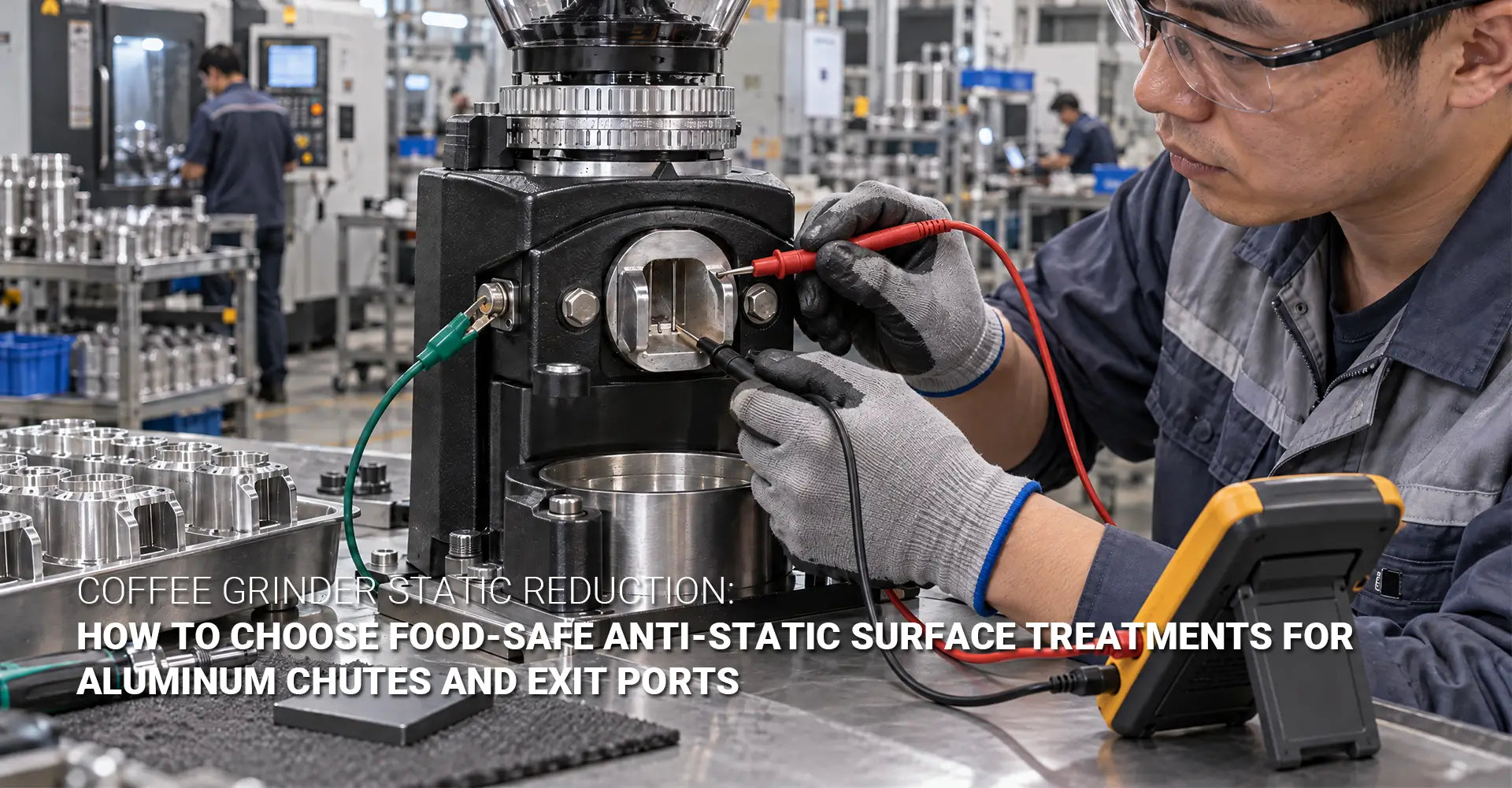
Grounding matters. A dissipative layer needs a path to ground. Treat grounding coffee grinder frames as part of the design, not an afterthought. If paint, anodizing, or plastic washers isolate the coating, it cannot drain charge.
Design beyond the coating. Good grinder chute design also cuts powder sticking. A smooth wall, a steeper angle, and fewer dead zones reduce the time powder sits in the chute. In addition, clean CNC machining leaves an even surface for the coating to bond to. Material choice matters as well. You can compare aluminum, stainless steel, and conductive plastics. If you use die-cast aluminum parts, check surface porosity before coating. Finally, ionizers, static eliminators, and humidity control can help as add-ons.
Know the limits. Before you buy any ESD coating coffee equipment makers rely on, remember that coatings wear. Cleaning chemicals can also change the surface over time. Because of this, plan for re-testing, not just a one-time check.
How Should Procurement Teams Audit Surface Finishing Suppliers?
An “anti-static” label means little without evidence. Therefore, treat every claim as a question that needs an answer.
Short answer: Ask for resistivity data, food-contact papers, durability reports, and first article samples before you approve a process.

Documents to request. Start with a clear paper trail. Ask for:
- The coating data sheet (composition, thickness, and cure)
- A food-contact Declaration of Compliance (FDA or EU)
- A migration test report
- A resistivity report with the method and the values
- Adhesion, wear, and cleaning durability reports
- A first article inspection report with thickness and resistivity readings
- Batch traceability and shelf-life information
What to put on the drawing and purchase order. Write the target in plain numbers. For example, list the resistivity range, the test method, the coating thickness, and the ground contact area. Also state that food-contact papers must ship with each batch. Otherwise, the supplier may fill in the blanks on their own.
Questions to ask before approval. Use this supplier technical audit checklist at the quote stage:
- Can you show measured resistivity on a real part?
- Can you explain the ground path from the coating to the machine?
- Is the coating cleared for direct food contact?
- How do you control coating thickness?
- What happens to the numbers after 50 cleaning cycles?
Red flags. Be careful when a supplier:
- Says “anti-static” but has no resistivity data
- Offers an industrial ESD coating with no food-contact papers
- Cannot explain the grounding path
- Shows only flat-coupon results
- Has no adhesion or cleaning tests
- Uses vague words like “contains conductive particles”
First article and batch sampling. Always inspect first articles for thickness, resistivity, and surface quality. After that, use a batch sampling plan so quality does not drift.
A short example. Picture a grinder with an anodized chute. Powder builds up, and customers complain. Then the team makes three changes. They add a food-safe dissipative coating, connect it to ground, and smooth the chute shape. As a result, much less powder stays on the wall. The key lesson is simple: the fix came from all three parts working together, not from one finish alone.
Conclusion
Static in a grinder chute is a charge problem, and the surface decides how well charge can escape. Standard anodizing and MAO do not solve it. A verified, food-safe dissipative coating, a clear ground path, and a smart chute shape do.
Contents of the Conclusion
- Anodizing alone does not reduce static. It is an insulating layer.
- The best fix is a combination. Use a verified, food-safe dissipative coating, a ground path, and good chute design.
- Use a quick supplier checklist. Ask for resistivity data, food-contact papers, adhesion and wear reports, and first article samples.
- Next step: If you need help with chutes, housings, or other coffee equipment parts, talk to Hotean about your design and finish needs.
Recommended External Links
[Coffee grinder static reduction][^1]
[Anti-static surface treatment][^2]
[Electrostatic dissipative coating][^3]
[Anti-static coating for aluminum][^4]
[^1]: A 2024 peer-reviewed study in *iScience* (Cell Press, US) systematically evaluates charge mitigation strategies during coffee grinding. It compares four techniques—time-resolved discharge, water addition, unipolar corona discharge, and balanced corona discharge—and provides the engineering principle behind **high-voltage ionizers** that neutralize static by bombarding grounds with positive and negative ions. The research confirms that **water addition to whole beans (less than 0.05 mL/g) is the most effective method**, preventing clump formation and fine particle adhesion, and resulting in a **15% higher coffee concentration** for espresso extracts from darker roasts. This is a primary scientific reference for grinder design and process optimization.
[^2]: MG Chemicals (Canada/US) publishes a comprehensive engineering guide defining ESD-safe coatings as materials with resistivity in the **10⁷–10⁹ Ω·cm** range—sufficient to dissipate charge buildup without being fully conductive. The guide covers adhesion to plastics, glass, and composites, humidity-independent performance, HAPs-free formulation, and step-by-step application including surface preparation, brush/spray methods, curing, and conductivity verification with a multimeter. This is a direct technical reference for specifying and applying anti-static surface treatments on insulating substrates.
[^3]: Intertronics (UK) technical product page for **Licron Crystal**, a permanent clear urethane static dissipative coating. It maintains surface conductivity of **10⁶–10⁹ Ω** across **0–100% humidity**, adheres to metal, plastic, glass, and most substrates, and is compliant with **ANSI/ESD-S20.20**. The page details application (aerosol or bulk spray), coverage rates, and grounding methodology, making it a directly applicable coating specification for converting surfaces to a static-safe condition.
[^4]: MG Chemicals (Canada/US) technical data for the **844WB** water-based ESD safe coating. It is a one-part, permanent static-dissipative urethane coating that adheres strongly to metals including aluminum, with a cured **surface resistance of 5.6 × 10⁷ Ω/sq** at 50 μm—firmly within the dissipative range. The coating meets **ANSI/ESD-S20.20** and is applied by brush, roller, or spray for protecting electronic assembly tools, conveyors, and enclosures from static charge buildup.
[^5]: A NASA Tech Briefs article (Marshall Space Flight Center) detailing the same conductive anodizing technology. It explains the mechanism—filling the porous anodic layer with a conductive nanocomposite—and notes that the treatment was developed to prevent static discharge on spacecraft satin-anodized aluminum without affecting thermal-optical properties. It also highlights the cost advantage: these nanocomposite finishes are expected to cost **20–50% less** and last longer than competing ESD finishes such as silver-impregnated anodize, black electroless nickel, or black chrome.