That 1-Second Quote Might Cost You a Week: Why DFM Review Matters Before Rapid Prototyping?
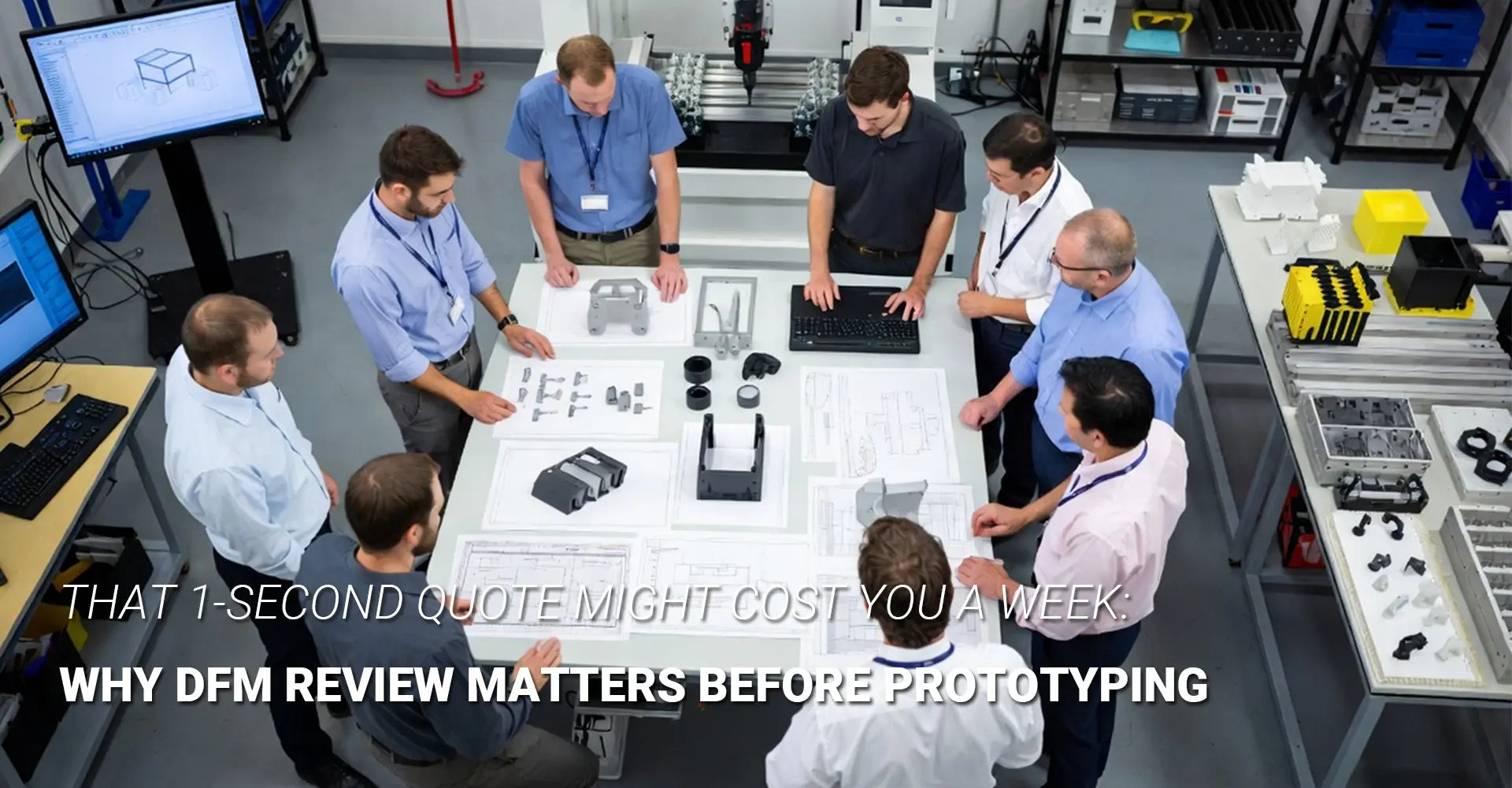
That 1-Second Quote Might Cost You a Week: Why DFM Review Matters Before Rapid Prototyping?

Speed feels like progress. So when an online platform promises a rapid prototyping quote in under a second, it is hard to say no. Engineers are under pressure. Deadlines are real. And clicking "Get Quote" feels like moving forward.
But here is the truth most buyers learn the hard way: a fast quote is not the same as a safe quote. That 1-second number tells you a price. It does not tell you whether your part can actually be made — cleanly, on time, and on budget. And when it cannot, the clock starts running against you.
This article breaks down exactly why design for manufacturing review is the real protection standing between your design and a costly, avoidable failure.
Quick Answer: A rapid prototyping quote from an automated platform only checks basic geometry. It cannot catch design flaws like incorrect wall thickness, poor draft angles, or inaccessible tool paths. A human DFM (Design for Manufacturing) review identifies these issues before production begins — saving you days of rework, thousands in tooling costs, and the frustration of a failed prototype.
So why do so many engineers still skip the DFM step? And what exactly does a proper engineering design review catch that algorithms miss? Let's walk through each piece — step by step.
Table of Contents
- Why Do Instant Rapid Prototyping Quotes Feel So Irresistible?
- What Can Automated Rapid Prototyping Quotes Actually Miss?
- What Does a Real DFM Engineering Review Actually Catch?
- How Much Does Skipping DFM Review Actually Cost You?
- Conclusion
Why Do Instant Rapid Prototyping Quotes Feel So Irresistible?
Let's be fair. Instant quoting platforms have genuinely changed the industry for the better. Ten years ago, getting a prototype quote meant waiting three to five business days. Today, you upload a CAD file and get a number in seconds. That is a real improvement — and buyers have noticed.
But there is a difference between speed as a feature and speed as a replacement for engineering judgment. Unfortunately, many buyers now confuse the two.
Why instant quotes are so appealing:
| Reason | What Buyers Believe | What Is Actually True |
|---|---|---|
| Speed | "I'm saving time by quoting now" | You may be deferring a bigger time loss later |
| Price visibility | "I know exactly what this costs" | The quote is only valid if the design is manufacturable |
| Zero friction | "No back-and-forth with engineers" | That back-and-forth is where problems get caught |
| Comparison shopping | "I can get 5 quotes in 5 minutes" | Comparing prices on a flawed design multiplies nothing |
The appeal of instant quoting is largely psychological. When a buyer is facing a tight deadline, the cognitive comfort of having a number reduces anxiety — even if that number is built on an unvalidated design.
There is also market pressure involved. As more platforms offer instant pricing, buyers begin to expect it. And when one supplier asks for 24 hours to review a file, it feels slower — even if that 24-hour review is the step that prevents a week of rework.
The result? A growing gap between what instant quoting vs engineering review actually delivers — and what buyers think they are getting from each. For high-stakes rapid prototyping projects, that gap has consequences.
What Can Automated Rapid Prototyping Quotes Actually Miss?
Algorithms are excellent at what they are designed to do. They can read geometry. They can calculate volume. They can match a part profile to a price database in milliseconds. But geometry is not design intent — and price databases do not understand context.
This is the core problem with relying on automation alone for manufacturability assessment. The system does not know why your wall is that thin. It does not know that your internal channel needs to be reached from a specific angle. It does not know that your tolerance stack-up makes a borderline feature critical.
What automated quoting systems typically cannot flag:
- Wall thickness issues that are technically within spec but will cause sink marks or warpage
- Draft angle problems that will prevent clean part ejection from molds
- Tool access limitations — features that look machinable but cannot be reached by any available cutting tool
- Gate location conflicts that will create poor material flow during injection molding
- Weld line positions where material fronts meet, creating structural weak points
- Material-process mismatches where the chosen technology is not ideal for the geometry
- Ejector pin mark placement that conflicts with aesthetic or functional surface requirements
Each of these issues requires machining accessibility awareness and contextual engineering judgment — not just geometric pattern recognition.
Consider two parts with identical wall thickness. One is a structural bracket with uniform cooling. The other is a cosmetic housing with thick and thin sections side by side. An algorithm sees the same wall dimension on both. A human DFM engineer sees a sink mark risk on the second — because experience fills in what geometry alone cannot tell.
This is what the industry calls context blindness in automated systems. The pattern recognition is real. But "similar geometry" does not mean "similar manufacturing challenge." That distinction matters enormously in CNC machining and 3D printing applications, where process-specific constraints change the rules entirely.
What Does a Real DFM Engineering Review Actually Catch?
A proper DFM analysis is not a checklist. It is an engineering conversation between your design and the manufacturing process — conducted by someone who has seen hundreds of similar failures and knows what to look for before a single chip is cut or gram of resin is melted.
Human engineers bring something no algorithm currently replicates: accumulated judgment. They know which features look fine on screen but cause problems in the real world. And they know how to communicate those problems in a way that actually helps you fix them.
What a thorough engineering design review identifies:
| Design Issue | Why It Matters | What Good DFM Feedback Looks Like |
|---|---|---|
| Wall thickness inconsistencies | Causes sink marks, warpage, and long cycle times | "Reduce this section from 4mm to 2.5mm and add a rib here for support" |
| Draft angle oversights | Prevents clean part ejection | "Add 1.5° draft to this face — current 0° will cause drag marks" |
| Tool access limitations | Features that cannot be machined as designed | "This internal radius requires a 4-axis setup — consider opening this pocket" |
| Sink mark predictions | Thick sections will show surface defects | "This boss is too thick relative to the wall — hollow it or reduce to 60% wall thickness" |
| Gate and weld line placement | Structural and aesthetic surface issues | "Move gate to this edge to push the weld line away from the stress concentration" |
The real value of prototype design feedback is not just what gets flagged — it is how it is communicated. A quality DFM report does not just say "fix this." It says: "Move this rib 2mm to the left to eliminate the sink risk" or "Switch from SLA to SLS here because your geometry will trap resin in this cavity."
That level of specificity is what separates a rejection from a solution. And for teams working on electronics manufacturing or automotive applications — where tolerances are tight and failures are expensive — that specificity is not optional. It is the whole point.
Wall thickness optimization is one of the most commonly cited areas where human review adds value that automated systems simply cannot match. Getting this right before production is the difference between a prototype that passes and one that cracks.
How Much Does Skipping DFM Review Actually Cost You?
This is where abstract risk becomes a concrete number. Every team that has been through a prototyping failure knows the feeling: a part comes back wrong, production stops, and suddenly that "1-second quote" is looking like a very expensive shortcut.
The design iteration cost of catching a problem after production has started is not just financial. It is schedule, team morale, and customer confidence. Let's look at how these scenarios actually play out.
Three real-cost failure scenarios when DFM review is skipped:
Scenario A — Part Fails in Production
- Wall too thin → part cracks on ejection
- Redesign required → re-quote → wait for new production run
- Result: 5–7 day delay + rework labor costs
Scenario B — Tooling Cut Before Review
- Mold fabricated based on unreviewed design
- Critical draft angle error discovered after tool is cut
- Tool modification or full retool required
- Result: $15,000–$50,000+ in wasted tooling spend
Scenario C — Assembly Fit Issues Downstream
- Prototype passes individual inspection
- Fails at assembly stage due to tolerance stack-up
- Entire design sent back for revision
- Result: Full project timeline pushed back 2–3 weeks
The data supports investing in review upfront. Studies and supplier case data consistently show that proper prototype failure prevention through DFM reduces total part cost by 15–30%. The savings come from multiple directions at once:
- Fewer secondary operations — optimized feature placement reduces finishing steps
- Less material waste — simplified geometry uses less raw material
- Shorter time-to-market — eliminating iteration loops gets to production faster
- Avoided tooling rework — the single most expensive line item in prototyping failures
The DFM review itself typically costs a fraction of what one failed production run costs. And when you factor in the schedule risk — which in competitive markets translates directly to revenue risk — the math becomes even clearer.
Instant quoting vs engineering review is not really a comparison between two quoting methods. It is a comparison between two risk profiles. One tells you a price fast. The other tells you whether that price is even valid.
Conclusion
Contents of Conclusion
Speed is valuable. But speed without safety is just a faster way to fail.
Here is what this article has shown:
- ✅ Instant rapid prototyping quotes are built on geometry — not engineering judgment
- ✅ Automated systems cannot catch context-dependent flaws like sink marks, tool access problems, or weld line conflicts
- ✅ A proper DFM analysis catches these issues before production begins — where fixing them is still cheap
- ✅ Skipping DFM review can cost 5–7 days of delay, thousands in rework, and tens of thousands in tooling failures
- ✅ Well-executed design for manufacturing consistently delivers 15–30% cost savings over the project lifecycle
The bottom line: That 1-second quote is a starting point — not a green light. A human engineering design review is the real step that protects your timeline, your budget, and your prototype.
Before you click "Get Quote" on your next project, ask yourself: Has anyone actually reviewed this design for manufacturability? If the answer is no — that is where to start.
[External Links Recommendation]
[Rapid prototyping quotes][^1]
[DFM analysis][^2]
[engineering design review][^3]
[prototype design feedback][^4]
[manufacturability assessment][^5]
[instant quoting vs engineering review][^6]
[^1]. This source offers instant rapid prototyping quotes that update in real-time, allowing engineers to compare prices across various 3D printing and CNC machining technologies while receiving immediate manufacturability feedback.
[^2]. This comprehensive guide provides an in-depth DFM analysis, detailing essential strategies and principles for optimizing product designs across injection molding, CNC machining, and 3D printing to ensure efficient, high-quality, and cost-effective production.
[^3]. This expert insight outlines the essential best practices for conducting effective engineering design reviews, emphasizing the importance of clear goals, productive discussion, and structured documentation to improve product outcomes.
[^4]. This comprehensive guide provides actionable strategies for gathering and maximizing prototype design feedback, covering everything from selecting the right participants to asking the most impactful questions during testing.
[^5]. This technical guide provides a systematic framework for conducting a manufacturability assessment, featuring a comprehensive checklist for manufacturing readiness that helps engineers identify production challenges early in the design phase.
[^6]. This insightful article compares instant quoting vs engineering review (manual quoting ), analyzing the trade-offs between speed and accuracy while highlighting when a detailed engineering review is essential for complex, high-precision manufacturing projects.