
PEEK vs. Aluminum 6061: Can This High-Performance Plastic Really Replace Metal in Structural Applications?
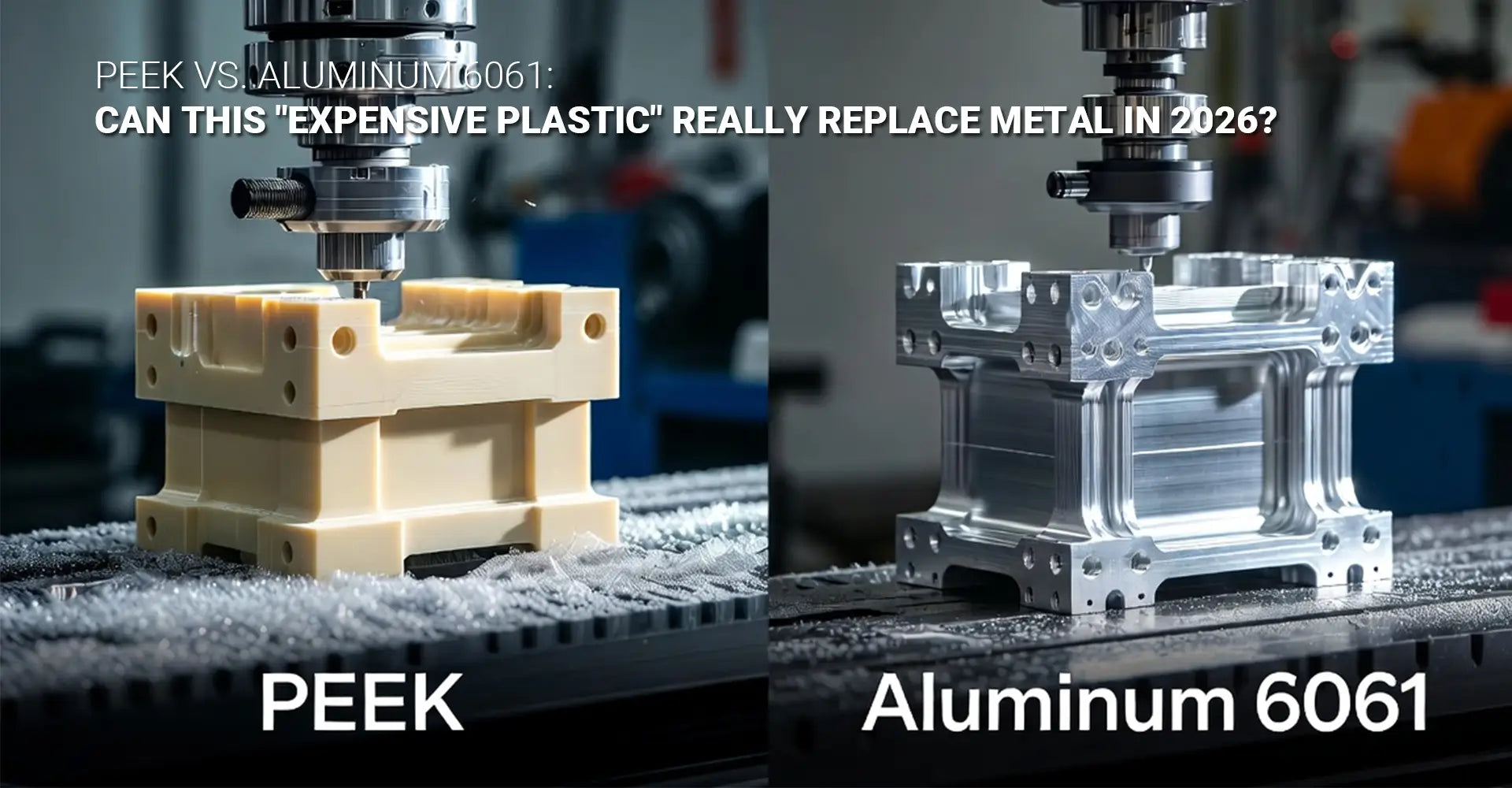
PEEK vs. Aluminum 6061: Can This High-Performance Plastic Really Replace Metal in Structural Applications?

Engineers have spent decades trusting aluminum 6061 for everything from aircraft brackets to medical devices. But something is changing. More and more design teams are asking a bold question: can a plastic part do this job better? PEEK — short for Polyether Ether Ketone — is no ordinary plastic. It sits in a class of its own, and in 2026, it is forcing a serious conversation about what "metal-grade performance" really means.
Here is the short answer: PEEK can replace aluminum 6061 in many structural applications — especially where weight, corrosion, or sustained heat are the real problems. But it is not always the right call. The decision depends on your load type, environment, production volume, and total cost of ownership.
"Choosing between PEEK and aluminum is not about which material is stronger on paper. It is about which one solves your problem better in the real world."
This guide walks you through every major factor — properties, manufacturing methods, cost, and real-world applications — so you can make a confident, data-backed decision.
Table of Contents
- What Makes PEEK and 6061 Aluminum So Different?
- How Does PEEK Stack Up Against 6061 in Strength and Weight?
- Can PEEK Handle the Heat and Chemicals Better Than Aluminum?
- Machined PEEK vs. 3D Printed PEEK vs. CNC Aluminum — Which Process Fits Your Part?
- When Does PEEK Actually Save You Money Over 6061?
- When Should You Stick With 6061 Aluminum Instead?
- Conclusion
What Makes PEEK and 6061 Aluminum So Different?
At first glance, comparing PEEK to aluminum 6061 sounds strange. One is a thermoplastic. The other is a metal alloy. But engineers are not comparing them because they are similar — they are comparing them because they compete for the same job. Both are used in demanding structural, industrial, and aerospace applications. And both have very different strengths and weaknesses that make one better than the other depending on the situation.
Key Properties at a Glance
Quick Comparison Table: PEEK vs. Aluminum 6061
| Property | PEEK (Unfilled) | CF-PEEK | Aluminum 6061 |
|---|---|---|---|
| Density | 1.32 g·cm⁻³ | 1.59 g·cm⁻³ | 2.70 g·cm⁻³ |
| Tensile Strength | 90–100 MPa | Up to 689 MPa | ~320 MPa |
| Continuous Use Temp | 250°C | 260°C | ~150°C (before property loss) |
| Corrosion Resistance | Excellent | Excellent | Moderate (anodizing required) |
| Chemical Resistance | Outstanding | Outstanding | Limited |
| Machinability | Good | Moderate | Excellent |
| Cost per kg | High | Very High | Low–Moderate |
| Weight vs. 6061 | ~51% lighter | ~41% lighter | Baseline |
Bottom line: PEEK and aluminum serve different masters. Aluminum wins on raw cost and machinability. PEEK wins on chemical resistance, sustained heat, and weight-to-performance ratio.
Material Composition and Why They Behave So Differently
Aluminum 6061 is a precipitation-hardened alloy. It contains magnesium and silicon as its primary alloying elements. This gives it good strength, excellent machinability, and decent corrosion resistance — especially when anodized. However, aluminum is still a metal. It conducts electricity. It reacts with strong acids and bases. And it loses mechanical strength at sustained temperatures above 150°C.
PEEK, on the other hand, is a semi-crystalline aromatic polymer. Its molecular backbone is made up of repeating ether and ketone groups bonded to benzene rings. This structure is what gives PEEK its extraordinary thermal stability and chemical resistance. Unlike most plastics, PEEK does not soften or creep under heat the way nylon or polycarbonate would. It holds its shape and strength at temperatures where many metals begin to struggle.
As a metal replacement plastic, PEEK does not try to mimic aluminum. Instead, it offers a completely different set of trade-offs — ones that happen to be more valuable in specific, demanding environments.
How Does PEEK Stack Up Against 6061 in Strength and Weight?
This is the question most engineers ask first — and for good reason. Structural decisions live and die by mechanical data. If PEEK cannot carry the load, nothing else matters. But the comparison is more nuanced than a simple tensile strength number. You need to look at how much strength you get per gram of material — and that is where the conversation shifts dramatically.
The Numbers That Matter
Key Mechanical Facts:
- Aluminum 6061 tensile strength: ~320 MPa
- Unfilled PEEK tensile strength: 90–100 MPa
- Carbon fiber reinforced PEEK (CF-PEEK) tensile strength: Up to 689 MPa — more than double aluminum 6061
- Aluminum 6061 density: 2.70 g·cm⁻³
- CF-PEEK density: 1.59 g·cm⁻³ — a 41% reduction in density
- Real-world weight savings with PEEK: 50–60% achievable in practice
The takeaway: Unfilled PEEK does not match aluminum in raw strength. But carbon fiber reinforced PEEK more than doubles it — at significantly less weight.
Strength-to-Weight Ratio and Real-World Impact
The strength to weight ratio PEEK offers — particularly in its carbon fiber reinforced form — is where the engineering argument becomes compelling. A CF-PEEK part delivering 689 MPa at a density of 1.59 g·cm⁻³ is performing at a specific strength that most aluminum alloys simply cannot match.
In practical terms, this means aerospace brackets, UAV frames, and automotive housings can carry the same structural load at nearly half the mass. For every kilogram removed from a moving vehicle, fuel consumption drops. For every kilogram saved in a satellite component, launch costs decrease. For every gram eliminated in a handheld medical device, user fatigue goes down.
Furthermore, the lightweight metal alternative argument extends beyond just weight. PEEK parts do not require protective coatings. They do not corrode. And in many cases, 3D printing allows designers to consolidate multiple aluminum components into a single PEEK part — removing fasteners, joints, and potential failure points at the same time.
That said, unfilled PEEK at 90–100 MPa is not suitable for high-stress structural applications where aluminum 6061's 320 MPa is genuinely needed. Always match the grade of PEEK to the actual load requirement — not just the application category.
Can PEEK Handle the Heat and Chemicals Better Than Aluminum?
Weight and strength matter. But for many engineers, the deciding factor is environment. What happens to your part at 200°C? What happens when it sits in a sulphuric acid bath, a saltwater spray, or a hydraulic fluid reservoir for years? This is where aluminum 6061 starts showing its limits — and where PEEK earns its reputation as one of the most capable engineering materials available.
Thermal and Chemical Performance Summary
Fast Facts: Thermal & Chemical Resistance
- PEEK continuous use temperature: 260°C (500°F)
- PEEK short-term exposure: possible beyond 300°C
- Aluminum 6061 begins losing strength above: 150°C
- Aluminum 6061 safe short-term limit: approximately 200–250°C before permanent property degradation
- PEEK chemical weakness: only highly concentrated sulfuric acid at room temperature
- Aluminum chemical weakness: strong acids, bases, saltwater, many industrial solvents
Summary: For sustained heat above 150°C or aggressive chemical exposure, PEEK outperforms aluminum by a wide margin.

Corrosion, Chemical Resistance, and Thermal Stability in Real Applications
High temperature plastic machining is in high demand precisely because of environments where aluminum fails. Downhole oil and gas tools regularly see temperatures above 150°C combined with highly corrosive drilling fluids. Semiconductor wet bench equipment is constantly exposed to hydrofluoric acid, hydrogen peroxide, and other aggressive chemistries. Chemical processing valves and pump components sit in media that would destroy an unprotected aluminum surface within weeks.
PEEK handles all of these environments with confidence. Its chemical resistance is so broad that industry documentation lists only one solvent capable of attacking it at room temperature: highly concentrated sulfuric acid. Everything else — including most organic solvents, bases, fuels, and pharmaceutical media — leaves PEEK essentially unaffected.
These chemical resistant plastic parts also eliminate a hidden cost that aluminum users often overlook: maintenance. Aluminum parts in corrosive environments require protective coatings, regular inspection, and periodic replacement. PEEK parts do not. Over a five- or ten-year service life, this difference in maintenance overhead can far outweigh the higher upfront material cost.
For thermal applications, PEEK's 260°C continuous use rating makes it viable in engine compartments, sterilizable medical instruments, and industrial ovens where aluminum would lose its structural integrity over time. No other common thermoplastic comes close to this thermal ceiling.
Machined PEEK vs. 3D Printed PEEK vs. CNC Aluminum — Which Process Fits Your Part?
Choosing the right material is only half the decision. The manufacturing process matters just as much. PEEK can be machined from solid billet, printed layer by layer, or injection molded at scale. Each method produces a different result — in terms of precision, geometry, strength, and cost. Knowing which process fits your part can save you significant time and money.
Process Comparison at a Glance
Manufacturing Process Quick Guide:
| Method | Typical Tolerance | Geometry Freedom | Strength | Best For |
|---|---|---|---|---|
| CNC Machined PEEK | ±0.005 mm | Limited by toolpath | Isotropic (best) | Precision parts, tight fits |
| 3D Printed PEEK | ±0.1–0.5 mm | Very high | Anisotropic (moderate) | Complex geometries, low volume |
| CNC Machined Aluminum | ±0.005 mm | Limited by toolpath | Isotropic | High-volume, cost-sensitive parts |
| Injection Molded PEEK | ±0.05–0.1 mm | Moderate | Near-isotropic | High-volume, repeatable parts (500+ units) |
Rule of thumb: Choose machining for precision. Choose 3D printing for complexity. Choose injection molding for volume.

When to Machine, When to Print, and When to Mold
CNC Machined PEEK is the gold standard for precision. PEEK machining services can achieve tolerances as tight as ±0.005 mm with excellent surface finishes straight off the machine. Because the part is cut from solid billet, the material is isotropic — meaning it has equal strength in all directions. This is critical for seals, bearings, bushings, and structural brackets where dimensional accuracy and consistent mechanical properties are non-negotiable.
3D Printed PEEK opens up a completely different design space. PEEK 3D printing services allow engineers to create internal cooling channels, lattice structures, and complex assembled geometries that would be impossible or prohibitively expensive to machine. The trade-off is tolerance and isotropy. Printed PEEK typically achieves ±0.1–0.5 mm, and the layer-by-layer build process introduces some directional weakness between layers. However, high-temperature build chambers operating at up to 260°C — combined with controlled chamber environments — significantly reduce interlayer weakness compared to standard FDM printing.
For PEEK injection molding vs machining, the economics shift decisively at volume. Below roughly 500 units, machining or 3D printing is more cost-effective because there are no tooling costs. Above 500 units, injection molding amortizes the high tool cost across enough parts to bring per-unit cost down substantially.
For parts requiring specific surface conditions after machining or printing, surface finishing services can improve dimensional accuracy, reduce friction, or prepare surfaces for bonding and sealing. Material selection across both metals and plastics is covered in detail through CNC metals and plastics resources, and a full overview of available 3D printing plastics — including PEEK grades — can help you select the right material variant before committing to a process.
A hybrid approach is also worth considering. Some engineers machine critical mating surfaces and tight-tolerance features on a part that was first rough-printed — combining the geometric freedom of 3D printing with the precision of CNC finishing.
When Does PEEK Actually Save You Money Over 6061?
PEEK costs more than aluminum 6061. That is simply true, and there is no point pretending otherwise. But "cost of material" and "cost of ownership" are two very different numbers. In many applications, PEEK's higher upfront price is more than recovered over the lifetime of the part. The key is knowing where those savings come from — and whether they apply to your situation.
Where the Real Savings Come From
Hidden Cost Advantages of PEEK Over Aluminum:
- No corrosion coatings needed — eliminates anodizing, painting, or plating costs
- No corrosion-related replacement — longer service life in aggressive environments
- Weight savings — reduced fuel or energy costs in transportation applications
- Part consolidation — 3D printing can merge multiple aluminum components into one PEEK part
- Reduced maintenance intervals — fewer inspections and replacements in harsh environments
- No electrical conductivity — eliminates insulating hardware in electronic assemblies
When PEEK is cheaper in the long run: Chemical processing, aerospace, downhole tools, and semiconductor environments where aluminum would require frequent replacement or protective treatment.
Volume Economics and the Total Cost Calculation
For low-volume production, 3D printing PEEK requires no tooling investment. A prototype or small batch of 5–50 parts can be produced quickly with no upfront cost beyond the material and machine time. This compares favorably to aluminum at low volumes, where setup and programming costs can dominate.
For mid-volume production (50–500 units), CNC machining of PEEK is competitive with aluminum machining — especially when you factor in the reduced secondary operations. PEEK does not need anodizing or chemical conversion coating. It comes off the machine ready to use in most cases.
For high-volume production above 500 units, injection molding PEEK becomes the most cost-effective path. While the tooling cost is significant, the per-part cost drops sharply. And unlike aluminum die casting, injection-molded PEEK parts require no surface treatment before deployment in corrosive environments.
The total cost calculation should always include: material cost, machining or printing time, surface treatment, maintenance over service life, and replacement frequency. When all of those factors are included honestly, PEEK wins the economics in a surprisingly wide range of applications — far beyond what the raw material price suggests.
When Should You Stick With 6061 Aluminum Instead?
Honest engineering guidance means acknowledging when a material is not the right answer. PEEK is exceptional in many environments. But aluminum 6061 still wins in several important scenarios. Understanding these cases protects you from over-engineering a solution — and from paying for performance you do not need.
Where Aluminum 6061 Still Wins
Stick with 6061 Aluminum When:
- You need high thermal conductivity — aluminum dissipates heat ~200x faster than PEEK
- Your application involves very high impact or shock loads — aluminum's ductility absorbs energy PEEK cannot
- Budget is the primary constraint — aluminum material and machining costs are significantly lower
- You are producing high volumes of simple parts — aluminum die casting is very cost-effective at scale
- Electrical conductivity is required — PEEK is an insulator; aluminum conducts
- Your operating temperature stays below 100°C with no chemical exposure — aluminum is perfectly adequate
The honest verdict: PEEK is not always better. It is specifically better in harsh thermal, chemical, and weight-sensitive environments. Outside those conditions, aluminum 6061 remains a smart, cost-effective choice.
Design Rules That Do Not Transfer Between Materials
The single biggest mistake engineers make when switching from aluminum to PEEK is copying the design directly. This approach almost always leads to problems. PEEK has a coefficient of thermal expansion (CTE) of approximately 47 µm/m·°C — roughly double that of aluminum at 23.6 µm/m·°C. In assemblies that involve both materials in close contact, this mismatch causes stress at joints and fastener holes during thermal cycling.
PEEK also has a much lower elastic modulus than aluminum — approximately 3.6 GPa unfilled versus 68.9 GPa for 6061. This means PEEK deflects significantly more under the same load. Parts designed to aluminum stiffness standards will flex unacceptably when made from unfilled PEEK. Carbon fiber reinforced grades improve this, but still fall short of aluminum's stiffness.
Additionally, PEEK is more susceptible to creep — slow, permanent deformation under sustained load — than aluminum, particularly at elevated temperatures. Designs with sustained compressive loads, tight press fits, or long-term bolt preload must account for creep in the specification.
The conclusion is simple: always redesign for PEEK, never just re-material. Work with experienced PEEK manufacturers early in the design process, reference the material datasheet for every grade you consider, and test prototypes under real operating conditions before committing to production.
Conclusion
The Contents of Conclusion
PEEK and aluminum 6061 are both excellent engineering materials. But they are not interchangeable. They solve different problems, in different environments, at different costs.
Here is how to make your decision quickly:
Choose PEEK when:
- Your part operates above 150°C continuously
- Corrosion or chemical exposure is a real threat
- Weight reduction directly saves fuel, payload, or user fatigue
- Maintenance elimination over a long service life justifies higher upfront cost
- Complex internal geometry requires 3D printing to be viable
Choose Aluminum 6061 when:
- Heat dissipation is the job, not heat resistance
- Impact and shock absorption matter more than chemical resistance
- Budget and simplicity are the primary drivers
- Electrical conductivity is required
- Operating conditions are mild and stable
The manufacturing method matters equally. Machining delivers precision. 3D printing delivers geometric freedom. Injection molding delivers volume economics. And in many cases, a hybrid approach combines the best of each.
Finally — and most importantly — never transfer an aluminum design directly into PEEK. Redesign from scratch, account for PEEK's different thermal expansion, stiffness, and creep characteristics, and involve experienced material and manufacturing partners early.
PEEK is not a magic replacement for aluminum. But in the right application, it is genuinely the better answer.
[External Links Recommendation]
[PEEK 3D printing services][1^]
[PEEK vs aluminum 6061][2^]
[PEEK machining services][3^]
[carbon fiber reinforced PEEK][4^]
[metal replacement plastic][5^]
[high temperature plastic machining][6^]
[1^]. This page offers professional 3D printing services for PEEK and other engineering thermoplastics, highlighting their expertise in producing parts with extreme toughness, chemical resistance, and heat deflection for industrial applications.
[2^]. This technical insight compares high-performance polymers like PEEK and ULTEM™ to Aluminum 6061, detailing how these advanced materials can replace metals by offering significant weight savings (50-60% lighter ) while maintaining comparable strength and high heat resistance.
[3^]. This expert guide details the technical requirements for PEEK machining, covering essential practices such as annealing and temperature control to achieve tight tolerances of ±0.0002" for critical medical and industrial components.
[4^]. This technical resource explores the properties of 30% carbon fiber reinforced PEEK (TECAPEEK CF30 ), highlighting its superior rigidity, creep strength, and thermal conductivity for demanding applications in aerospace, automotive, and marine industries.
[5^]. This expert guide outlines the strategic benefits of metal-to-plastic replacement, including significant weight reduction, cost savings, and enhanced design flexibility through the use of high-performance engineered resins.
[6^]. This technical guide explores the best heat-resistant plastics for CNC machining, defining critical factors like Heat Deflection Temperature (HDT ) and Continuous Use Temperature (CUT) for materials such as Vespel, Torlon, and PEEK in extreme environments.