In-House vs. Outsourced CNC Milling: What's Your Shop Really Paying Per Hour in 2026?
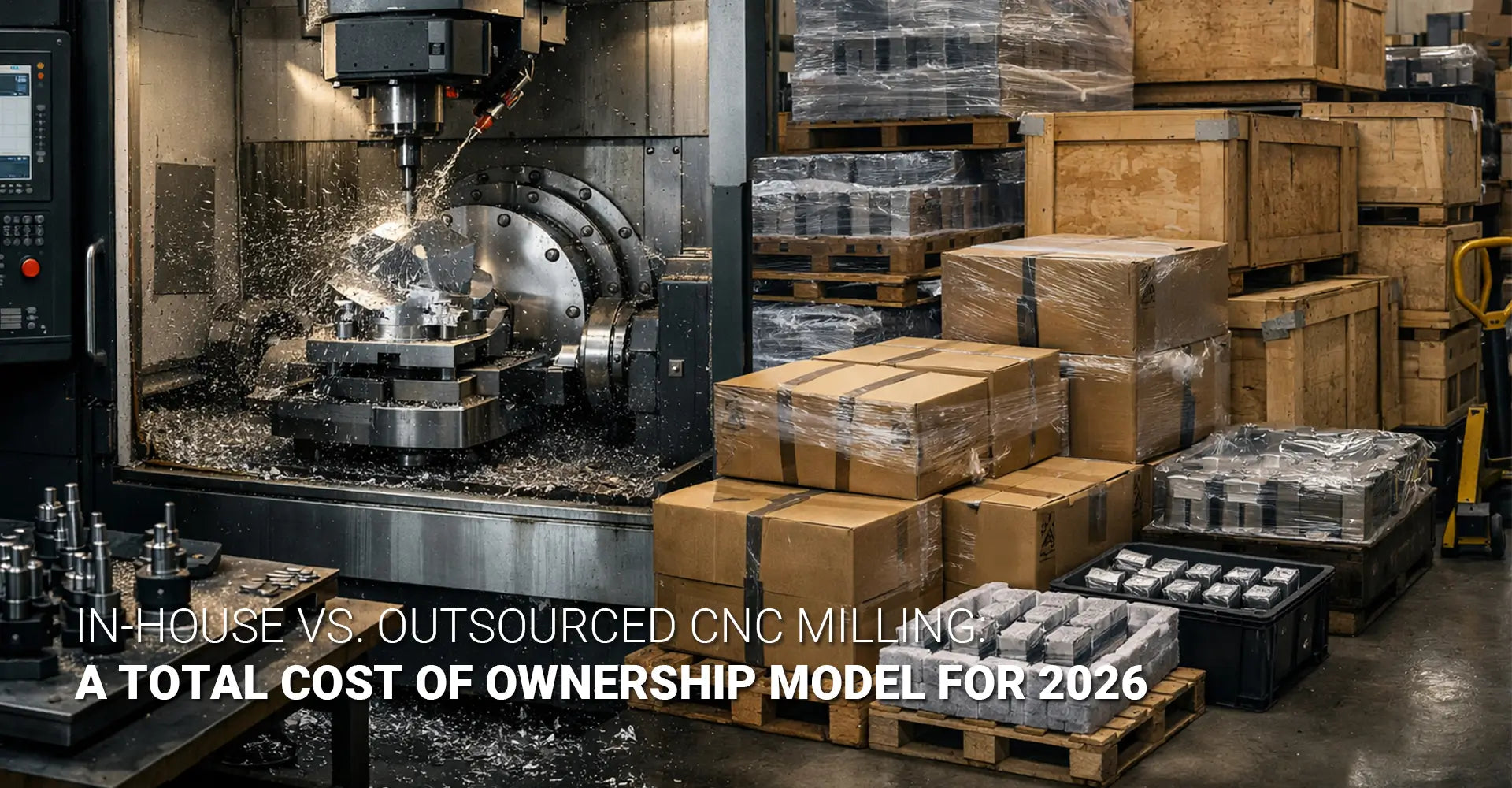
In-House vs. Outsourced CNC Milling: What's Your Shop Really Paying Per Hour in 2026?

Most shop owners look at the machine price tag. Then they sign the check. Then they spend the next five years wondering why the numbers don't add up. The sticker price is only the beginning. The real cost — depreciation, tooling, labor, floor space, and maintenance — is what kills ROI quietly, one shift at a time.
⚡ Quick Answer: Key Cost Ranges at a Glance
Before we go deep, here's what you need to know right now.
| Cost Category | In-House (5-Axis) | Outsourced |
|---|---|---|
| Machine acquisition | $250K–$420K | $0 |
| Effective depreciation rate | $17–$59/hr (by utilization) | N/A |
| Burdened labor rate | $42–$65/hr | Included in quote |
| Tooling (inserts, 5-axis) | $18–$25/hr | Included in quote |
| Consumables & nitrogen | 7–9% of machine value/year | N/A |
| Floor space cost | $7,000–$10,000/year | $0 |
| Outsourcing base rate | N/A | $72–$185/hr (varies by axis count) |
| Outsourcing landed rate | N/A | Up to $140–$160/hr all-in |
| Quality escape risk | Lower (in-house control) | $8,000–$25,000 per incident |
| Break-even utilization | 1,000–2,400 hrs/year | N/A |
Bottom line: If your annual outsourcing spend on a single machine platform exceeds $400,000–$500,000, you almost certainly need to run a formal in house vs outsourced CNC milling analysis. Everything below shows you exactly how.
So now you've seen the numbers at a glance. But numbers without context are just noise. The real question is: which option is right for your volume, your parts, and your cash flow? That answer requires walking through the full picture — used vs. new machines, invisible in-house costs, what outsourcing quotes hide, and how to calculate your actual break-even point.
Table of Contents
- Is the "Cheap Used Machine" Really Saving You Money?
- What Are the Real "Invisible" Costs of Running CNC In-House?
- Does the Outsourcing Quote Tell the Whole Story?
- How Do You Calculate Your Break-Even Point?
- Conclusion
Is the "Cheap Used Machine" Really Saving You Money?
The used machine listing looks like a deal. A late-model 5-axis at $250,000 versus $420,000 new. That's $170,000 back in your pocket. So you call the broker, run a quick inspection, and start imagining the parts flowing through.
But here's the problem: that $170,000 gap closes faster than most owners expect.
The Real 5-Year Picture on Used CNC Equipment
When evaluating used CNC machine hidden costs, here is what the broker doesn't mention:
- No warranty. Third-party coverage, if available at all, caps around $3,000. Anything beyond that is your bill.
- 15–20% higher maintenance costs over 5 years compared to new equipment. On a $250K machine, that's $37,500–$50,000 in extra spend.
- Shipping damage risk. Crashes and transport stress show up weeks after installation — not during inspection.
- Older processing technology. Slower cycle times, higher energy consumption, and less compatibility with newer CAM strategies.
"The used machine might save you $150,000 upfront. But over five years, you often pay it back in maintenance, downtime, and missed capacity."

So who should buy used? Cash-constrained startups with strong in-house mechanical talent can make it work. But for any operation that needs predictable uptime, reliable 5-axis capability, and consistent part quality, the 5 axis machine total cost of ownership math often favors new equipment over a 5-year horizon.
The lesson here is straightforward: always compare total cost, not purchase price. A machine that costs less to buy but more to run is not a bargain. It's a delayed invoice.
What Are the Real "Invisible" Costs of Running CNC In-House?
Every shop owner knows about labor and tooling. But few account for all of them together — in the same spreadsheet, at the same time, divided by actual productive hours. That's where the real hourly rate reveals itself.
Full In-House Cost Breakdown (Per Year, Per Machine)
Here are the cost categories that together determine your true machine shop hourly rate calculation:
1. Depreciation This one moves more than any other variable. At 3,500 hours/year, depreciation on a $420K machine over 10 years runs about $17/hr. At 1,000 hours/year, that same machine costs $59/hr in depreciation alone. Utilization is everything.
2. Burdened Labor A skilled CNC machinist costs $42–$65/hr fully burdened — wages, benefits, payroll taxes, and all. That rate is fixed. It doesn't go down when the machine isn't running.
3. Tooling 5-axis work is insert-hungry. Budget $18–$25/hr just for cutting tools on complex 5-axis operations. This is a real cash expense that compounds fast at scale.
4. Consumables and Nitrogen Coolant, lubricants, cutting fluids, and nitrogen (for certain machine types) run 7–9% of machine value per year. On a $420K machine, that's $29,400–$37,800 annually.
5. Floor Space Your shop floor isn't free. A 5-axis cell typically requires 400–600 sq ft. At average industrial lease rates, that's $7,000–$10,000/year — a line item most people forget entirely.
When you add all of these up at low utilization, an in-house hourly rate can easily exceed $130–$150/hr. At high utilization (3,000+ hours), that same machine might run at $65–$80/hr. The difference? Just spindle time.
This is why machine tool depreciation deserves its own line in every make-or-buy analysis. It's not a fixed number. It's a sliding scale that punishes underutilization hard and rewards consistency. Understanding your machining options before committing to capital is the most important step you can take.
Does the Outsourcing Quote Tell the Whole Story?
Short answer: no. The hourly rate on an outsourcing quote is the floor, not the ceiling. The real cost lands higher once you add every line item that follows the initial quote.
What the Quote Leaves Out
Here is a checklist of hidden adders that a standard outsourcing quote typically does not include upfront:
- Setup fees: $350–$900 per new part number
- Programming charges: $110–$160/hr if the shop handles CAM
- Material markup: 18–32% above raw material cost
- Design change fees: Common after part release
- Expedite premiums: 25–50% to jump the queue
- Freight (both ways): Often forgotten in comparisons
A shop quoting $85/hr can land at $140–$160/hr once the part arrives at your dock.
Outsourcing rate ranges by machine type:
- 3-axis shops: $72–$92/hr
- 5-axis shops: $135–$185/hr
These rates vary significantly by region, complexity, and whether the shop runs high-volume or prototype work.
Beyond price, there's quality risk. In-house, you control the process, the tooling, the inspection protocol, and the feedback loop. Outsourced, you depend on another shop's interpretation of your drawing.
One missed dimension — say, a 0.012mm tolerance read incorrectly — can scrap an entire downstream assembly. The average cost of a quality escape in aerospace supply chains: $8,000–$25,000, once you count rework, expedited shipping, inspection, and potential line-down charges.
For companies running complex or tight-tolerance parts, the quality risk premium alone may tip the math toward in-house control — even if the pure dollar cost is close. This is especially true in automotive CNC machining and industrial machinery production, where tolerance failures carry the highest downstream cost.
A rigorous outsourcing vs in-house machining cost analysis must account for this risk — not just the rate card.
How Do You Calculate Your Break-Even Point?
This is the question that resolves the entire debate. Not "which is cheaper in theory?" but "at what volume does in-house become cheaper for my specific situation?"
The Utilization Crossover That Changes Everything
Here's the core insight: the spindle utilization rate is the single biggest driver of in-house cost per hour. Low utilization means high cost. High utilization means low cost. The crossover points are:
- 3/4-axis machines: Break-even at 1,600–2,400 hours/year
- 5-axis machines: Break-even at 1,000–1,500 hours/year (higher machine cost moves this lower)
Below these thresholds, outsourcing almost always wins on pure cost. Above them, in-house wins — assuming volume is stable.
Real-world example: Two Matsuura MX-520 machines running at 3,500 hours/year paid back fully in 19 months. That's not a marketing case study. That's what consistent, high-utilization production does to the ROI curve.
![Sub-heading 4 Featured Image: Break-even chart showing in-house vs. outsourcing cost curves crossing at 1,600–2,400 hrs/year5555]
The 5-Step Decision Framework
Use this CNC machine ROI calculator framework to run your own numbers:
Step 1 — Pull your outsourcing spend by machine class List every part number. Calculate total annual hours and dollars by machine type (3-axis, 5-axis, turning).
Step 2 — Build your in-house rate at three utilization levels Run the math at 60%, 80%, and 100% of planned capacity. Your real rate will land somewhere in that range.
Step 3 — Add capital recovery Spread machine acquisition cost over 7–10 years. Include financing interest if applicable.
Step 4 — Run the crossover chart Plot in-house total annual cost vs. outsourcing total annual spend across a range of hours. Where they cross is your break-even.
Step 5 — Update every 12–18 months Material prices shift. Labor markets change. Demand fluctuates. A break-even analysis machining model that's two years old may be pointing you in the wrong direction.
Note on lights-out automation: A robotic pallet cell costing $80,000–$150,000 typically pays back in 8–14 months on batches over 200 pieces. It turns a 9-hour attended shift into 22 hours of spindle time — without adding headcount. If your parts are process-stable and your volumes are consistent, automation pushes the break-even point sharply lower.
The goal of a proper cost per part calculation is not to find a winner on paper. It's to find the crossover point specific to your volume, your parts, and your capital structure — then make a decision with actual numbers behind it. Custom CNC milling services can also bridge the gap during the transition period while you ramp in-house capacity.
Conclusion
Here's what this article has shown:
- The machine price is not the cost. Depreciation, labor, tooling, consumables, and floor space together determine your true hourly rate — and that rate swings dramatically based on utilization.
- Used machines can save money upfront — or cost more over time. The math depends on maintenance, uptime, and how many hours you actually run.
- Outsourcing quotes are starting points. Setup fees, programming, material markup, and quality escape risk push the real landed cost well above the base rate.
- The $400K–$500K annual outsourcing threshold is your trigger. If you're spending that much on work that fits a single machine platform, a formal make-or-buy analysis is overdue.
- Utilization is the lever. In-house wins at high volume and stable demand. Outsourcing wins at low volume and variable demand. A hybrid strategy — 60–75% in-house on core work, outsourcing on overflow and specialty — often outperforms both extremes.
Final takeaway: Update your model every 12–18 months. The companies that stay ahead treat capacity decisions like product design reviews — scheduled, data-driven, and willing to change direction when the numbers change.
📎 External Links & Further Reading
[In house vs outsourced CNC milling][^1]
[5 axis machine total cost of ownership][^2]
[Used CNC machine hidden costs][^3]
[Machine shop hourly rate calculation][^4]
[Outsourcing vs in-house machining cost analysis][^5]
[Break-even analysis machining][^6]
[^1]: Comprehensive cost analysis comparing in-house CNC machining vs outsourcing, including real-world case studies of aerospace, medical, and agricultural manufacturers with detailed hourly rate breakdowns and decision frameworks for 3/4/5-axis work [citation:1]
[^2]: Strategic guide to 5-axis CNC total cost of ownership covering initial investment ($300k-$1M+), 10-year maintenance costs, operator training, consumables management, and negotiation strategies for maximizing ROI [citation:8]
[^3]: Comprehensive guide from Tormach detailing the true costs of used CNC equipment including outdated controls, proprietary software no longer supported, difficulty sourcing spare parts for legacy machines, and expensive retrofitting requirements for modern machining strategies
[^4]: Detailed step-by-step methodology for calculating CNC hourly rates with formulas for fixed costs (depreciation), variable costs (labor, power, tooling), overhead allocation, and utilization adjustments—includes academic references and industry examples from aerospace and automotive sectors
[^5]: Comprehensive total-cost framework comparing in-house vs outsourced CNC machining with real-world case studies (aerospace titanium, medical prototyping) and detailed crossover analysis showing breakeven points at 1,600–2,400 hours/year for 3/4-axis work including hidden costs like floor space, coolant management, and quality escapes [citation:1]
[^6]: ROI calculator methodology for prototype manufacturing decisions with specific breakeven thresholds (400–500 prototypes/year per machine), labor economics breakdown (fully burdened rates $42–$90/hour), and comparative analysis of in-house 3D printing vs outsourced CNC machining [citation:3]
For companies evaluating their machining capacity strategy in 2026, the decision framework above provides a starting point — but every situation requires its own numbers. Run the model with your actual hours, your actual rates, and your actual parts.