Rapid Sheet Metal Prototyping: Can You Get a Functional Enclosure in Under 7 Days?
Rapid Sheet Metal Prototyping: Can You Get a Functional Enclosure in Under 7 Days?

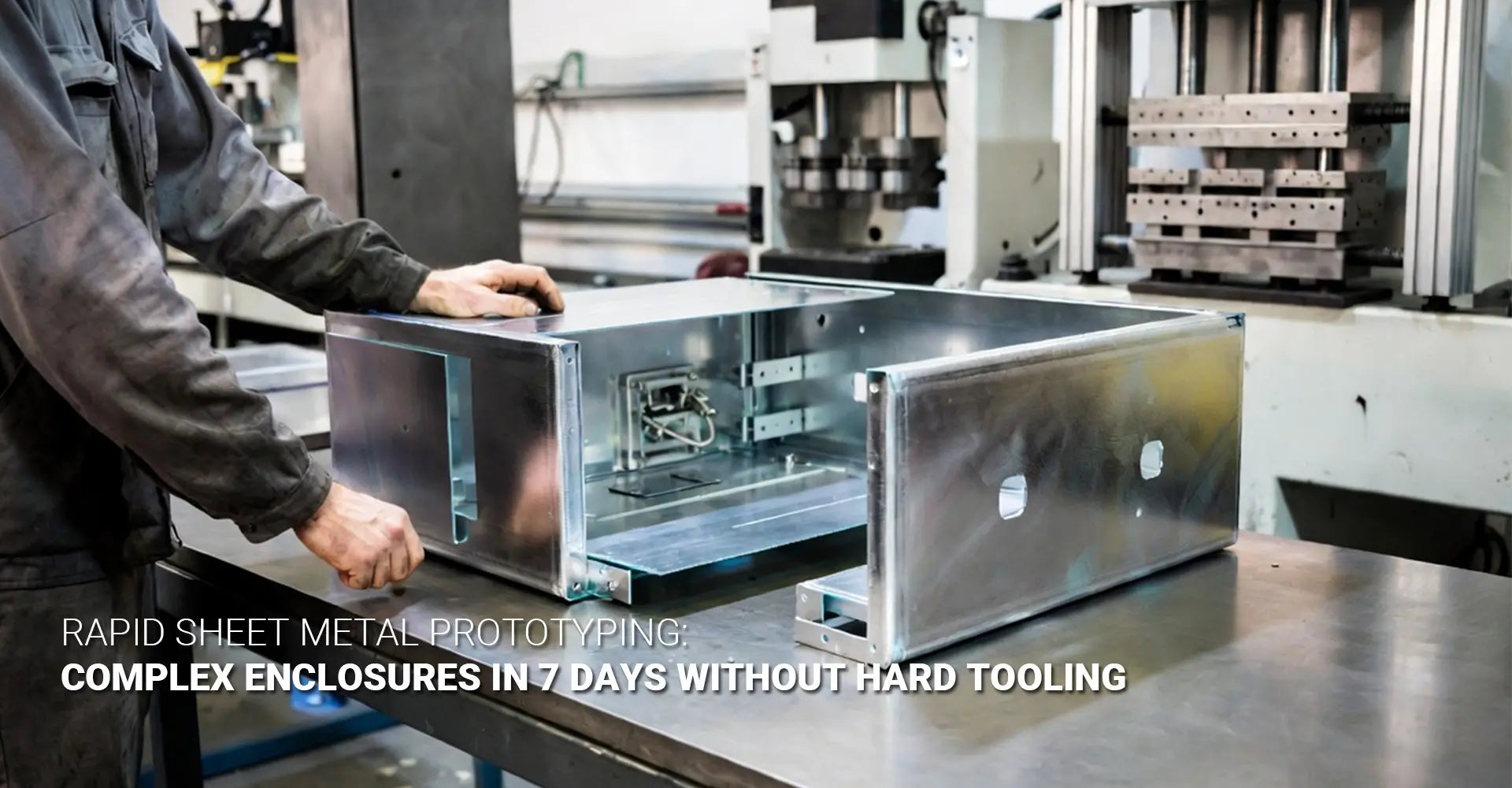
Most product teams bleed weeks — sometimes months — waiting for hard tooling to arrive. Your design is ready. Your investors want a demo. Your engineers need to run fit-and-function tests. But the enclosure? Still in a queue somewhere. This is one of the most common and most painful bottlenecks in hardware development. The good news is that it no longer has to be this way. Rapid sheet metal prototyping has changed the timeline entirely — and the results are production-quality, not "close enough."
Quick Answer: Yes — using CNC bending and soft tooling stamping, you can receive fully functional, production-grade sheet metal enclosures in as little as 6 business days. No hard tooling required. Costs start at a fraction of production tooling investment. Parts are made from your exact specified material, with your finish, to production-level tolerances.
| Method | Lead Time | Tooling Cost | Best For |
|---|---|---|---|
| CNC Bending | 3–7 days | $0 die cost | Complex bends, low qty |
| Soft Tooling Stamping | 7–14 days | $2,000–$5,000 | 10–500 units |
| Hard Tooling Stamping | 8–12 weeks | $15,000–$50,000+ | 500+ units |
So why do so many engineering teams still default to hard tooling too early? Often, it comes down to a lack of awareness about what soft methods can actually deliver. In this guide, we break down exactly how rapid sheet metal prototyping works — covering the tooling decision framework, CNC bending capabilities, soft tooling stamping options, material choices, and the real cost math behind it all. By the end, you will know exactly which method fits your project — and when to make the switch to production.
Table of Contents
- What Is the "Prototype Paradox" in Sheet Metal Enclosure Development?
- How Does CNC Bending Deliver Complex Geometries Without Dies?
- When Does Soft Tooling Stamping Make More Sense Than CNC Bending?
- What Materials and Finishes Are Available in Rapid Sheet Metal Prototyping?
- Conclusion & Decision Framework
What Is the "Prototype Paradox" in Sheet Metal Enclosure Development?
There is a frustrating catch-22 at the heart of hardware development. You need a working enclosure to validate your product. But production tooling — the kind that makes enclosures at scale — costs a fortune and takes months to build. So you are stuck: you cannot fully validate without parts, and you cannot justify production investment without validation. This is the prototype paradox, and it affects product teams across every industry, from consumer electronics to industrial machinery.
The core problem in three lines:
- Hard tooling costs $15,000–$50,000+ and takes 8–12 weeks to build.
- Your design will almost certainly change after first-article testing.
- Committing to hard tooling before validation is a high-cost gamble.
What is the smarter path? Use sheet metal prototype services that rely on soft methods — CNC bending and soft tooling dies — to deliver functional enclosures first. Then commit to hard tooling only after your design is locked.
The financial risk of early hard tooling commitment goes beyond the upfront cost. Consider this scenario: you invest $20,000 in a stamping die for your enclosure. Three weeks into testing, your thermal team discovers the vent placement needs to move 15mm. Now your $20,000 die is a paperweight, and you are starting over.
With short run sheet metal methods, this is not a crisis — it is just a programming update or a modified soft die insert. Low volume sheet metal fabrication is specifically designed for this phase of development. It assumes iteration. It prices in change. And it keeps your project moving forward without a catastrophic budget hit every time a design revision happens.
Here is why this matters beyond just cost:
- Speed compounds. A faster prototype cycle means more iterations in the same calendar time. More iterations mean a better final product.
- Confidence compounds. When you commit to production tooling after validated prototypes, you commit with data — not hope.
- Risk shrinks. Every dollar spent on prototyping is insurance against a much larger production mistake.
The prototype paradox is real. But it has a well-tested solution.
How Does CNC Bending Deliver Complex Geometries Without Dies?
When most engineers hear "no dedicated tooling," they assume a tradeoff in part quality or geometric complexity. That assumption is wrong. Modern CNC bending prototyping uses press brakes with multi-axis backgauges, programmable crowning systems, and offline simulation software to execute bend sequences that rival — and often match — what stamping dies produce. The key insight is this: the tooling is in the machine, not in a custom die.
What CNC bending can achieve:
- Tolerances of ±0.1mm on bend angles and hole-to-feature relationships
- Bend sequences with 6+ individual bends on a single part
- Full electronics chassis, server enclosures, and multi-flange brackets — without a single custom die
- Quick turn sheet metal fabrication turnaround of 3–7 business days from CAD file to finished part
Ideal applications:
- Multi-bend electronic enclosures
- Server and rack chassis
- Mounting brackets with complex flange geometry
- Custom panels with tight dimensional requirements

The real power of CNC bending for custom enclosure prototyping lies in programmability. A skilled CNC press brake operator does not build a die for your part — they build a program. That program defines the exact bend sequence, the back-gauge position for each step, the tonnage required, and the springback compensation for your specific material and thickness.
For automotive enclosures and brackets, where material grades vary and tolerances are tight, this programmability is critical. A single press brake can handle 16-gauge cold-rolled steel in the morning and 0.063" 5052 aluminum in the afternoon — no changeover cost, no retooling delay.
Here is what makes a geometry "CNC bending friendly":
- Consistent bend radii — matching your standard tooling radius set
- Adequate flange length — enough material for the back-gauge to register against
- Logical bend sequence — bends that don't collide with the machine as the part forms
- Standard material — CRS, galvanneal, stainless, or aluminum in common gauges
What CNC bending does not excel at: deep drawn features, embossed logos, and high-volume repetition where a stamping die would be faster per part. For those features, soft tooling enters the picture.
When Does Soft Tooling Stamping Make More Sense Than CNC Bending?
CNC bending is excellent for complexity and flexibility. But when your design stabilizes and your quantities move into the 10–500 unit range, soft tooling stamping often becomes the better choice. It delivers higher consistency across a batch, handles certain formed features more cleanly, and can be more cost-effective per part at moderate volumes. Understanding when to switch — and when to combine both — is a skill that separates experienced prototype engineers from beginners.
Soft tooling defined: Soft tooling uses lower-cost die materials — aluminum alloy, kirksite (a zinc alloy), or even 3D-printed polymer inserts — instead of hardened tool steel. This makes dies:
- Faster to build: 2–4 weeks vs. 8–12 weeks for hard tooling
- Cheaper to make: $2,000–$5,000 vs. $15,000–$50,000+
- Easier to modify: inserts can be machined or replaced without scrapping the whole die
- Limited in lifespan: typically 500–5,000 parts before wear becomes an issue
For prototype to production sheet metal workflows, soft tooling is often the perfect bridge — close enough to production intent to validate the design, but flexible enough to allow late-stage changes.

The most sophisticated rapid prototyping enclosure projects do not choose between CNC bending and soft tooling — they use both. This hybrid approach assigns each method to what it does best:
- Soft tooling handles features that benefit from a die: consistent embosses, louvers, dimples, or formed flanges that repeat identically across all 200 parts.
- CNC bending handles the surrounding geometry: the main box shape, the mounting flanges, any features that might still be in flux.
This combination gives you the per-part consistency of stamping where you need it and the design flexibility of CNC bending where you need that. It is the approach most experienced fabricators recommend for enclosures in the 50–300 unit range.
One more scenario where soft tooling wins clearly: iterative prototyping sprints. Because aluminum dies can be modified — new holes added, radii adjusted, features removed — you can run three or four design iterations without building a new die from scratch each time. Some fabricators offer structured sprint programs where they build one soft die, run a batch, collect your feedback, modify the die, and run again — all within a few weeks.
What Materials and Finishes Are Available in Rapid Sheet Metal Prototyping?
One of the most persistent myths about sheet metal prototyping is that you have to compromise on material or finish. Engineers assume that "fast" means "approximate" — that they will get a part that looks like their design but is not made from production-spec material. This is simply not true with a capable fabricator. The sheet metal prototype cost may be higher per part than production, but the material, the thickness, and the finish can all match production intent exactly.
Common materials available for rapid prototyping:
- Cold-Rolled Steel (CRS) — 18ga, 16ga, 14ga; excellent for enclosures and chassis
- Galvanneal — CRS with zinc-iron coating; weldable, paintable, corrosion-resistant
- 304 & 316 Stainless Steel — food-grade and industrial applications
- 5052 & 6061 Aluminum — lightweight enclosures, thermal management parts
Finishing options:
- Powder coating — any RAL color, multiple textures
- Zinc, nickel, or chrome plating
- Anodizing (for aluminum)
- Silk screen printing and laser engraving for labeling

Material selection in prototyping is not just about replicating production specs — it is also about getting accurate test data. If your production part will be 16-gauge CRS powder-coated in RAL 9005 matte black, your prototype should be exactly that. Testing a prototype made from a different material or gauge gives you unreliable data on weight, stiffness, thermal behavior, and fit.
Here is a practical finishing guide for prototype quantities:
| Finish | Min Quantity | Lead Time Added | Notes |
|---|---|---|---|
| Powder Coat | 1 piece | +2–3 days | Full color matching available |
| Zinc Plating | 5 pieces | +3–5 days | Corrosion protection |
| Anodize (Type II) | 1 piece | +2–4 days | Aluminum only |
| Nickel Plating | 5 pieces | +4–6 days | EMI shielding applications |
| Laser Engraving | 1 piece | +1 day | Part numbers, logos, labels |
One important consideration: surface finish affects tolerances. Powder coating adds approximately 0.003"–0.006" per surface. If you have tight clearances between mating parts, communicate this to your fabricator upfront. A good sheet metal fabrication partner will account for coating thickness in the flat pattern and ensure your finished, coated part still meets dimensional requirements.
Conclusion & Decision Framework
Summary
Rapid sheet metal prototyping is not a workaround. It is a deliberate strategy for managing risk, compressing timelines, and delivering better products. Here is the decision framework in plain terms:
Under 50 units? → Use CNC bending for complex geometry. Zero tooling cost. 3–7 day lead time. Full material and finish options.
50–500 units? → Evaluate soft tooling stamping or a hybrid CNC + soft tooling approach. $2,000–$5,000 tooling investment. Production-like consistency. Design can still be modified.
500+ units? → Run the amortization math on hard tooling. At this volume, the per-part savings from hard tooling begin to offset the $15,000–$50,000 upfront investment.
Key Takeaways
- Hard tooling too early is one of the most expensive mistakes in hardware development. It locks your design before it is ready.
- CNC bending delivers ±0.1mm tolerances on complex enclosures with zero die cost and 3–7 day turnarounds.
- Soft tooling bridges prototype and production for 10–500 unit runs at a fraction of hard tooling cost.
- Hybrid approaches — CNC forming plus soft stamped features — give maximum flexibility for complex assemblies.
- Material and finish do not have to be compromised. Prototype in exactly the same spec as production.
- >>To get a quote, provide: STEP file, material spec, quantity, finish requirements, and your timeline. A capable fabricator responds within 24 hours.
External Links & Recommended Resources
[Rapid sheet metal prototyping][^1]
[sheet metal prototype services][^2]
[Low volume sheet metal fabrication][^3]
[CNC bending prototyping][^4]
[Soft tooling stamping][^5]
[Prototype to production sheet metal][^6]
[^1] This technical resource from Protolabs, a leading US digital manufacturer, provides detailed insights into rapid prototyping advantages, material selection, and 3-day lead time capabilities for custom metal components.
[^2] A comprehensive service page by Xometry that outlines their industrial-grade sheet metal prototyping process, including DFM feedback, instant quoting, and support for complex geometries across various industries.
[^3]: Discusses Flexform™ technology for low-volume sheet metal forming, ideal for prototypes and development components in various alloys, with case studies from Ford and the jet engine industry [citation:1].
[^4]: Introduces the HotBend 35, a CNC machine that brings sequential metal tube bending technology to the plastic sector for flexible prototype production [citation:2].