How Does Die Casting Surface Finishing Stop Coating From Peeling Off Stand Mixer Beaters?
How Does Die Casting Surface Finishing Stop Coating From Peeling Off Stand Mixer Beaters?
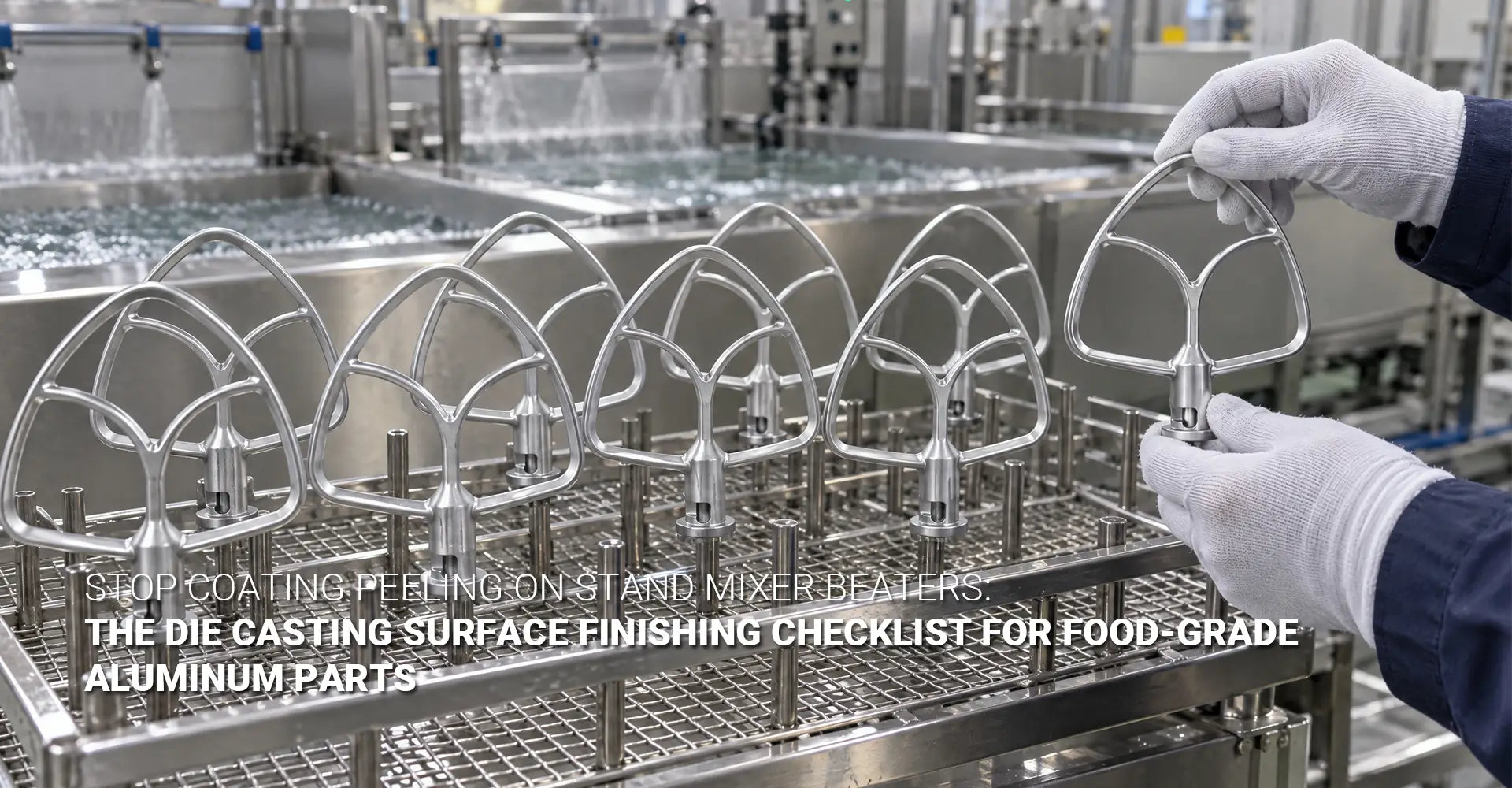
A new stand mixer beater looks perfect out of the box. The coating is smooth, shiny, and slick. Then, after a few weeks, tiny flakes show up in the batter. Soon, bare gray metal appears. This pattern sits behind most reports of coating peeling dishwasher users complain about, and it hurts a brand fast. Returns rise, reviews turn sour, and buyers stop trusting the product. Many teams blame the paint. However, the real cause usually starts much earlier, at the raw casting. In stand mixer beater manufacturing, the coating is only as strong as the surface under it. This guide shows you where peeling starts, how to stop it, and how to prove it with tests. It is written for buyers of kitchen appliances who want clear answers fast.

Coating peels off stand mixer beaters mainly because the aluminum casting was not prepared well. Leftover mold release agent, tiny surface pores, and oxide layers stop the coating from gripping the metal. The fix is a clean, etched, and sealed surface, followed by a coating that passes the ASTM D3359 coating adhesion test with a rating of 4B or better.
Key Takeaways
| Question | Quick Answer |
|---|---|
| What causes peeling? | Poor surface prep on the aluminum casting |
| What are the top three culprits? | Mold release agent, surface pores, and oxide layers |
| What is the best fix? | Clean, etch, add a conversion layer, then dry and handle with care |
| Which coatings work? | PTFE, ceramic, or epoxy, all meeting FDA rules |
| What adhesion score should you require? | 4B or better on the ASTM D3359 scale |
| How many wash cycles should a part survive? | 50 to 100 dishwasher cycles with no peeling |
| How many parts should you test? | 3 to 5 parts per batch or per shift |
Now you have the short answer. Next, we will follow the beater from raw casting to finished part. First, you will see why aluminum is hard to coat. Then, we will walk through pre-treatment, coating choices, and testing rules. Along the way, you will learn what a good food grade coating for aluminum parts needs from the metal beneath it. Finally, you will get a checklist that you can copy into your own purchase documents.
[Table Of Content]
- Why Does Aluminum Die Casting Coating Adhesion Fail So Often?
- Which Pre-Treatment Steps Come Before the Coating Goes On?
- Which Food-Grade Coating Fits a Stand Mixer Beater Best?
- How Can a Supplier SOW Coating Spec Prevent Peeling Before Shipment?
- Conclusion
Why Does Aluminum Die Casting Coating Adhesion Fail So Often?
Aluminum looks easy to coat. It is light, smooth, and clean to the eye. In truth, cast aluminum is a tricky base. The casting process leaves traces that you cannot always see. For this reason, aluminum die casting kitchen appliance parts need extra care before any coating goes on. A beater faces hot water, strong soap, and constant flexing. So, even a small flaw at the surface can grow into a large peeled patch.
Adhesion fails for three main reasons. First, release agent residue blocks the bond between metal and coating. Second, tiny pores trap oils and moisture under the film. Third, a thin oxide layer forms on the aluminum and weakens the grip. If any of these stay on the surface, the coating sticks to dirt instead of metal.
Let’s look at each cause more closely.
Mold release agent. Workers spray a release agent into the die so the part pops out easily. However, extra spray can stay on the casting. Because of this, the coating bonds to a greasy film and not to the metal. During a wash, hot water and soap soften that film. As a result, the coating lifts off in sheets.
Surface pores. Die casting porosity creates tiny holes and cracks at the surface. These holes trap oil, leftover release agent, and water. At first, the coating bridges over them and looks fine. Later, dishwasher heat makes the trapped material expand or give off gas. That pressure pushes the coating up and forms blisters.
Oxide layers. Aluminum grows a thin oxide skin within minutes of air exposure. This skin can be uneven and weak. Also, plain washing does not remove it fully. Therefore, cleaning alone is not enough. The surface must also be etched and treated, as the next section explains.
Not sure where your own failures began? Use this quick check on a peeled beater:
- Coating fault: Peeling starts at edges, scratches, or worn spots. The coating may blister or flake in thin sheets.
- Casting fault: Peeling spreads in wide, even patches. You may see a greasy film or dark spots on the back of the peeled piece. The bare aluminum may look rough or pitted.
If the exposed metal looks dirty or pitted, the casting prep is the likely cause. On the other hand, if the metal looks clean and even, look at the coating material or the curing step instead.
Which Pre-Treatment Steps Come Before the Coating Goes On?
Most peeling is won or lost before the coating ever touches the part. Good surface finishing is a chain of steps, and each step has a job. If one link breaks, the whole chain fails. In addition, many beaters have small machined areas, such as the shaft socket. These features should go through the same cleaning line as the cast surfaces. Parts made with aluminum CNC machining often carry cutting oils that must also be removed.
A strong pre-treatment line has four steps. First, degrease and clean with an alkaline bath. Second, etch the surface to remove the oxide skin. Third, apply a thin conversion layer. Fourth, dry the part and handle it with care. Skipping even one step raises the risk of peeling.
Here is what each step does and why it matters.
- Degreasing and alkaline cleaning. This step removes oils, grease, mold release agent, and loose dust. It is the first line of defense. If oil stays on the part, no later step can fix it.
- Etching and surface activation. Next, a mild etch removes the weak oxide skin. It also leaves a fresh, even aluminum surface. This clean surface gives the coating something to grip.
- Conversion layer. After etching, a thin chemical film forms on the metal. This film is stable, and it bonds well with both the aluminum and the coating. It also slows new oxide growth.
- Drying and controlled handling. Finally, the part must dry fully and stay clean. Workers should wear clean gloves. Also, parts should not sit around for long before coating. A fingerprint or a damp spot can undo all the earlier work.
Step three deserves a closer look. The conversion coating aluminum parts receive acts like a primer for the whole system. It does not replace cleaning, though. It works only on a surface that is already clean and active.
Some castings still have deep pores after cleaning. In these cases, sealing the pores can help. Sealing adds cost, so it is worth asking for only when the part shows heavy pitting. For a beater that sees daily dishwasher use, though, the extra step often pays for itself in fewer returns.
One more tip: ask your supplier how long parts wait between cleaning and coating. A short, controlled gap is a good sign. A long, unplanned gap is a warning.
Which Food-Grade Coating Fits a Stand Mixer Beater Best?
Once the metal is ready, you must pick the right coating. The best choice depends on how the beater is used, washed, and handled. Also, coating thickness matters as much as the material. A film that is too thin leaves pores uncovered. A film that is too thick can crack or chip. So, choosing the right range is just as important as choosing the right type.
Three coatings are common on beaters: PTFE, ceramic, and epoxy. Each one must meet the rules for an FDA food contact coating, such as 21 CFR 175.300. Here is a quick comparison.
| Coating | Main Strength | Main Weakness | Typical Film Thickness |
|---|---|---|---|
| PTFE | Excellent non-stick feel | Soft and easy to scratch | 15–30 µm |
| Ceramic | Hard and heat resistant | Can feel less slick | 20–40 µm |
| Epoxy | Lower cost and good grip | Weaker non-stick and heat resistance | Follow the data sheet |
Now let’s dive into the details of each option.
PTFE. PTFE coating aluminum parts is popular because food slides off so easily. Batter, dough, and frosting rinse away with little effort. However, PTFE is soft. Metal spoons and rough sponges can scratch it. Because of this, PTFE suits homes where users follow the care rules. It is also wise to test it hard in the dishwasher before you approve it.
Ceramic. Ceramic coatings are harder than PTFE. They resist scratches and handle high heat well. Many brands sell them with names like “diamond” or “mineral.” That said, they can feel less slick over time. They also need a very clean, well-prepared surface, because a hard film can crack if the base is weak.
Epoxy. Epoxy costs less and bonds well to treated aluminum. It works for budget lines. However, it offers less non-stick performance and lower heat resistance. As a result, it fits best where price matters more than long-term feel.
Why is thicker not always better? A heavy film holds more stress inside it. When the part heats and cools, that stress can crack the film. Cracks let water in, and then the coating peels from below. On the other hand, a very thin film may not cover pores. The smart move is to set a film thickness range on your drawing. Then, check it with a thickness gauge on real parts.
Whichever coating you choose, ask for a written FDA compliance record. Also, remember that the coating brand is rarely the main problem. The surface under it matters more.
How Can a Supplier SOW Coating Spec Prevent Peeling Before Shipment?
Peeling is a process problem, so your paperwork must control the process. A clear SOW turns quality from hope into proof. It tells the supplier what to do, how to check it, and what counts as a pass. It should also call for a dishwasher durability test, because a lab bench cannot copy real kitchen life. Hot water, strong soap, and long cycles reveal weak bonds fast.
The cross-hatch adhesion test is the quickest proof of a strong bond. A tester cuts a grid through the coating down to the metal. Then, the tester presses tape over the grid and pulls it off. Finally, the tester compares the grid to a chart. The rating runs from 0B, which means total failure, to 5B, which means no coating came off.

A good SOW leaves no room for guessing. Here is a checklist you can copy:
- Alloy: Name the alloy, such as ADC12, A356, or a food-safe equivalent.
- Pre-treatment: List each step, including degreasing, alkaline cleaning, etching, and the conversion layer.
- Coating type and film thickness: State PTFE, ceramic, or epoxy. Give a thickness range, such as 15 to 40 µm, based on the coating data sheet.
- Adhesion: Require ASTM D3359 with a minimum rating of 4B.
- Wash durability: Require 50 to 100 dishwasher cycles with no peeling or blistering.
- Food safety: Require FDA compliance papers for the coating.
- First article checks: Ask for size, film thickness, adhesion, and wash results on the first sample parts.
- Batch sampling: Test 3 to 5 parts per batch or per shift, and reject any batch that scores below 4B.
Testing timing matters too. Run the grid cut on fresh parts. Then, run it again on parts that finished the wash cycles. A coating that passes only when new may still fail in a customer’s kitchen.
What about corrosion tests? A salt spray test, which follows ASTM B117, checks how well a coating resists corrosion. It does not prove food safety or wash life. For a beater that is rinsed and dried at home, it may add little. Still, some suppliers use it as a quick screen for coating flaws. Treat it as a bonus and never as a replacement for adhesion and wash tests.
Finally, watch for red flags during audits and visits:
- The supplier cannot name every pre-treatment step.
- No one records the adhesion rating for each batch.
- Parts wait a long time between cleaning and coating.
- The supplier points to the coating brand as proof of quality.
- Peeled samples show greasy film or pitted metal underneath.
Any one of these signs means adhesion risk is high. Therefore, ask for fixes before you place a large order.
Conclusion
Coating failure on stand mixer beaters is not a mystery. It is a process control problem that starts at the casting surface. Leftover release agent, pores, and oxide layers stop the coating from bonding. A clean, etched, and treated surface solves most of that. After that, the right coating, a tight film thickness range, and clear tests close the gap.
Here is the plan in short form:
- Know the causes: Release agent, pores, and oxide layers weaken the bond.
- Fix the surface: Degrease, etch, add a conversion layer, then dry and handle with care.
- Pick the right coating: Match PTFE, ceramic, or epoxy to real use, and confirm FDA compliance.
- Prove it with tests: Require 4B or better on ASTM D3359 and 50 to 100 dishwasher cycles with no peeling.
- Write it down: Put every rule into your SOW so the supplier cannot guess.
Does this really work? One maker cut peeling complaints by 80% after adding three things: pre-treatment checks, adhesion tests, and dishwasher tests. Before that, the team had no way to verify surface prep, and it relied only on the coating brand. Next, ask your supplier for a first article inspection coating report. It should show size, film thickness, adhesion rating, and wash results before mass production starts. Then, keep the batch checks running so that quality stays steady.
Take one more step today. Audit your supplier’s full surface chain, from casting to coating to test records. Catch weak spots with ASTM D3359 before your customers do.
Recommended External Links
- ASTM D3359: Standard Test Methods for Rating Adhesion by Tape Test
- ASTM B117: Standard Practice for Operating Salt Spray (Fog) Apparatus
-
21 CFR 175.300: Resinous and Polymeric Coatings (eCFR)
[aluminum die casting coating adhesion][^1]
[food grade coating for aluminum parts][^2]
[PTFE coating aluminum adhesion][^3]
[ASTM D3359 coating adhesion test][^4]
[conversion coating aluminum][^6]
[^1]: Element Materials Technology provides a failure analysis case study of powder coat nonbonding on an aluminum die casting. The analysis identifies organic acid salts, hydrocarbon oils, and silicone on the diecast surface as the root cause of adhesion failure. The document explains that excess die lubricants act as a physical barrier at the molecular level, preventing proper bonding between the powder coat and the casting surface.
[^2]: Lorin Industries, a US-based leader in coil anodized aluminum, presents ClearMatt® anodized aluminum which meets NSF 51 guidelines for primary food contact. The anodized surface is molecularly bonded to the aluminum, meaning it will not chip, flake, or peel, and its sapphire-hard surface creates an anti-microbial finish that minimizes contaminant transfer, making it ideal for food surfaces in appliances including coffee makers and refrigerator fronts.
[^3]: A 2021 academic conference paper that investigates the enhancement of scratch resistance and hardness of PTFE coatings on aluminum using additives like boron carbide, titanium diboride, and silicon carbide. The study specifically uses the **ASTM D3359 cross-cut adhesion test** to evaluate coating adhesion to the metal surface.
[^4]: A detailed explainer from the ANSI Blog that breaks down the two test methods within ASTM D3359-23. It clearly describes how Test Method A uses an X-cut and Test Method B uses a lattice (crosshatch) pattern of six or eleven cuts in each direction, with adhesion rated on a 0 to 5 scale.
[^5]: This peer-reviewed Elsevier study investigated the effect of melt cleanliness on porosity formation in automotive aluminum high-pressure die castings under actual industrial production conditions at Nissan Casting Australia. It identifies three types of porosity—gas porosity (caused by trapped air, steam, and burning products of organic lubricants), shrinkage porosity (from premature gate solidification), and flow porosity (from insufficient pressure toward the end of cavity filling)—and demonstrates that the probability of casting rejection due to excessive porosity increases as the number of inclusions in the melt increases.
[^6]: A ScienceDirect topic page providing a comprehensive overview of chromate conversion coatings. It explains that these coatings are achieved by immersion and electrochemical processes, using hexavalent chromium (VI) or trivalent chromium (III), and are employed on aluminum, zinc, tin plate, copper, cadmium, magnesium, and zinc-plated surfaces to impart brightness and improve corrosion resistance. Major reasons for widespread use include the self-healing nature of the coating, ease of application, high electrical conductivity, and high efficiency-to-cost ratio.