Swiss Turning vs. Mill-Turn: How Do You Choose the Right Process for Precision Machined Components?
Swiss Turning vs. Mill-Turn: How Do You Choose the Right Process for Precision Machined Components?
A shaft that costs $2 on the right machine can cost $3 or more on the wrong one. That gap usually has nothing to do with bad machining. It comes from sending a part to a process that was never built for its size or shape. Every turned part has just two numbers that matter most at the start: diameter and length. Those numbers decide which machine should touch the part first. Get the match right, and cost drops. Get it wrong, and someone pays for capability nobody ever used. This guide walks through the filters that matter, then shows how cost and part shape settle everything else.

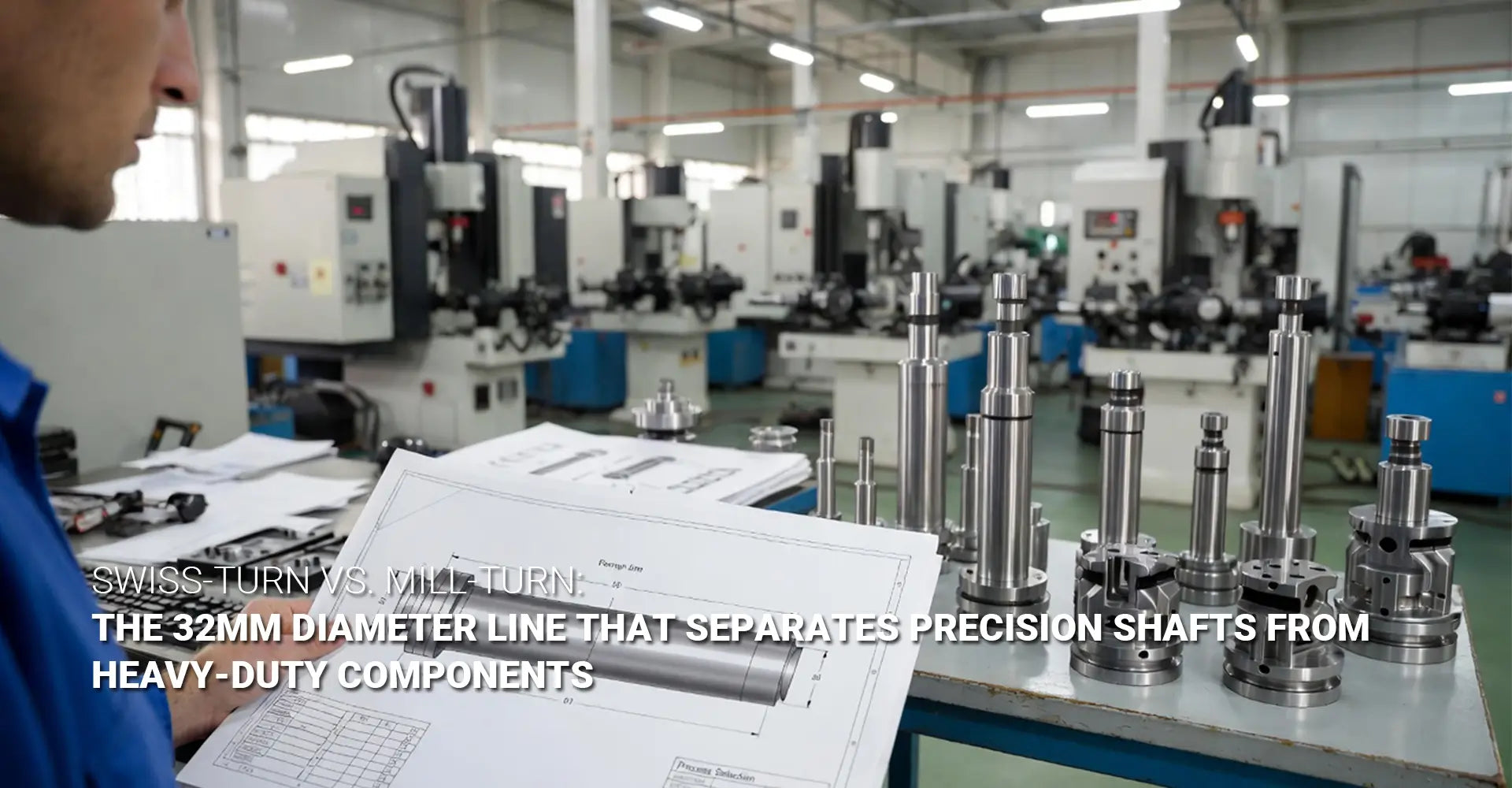
Here is the short answer, right up front. Swiss turning fits diameters under 32mm, especially when the part's length runs at least five times longer than its diameter. Mill-turn handles larger diameters, thick blocks, forgings, and parts with complex 3D shapes. If a part is small, long, and needs tight tolerance, Swiss usually wins. If a part is large or geometrically complex, mill-turn usually wins. That single rule solves most CNC turning process selection questions before a single quote even comes back.
Knowing the short answer helps with the easy cases. But real parts rarely stay easy for long, and a Swiss turning vs mill turn decision needs more than one rule of thumb to hold up under pressure. Diameter and length only make up the first two filters. Volume and part features often flip the decision, so it helps to walk through each layer one step at a time before locking in a supplier.
Table of Contents
- What Diameter Limit Decides Between Swiss and Mill-Turn?
- Why Does the Length-to-Diameter Ratio Decide Your Process?
- How Much Can Machine Choice Change Your Per-Part Cost?
- Which Process Wins for Larger Diameters and Complex Shapes?
What Diameter Limit Decides Between Swiss and Mill-Turn?
A sliding headstock lathe, better known as a Swiss-type lathe, was built around one goal: holding thin bar stock steady while it spins at high speed. That single design choice sets a hard ceiling on how large a part can get before the machine stops making sense.
So where does that ceiling sit? Most Swiss machines top out at a bar diameter 32mm (1.25 inches), though a few larger models stretch to 38mm or even 51mm in bushing-less mode. The real sweet spot for tight tolerance work sits between 5mm and 20mm. Anything wider than that range usually belongs on a different machine entirely.
Why does 32mm act as such a firm wall? The answer sits inside guide bushing machining. A guide bushing supports the bar stock right at the cutting tool, only millimeters away from where metal is actually removed. Because the bushing holds material so close to the cut, the part barely flexes, even at high spindle speeds. This support system works beautifully on thin stock. However, it turns into a real constraint once diameter grows, since the bushing bore has a fixed size and pushing larger stock through it strains the mechanism instead of steadying it. That is the true reason Swiss shops draw their line near 32mm. Buyers sourcing turned shafts, pins, and small housings can review typical diameter ranges and tolerance capability on Hotean's CNC turning page before locking in a process.
Why Does the Length-to-Diameter Ratio Decide Your Process?
Diameter alone does not tell the whole story. A short, fat part and a long, thin part can share the exact same diameter yet need completely different machines. That is where a second number steps in, and it often matters more than diameter by itself.
The rule of thumb is simple: once a part's length reaches five times its diameter, Swiss turning should go on the table. Skilled shops push that ratio even further, running parts at 20:1 or even 25:1 without losing straightness. Below that ratio, a standard lathe usually handles the job just fine.
Picture an 8-inch-long shaft that measures only a quarter inch across. That works out to an L/D ratio near 32:1. On a conventional lathe, a shaft that thin would whip and bend the moment the cutting tool touched it, ruining straightness and surface finish in seconds. A Swiss guide bushing solves that problem by supporting the bar right where the cut happens, which keeps deflection under control even at extreme ratios. Because of this, industries that rely on long, slender shafts, pins, and connectors — automotive fuel systems and sensor housings among them — often specify Swiss turning by default. Buyers sourcing these kinds of components can browse typical part types on Hotean's automotive machining page for reference.
How Much Can Machine Choice Change Your Per-Part Cost?
A higher hourly rate scares off a lot of buyers before they even look at the math. Swiss machines often carry a rate close to mill-turn centers, so it's easy to assume the cost per part lands somewhere near equal too. That assumption turns out to be wrong more often than not.
At production volume, Swiss CNC cost per part typically runs 30% to 50% lower than the same part made on a conventional lathe. The savings come from cycle time, not the hourly rate itself. A Swiss machine finishes small parts so quickly that the shorter cycle more than makes up for its similar hourly cost.
Setup on a Swiss machine takes longer than setup on most other lathes, and that upfront cost only pays off once volume climbs. Shops generally recommend Swiss turning once an order reaches 10,000 units or more, since that's where the setup investment spreads thin enough to matter. Below that volume, mill-turn often wins simply because its setup is quicker and less involved. This is exactly why buyers sourcing high-volume precision parts for pumps, gearboxes, and other repeat-order equipment tend to land on Swiss turning once quantities climb. Component buyers working on repeat-order industrial equipment can find relevant sourcing details on Hotean's industrial machinery page.
Which Process Wins for Larger Diameters and Complex Shapes?
Not every part fits neatly inside the Swiss diameter window. Some components start life as a forging, a thick block, or a shape that bends in three directions instead of just spinning around one axis. Those parts need a different kind of machine altogether.
A mill-turn center, sometimes called a multi-tasking turning center, handles diameters up to 300mm or even 500mm, along with irregular surfaces that a Swiss lathe simply cannot reach. These machines trade the tight diameter ceiling of Swiss turning for far greater shape freedom.
Mill-turn strength shows up clearest on parts with cross-holes, milled flats, and threads that all need to sit on the same component. Live tooling stations and sub-spindles let the machine switch between turning and milling without ever unclamping the part. That means one-setup complete machining from raw stock to finished geometry, cutting out the tolerance stack-up that comes from moving a part between separate machines. For parts with pockets, flats, or milled features that go beyond simple turning, Hotean's custom CNC milling services page covers the added capability needed. Material choice also plays into this decision, since some metals and plastics machine more predictably on one process than the other — a comparison worth checking on Hotean's CNC metals and plastics page before finalizing a spec.
Before signing off on either process, ask the supplier one direct question:
"What is this part's diameter and L/D ratio, and which machine actually fits both numbers?"
A supplier who can't answer that with real data is guessing with someone else's budget.
Conclusion
Choosing between Swiss turning and mill-turn doesn't need to feel complicated once the right filters get applied in order. Diameter narrows the field first. The length-to-diameter number narrows it further. Volume and part shape settle anything left over. Buyers who walk through these steps before requesting a quote tend to avoid paying for capability their part never needed.
To recap the full decision path:
- Diameter check: Parts at or under 32mm point toward Swiss turning; larger parts point toward mill-turn.
- Ratio check: An L/D ratio above 5:1 favors Swiss, and skilled shops routinely push that ratio to 20:1 or beyond.
- Volume check: High-volume orders, generally 10,000 units or more, make Swiss economics hard to beat.
- Feature check: Forgings, thick blocks, and complex 3D shapes favor mill-turn even when diameter alone might suggest Swiss.
- Bottom line: Ask for diameter and ratio numbers before any quote gets locked in. That single question prevents most costly machine mismatches.
Recommended External Resources
[CNC turning process selection][^4]
[^1]: A guide from Sheldon Precision (US-based) explaining how the guide bushing supports the workpiece close to the cutting tool, minimizing deflection and enabling high-precision machining on Swiss-type lathes.
[^2]: A blog from Absolute Machine Tools comparing rotary and fixed guide bushings and explaining that the guide bushing is the key component distinguishing CNC Swiss‑type lathes from conventional lathes.
[^3]: A 2026 guide from Machine Tool Search (US-based) breaking down real-world CNC machining hourly costs. It notes that Swiss lathes command a premium at **$100–$180/hr** due to precision and tooling[reference:0], explains why 5-axis machines reduce setups but cost more to operate[reference:1], and highlights that **setup time is often the biggest missed factor**—for low-volume jobs, setup time frequently costs more than machining time itself[reference:2].
[^4]: A detailed comparison from Hogge Precision (US-based machine shop) explaining when to choose conventional CNC turning versus Swiss CNC turning[reference:3]. Conventional turning is better suited for shorter, large-diameter parts (typically >0.750 in)[reference:4], while Swiss turning uses a **guide bushing** to support the workpiece near the cutting tool, making it ideal for long, slender parts with tight tolerances[reference:5]. The guide bushing prevents deflection regardless of workpiece length[reference:6].