
3D Printing vs. Aluminum Extrusion: Which Costs Less for Your Custom Profile Project?
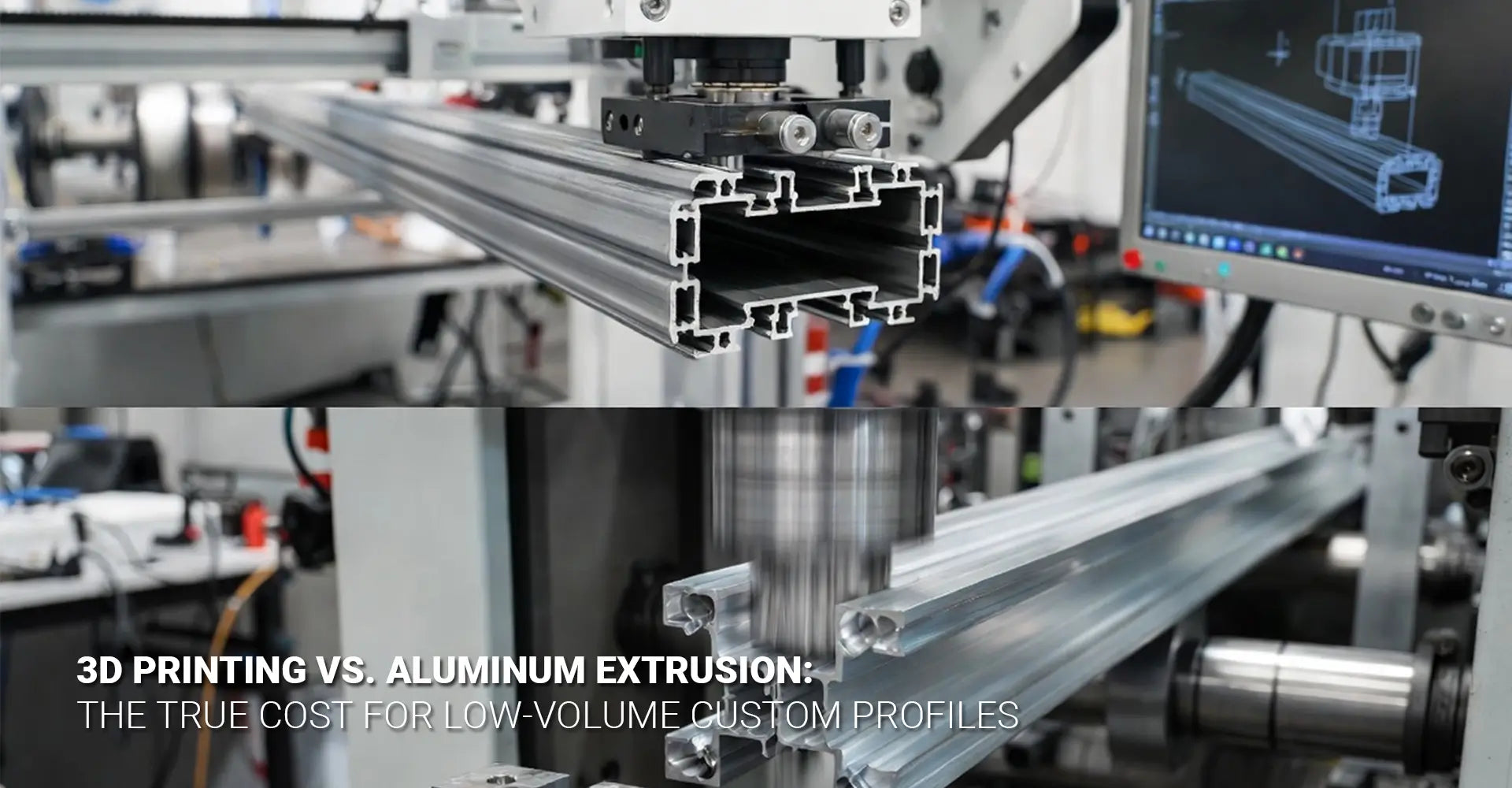
3D Printing vs. Aluminum Extrusion: Which Costs Less for Your Custom Profile Project?

You're standing at a manufacturing crossroads. Your product needs custom rails or housings, but the quote for an aluminum extrusion die just landed on your desk—and it's eye-watering. Meanwhile, you've heard whispers about 3D printing as an alternative, but you're not sure if it can handle your project's demands. Therefore, this decision isn't just about manufacturing methods. It's about your budget, timeline, and whether you'll launch your product this quarter or next year.
Quick Answer: Which Method Saves You Money?
At a Glance: The Cost Breakdown
| Factor | 3D Printing | Aluminum Extrusion |
|---|---|---|
| Upfront Tooling Cost | $0 | $1,500 - $10,000+ |
| Best for Quantities | 1-200 parts | 500+ parts |
| Lead Time to Production | 2-5 days | 8-12 weeks |
| Design Flexibility | Variable cross-sections, integrated features | Fixed cross-section only |
| Break-Even Point | N/A | Typically 100-200 units |
| Material Options | High-performance polymers | Aluminum alloys |
Bottom Line: For production runs under 200 parts, 3D printing typically delivers lower total costs because you skip the expensive die investment entirely. However, once you're manufacturing hundreds or thousands of units, extrusion's low per-part cost eventually wins out.
Why This Comparison Matters for Your Project
Engineers and product designers face this dilemma constantly. On one hand, aluminum extrusion promises durability and a proven track record. On the other hand, the upfront investment can kill a project before it starts. Additionally, market demands have shifted. Customers want customization, and businesses need to test products without betting the farm on tooling. Consequently, understanding when each method makes financial sense isn't just helpful—it's critical for your project's survival.
Table of Contents
- What Makes Aluminum Extrusion So Expensive for Small Batches?
- How Does 3D Printing Change the Cost Equation for Custom Profiles?
- Where Is the Break-Even Point Between These Two Methods?
- Can 3D Printed Polymers Match Aluminum's Performance for Rails and Housings?
- Conclusion
What Makes Aluminum Extrusion So Expensive for Small Batches?
The Fixed Cost Trap
Aluminum extrusion works brilliantly for high-volume production, but it carries a hefty price tag upfront. Moreover, this cost structure creates a significant barrier for small businesses and startups. The culprit? Custom extrusion dies that must be manufactured before you can produce even a single part.
The Real Numbers Behind Extrusion Dies
When exploring aluminum in CNC machining and extrusion, you'll quickly discover the tooling cost for extrusion die dominates your budget:
- Simple profiles: $1,500 to $3,000 per die
- Complex profiles: $10,000 or more per die
- Lead time: 8 to 12 weeks for fabrication
- Minimum orders: Often 500 to 1,000 meters required
Furthermore, these dies aren't disposable. They're precision tools machined from hardened steel, designed to withstand the extreme pressures of forcing hot aluminum through a shaped opening thousands of times.
Why Dies Cost So Much (And Why You Can't Avoid It)
The manufacturing process for extrusion dies explains the price tag. First, engineers must design the die to account for how aluminum flows and cools. Then, skilled machinists cut the profile shape into a solid steel block using CNC machining services. After that, the die undergoes heat treatment to harden it for production use.
Each die is essentially a custom tool built specifically for your profile. Unlike injection molding, where family molds can produce multiple parts, an extrusion die creates only one cross-sectional shape. Therefore, any design change means starting over with a new die. This lack of flexibility makes low volume extrusion cost prohibitively expensive for prototyping or small production runs.
Additionally, extruders often require minimum order quantities because setting up the extrusion line takes time and labor. Even if your die only costs $2,000, you might be forced to order far more material than you actually need. As a result, you're paying for inventory that sits in your warehouse while you test the market.
How Does 3D Printing Change the Cost Equation for Custom Profiles?
The Zero-Tooling Advantage
Custom profile 3D printing flips the traditional manufacturing model on its head. Instead of investing thousands in tooling before producing your first part, you simply send a digital file and start printing. Consequently, this eliminates the biggest financial barrier to entry for small-batch manufacturing.
Understanding the Linear Cost Model
The economics of 3D printing are refreshingly straightforward:
- Tooling investment: $0
- Cost formula: (Price per part) × (Quantity needed)
- Design changes: Free between parts
- Production timeline: 2 to 5 days from design to finished parts
- Minimum order: Often just 1 part
Unlike extrusion's high fixed cost plus low variable cost model, additive manufacturing delivers a consistent per-part price regardless of volume. Therefore, your first part costs the same as your hundredth part. This predictability makes budgeting simpler and eliminates the risk of over-ordering.
Design Freedom That Extrusion Can't Match
Beyond cost, 3D printing unlocks capabilities that traditional extrusion simply cannot achieve. For instance, you can create:
Variable cross-sections: The profile changes shape along its length, something physically impossible with a fixed die.
Integrated features: Mounting bosses, snap-fits, internal channels, and complex lattices print as a single piece. This eliminates assembly steps and reduces part count.
True geometric complexity: Undercuts, re-entrant angles, and fully enclosed hollow sections are standard in additive manufacturing but impossible to pull through an extrusion die.
Instant iteration: Need to adjust a dimension or add a feature? Simply modify your CAD file and print again. No new tooling required.
This flexibility proves invaluable for on-demand rail and housing applications in electronics manufacturing and industrial machinery, where custom fits and rapid design changes are common. Moreover, companies can test multiple design variations simultaneously without multiplying their tooling investment.
Additionally, short run manufacturing becomes economically viable. Whether you need 5 parts for a prototype or 150 units for a limited market test, the cost structure remains favorable. Therefore, businesses can validate designs and market fit before committing to expensive production tooling.
Where Is the Break-Even Point Between These Two Methods?
Setting Up the Comparison
Choosing between 3D printing vs aluminum extrusion requires a cost per part analysis that accounts for both fixed and variable costs. Fortunately, the math isn't complicated once you understand the key variables. However, the break-even point shifts based on several factors specific to your project.
The Break-Even Formula Explained
To find where extrusion becomes cheaper, use this simple calculation:
Break-even quantity = Die cost ÷ (3D printing cost per part - Extrusion cost per part)
For example, imagine your project has these costs:
- Extrusion die: $5,000
- 3D printed part: $30 each
- Extruded part: $5 each (after die is paid)
Break-even = $5,000 ÷ ($30 - $5) = 200 parts
This means you'd need to produce more than 200 units before extrusion becomes the cheaper option.
Real-World Cost Scenarios
Let's examine how quantities affect total project costs across different scenarios:
Scenario 1: Simple Rail Profile (50 units needed)
- 3D printing total: 50 × $25 = $1,250
- Extrusion total: $2,000 (die) + (50 × $4) = $2,200
- Winner: 3D printing saves $950
Scenario 2: Complex Housing Profile (200 units needed)
- 3D printing total: 200 × $35 = $7,000
- Extrusion total: $8,000 (die) + (200 × $6) = $9,200
- Winner: 3D printing saves $2,200
Scenario 3: Standard Guide Rail (500 units needed)
- 3D printing total: 500 × $30 = $15,000
- Extrusion total: $3,000 (die) + (500 × $5) = $5,500
- Winner: Extrusion saves $9,500
Scenario 4: Mass Production (2,000 units needed)
- 3D printing total: 2,000 × $28 = $56,000
- Extrusion total: $4,000 (die) + (2,000 × $4) = $12,000
- Winner: Extrusion saves $44,000
Factors That Shift the Break-Even Point
Several variables can move the crossover quantity up or down:
Part complexity: Intricate profiles with internal features favor 3D printing because die costs escalate rapidly for complex geometries. Conversely, simple solid shapes break even faster with extrusion.
Material requirements: High-performance polymer profiles cost more per part than standard printing materials. However, specialized aluminum alloys also increase extrusion costs.
Profile dimensions: Larger cross-sections consume more printing material, raising the per-part cost. Meanwhile, bigger profiles require larger, more expensive extrusion dies.
Design changes: If you anticipate iterations, 3D printing's zero retooling cost becomes even more valuable. Each extrusion design change means buying another die.
Timeline pressure: When speed matters, 3D printing's 3-day turnaround might justify higher per-part costs compared to waiting 10 weeks for die fabrication.
Quick Decision Guide by Quantity
Based on typical industrial projects, here's a rough guide:
- 1-50 units: 3D printing almost always wins
- 51-150 units: 3D printing usually wins (depends on complexity)
- 151-300 units: Analyze carefully; either method could be optimal
- 301-500 units: Extrusion often becomes competitive
- 500+ units: Extrusion typically delivers better economics
Remember, these ranges shift based on your specific profile and requirements. Therefore, always calculate your exact costs before committing.
Can 3D Printed Polymers Match Aluminum's Performance for Rails and Housings?
The Honest Performance Assessment
Material performance is where aluminum traditionally dominates. After all, metal has been the go-to choice for structural components for good reason. However, modern high-performance polymers have closed the gap considerably, and design flexibility can sometimes compensate for material limitations.
Material Properties Head-to-Head
Let's compare key mechanical properties that matter for rails and housings:
Aluminum 6061-T6:
- Tensile strength: 310 MPa
- Modulus (stiffness): 69 GPa
- Density: 2.7 g/cm³
- Temperature resistance: 150°C continuous
Nylon (PA12) - Standard:
- Tensile strength: 45-55 MPa
- Modulus: 1.5-1.8 GPa
- Density: 1.01 g/cm³
- Temperature resistance: 80-100°C continuous
Carbon Fiber Reinforced PEKK:
- Tensile strength: 150-200 MPa
- Modulus: 12-15 GPa
- Density: 1.3-1.4 g/cm³
- Temperature resistance: 200°C continuous
When Polymers Work Well (And When They Don't)
High-performance polymer profiles excel in specific applications:
Good applications for 3D printed polymers:
- Guide rails with moderate loads
- Protective housings and enclosures
- Cable management systems
- Mounting brackets and fixtures
- Jigs and fixtures for assembly
- Weight-sensitive applications
- Electrically insulating components
- Corrosion-prone environments
Applications requiring aluminum:
- High-load structural members
- Components experiencing impacts
- High-temperature environments (above 150°C)
- Applications requiring maximum stiffness
- Parts needing excellent thermal conductivity
- Components exposed to UV and outdoor weathering
Design Strategies to Compensate
Smart design can bridge performance gaps. For instance, 3D printing enables topology design that places material only where stress demands it. This approach creates lightweight structures that meet strength requirements while using less material.
Additionally, printed parts can incorporate ribbing, gussets, and internal honeycomb structures that aluminum extrusions cannot achieve. These features dramatically increase stiffness-to-weight ratios without adding significant cost or print time.
Moreover, multi-material printing allows combining rigid and flexible polymers in a single part. Therefore, you can create assemblies that would require multiple aluminum components and fasteners, reducing assembly time and potential failure points.
Real-World Application Examples
Several industries have successfully deployed 3D printed profiles:
Electronics manufacturing: Custom cable management rails that route wiring through internal channels impossible to extrude. The integrated design eliminates clips and fasteners.
Industrial machinery: Equipment housings with snap-fit assembly features that reduce installation time by 70% compared to traditional fastened aluminum enclosures.
Medical devices: Lightweight guide rails for patient positioning systems where weight reduction improves usability and aluminum's electrical conductivity would interfere with imaging equipment.
Automotive prototyping: Interior trim profiles for concept vehicles where rapid design iteration matters more than ultimate material properties during the validation phase.
Conclusion
The choice between 3D printing and aluminum extrusion isn't about which method is "better" in absolute terms. Instead, it's about matching the manufacturing approach to your specific project requirements. Each method has clear strengths that shine in different scenarios.
For production runs under 200 units, 3D printing typically delivers lower total costs, faster turnaround, and greater design flexibility. You avoid the expensive die investment entirely while gaining the ability to iterate designs without penalty. This makes additive manufacturing ideal for prototyping, market testing, and custom one-off projects.
Conversely, once you're producing 500 or more units and your design is finalized, aluminum extrusion's economics become compelling. The initial die investment gets spread across many parts, driving per-unit costs down significantly. Moreover, aluminum's superior strength and thermal properties make it the right choice for demanding structural applications.
The Smart Hybrid Strategy
Many successful companies use a staged approach:
Stage 1 (Prototype & Validation): Use 3D printing to design, test, and refine your profile. Manufacture your first 50-200 units for real-world testing and initial customer feedback. This validates both the design and market demand without tooling risk.
Stage 2 (Growing Demand): As orders increase to several hundred units, continue with 3D printing or explore bridge tooling options like prototype extrusion dies that cost less but have shorter lifespans.
Stage 3 (Production Scale): Once your design is frozen and you're producing thousands of units, invest in the final hardened production die. Your 3D printed parts served as perfect functional prototypes, reducing the risk of expensive die modifications.
This approach minimizes financial risk while maximizing learning and flexibility. You only commit to expensive tooling after proving your design works and customers want it.
Making Your Decision
Ask yourself these five questions:
- Quantity: How many parts do I need in the next 12 months?
- Design certainty: Is my design finalized, or might it change?
- Timeline: Can I wait 10-12 weeks for tooling, or do I need parts next week?
- Performance requirements: Do I truly need aluminum's properties, or will advanced polymers suffice?
- Budget: Can I afford the upfront die investment, or do I need to preserve cash flow?
Your answers will point you toward the right manufacturing method for your situation.
Recommended Resources
[3D Printed Polymer Profiles][^1]
[Custom Aluminum Profiles][^2]
[Low volume extrusion cost][^3]
[On-demand rail and housing][^4]
[Tooling cost for extrusion die][^5]
[Additive Manufacturing vs. Extrusion][^6]
---
[^1]: Explore this link to understand how 3D printed polymer profiles can enhance design flexibility and reduce production costs.
[^2]: Discover the manufacturing process of custom aluminum profiles to appreciate their versatility and applications in various industries.
[^3]: Understanding low volume extrusion costs can help you make informed decisions about manufacturing and budgeting.
[^4]: Exploring on-demand rail and housing can provide insights into innovative transportation and housing solutions that meet modern needs.
[^5]: Understanding tooling costs is crucial for budgeting in manufacturing processes, especially for extrusion.
[^6]: Exploring this comparison can help you choose the right manufacturing method for your project.





Running Counter-Strike on a tablet is a topic a lot of Australian gamers have been asking about, and truthfully it’s more doable than most people expect, especially given how much portable gaming tech has advanced in recent years, so allow me walk through precisely how to get it running for players looking to get competitive without a gaming PC, starting with [url=https://plugnplay.re/]plugnplay.re[/url] as a solid starting point for hardware and software guides that actually suit iOS and Android tablets. The first thing to know is that native CS2 isn’t available on mobile platforms out of the box, so the approach most serious players go with is cloud gaming — options such as Xbox Cloud Gaming let you stream CS2 straight onto an iPad via a decent broadband or mobile connection. Ping and latency is honestly the single most important variable — you’ll want at least 30ms ping begins to affect responsiveness that makes accurate shooting feel impossible, especially when you’re using a public network you may want to tether to your mobile data to get a more steady connection. There’s helpful tablet gaming content at https://plugnplay.re/ covering the real-world setup questions so you’re not guessing. A Bluetooth controller is another thing to sort out upfront — playing with touch alone for a competitive FPS are really difficult alongside a decent Bluetooth controller, with controllers like a Razer Kishi connect seamlessly on the majority of iOS and Android devices which makes cloud gaming on a tablet genuinely competitive. Your tablet’s screen also plays a bigger role than most players realise — a screen smaller than an 8-inch display starts to feel cramped for identifying opponents across the map, so if you have a larger iPad Pro it’s going to provide a noticeable benefit when reading the map and spotting players. Last but not least, think about how fast your battery drains — streaming games drains battery fast, so keeping a charging cable nearby or staying plugged in during longer sessions is the difference between completing a session and watching your screen go dark.
Selecting a solid online pokie isn’t as easy as blindly clicking on any random game appears on screen, and if you have walked away thinking you threw away your bankroll on a frustrating pokie that paid nothing, then you already know just how much picking well counts, which is why guides like [url=https://cluj.pm/]The Pokies Casino Australia[/url] exist — helping Australian gamblers cut through the endless options and identify titles that actually pay out. RTP remains the first number every player should look at when evaluating a new game, since it gives you a clear picture of roughly how much the game is built to pay back across thousands of sessions, and look for 96% is generally a solid starting point if you want a real play session. Variance is the next element to understand, since high-vol titles tend to eat through funds for long stretches until the right combination finally lands, but low-vol games deliver wins frequent but smaller rewards much more consistently. Knowing which kind suits your session funds and your playing style in advance is the difference between a good run and walking away empty. You’ll also pay attention to the special features any pokie carries — free spins, multiplier mechanics, expanding wilds, and bonus rounds often change the experience and sometimes account for the bulk of a pokie’s big win opportunities. There’s genuinely helpful review material at https://cluj.pm/ covering exactly these metrics so Aussie punters don’t have to figure it all out from scratch. Theme and design might seem like a minor consideration alongside the numbers, but in practice it counts more often than you’d expect — sitting through hours on a game whose visuals grate on you is a surefire way to make poor decisions and chase losses. Likewise, confirming that a title loads reliably on mobile is increasingly important for Aussie punters who prefer to spin during a commute. At the end of the day is that choosing well is something you develop the more you play, handling it with a clear strategy rather than impulsively is what separates punters who regularly get value from their time and money from those who never stop feeling the house always has an unfair edge.
When it comes to virtual casinos, bonuses play an important role for attracting and retaining players. Among all the virtual gambling platforms out there, [url=https://karlovac10.run/]National Casino play online[/url] stands out for the attractive reward offerings. If you’re a first-time player or an experienced veteran, https://karlovac10.run/ provides a promotion to match your gaming style. For beginners, they provides a generous introductory offer that usually includes a blend of bonus spins and bonus money that you can utilize on playing your favorite slots and tables. These bonuses go beyond offering extra benefits ; they also enabling players to explore new games and potentially boost your chances of winning without having to spend your own money. When it comes to loyal players, [url=https://karlovac10.run/]National Casino play online[/url] also offers continuous promotions, including reload bonuses, rebates offers, along with exclusive events designed to maintain the thrills going and simultaneously recognizing your loyalty. Through leveraging these enticing promotions, gamblers can enhance their online gambling adventure while boost their odds of substantial rewards
Every time a full-time fabrication nerd slide down my face shield and feel the arc roar, I’m reminded that discipline keeps glowing puddles firmly where a tradesperson need them, and the identical rule carries over to online wagering; smart staking mustn’t be roulette of fate, which is why I’ve hammered out this long-form guide peppered with real-world, no-nonsense strategies, and right up front I’m linking the expanded reference at PlayCroco so you can bookmark it before the sparks cool. The first lesson all mates at the barbie get is the core segmentation plan: divide your available chips into a rigid “untouchable” fund covering rent or mortgage, a “daily life” fund, and finally a “adventure” fund that is the exclusive pool you ever stake at an online table; cross-contaminating those buckets is like letting slag drip onto fresh welds, a classic way to melt your roof overhead. The second pillar is preset cut-offs: set a session duration before logging in and exit away when the countdown hits zero, ahead or down, because fatigue distorts judgment the way poor shielding gas distorts under excess heat. The third blast-resistant principle is meticulous logging: open a ledger and record amount placed, slot type, result, and tilt factor; that paperwork may feel dull, yet spotting leaks early plugs hemorrhages before they swallow a deposit. The fourth commandment is never swinging the hammer harder after a miss, a reflex baked into human wiring, and here’s my mental hack: frame each spin as a segment of electrode, finite and measurable, so when the wire spool runs out you simply stop the pass—no raiding rent money. The fifth rule addresses bonus traps: analyse rollover terms the way you’d scrutinize a spec sheet, because many “gifted” chips lock your funds behind harsh wagering multipliers that seldom pay out before you reach financial fatigue. The sixth insight is embracing variance: slots with massive jackpots dangle life-changing highs yet return infrequent wins, whereas low-variance games deal smaller but more consistent returns; matching game volatility with your cash comfort level is like picking the correct amperage for a given joint—bad combos create weak beads. The seventh checkpoint covers log-in discipline: enable MFA, refresh passphrases, check linked payment methods, and never tick “auto-top-up” toggles; storing sensitive data parallels welding in sandals. The eighth step—here comes our five-sentence mark, so watch for the promised inline reference—folds in headspace: bake stretch intervals every half hour, walk out, recalibrate, and resume only if focus is sharp; adrenaline-drunk decisions scrap even the best math. To close the loop, stay following regulator bulletins, compare payout ratios, and keep your disclaimer goggles polished so you never mistake marketing hype for audited results; never forget, the rigor that passes X-ray can also steer a wallet clear of property risk. And speaking of clear tools, you can deep-dive the timing checklist over at https://mage-interieur.world/ where the content breaks down variance charts, showcases withdrawal timing graphs, and outlines deposit caps so you’re never forced to wing it; keep beads uniform and bets uniform
As a bonus hunter exploring the layered reward matrix of Australia’s virtual gaming lounges, your game plan must be thorough intel gathering; ignite that expedition with jordanmosermusic.art where data-driven storytellers unpack all ranks, showing you the fastest ways to ascend with bankroll discipline intact. Ahead of spinning your inaugural reel, bench-test reward ratios: some sites offer units at a 1:1 ratio, though peers expect larger stakes to snag identical credit, rendering points harvesting a steeper climb. Of parallel importance is memorising cash-out equations; might reward vouchers swap into withdrawable AUD, or do they route through free-spin bundles that slice equity? Beyond that, look for seasonal triple-point promos because layering these accelerators rockets your tier climb, allowing you to claim black-card perks months sooner. Yet no reward is free; bet-through stipulations often shackle bonuses ahead of significant coin make their pilgrimage across games, hence decode policy pages with a hawk’s eye. If terms still puzzle you, consult https://jordanmosermusic.art/ to see real-world examples that turn policy fog into clarity. After that, utilise loss-back offers dampen losing streaks; even a mini rebate on overall deficit rests like a safety net. Yet, sidestep restricted offers that trap compensation within sticky bonus wallets; they dress up as gifts yet evaporate once payout is requested, dumping you on the cold floor. A stealthy lever in the VIP toolkit is multi-wallet play, holding memberships across a small cluster of regulated operators; this rotation dodges point plateaus, thanks to the fact you keep earning each time you swap venues. Just make sure every venue holds a valid state-approved certification, provides eCOGRA certificates, and features payment options aligned with local regulations. Outfitting your persona with budget trackers turns invisible leaks visible; a basic tracker app maps out exact cost per tier, highlighting whether the marketed royal level justifies the time investment. Finally, tier accounting reduces to one simple truth: value received should surpass risk absorbed; iterate boldly, and lash moves to hard data. Stick to the guidelines above, pair them with personal limits, and you’ll find the reward staircase serving your interests instead of stripping it. Fortify that perspective, and across sessions the Down Under betting world will feel less like a maze and increasingly resemble a charted island where caution yields fruit