
3D Printing vs. Aluminum Extrusion: Which Costs Less for Your Custom Profile Project?
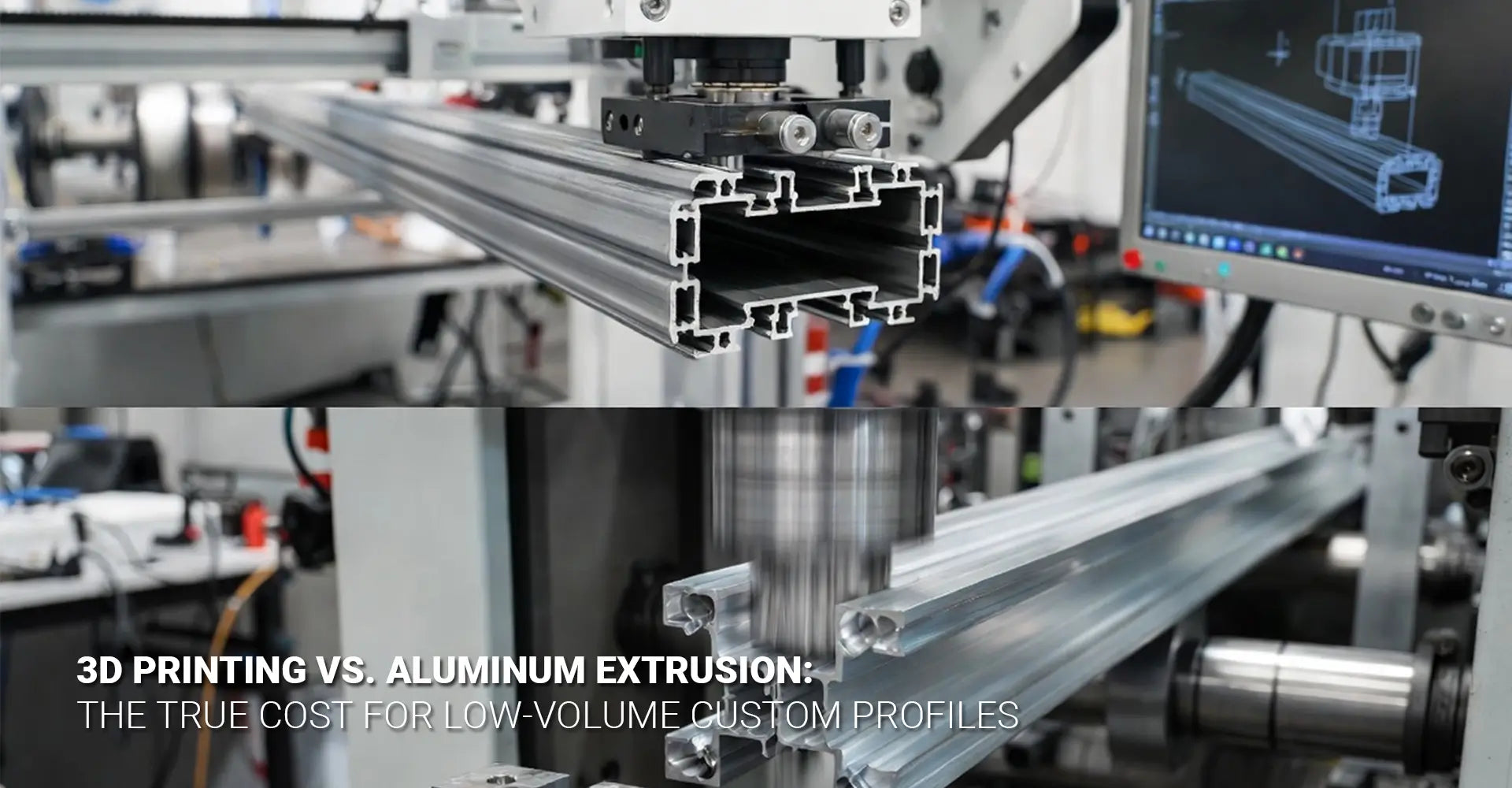
3D Printing vs. Aluminum Extrusion: Which Costs Less for Your Custom Profile Project?

You're standing at a manufacturing crossroads. Your product needs custom rails or housings, but the quote for an aluminum extrusion die just landed on your desk—and it's eye-watering. Meanwhile, you've heard whispers about 3D printing as an alternative, but you're not sure if it can handle your project's demands. Therefore, this decision isn't just about manufacturing methods. It's about your budget, timeline, and whether you'll launch your product this quarter or next year.
Quick Answer: Which Method Saves You Money?
At a Glance: The Cost Breakdown
| Factor | 3D Printing | Aluminum Extrusion |
|---|---|---|
| Upfront Tooling Cost | $0 | $1,500 - $10,000+ |
| Best for Quantities | 1-200 parts | 500+ parts |
| Lead Time to Production | 2-5 days | 8-12 weeks |
| Design Flexibility | Variable cross-sections, integrated features | Fixed cross-section only |
| Break-Even Point | N/A | Typically 100-200 units |
| Material Options | High-performance polymers | Aluminum alloys |
Bottom Line: For production runs under 200 parts, 3D printing typically delivers lower total costs because you skip the expensive die investment entirely. However, once you're manufacturing hundreds or thousands of units, extrusion's low per-part cost eventually wins out.
Why This Comparison Matters for Your Project
Engineers and product designers face this dilemma constantly. On one hand, aluminum extrusion promises durability and a proven track record. On the other hand, the upfront investment can kill a project before it starts. Additionally, market demands have shifted. Customers want customization, and businesses need to test products without betting the farm on tooling. Consequently, understanding when each method makes financial sense isn't just helpful—it's critical for your project's survival.
Table of Contents
- What Makes Aluminum Extrusion So Expensive for Small Batches?
- How Does 3D Printing Change the Cost Equation for Custom Profiles?
- Where Is the Break-Even Point Between These Two Methods?
- Can 3D Printed Polymers Match Aluminum's Performance for Rails and Housings?
- Conclusion
What Makes Aluminum Extrusion So Expensive for Small Batches?
The Fixed Cost Trap
Aluminum extrusion works brilliantly for high-volume production, but it carries a hefty price tag upfront. Moreover, this cost structure creates a significant barrier for small businesses and startups. The culprit? Custom extrusion dies that must be manufactured before you can produce even a single part.
The Real Numbers Behind Extrusion Dies
When exploring aluminum in CNC machining and extrusion, you'll quickly discover the tooling cost for extrusion die dominates your budget:
- Simple profiles: $1,500 to $3,000 per die
- Complex profiles: $10,000 or more per die
- Lead time: 8 to 12 weeks for fabrication
- Minimum orders: Often 500 to 1,000 meters required
Furthermore, these dies aren't disposable. They're precision tools machined from hardened steel, designed to withstand the extreme pressures of forcing hot aluminum through a shaped opening thousands of times.
Why Dies Cost So Much (And Why You Can't Avoid It)
The manufacturing process for extrusion dies explains the price tag. First, engineers must design the die to account for how aluminum flows and cools. Then, skilled machinists cut the profile shape into a solid steel block using CNC machining services. After that, the die undergoes heat treatment to harden it for production use.
Each die is essentially a custom tool built specifically for your profile. Unlike injection molding, where family molds can produce multiple parts, an extrusion die creates only one cross-sectional shape. Therefore, any design change means starting over with a new die. This lack of flexibility makes low volume extrusion cost prohibitively expensive for prototyping or small production runs.
Additionally, extruders often require minimum order quantities because setting up the extrusion line takes time and labor. Even if your die only costs $2,000, you might be forced to order far more material than you actually need. As a result, you're paying for inventory that sits in your warehouse while you test the market.
How Does 3D Printing Change the Cost Equation for Custom Profiles?
The Zero-Tooling Advantage
Custom profile 3D printing flips the traditional manufacturing model on its head. Instead of investing thousands in tooling before producing your first part, you simply send a digital file and start printing. Consequently, this eliminates the biggest financial barrier to entry for small-batch manufacturing.
Understanding the Linear Cost Model
The economics of 3D printing are refreshingly straightforward:
- Tooling investment: $0
- Cost formula: (Price per part) × (Quantity needed)
- Design changes: Free between parts
- Production timeline: 2 to 5 days from design to finished parts
- Minimum order: Often just 1 part
Unlike extrusion's high fixed cost plus low variable cost model, additive manufacturing delivers a consistent per-part price regardless of volume. Therefore, your first part costs the same as your hundredth part. This predictability makes budgeting simpler and eliminates the risk of over-ordering.
Design Freedom That Extrusion Can't Match
Beyond cost, 3D printing unlocks capabilities that traditional extrusion simply cannot achieve. For instance, you can create:
Variable cross-sections: The profile changes shape along its length, something physically impossible with a fixed die.
Integrated features: Mounting bosses, snap-fits, internal channels, and complex lattices print as a single piece. This eliminates assembly steps and reduces part count.
True geometric complexity: Undercuts, re-entrant angles, and fully enclosed hollow sections are standard in additive manufacturing but impossible to pull through an extrusion die.
Instant iteration: Need to adjust a dimension or add a feature? Simply modify your CAD file and print again. No new tooling required.
This flexibility proves invaluable for on-demand rail and housing applications in electronics manufacturing and industrial machinery, where custom fits and rapid design changes are common. Moreover, companies can test multiple design variations simultaneously without multiplying their tooling investment.
Additionally, short run manufacturing becomes economically viable. Whether you need 5 parts for a prototype or 150 units for a limited market test, the cost structure remains favorable. Therefore, businesses can validate designs and market fit before committing to expensive production tooling.
Where Is the Break-Even Point Between These Two Methods?
Setting Up the Comparison
Choosing between 3D printing vs aluminum extrusion requires a cost per part analysis that accounts for both fixed and variable costs. Fortunately, the math isn't complicated once you understand the key variables. However, the break-even point shifts based on several factors specific to your project.
The Break-Even Formula Explained
To find where extrusion becomes cheaper, use this simple calculation:
Break-even quantity = Die cost ÷ (3D printing cost per part - Extrusion cost per part)
For example, imagine your project has these costs:
- Extrusion die: $5,000
- 3D printed part: $30 each
- Extruded part: $5 each (after die is paid)
Break-even = $5,000 ÷ ($30 - $5) = 200 parts
This means you'd need to produce more than 200 units before extrusion becomes the cheaper option.
Real-World Cost Scenarios
Let's examine how quantities affect total project costs across different scenarios:
Scenario 1: Simple Rail Profile (50 units needed)
- 3D printing total: 50 × $25 = $1,250
- Extrusion total: $2,000 (die) + (50 × $4) = $2,200
- Winner: 3D printing saves $950
Scenario 2: Complex Housing Profile (200 units needed)
- 3D printing total: 200 × $35 = $7,000
- Extrusion total: $8,000 (die) + (200 × $6) = $9,200
- Winner: 3D printing saves $2,200
Scenario 3: Standard Guide Rail (500 units needed)
- 3D printing total: 500 × $30 = $15,000
- Extrusion total: $3,000 (die) + (500 × $5) = $5,500
- Winner: Extrusion saves $9,500
Scenario 4: Mass Production (2,000 units needed)
- 3D printing total: 2,000 × $28 = $56,000
- Extrusion total: $4,000 (die) + (2,000 × $4) = $12,000
- Winner: Extrusion saves $44,000
Factors That Shift the Break-Even Point
Several variables can move the crossover quantity up or down:
Part complexity: Intricate profiles with internal features favor 3D printing because die costs escalate rapidly for complex geometries. Conversely, simple solid shapes break even faster with extrusion.
Material requirements: High-performance polymer profiles cost more per part than standard printing materials. However, specialized aluminum alloys also increase extrusion costs.
Profile dimensions: Larger cross-sections consume more printing material, raising the per-part cost. Meanwhile, bigger profiles require larger, more expensive extrusion dies.
Design changes: If you anticipate iterations, 3D printing's zero retooling cost becomes even more valuable. Each extrusion design change means buying another die.
Timeline pressure: When speed matters, 3D printing's 3-day turnaround might justify higher per-part costs compared to waiting 10 weeks for die fabrication.
Quick Decision Guide by Quantity
Based on typical industrial projects, here's a rough guide:
- 1-50 units: 3D printing almost always wins
- 51-150 units: 3D printing usually wins (depends on complexity)
- 151-300 units: Analyze carefully; either method could be optimal
- 301-500 units: Extrusion often becomes competitive
- 500+ units: Extrusion typically delivers better economics
Remember, these ranges shift based on your specific profile and requirements. Therefore, always calculate your exact costs before committing.
Can 3D Printed Polymers Match Aluminum's Performance for Rails and Housings?
The Honest Performance Assessment
Material performance is where aluminum traditionally dominates. After all, metal has been the go-to choice for structural components for good reason. However, modern high-performance polymers have closed the gap considerably, and design flexibility can sometimes compensate for material limitations.
Material Properties Head-to-Head
Let's compare key mechanical properties that matter for rails and housings:
Aluminum 6061-T6:
- Tensile strength: 310 MPa
- Modulus (stiffness): 69 GPa
- Density: 2.7 g/cm³
- Temperature resistance: 150°C continuous
Nylon (PA12) - Standard:
- Tensile strength: 45-55 MPa
- Modulus: 1.5-1.8 GPa
- Density: 1.01 g/cm³
- Temperature resistance: 80-100°C continuous
Carbon Fiber Reinforced PEKK:
- Tensile strength: 150-200 MPa
- Modulus: 12-15 GPa
- Density: 1.3-1.4 g/cm³
- Temperature resistance: 200°C continuous
When Polymers Work Well (And When They Don't)
High-performance polymer profiles excel in specific applications:
Good applications for 3D printed polymers:
- Guide rails with moderate loads
- Protective housings and enclosures
- Cable management systems
- Mounting brackets and fixtures
- Jigs and fixtures for assembly
- Weight-sensitive applications
- Electrically insulating components
- Corrosion-prone environments
Applications requiring aluminum:
- High-load structural members
- Components experiencing impacts
- High-temperature environments (above 150°C)
- Applications requiring maximum stiffness
- Parts needing excellent thermal conductivity
- Components exposed to UV and outdoor weathering
Design Strategies to Compensate
Smart design can bridge performance gaps. For instance, 3D printing enables topology design that places material only where stress demands it. This approach creates lightweight structures that meet strength requirements while using less material.
Additionally, printed parts can incorporate ribbing, gussets, and internal honeycomb structures that aluminum extrusions cannot achieve. These features dramatically increase stiffness-to-weight ratios without adding significant cost or print time.
Moreover, multi-material printing allows combining rigid and flexible polymers in a single part. Therefore, you can create assemblies that would require multiple aluminum components and fasteners, reducing assembly time and potential failure points.
Real-World Application Examples
Several industries have successfully deployed 3D printed profiles:
Electronics manufacturing: Custom cable management rails that route wiring through internal channels impossible to extrude. The integrated design eliminates clips and fasteners.
Industrial machinery: Equipment housings with snap-fit assembly features that reduce installation time by 70% compared to traditional fastened aluminum enclosures.
Medical devices: Lightweight guide rails for patient positioning systems where weight reduction improves usability and aluminum's electrical conductivity would interfere with imaging equipment.
Automotive prototyping: Interior trim profiles for concept vehicles where rapid design iteration matters more than ultimate material properties during the validation phase.
Conclusion
The choice between 3D printing and aluminum extrusion isn't about which method is "better" in absolute terms. Instead, it's about matching the manufacturing approach to your specific project requirements. Each method has clear strengths that shine in different scenarios.
For production runs under 200 units, 3D printing typically delivers lower total costs, faster turnaround, and greater design flexibility. You avoid the expensive die investment entirely while gaining the ability to iterate designs without penalty. This makes additive manufacturing ideal for prototyping, market testing, and custom one-off projects.
Conversely, once you're producing 500 or more units and your design is finalized, aluminum extrusion's economics become compelling. The initial die investment gets spread across many parts, driving per-unit costs down significantly. Moreover, aluminum's superior strength and thermal properties make it the right choice for demanding structural applications.
The Smart Hybrid Strategy
Many successful companies use a staged approach:
Stage 1 (Prototype & Validation): Use 3D printing to design, test, and refine your profile. Manufacture your first 50-200 units for real-world testing and initial customer feedback. This validates both the design and market demand without tooling risk.
Stage 2 (Growing Demand): As orders increase to several hundred units, continue with 3D printing or explore bridge tooling options like prototype extrusion dies that cost less but have shorter lifespans.
Stage 3 (Production Scale): Once your design is frozen and you're producing thousands of units, invest in the final hardened production die. Your 3D printed parts served as perfect functional prototypes, reducing the risk of expensive die modifications.
This approach minimizes financial risk while maximizing learning and flexibility. You only commit to expensive tooling after proving your design works and customers want it.
Making Your Decision
Ask yourself these five questions:
- Quantity: How many parts do I need in the next 12 months?
- Design certainty: Is my design finalized, or might it change?
- Timeline: Can I wait 10-12 weeks for tooling, or do I need parts next week?
- Performance requirements: Do I truly need aluminum's properties, or will advanced polymers suffice?
- Budget: Can I afford the upfront die investment, or do I need to preserve cash flow?
Your answers will point you toward the right manufacturing method for your situation.
Recommended Resources
[3D Printed Polymer Profiles][^1]
[Custom Aluminum Profiles][^2]
[Low volume extrusion cost][^3]
[On-demand rail and housing][^4]
[Tooling cost for extrusion die][^5]
[Additive Manufacturing vs. Extrusion][^6]
---
[^1]: Explore this link to understand how 3D printed polymer profiles can enhance design flexibility and reduce production costs.
[^2]: Discover the manufacturing process of custom aluminum profiles to appreciate their versatility and applications in various industries.
[^3]: Understanding low volume extrusion costs can help you make informed decisions about manufacturing and budgeting.
[^4]: Exploring on-demand rail and housing can provide insights into innovative transportation and housing solutions that meet modern needs.
[^5]: Understanding tooling costs is crucial for budgeting in manufacturing processes, especially for extrusion.
[^6]: Exploring this comparison can help you choose the right manufacturing method for your project.






Why Most Modern Online Casino Has Transitioned to Mobile https://studii.co.uk/2026/07/20/le-role-des-themes-et-du-storytelling-dans-les-machines-a-sous-modernes/
Over the recent years, the online casino industry has transformed completely. What many players previously considered a PC-oriented form of entertainment has quickly become a smartphone-driven experience. In the current market, a large number of online casinos are created with mobile users in mind.
This transition did not happen without reason. It happened because the internet became more mobile. Today’s casino users now expect instant access to games. They no longer want to be restricted by a desktop computer.
Instead, players want to launch a casino from their smartphone, look through offers, join a live table, and continue their day. As a result, mobile access has become a key part of the online casino experience.
At the beginning of online gambling, casinos were mostly websites built around big screens. Users often needed to sit at a desktop, open a browser, and enter the casino site. The layouts were often crowded, and many games were developed for larger screens.
Smartphone layouts were often basic. Sometimes, mobile players had to deal with tiny buttons. Such a setup would not work for current users. Players now expect a casino that feels natural on a phone.
One of the biggest reasons behind the mobile shift is convenience. A smartphone is usually in a player’s hand. People already use it for booking trips. It is not surprising that online casinos moved into the mobile space.
For modern casino fans, mobile casinos are no longer a smaller version of desktop casinos. They are the default option. A player can sign up, confirm details, make a deposit, activate an offer, play games, and cash out from one device.
This easy access is exactly why casinos keep improving mobile platforms. If a casino does not work well on smartphones, it risks losing players. Players have too many choices for a bad mobile experience to survive.
A second big driver is speed. Mobile users are usually not willing to wait. If games do not open quickly, the player may move to a competitor. That is why, successful casinos focus on stable gameplay.
Modern mobile casinos use responsive design. They make sure that games are easy to find. The user journey must feel simple on a small screen.
This reshaped the way casino games are designed. Before mobile became dominant, many casino games were made mainly for computer browsers. Today, developers often design games for mobile browsers from the very beginning.
Modern reels, baccarat, instant-win games, and streamed casino tables are now optimized for mobile. The menus are made to be easy to use. The final experience is a casino that feels less like an old desktop site.
Modern browser technology played a huge role in this change. Before HTML5 became common, many games required special browser support. That made mobile play harder. Today, most casino games can run without downloads.
As a result, players can tap a game icon and start playing quickly. For people who prefer fast access, this is extremely important. The faster the experience feels, the more likely players are to explore.
Banking have also become much more streamlined. A casino cannot succeed on mobile if the payment process is unclear. Players want to add money without stress. They also want withdrawals to feel transparent.
Many modern casinos now support prepaid methods. Depending on the region, they may also support crypto payments. The purpose is to make payments comfortable for users who are playing from a phone.
Safety is another important reason why mobile casinos had to improve. Many users used to think that mobile gambling might be less secure as desktop gambling. But, reputable casinos use account verification. These features help make mobile play more trustworthy.
Naturally, players should choose licensed casinos. A nice mobile design does not prove that a casino is safe. But when a casino is properly licensed, its mobile version can be a strong part of the platform.
An additional factor mobile casinos became so popular is the rise of casual play. Modern players do not always want to sit at a computer for a long time. They may want to play for a quick session. Mobile casinos are perfect for this kind of behavior.
Someone can open a casino while waiting somewhere. They can look at new games and then stop. This on-demand style is one of the biggest strengths of mobile gambling.
Live casino tables also became a huge part of the mobile casino boom. When live casinos first appeared, many people assumed that live games would work best on laptops. The reason was simple: live games include real dealers. But mobile technology improved so much that this is no longer a problem.
In many casinos, players can join live blackjack from a smartphone. The table layout is usually designed for mobile screens. Players can switch tables with simple taps.
For many users, this feels even more personal than desktop play. The casino is on their own device. This gives live casino gaming a sense of connection.
Casino offers have also moved strongly toward mobile. Many casinos now offer app-only promotions. That helps players to see new promotions instantly.
From the casino’s perspective, mobile gives a direct way to reach players. Instead of waiting for someone to visit a desktop site, casinos can use email links. As a result, the communication process faster.
Mobile access has also transformed how players discover casinos. In the past, people often found casinos from a desktop browser. In many cases, players discover casino brands through recommendations while using their phones.
In practice, the first impression usually happens on a small screen. If the mobile site looks bad, the player may lose trust. A smooth phone experience can make the casino feel serious.
The modern app economy also pushed casinos toward mobile. Online casinos are not only competing with other gambling sites. They are competing with sports apps. Most of these services are built for smooth phone use. Casinos had to match that level of usability.
The main point is, mobile is no longer an extra feature. It is the new standard. An operator with a weak mobile site is likely to look old-fashioned.
There is clearly an economic reason. Mobile traffic can be extremely valuable. If a casino works well only on desktop, it reduces its reach. A strong mobile platform allows the casino to increase engagement.
This is especially important in regions where mobile internet dominates. In such markets, a weak mobile casino is not just inconvenient. It is almost invisible.
Mobile applications are another part of this evolution. Some casinos offer downloadable applications, while others focus on responsive web platforms. Both formats can work well. Apps may provide exclusive offers, while mobile websites are easier to access.
Even with a dedicated mobile app, it still needs a strong mobile website. Some visitors will download an app immediately. They may want to check bonuses in a mobile browser. That is why responsive design remains a major requirement.
Responsible gambling tools also need to work properly on mobile. Modern casinos often include loss limits. These features should be visible on a smartphone.
This matters because mobile access makes casinos always available. Players need clear ways to set limits. A good mobile casino should not hide responsible gambling tools behind unclear settings. They should be part of a transparent experience.
Personalization is another trend connected to mobile casinos. Many platforms use player behavior to show recently played titles. This makes the mobile homepage feel easier to navigate.
For mobile visitors, personalization can save time. Instead of searching through hundreds of games, they can quickly find recent games. For brands, it can improve loyalty.
Game providers have also adapted to the mobile-first world. A lot of fresh casino titles are tested across browsers. Developers focus on smooth animations. A game that performs badly on mobile is unlikely to succeed.
Mobile has also influenced the style of casino games. Many titles now include features inspired by casual entertainment. These may include progress bars. This format works well for players who are already used to app-based entertainment.
Even so, traditional casino games remain popular. Baccarat continue to attract players. The difference is that these games are now optimized for smartphones. The goal is not to remove the classic casino experience, but to make it more flexible.
Casino reviews have also changed because of mobile. Reviewers now pay attention to support access. A casino may have a strong reputation, but if the mobile experience is poor, the overall rating can suffer.
This shows how important mobile has become. It is no longer a small section of a review. It is one of the main standards by which casinos are compared.
This transition is not perfect. Operators must support different screen sizes. A site that looks good on one phone may not work perfectly on another. That is why mobile optimization requires constant testing.
A further difficulty is balance. A mobile casino must be clean, but it also needs to include responsible gambling features. If too much is placed on one screen, the site feels confusing. If too much is hidden, the site feels limited. The best mobile casinos find a clean structure.
Customer support has also moved to mobile. Players expect to contact support through email directly from their phones. If account verification is delayed, they want help quickly. A mobile casino with poor support access can feel frustrating.
Fast phone-friendly assistance makes the entire platform feel more trustworthy. It shows that the casino understands how people actually use the site.
The coming years of digital gambling will likely become even more mobile-focused. It is reasonable to expect more personalized promotions. Mobile technology will continue to guide the industry.
More interactive game shows may also become more connected to mobile devices over time. While not every trend will become mainstream, the general direction is clear: casinos will keep trying to make the experience more immersive on smartphones.
To sum up, the move to mobile is not just a temporary trend. It is a core evolution in the online casino world. Players want flexibility. Operators want more retention. Game developers want to create titles that work where players actually spend their time. All of these factors point in the same direction: mobile.
Online casinos that understand this are more likely to stay competitive. Platforms that treat mobile as secondary will probably fall behind. The modern casino industry has already made its choice, and that choice is focused on players on the go.
The Evolution shaping Video Slots remains one of the biggest transformations in the iGaming industry. Tracing back to the very first mechanical machines to the high-tech online pokies of today, slots have been shaped by decades of innovation. If you’re wanting to explore this topic further and at the same time keen to see how far things have come firsthand, Vegazone Casino is a name worth remembering.
For anyone keen to get a closer look at how this all works today, you can find by visiting https://3dwave.tech/, which is where it’s easy to find how modern the current lineup really is.
The pioneers of the genre appeared towards the end of the 19th century. The original devices operated as purely physical, gear-driven systems built around simple fruit and bell symbols paired with a manual arm to set the reels spinning – and this is precisely why people started calling them “one-armed bandits.”
Throughout the decades as technology advanced, these games took on new forms. Those decades brought a move away from purely mechanical designs, such machines enabled bigger jackpots beyond what old-school slots were capable of.
The biggest shift arrived alongside the move into the digital era around that time. As opposed to old-fashioned gear systems, these new machines used digital displays to display the familiar reel-spinning action, making room for more creative themes beyond anything seen previously.
The turn of the millennium introduced yet another major shift with the emergence of digital casino sites. At last, players could experience casino-style gaming from their own computer, which massively expanded the reach of the industry.
Smartphones subsequently changed the game once again. Players found they could spin the reels on the go, any time it suited them.
Nowadays, video slots come packed with immersive soundtracks, along with creative special features for example free spin multipliers. Game studios keep innovating, drawing inspiration from video games and blockbuster films to create something truly original for players.
As we look to the future, the development of pokies remains far from over. Fresh developments for example augmented reality features has the potential to open up entirely new possibilities for the world of online pokies.
All things considered, the history behind these games reflects the constant drive toward better, more engaging experiences. No matter your experience level, it’s an exciting era to dive into everything modern slots have to offer.
Dokonywanie depozytow za pomoca kryptowalut w kasynie internetowym okazalo sie jedna z najbardziej cenionych opcji na wplacanie pieniedzy. Z kazdym rokiem wiecej entuzjastow hazardu online decyduje sie na te metode platnosci, bo dzieki niej mozna zachowac pelna prywatnosc. Jesli chcesz znalezc dobrego serwisu, gwarantujacego taka mozliwosc, dobrym wyborem bedzie Rolling Slots Casino w Polsce.
Wiecej informacji na ten temat jak rowniez pelna oferte bonusowa sprawdzisz w serwisie https://istmos.tech/, na tej stronie w prosty sposob przedstawiono, jak dziala caly proces wplaty.
Jedna z glownych zalet wplat za pomoca kryptowalut stanowi krotki czas oczekiwania. W przeciwienstwie do kart platniczych, wplaty w krypto pojawiaja sie na saldzie praktycznie od razu, co sprawia ze mozna szybciej rozpoczac gre.
Prywatnosc uzytkownika to istotny element, ktory przyciaga uzytkownikow do korzystania z tego rozwiazania. Dzieki technologii blockchain, przelewy pozostaja w pelni transparentne. Dodatkowo gracze nie maja obowiazku ujawniac danych swojej karty platniczej, co podnosi poziom ich prywatnosc.
Istotne jest tez, ze minimalne prowizje okazuja sie kolejnym atutem wspierajacym wybor tej metody platnosci. W porownaniu z tradycyjnymi systemami bankowymi, koszty towarzyszace wplatom w krypto okazuja sie najczesciej zauwazalnie mniejsze.
Elastycznosc kryptowalut to dodatkowo znaczacy aspekt wspierajacy wybor tej metody wplat. Uzytkownicy sa w stanie zasilac saldo przez cala dobe, z pominieciem koniecznosci angazowania posrednikow finansowych.
Reasumujac, prostota platnosci kryptowalutowych w kasynach online sprawia, ze coraz wieksza spolecznosc decyduje sie na ten sposob finansowania konta jako glowna opcje doladowywania konta w kasynie.
Just had a killer gaming session cooking in those crash rounds and straight up that satisfaction is unmatched when you understand when to cash out. Checked out Vegazone casino for this session and wasn’t disappointed. Funded with Mastercard and saw they also have Neosurf which is great. The rising multiplier experience is stupidly fun – you must keep a clear head and most importantly avoid getting greedy. Compared to Spaceman, JetX which I’ve spent time on, it offers that real-time decision-making buzz. Schysst place to play for Swedish players – worth a visit at https://gluu.tech/
Wrapped up a deadly evening session punting on crash games and honestly reckon it hits different when you work out the right time to cash out. Tried out Vegazone for this session and was pretty happy. Deposited via Mastercard and noticed they also take PayPal which is handy. Watching that multiplier rise gets your heart pumping — you have to stay calm but also pull out at the right moment. Compared to Lucky Jet, Aviator which I’ve played heaps, it offers that real-time strategy rush. Solid site for Aussie players — have a squiz at https://rootskitchen.bar