Don't Pay True 5-Axis Prices for Indexed Parts: How Do You Read a 5 Axis CNC Machining Factory's Real Capability?
Don't Pay True 5-Axis Prices for Indexed Parts: How Do You Read a 5 Axis CNC Machining Factory's Real Capability?
If you've ever paid a premium for "5-axis machining" and received parts with visible step marks and poor surface finish, you are not alone. The "5-axis" label appears on nearly every shop's website today. But the machines behind that label are not all equal. Some move all five axes at the same time. Others simply tilt a part to a fixed angle, then cut with only three axes moving. The difference matters enormously — for your part quality, your cycle time, and your invoice total.
This guide gives you the exact checkpoints to use before you place your next purchase order.

Quick Answer — The 3 Things That Separate a Real Simultaneous 5-Axis Shop from a 3+2 Operation:
- RTCP is active. The control panel shows M128 (Heidenhain), TRAORI (Siemens), or G43.4 (Fanuc) during a live cut.
- The rotary axes use direct drive motors. Motion is silent and continuous — not jerky or stepped.
- The machine can run a simultaneous test cut. A hemisphere or tilted cone comes off the spindle with consistent surface finish, no step marks.
If any of these three are missing, you are looking at a pseudo 5 axis machining setup — regardless of what the brochure says.
Knowing what to look for is only half the battle. The other half is knowing where to look and what questions to ask. The four sections below walk you through each checkpoint — from the control panel to the rotary table hardware, and from the shop floor to a remote video call.
Table of Contents
- What Is the "Fake 5-Axis" Problem, and How Widespread Is It?
- How Do You Check the Control Panel for RTCP on a Factory Visit?
- What Does the Rotary Table Hardware Tell You About True Simultaneous Capability?
- What Questions Confirm 5-Axis Capability Without a Physical Visit?
- Conclusion
What Is the "Fake 5-Axis" Problem, and How Widespread Is It?
The problem starts with a simple business decision. A shop wants to attract higher-value work. So the owner purchases a used 3-axis machining center, bolts on a fourth-axis rotary table, and adds a tilting head. The machine can now position a part at a compound angle. That positioning is called 3+2 machining — and it is genuinely useful for many parts. But it is not the same as moving all five axes simultaneously under load. Nevertheless, the shop lists "5-axis CNC machining" on its website. And it quotes 5-axis prices.
Here is the cost gap buyers are missing:
| Machine Type | Typical Machine Purchase Price | Typical Shop Hourly Rate |
|---|---|---|
| 3+2 retrofit (worm gear trunnion) | $150,000 – $250,000 | ~$120/hr |
| True 5-axis simultaneous | $350,000 – $600,000+ | ~$200/hr |
Bottom line: You should never pay simultaneous rates for indexed work. The cost difference between these two setups is 2–3x on capital equipment alone.
Understanding true 5 axis vs 3+2 machining starts with understanding what each setup can actually do.
A 3+2 machine positions the part at an angle, then locks the rotary axes in place. From that point on, only three linear axes (X, Y, Z) move during the cut. This approach works well for:
- Angled holes drilled at compound angles
- Flat faces machined from multiple sides in one setup
- Simple pockets accessed from a tilted direction
A true simultaneous 5-axis machine keeps all five axes moving at the same time throughout the cut. The tool constantly changes its angle relative to the part surface. This is the only approach that works for:
- Impellers and turbine blades with twisted freeform surfaces
- Complex mold cores with undercuts and sculpted geometry
- Aerospace structural components requiring tight tolerances across curved features
The bait-and-switch cycle works because many buyers cannot tell the difference until the parts arrive. A 3+2 shop bids on a freeform surface part it cannot cut simultaneously. It then machines the part in many small indexed steps, leaving visible scallops. The shop blames the design. The buyer reworks the parts or scraps them. The right answer is to verify capability before awarding the purchase order — which is exactly what the next two sections show you how to do.
How Do You Check the Control Panel for RTCP on a Factory Visit?
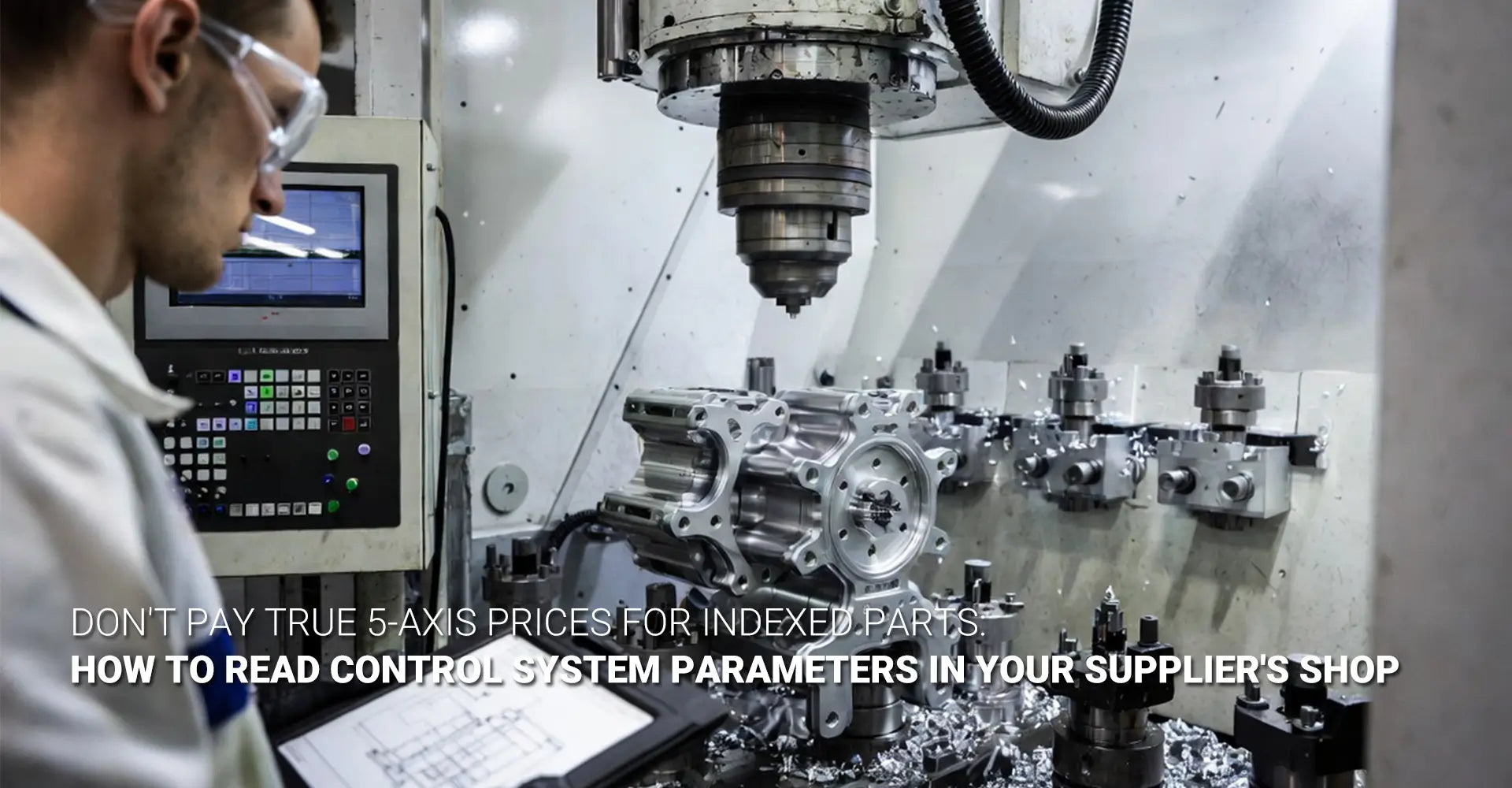
The CNC controller is the single most revealing spot on the shop floor. Everything a machine can do is registered in its control system. If a machine has true simultaneous 5-axis capability, the control will have a specific compensation function active during cutting. That function is called the RTCP function — Rotating Tool Center Point. Without it, simultaneous 5-axis motion produces constant tool tip errors, leading to gouges and inconsistent surface finish. RTCP is, as machinists often say, non-negotiable for true 5-axis work.
RTCP by Control Brand — What to Look For on the Screen:
| Control Brand | RTCP Function Name | Where to Find It |
|---|---|---|
| Heidenhain | M128 | Active in the status line during a 5-axis program |
| Siemens | TRAORI | Appears in the cycle/transformation list |
| Fanuc | G43.4 or G43.5 | Shown in the active G-code display |
Red Flag: The machine has B and C rotary axes — but no RTCP cycle appears anywhere in the control manual or on the screen during a live cut. That machine cannot perform true simultaneous 5-axis machining.

To understand why RTCP matters, consider what happens without it. As a rotary axis tilts, the position of the tool tip in space changes — even if the linear axes do not move. On a 3-axis machine, this is never an issue. But on a 5-axis machine cutting a freeform surface, the rotary axes are constantly changing angle. Without RTCP, the programmer must manually calculate the exact tool tip position for every angular increment. For a complex surface with thousands of tool path points, that is simply not practical.
RTCP solves this by automatically compensating for tool length and pivot point offsets in real time. The programmer writes the tool path as if the machine were a standard 3-axis setup. The control then handles all the rotary mathematics internally, keeping the tool tip exactly on the programmed surface.
This also has direct implications for post processor requirements. A proper 5-axis post processor must be configured to output RTCP-compatible code. A shop running 3+2 work does not need this. So when a supplier cannot show you RTCP-compatible post processing, that is a strong signal that simultaneous capability is absent. For precision custom CNC milling services involving complex surfaces, this distinction directly determines whether your part can be produced to specification.
A quick verification step during a factory visit: ask the operator to load a 5-axis program and point to the RTCP indicator on the control screen. If the operator hesitates, or the indicator is not present, you have your answer.
What Does the Rotary Table Hardware Tell You About True Simultaneous Capability?
After checking the control panel, move your attention to the machine's physical rotary axes. The drive system on these axes tells you immediately whether the machine can sustain smooth simultaneous motion under cutting load — or whether it can only index to fixed positions and lock in place. This is the second critical checkpoint in any 5 axis machine audit, and it requires nothing more than your eyes and, in some cases, your hand.
Direct Drive vs. Worm Gear — The Two-Second Test:
| Hardware Type | What You Hear | What You Feel | Simultaneous Capable? |
|---|---|---|---|
| Direct drive torque motor | Silent, smooth | Continuous, no vibration | ✅ Yes |
| Worm gear with brake | Click when brake releases | Jerky, stepped motion | ❌ No (3+2 only) |
Field test: Ask the operator to rotate the B-axis very slowly while you place your hand near the axis housing. A direct drive is smooth and continuous. A worm gear drive is jerky. You will feel the difference immediately.

Understanding machine tool kinematics helps here. A direct drive torque motor connects the motor directly to the rotary axis with no mechanical intermediate. There is no backlash, no gear lash, and no need for a mechanical brake to hold position. The motor holds the axis with electromagnetic force, even during a cut. This allows smooth, continuous motion at any feed rate — which is exactly what simultaneous 5-axis cutting requires.
A worm gear drive, by contrast, uses a gear reduction to rotate the axis. It requires a mechanical brake to hold the axis rigid during cutting. The brake must release before the axis can move and re-engage when it stops. This produces the characteristic click and the stepping motion you can feel. The axis can only move to discrete angular increments — often 5° or 15° steps — and cannot interpolate smoothly between angles under load.
You can also inspect the rotary table surface for clamping marks. On a 3+2 retrofit table that indexes in fixed steps, repeated clamping leaves small circular wear marks or discoloration around the common index positions. These marks are absent on a direct drive table, because the axis holds position without mechanical clamping.
Brand-level reference for buyers auditing machine specifications on the shop floor:
| Brand | True 5-Axis Model (Direct Drive) | 3+2 Budget Model (Worm Gear) |
|---|---|---|
| DMG MORI | DMU series | CMX with rotary add-on |
| Haas | UMC series (with RTCP option) | VF series with trunnion |
| Mazak | VARIAXIS series | VC series with rotary |
Always verify the specific model number and confirm whether RTCP was purchased as an option. On used machines, RTCP may have been available as a factory option but never activated.
B/C axis capability is another term worth checking. A machine with genuine B and C axis interpolation — meaning both axes can move simultaneously and continuously — is a direct indicator of true 5-axis hardware. A machine that only has an A and B axis that lock in place has 3+2 capability at best. Ask the supplier to specify which axes are available and whether they support simultaneous interpolation or positional indexing only.
What Questions Confirm 5-Axis Capability Without a Physical Visit?
Not every sourcing decision comes with a factory visit. Shipping schedules are tight, travel budgets are limited, and urgent RFQs sometimes require a quick decision. Fortunately, a well-structured remote verification process can reveal the same information as an in-person audit — if you know exactly what to ask. This section covers the four remote questions that work consistently, and explains what each answer reveals about simultaneous vs positional capability.
Four Remote Questions to Ask Any Supplier Before Issuing a PO:
- "What is the maximum feed rate with all five axes moving simultaneously?" A true 5-axis machine will have a documented simultaneous feed rate in its specification sheet. A 3+2-only machine has no answer to this question, because its rotary axes do not move during cutting.
- "What is the smallest angular increment your rotary axes can move?" True 5-axis: sub-degree, continuous interpolation. 3+2: 1°, 5°, or 15° fixed steps.
- "Can you send a screenshot of your control panel with RTCP active during a 5-axis program?" Look for M128, TRAORI, or G43.4 on the screen. If they cannot send this, they do not have it.
- "Does your machine specification sheet explicitly list 'simultaneous 5-axis' and 'RTCP'?" Request the document. If the sheet only says "5-axis ready" or "5-axis capable," that often means 3+2 only.
If a supplier refuses any of these requests, that refusal is your answer.

Remote verification also covers 5 axis cost optimization for your procurement team. Once you have confirmed capability, you can match the right machine to the right part — and pay accordingly.
For parts with only angled holes, simple compound faces, or flat pockets accessible from a tilted angle, 3+2 positional machining is entirely adequate. Insisting on true simultaneous for these features means paying $200/hr when $120/hr produces the same result. The savings on a mid-volume run are significant.
For parts with freeform sculpted surfaces — impellers, turbine components, complex mold cores — true simultaneous is not optional. A 3+2 shop will attempt the work, but the result will be poor surface finish, extended hand polishing time, and failed dimensional inspection. The cost of scrapped parts or rework far exceeds any savings on the hourly rate.
This logic forms the foundation of a sound procurement factory visit checklist. Before any visit or remote audit, classify your parts first:
- Requires true simultaneous: freeform surfaces, continuous contours, twisted geometry → verify RTCP + direct drive
- Adequate with 3+2: angled holes, flat faces from multiple setups, simple compound pockets → verify indexing accuracy and angular resolution
For CNC turning components that later require 5-axis milled features, the same logic applies: confirm that the milling step uses the correct capability class for the geometry involved.
Industries sourcing complex fabricated enclosures — including kitchen appliances and industrial machinery — increasingly require tight-tolerance multi-axis features. Knowing how to verify the capability behind the quote protects both quality and budget.
For buyers working across a range of CNC metals and plastics, the material also affects which capability class is appropriate. Titanium impellers demand true simultaneous with aggressive tool engagement control. Aluminium bracket drilling at a compound angle is entirely within 3+2 range.
Conclusion
Summary
The "5-axis" label on a supplier's website tells you very little. What tells you everything is what you find at two specific checkpoints — the control panel and the rotary axis hardware.
Here is what to remember:
- ✅ RTCP active (M128 / TRAORI / G43.4) = true simultaneous capability confirmed at the software level
- ✅ Direct drive torque motor, silent and continuous = true simultaneous capability confirmed at the hardware level
- ❌ No RTCP in the manual or on screen = 3+2 only, regardless of axis count
- ❌ Worm gear with brake, clicking and stepping = 3+2 only, regardless of what the brochure says
Pay simultaneous rates only for parts that require simultaneous motion. For simple compound angle features, 3+2 is correct — and so is a lower hourly rate. The informed buyer does not ask "Can you do 5-axis?" They ask "What kind of 5-axis, and can you prove it?" That question separates the capable shops from the rest.
Share this audit checklist with your sourcing team before the next factory visit or supplier qualification call.
External Links
[5 axis cnc machining factory][^1]
[true 5 axis vs 3+2 machining][^2]
[RTCP function] [^3]