Headphone Yokes Snap on the First Drop? Choosing the Right Aluminum Die Casting Manufacturer
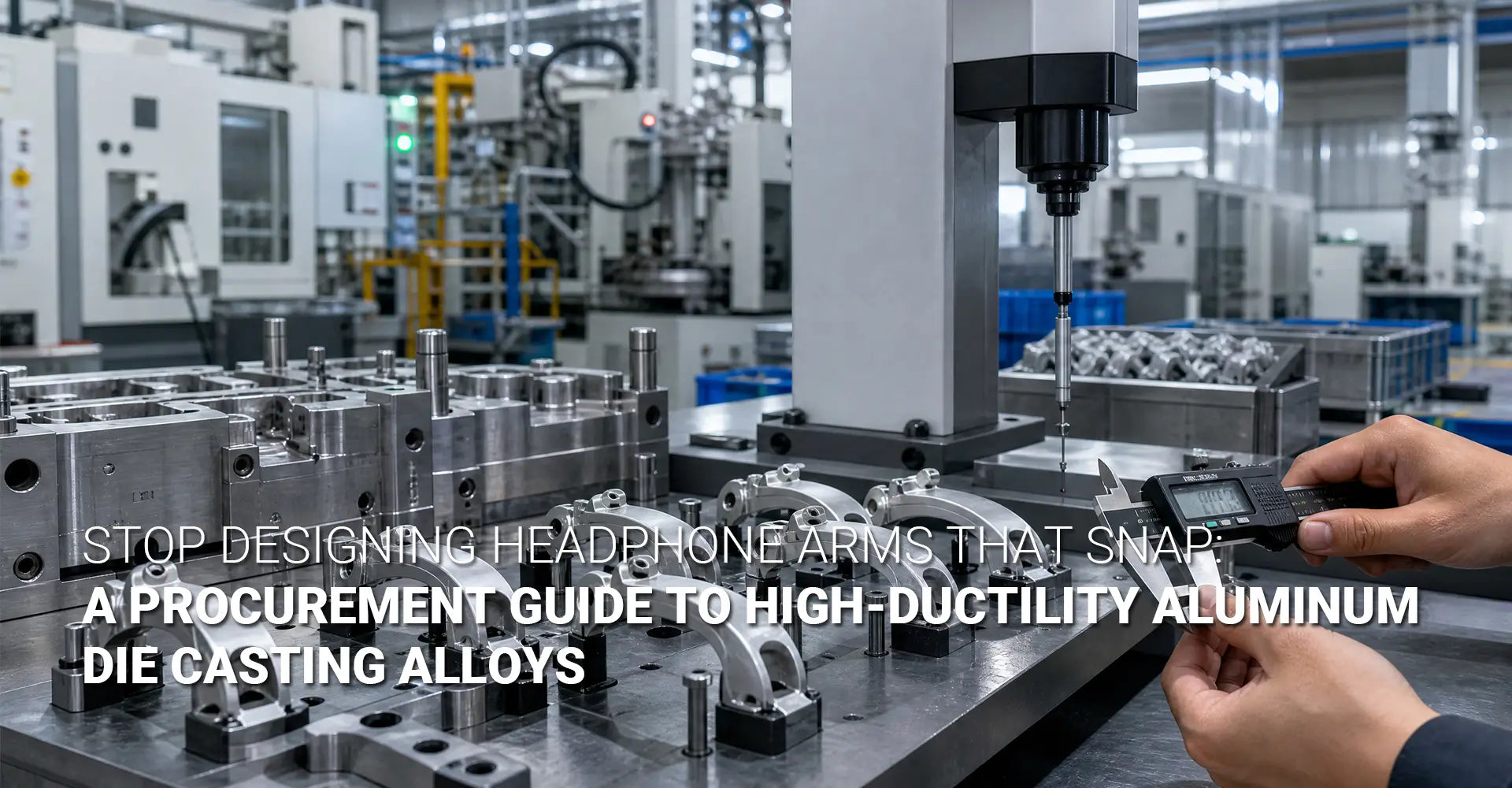
Headphone Yokes Snap on the First Drop? Choosing the Right Aluminum Die Casting Manufacturer
KEY TAKEAWAYS
- Why do some headphone yokes break so easily? Many are made from ADC12, a low-cost alloy with only 2 to 4 percent elongation.
- What alloy performs better in drop tests? AlSi10MnMg, with 6 to 12 percent elongation, gives far more give before it cracks.
- How much does drop test performance improve? Field data points to over 40 percent higher pass rates with the tougher alloy.
- Does the tougher alloy cost more? Yes, roughly 10 to 20 percent more per part, but fewer returns can offset that.
- Who should read this? Procurement managers sourcing headphone yokes, arm brackets, or similar structural parts.
Dropping your headphones should not mean replacing them. Yet many people who own premium wireless headphones share the same story online: the headband flexes once too often, or the unit slips off a desk, and the yoke, the small metal arm that connects the earcup to the headband, snaps clean in half. This is not bad luck. It is usually a material choice made early in production, long before the headphones ever reached a store shelf. The part that failed was likely cast by an aluminum die casting manufacturer using a low-cost alloy that was never built for repeated stress or sudden impact.

Quick answer: The most common cause of headphone yoke failure is ADC12 aluminum, a brittle die casting alloy with only 2 to 4 percent elongation at break. Switching to AlSi10MnMg, a high-ductility alloy also known as Silafont-36, can raise drop test pass rates by more than 40 percent because it bends under stress instead of cracking. The trade-off is a modest 10 to 20 percent material cost increase, which most manufacturers recover through fewer warranty claims.
So why does this happen so often, and what can procurement teams do about it? The answer comes down to a single material property called elongation, and understanding it can change how you specify every structural die cast part you order. Let's walk through what causes these failures, why one alloy performs so differently from the other, and how to write a specification that protects your product from day one.
TABLE OF CONTENTS
- What Makes ADC12 So Brittle for Headphone Parts?
- What Is AlSi10MnMg and Why Is It Tougher Than ADC12?
- How Do ADC12 and AlSi10MnMg Compare in Drop Test Performance?
- What Should Procurement Managers Ask Before Switching Alloys?
- Choosing an Alloy That Survives Real-World Drops
WHAT MAKES ADC12 SO BRITTLE FOR HEADPHONE PARTS?
ADC12 is one of the most common die casting alloys in the world, and there is a good reason for that. It flows well into a mold, it machines cleanly, and it costs less than most alternatives. Because of this, many suppliers reach for it by default, even when the part will face impact or constant flexing, like a headphone die casting arm bracket that opens and closes hundreds of times a year.
Quick answer: ADC12 is inexpensive and easy to cast, but its high iron content makes it brittle. That trade-off works fine for parts that just sit still, but it fails for parts that bend or take a hit.

The trouble starts with chemistry. ADC12 typically contains 0.8 to 1.3 percent iron. During casting, that iron forms sharp, needle-shaped particles inside the metal. These needles act like tiny cracks waiting to happen. When the part is struck or flexed, stress concentrates around these needles, and the metal fails suddenly rather than bending first. This is known as an ADC12 brittle fracture, and it explains why a dropped headphone yoke often shatters into pieces instead of simply denting. For a stationary bracket or housing, this weakness rarely matters. But for a headphone yoke die casting that flexes every time someone puts the headphones on, it is a real design risk.
WHAT IS ALSI10MNMG AND WHY IS IT TOUGHER THAN ADC12?
If ADC12 is the industry default, AlSi10MnMg is the alloy that automakers turn to when a part absolutely cannot shatter. It was developed for structural components in vehicles, including parts that must survive a crash without breaking apart.
Quick answer: AlSi10MnMg keeps iron content extremely low and adds controlled manganese, which produces a much more ductile, crack-resistant structure than ADC12.
The chemistry tells the whole story. Because AlSi10MnMg holds iron below 0.15 percent, it avoids the sharp intermetallic needles that weaken ADC12. Manganese, held between 0.50 and 0.80 percent, neutralizes any remaining iron by forming small, rounded particles instead of jagged ones. The alloy also skips copper, which would raise strength slightly but reduce toughness and corrosion resistance. This is what makes AlSi10MnMg high toughness aluminum so different from a standard die casting alloy: it bends before it breaks. Even better, it reaches 6 to 12 percent elongation in the as-cast state, so no heat treatment step is required to get there. Some suppliers market Silafont-36 headphone parts specifically because the name is trademarked by Rheinfelden Alloys, though other producers sell chemically similar versions such as trimal-05 or Aural-2.
HOW DO ADC12 AND ALSI10MNMG COMPARE IN DROP TEST PERFORMANCE?
Numbers make the difference easy to see. When you place these two alloys side by side, the gap in performance is not small. It is the kind of gap that shows up directly in a product's return rate.
Quick answer: AlSi10MnMg offers two to three times the elongation of ADC12, comparable strength, and a dramatic jump in impact toughness.
Here is what the testing data shows:
- Elongation at break: ADC12 sits at 2 to 4 percent, while AlSi10MnMg reaches 6 to 12 percent in its as-cast form. This single number is the best predictor of whether a part survives impact.
- Tensile strength: ADC12 measures around 320 MPa, and AlSi10MnMg lands between 280 and 310 MPa. The strength is close enough that you are not giving up much to gain far greater ductility.
- Impact toughness: In Charpy impact testing, AlSi10MnMg has shown values 1.5 to 3.7 times higher than ADC12, meaning it absorbs far more energy before it cracks.
- Drop test results: Manufacturers switching to the tougher alloy have reported pass rate improvements of 40 percent or more on structural die casting components subjected to repeated drop testing.
Put simply, ADC12 wins on cost and ease of casting, but AlSi10MnMg wins on almost everything related to surviving daily use. For any audio equipment die casting that customers will handle, fold, or occasionally drop, that trade-off usually favors the tougher alloy.
WHAT SHOULD PROCUREMENT MANAGERS ASK BEFORE SWITCHING ALLOYS?
Choosing a better alloy is only half the job. The other half is making sure your supplier actually delivers it, with a specification tight enough that it cannot be quietly substituted.
Quick answer: Ask for the exact chemical composition, the mechanical properties in the as-cast state, and confirmation that no heat treatment shortcuts have been taken.
Start with the paperwork. Your purchase order or drawing should read something like this:
"Material: AlSi10MnMg high-ductility aluminum die casting alloy. Conforms to EN AC-43500 (Silafont-36 / trimal-05 equivalent). Iron content 0.15 percent maximum, Manganese 0.50 to 0.80 percent. Mechanical properties in as-cast (F) state: UTS 280 MPa minimum, Elongation 6 percent minimum."
A clear specification like this leaves little room for a supplier to swap in a cheaper alloy without you noticing. Beyond the material call-out, a few design and cost questions deserve attention too:
- Cost impact: Expect a 10 to 20 percent material premium, mostly because the low iron limit requires primary aluminum rather than recycled stock.
- Processing changes: AlSi10MnMg needs a higher casting temperature, typically above 680°C compared to roughly 640°C for ADC12.
- Design freedom: Because the material absorbs more energy before failing, walls can sometimes run thinner, and fewer reinforcing ribs may be needed.
- Finishing limits: This alloy is not well suited to decorative anodizing, so if a bright finish matters, discuss options with your finishing partner early. Hotean's surface finishing services can help you confirm which coatings will hold up on this alloy before tooling begins.
It also helps to loop in your die casting partner early, since mold flow and gate placement both shift slightly with this alloy. A supplier experienced in die casting production, and comfortable running both CNC machining for post-cast finishing, can walk you through these adjustments before the first sample ever gets cast.
CONCLUSION
CHOOSING AN ALLOY THAT SURVIVES REAL-WORLD DROPS
At the end of the day, a headphone yoke has one job: hold the earcup in place through years of everyday handling. A brittle alloy chosen only for its low price cannot do that job well, no matter how clean the finish looks on day one. The gap between ADC12 and AlSi10MnMg is not a minor technical footnote. It is the difference between a part that survives a drop and one that ends up in a landfill.
For teams sourcing consumer electronics aluminum parts, the lesson is simple. Do not default to whatever alloy is cheapest per kilogram. Look at how the part will actually be used, then match the material to that reality. A 10 to 20 percent cost increase on the front end is a small price to pay compared to warranty claims, one-star reviews, and lost customer trust. If your current supplier cannot explain their alloy chemistry in detail, or cannot confirm mechanical properties in writing, that is worth a second look.
Working with a manufacturer who also understands electronics manufacturing end to end can make this transition easier, since alloy selection, tooling, and finishing all need to line up before mass production begins. Ask questions, request test data, and put the specification in writing. Your product, and your customers, will notice the difference.
RECOMMENDED EXTERNAL RESOURCES
European Aluminium Association, Alloy Designation Standards (EN AC-43500): https://www.european-aluminium.eu/
ASM International, Aluminum Casting Alloy Properties Database: https://www.asminternational.org/
[AlSi10MnMg high toughness aluminum][^1]
[high elongation aluminum alloy][^3]
[structural die casting components][^4]
[^1]: MakeItFrom.com – material property database listing EN AC-43500 (AlSi10MnMg) cast aluminum with comprehensive mechanical data, including ultimate tensile strength ranges of 260–348 MPa, yield strength of 140–200 MPa, and elongation of 6–11% depending on heat treatment and casting conditions[reference:3][reference:4][reference:5].
[^2]: A 2009 peer-reviewed paper (Japan Foundry Engineering Society) proposing a cold crack criterion for JIS ADC12. It defines a critical temperature to ductility (≈573K) and demonstrates that thermal stress simulation can predict cold cracking when equivalent plastic strain exceeds the fracture strain below this threshold. [5†L7-L23][6†L5-L20]
[^3]: A technical specification page for **AlSi10MnMg (EN AC-43500)**—the reference alloy for automotive mega-castings (Tesla, BMW, Mercedes-Benz). Copper-free design with **6–12% elongation in as-cast state** without heat treatment. Manganese (0.50–0.80%) neutralizes iron by forming compact Al₁₅(Mn,Fe)₃Si₂ intermetallics instead of brittle needles. [11†L5-L9][11†L22-L27][11†L37-L40]
[^4]: Foundry Trade Journal feature article discussing the growing adoption of structural die casting components in the automotive industry, with applications in Audi A8, BMW 7 Series, and Mercedes S-Class, replacing multiple steel components with single aluminum die castings to reduce vehicle weight.[reference:2]