Can Handheld Laser Welding Keep Stainless Steel Enclosures Flat Within 0.5mm?
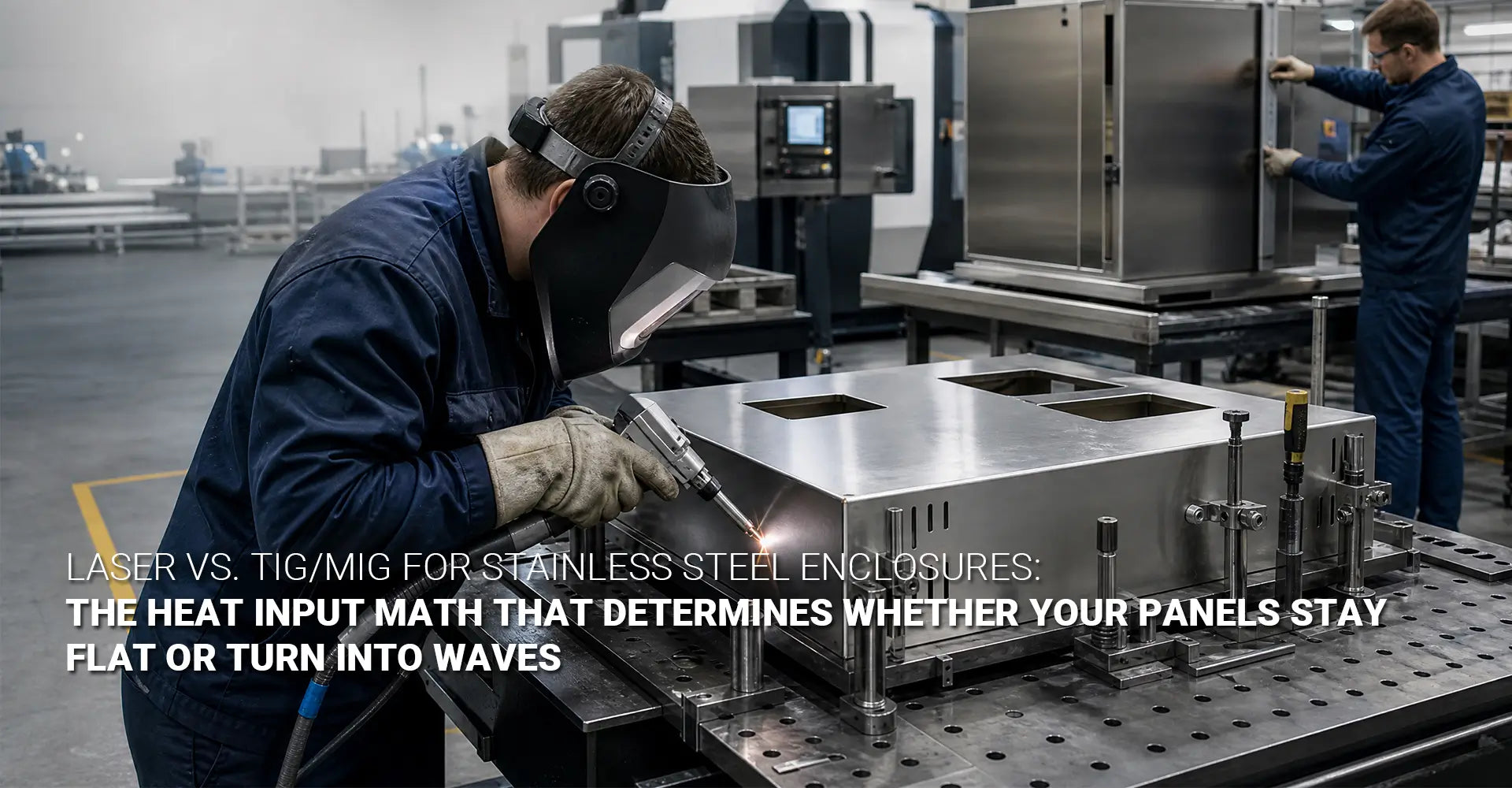
Can Handheld Laser Welding Keep Stainless Steel Enclosures Flat Within 0.5mm?
If you have ever pulled a welded stainless panel off the line and seen waves running across the surface, you already know the problem. Thin stainless steel warps fast under too much heat. And once it warps, it is hard to fix without extra grinding, extra labor, and extra cost.
This is one of the most common headaches for buyers of stainless enclosures, cabinets, and equipment housings. So the question is simple: can a different welding process actually solve it? The short answer is yes. Handheld laser welding keeps thin stainless steel flat because it puts far less heat into the metal than TIG or MIG welding does. That single difference changes almost everything downstream, from flatness to finishing time to total part cost.

Quick Answer: What You Need to Know Before You Choose a Welding Process
Here is the short version, so you can act on it right away.
| Factor | TIG / MIG Welding | Handheld Laser Welding |
|---|---|---|
| Heat input on 18-gauge stainless | Baseline | About 50% less |
| Distortion on 0.5mm panels | Often exceeds 1mm | Typically under 0.5mm |
| Heat-affected zone width | 3–8mm (TIG), 5–10mm (MIG) | 0.5–2mm |
| Welding speed on thin stainless | Baseline | Up to 4× faster |
| Post-weld finishing | Grinding and polishing needed | Minimal to none |
| Operator skill required | Certified welder, years of training | General operator, short training |
| Labor cost | Baseline | Cut by 60%+ |
| Power consumption | Baseline | 80–90% lower |
If your parts are thin stainless, under 2mm, and need to stay flat, laser welding is very likely the right sheet metal welding service for the job. Keep reading to see the physics behind these numbers, and how to check whether your supplier can actually deliver them.
Now that you have the headline numbers, let's look at why heat, not welder skill, is really the cause of warped panels.
Table of Contents
- Why Does Thin Stainless Steel Warp Under TIG and MIG Welding?
- What Makes Handheld Laser Welding Different From TIG and MIG?
- How Flat Can Laser Welding Really Keep a Stainless Steel Enclosure?
- Does Laser Welding Lower the Total Cost of Sheet Metal Fabrication?
- Conclusion
Why Does Thin Stainless Steel Warp Under TIG and MIG Welding?
Picture a technician welding a seam on a thin stainless panel. The weld looks fine at first. But an hour later, the whole sheet has a visible wave in it. This happens on shop floors every day, and it is not a sign of poor welding skill. It is a sign of too much heat going into too little metal.
Thin stainless steel has very little mass to absorb heat. So when a welder applies a high-heat process like TIG or MIG, the metal near the weld expands quickly. Then, as it cools, it contracts unevenly. That uneven contraction pulls the panel into a wave shape. Once the metal cools fully, the warp is locked in place. Grinding or hammering the panel flat afterward is slow, and it often leaves visible marks on the surface.
The size of this problem depends heavily on the heat-affected zone, or HAZ. This is the area of metal next to the weld that gets hot enough to change its properties, even though it never actually melts. A wider HAZ means more metal expands and contracts, so more distortion follows.
Here is how the two processes compare on that measurement:
- TIG welding: HAZ of roughly 3–8mm
- MIG welding: HAZ that can exceed 5–10mm
- Laser welding: HAZ of only 0.5–2mm
A narrower HAZ means less of the surrounding stainless steel ever heats up. As a result, less of the panel expands, and less of it needs to contract as it cools. This single fact explains most of the flatness gap between laser and arc-based welding methods. It is also the starting point for real thin sheet distortion control and consistent heat-affected zone reduction across a production run.
What Makes Handheld Laser Welding Different From TIG and MIG?
So why does laser welding create such a narrow HAZ in the first place? The answer comes down to how the energy actually reaches the metal.
TIG and MIG welding use an electric arc. That arc spreads heat across a fairly wide area, similar to holding a torch close to a surface. Laser welding works differently. It uses a fiber laser, usually at a wavelength around 1,064 nanometers, focused down to a very small, precise point. Because the energy is so concentrated, it heats a much smaller area of metal.
This creates what welders call the "keyhole" effect. The focused laser beam is intense enough to vaporize a narrow channel straight into the metal. That channel lets the laser reach full penetration depth without spreading heat sideways into the surrounding material. TIG and MIG, by contrast, rely on melting a wider pool of metal from the surface down, which naturally pushes heat outward into the base material.
Put simply, laser welding delivers energy like a pinpoint, while TIG and MIG deliver it more like a wide brush. That is the core reason handheld laser welding stainless steel panels stay flatter than panels welded with older arc-based methods. It also explains most of the practical differences you will read about next in any laser welding vs TIG/MIG comparison.
How Flat Can Laser Welding Really Keep a Stainless Steel Enclosure?
Numbers matter more than marketing claims, so let's look at real measurements. On 0.5mm stainless steel, laser welding with rigid fixturing typically holds distortion below 0.5mm across a full panel. That is a tight, usable tolerance for enclosures, cabinets, and equipment housings.
TIG welding on the same material tells a different story. Angular distortion on TIG-welded thin stainless panels often exceeds 1mm. On a large panel, that difference is easy to see with the naked eye. It shows up as a visible wave or bow once the part is placed on a flat surface.
Speed is the other major advantage, and it compounds the cost savings from flatness. On 2mm stainless steel butt joints, handheld laser welding runs up to four times faster than TIG. One documented example: a 1.5kW handheld laser system produced full-penetration welds on 3mm stainless at speeds over 1.2 meters per minute. TIG, on the same joint, typically runs at only 0.3 to 0.4 meters per minute. That kind of laser welding speed advantage adds up quickly across a full production run.
Flatness and speed also change what happens after the weld is finished. Laser welding produces a smooth, spatter-free bead. On brushed stainless finishes, the narrow HAZ does not spread past the weld line by more than 2–3mm. That keeps the original brushed texture intact almost everywhere on the panel. So instead of re-polishing an entire enclosure, a technician only needs to touch up a thin strip along the seam. For any shop doing serious stainless steel enclosure fabrication, that difference alone can justify post-weld grinding elimination as a stated production goal, not just a nice bonus.
If your enclosures also need a specific texture or protective coating after welding, it helps to plan the whole finishing sequence together. Hotean's surface finish services page covers how post-weld finishing choices connect to the welding process itself.
Does Laser Welding Lower the Total Cost of Sheet Metal Fabrication?
Flatness is only part of the financial picture. The bigger story is what laser welding does to total production cost, from labor to energy to rework.
Start with labor. TIG welding requires a certified welder with years of hands-on training, especially for code-quality work on stainless steel. Handheld laser welding is much easier to learn. A general operator can become proficient with a short training period, not years of practice. That difference alone drives labor cost reductions of more than 60%. In some shops, a single laser welding unit can effectively do the work that once required up to three certified TIG welders.
Energy use tells a similar story. Traditional arc welding does not convert electricity into usable weld energy very well. Laser systems have a much higher photoelectric conversion rate, which means they use 80% to 90% less power to produce a comparable weld. On a facility running multiple shifts, that adds up on the electric bill every single month.
Add these savings together with reduced consumables (no tungsten electrodes to replace) and the near-elimination of post-weld grinding, and total processing costs can drop by up to 30%. That is a meaningful number for any buyer trying to control sheet metal fabrication cost reduction across a large order or a repeat production contract.
Of course, none of these numbers help unless your supplier can actually deliver them. Before you commit to a source for industrial enclosure welding or stainless steel cabinet manufacturing, it is worth asking a few direct questions:
"What fixturing do you use for thin stainless panels, and what distortion range do you typically see on 0.5–1.5mm material?" A confident supplier will answer with a specific number, such as "under 0.5mm" or "under 1mm." Vague answers are a warning sign.
"Do you use pulsed or continuous wave laser welding for thin materials?" Pulsed laser welding generally offers better distortion control, cutting welding deformation by roughly 57% compared to continuous wave laser welding.
"Can you share flatness measurement data from a recent, similar enclosure project?" Real project data tells you far more than a general sales pitch.
A supplier who can walk through these answers with real numbers understands the process well. One who simply says "it's usually fine" is guessing, and guessing is expensive once a batch of panels ships with visible warp.
If your enclosure design is still in the prototype stage, it also helps to test fit and finish before committing to full production tooling. Hotean's rapid prototyping services let you validate flatness and fit on a small batch first.
Conclusion
Thin stainless steel does not have to warp. The root cause of most panel distortion is simple: too much heat going into too little metal, too fast. TIG and MIG welding both introduce more heat than thin stainless can handle without shifting shape. Laser welding solves this by focusing energy into a small, precise point, cutting heat input roughly in half and shrinking the heat-affected zone down to a fraction of TIG's width.
The result is measurable. Distortion under 0.5mm on thin panels. Welding speeds up to four times faster. Labor costs cut by more than 60%. Power use down 80–90%. And in most cases, no need for full-panel post-weld polishing.
That said, laser welding is not the answer for every job. If your parts require very long weld seams, over 1.5 meters, on material 2mm or thicker, TIG can still hold its own. But for typical industrial enclosures, cabinets, and equipment housings in the 0.5–2mm range, laser welding is now the practical standard, not just an alternative worth considering.
Before you place your next order, ask your supplier about their laser welding capability, their fixturing approach, and their real distortion measurements on parts similar to yours. The difference between a wave-finished panel and a flat, clean enclosure is visible the moment you set it on a table, and the cost math almost always favors the flatter option.
If you are sourcing enclosures, panels, or custom housings and want a partner who can speak to these numbers directly, Hotean's sheet metal fabrication team works with stainless, aluminum, and steel across a range of thicknesses. For broader industrial equipment components beyond enclosures, the industrial machinery page covers related capabilities, and the sheet metals overview walks through material options for your next project.
Further Reading
[laser welding vs TIG/MIG][^1]
[thin sheet distortion control][^2]
[heat-affected zone reduction][^3]
[stainless steel enclosure fabrication][^4]
[post-weld grinding elimination][^5]
[laser welding speed advantage][^6]
[^1]: Miller Electric's comprehensive comparison of handheld laser welding versus TIG and MIG. Laser welding introduces **roughly 50% of the total heat** that TIG or MIG would put into the same 18-gauge carbon steel part, producing a narrow heat-affected zone (HAZ) with minimal distortion and no arc-related spatter[reference:0]. TIG applies heat across a wider area with slower travel speed, causing more warping on light-gauge sections[reference:1]. MIG moves faster than TIG but its arc still covers a larger area than a laser's focused beam[reference:2].
[^2]: Canadian Metalworking's case study on laser welding evolution. A customer's part that took 35 minutes with TIG (20 min welding + 15 min grinding) was reduced to **1.5 minutes with laser welding**—no finishing required[reference:10]. Less heat input results in lower distortion, and finishing can consume up to 50 minutes just on edges[reference:11][reference:12]
[^3]: A technical guide from Olympus Technologies (UK) detailing how collaborative robot (cobot) laser welding reduces the heat-affected zone (HAZ) by up to 90% compared to TIG welding—from approximately 5mm down to under 0.5mm on 1.5mm stainless steel[reference:0]. The article covers six core process parameters (laser power, travel speed, spot size, pulse shaping, focus position, and shielding gas) and provides specific parameter examples for achieving different HAZ profiles on 304 stainless steel[reference:1][reference:2].
[^4]: A Made in Britain directory listing for Hocklynn Sheet Metal & Fabrication, a Bristol-based sheet metal fabrication company established in 1972 with over 50 years of British manufacturing experience[reference:10]. Capabilities include CNC laser cutting, CNC press brake folding, MIG/TIG welding, insertion, assembly, and powder coating for enclosures, housings, panels, and fabricated components in mild steel, stainless steel, and aluminium[reference:11].
[^5]: The Fabricator details how Estes Design & Manufacturing adopted laser welding specifically to eliminate the post-weld grinding bottleneck—a process that not only increased labor costs but slowed overall part flow. The laser welding system has allowed the fabricator to "reduce the grinding and graining time greatly and, for some jobs, eliminate it entirely." [9†L23-L27]
[^6]: Dato Laser reports that laser welding systems routinely operate at speeds of 1–10 meters per minute depending on material type and thickness, while manual TIG welding might proceed at 100–150 mm per minute. A component requiring 60 seconds of arc welding can often be completed in 6–10 seconds with laser technology—representing a 6–10× improvement in direct processing time. [12†L50-L57]