Why Is Your CNC Insert Chipping on Die Cast Aluminum — And Is Your Melt Actually Clean?
Why Is Your CNC Insert Chipping on Die Cast Aluminum — And Is Your Melt Actually Clean?
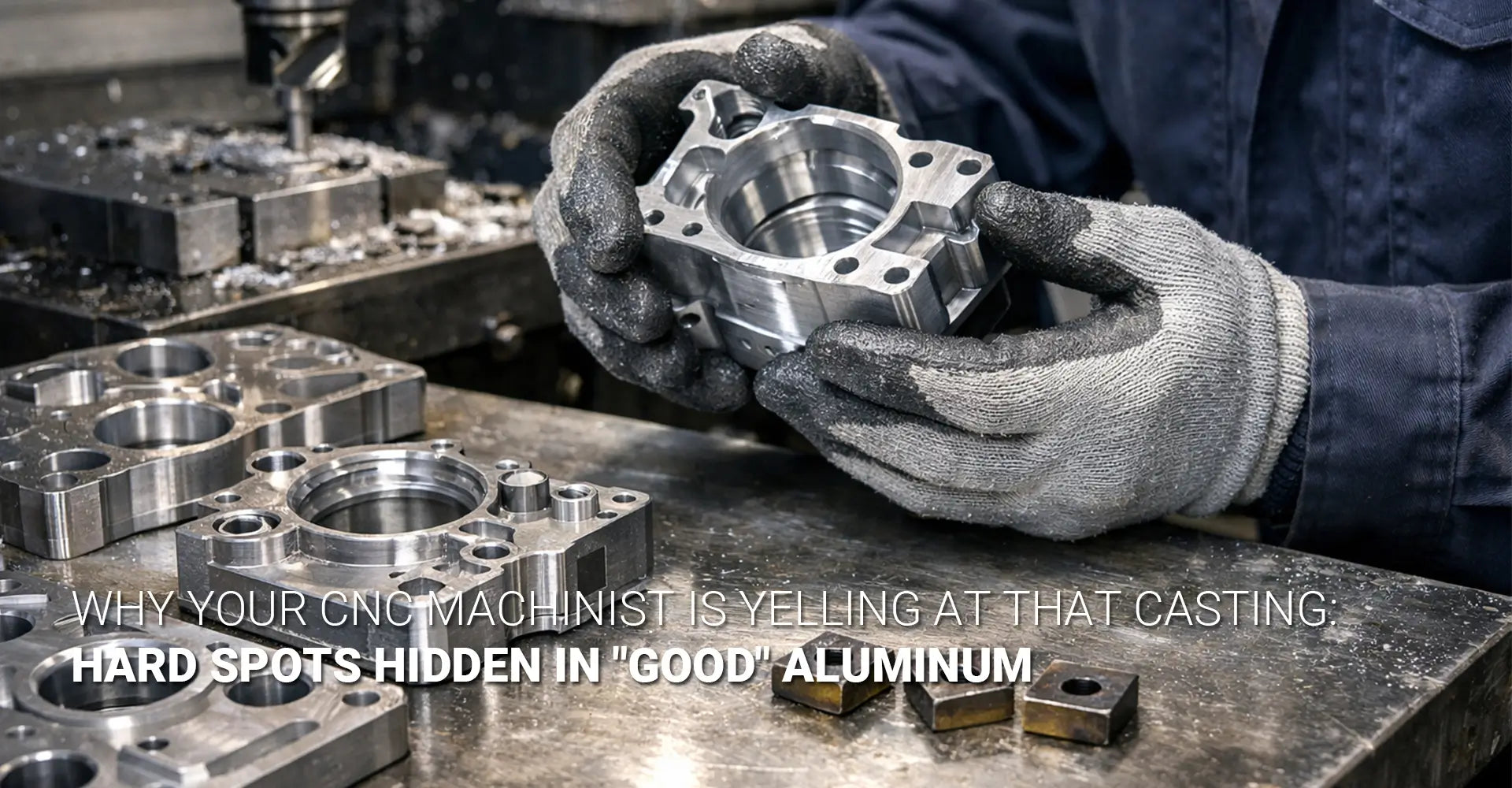
If you run a machine shop, you know the feeling. A fresh insert goes in. The program starts. Then — crack — another edge gone. The part looks fine. The feeds and speeds are right. But something inside that casting just ate your tooling alive. So what is really going on?

The short answer: Your aluminum casting may contain hidden ceramic particles — called oxide inclusions — that are nearly as hard as your carbide insert. No amount of feed adjustment will fix a melt quality problem. The solution starts at the foundry, not the CNC machine.
Machining die cast aluminum is one of the most common — and most misunderstood — manufacturing challenges today. The frustration is real. The damage is measurable. And the fix is simpler than most machinists expect.
Quick Reference: Hard Spots at a Glance
| Factor | Detail |
|---|---|
| What are hard spots? | Oxide inclusions (Al₂O₃) trapped in the casting |
| How hard are they? | 1,500–2,000 HV — vs. 60 HV for aluminum |
| What causes them? | Poor melt treatment, turbulence, and inadequate degassing |
| What do they destroy? | Carbide inserts, toolholders, spindle bearings, finished parts |
| How are they prevented? | Rotary degassing + ceramic foam filtration + RPT testing |
| Can you see them? | Rarely — they look like sand grains inside a clean casting |
| Who is responsible? | The die caster — melt quality is a foundry problem |
Table of Contents
- What Exactly Is a Hard Spot in Die Cast Aluminum — And Why Is It Not Porosity?
- Where Do Hard Spots Come From — What Happens Inside the Melt?
- How Does the Aluminum Degassing Process Actually Remove Hard Spots?
- What Is the Real CNC Cost of Ignoring Melt Quality in Die Casting — Is It Worth Specifying?
- Conclusion & Checklist
- FAQ
Sub-heading 1: What Exactly Is a Hard Spot in Die Cast Aluminum — And Why Is It Not Porosity?
Most machinists reach for the same explanation when an insert fails without warning: porosity. It is a reasonable guess. Porosity is common in die casting. It is visible under magnification. And it does cause surface defects. But porosity does not break carbide edges. Hard spots in aluminum casting are a completely different problem — and confusing the two leads shops to the wrong fix every time.
Here is what you need to know right away:
Hard spots are oxide inclusions — particles of aluminum oxide (Al₂O₃) — that form when molten aluminum contacts air. They are ceramic by nature. They are extremely hard. And they are nearly invisible inside a finished casting.
| Material | Vickers Hardness (HV) |
|---|---|
| Aluminum alloy (A380) | ~60 HV |
| Carbide insert (coated) | ~1,800 HV |
| Aluminum oxide inclusion (Al₂O₃) | 1,500–2,000 HV |
| Diamond | ~10,000 HV |
Bottom line: When your insert hits an oxide inclusion, it is essentially cutting ceramic with ceramic. Edge chipping or sudden fracture follows almost immediately.
This is oxide inclusions machining — and it is why die casting defect tool breakage often looks sudden, random, and impossible to predict.

So why do so many shops misdiagnose hard spots as porosity? Because porosity vs hard spots share a few surface similarities — both are internal defects, both are invisible before machining, and both show up as part failures. But the comparison ends there.
Porosity is gas — hydrogen bubbles trapped during solidification. It creates voids. Those voids cause surface pitting and reduce part strength. But they do not destroy cutting edges. A tool passes through a pore and keeps cutting.
Hard spots (oxide inclusions) are solid ceramic particles. They have sharp, irregular edges. They do not compress or move. When a cutting edge contacts one, the impact is instantaneous — and the result is ceramic particle tool wear that looks nothing like normal flank wear.
How to tell them apart on the insert:
- Normal wear: Gradual, uniform flank wear. Predictable tool life.
- Hard spot failure: Sudden chipping. A visible impact crater at one specific point on the edge. Possible embedded speck at the failure site on the machined surface.
Standard X-ray inspection — commonly used to check castings for porosity — is also largely ineffective for detecting small oxide inclusions. That matters, because it means a casting can pass quality inspection and still destroy tooling on the floor.
Where Do Hard Spots Come From — What Happens Inside the Melt?
Hard spots do not appear by accident. They are created — through specific, identifiable events that happen inside the foundry long before your casting reaches the machine. Understanding the melt story is the first step toward preventing tooling damage on the shop floor. And it starts with understanding what molten metal treatment decisions are actually being made — or skipped — by your die caster.
Three main causes of hard spots in die cast aluminum:
- Surface oxidation during melting — Aluminum forms an oxide skin the moment it contacts air. If this skin is broken and mixed back into the melt during stirring or charging, oxide particles become suspended throughout the liquid metal.
- Turbulence and vortexing during transfer — Pouring or pumping molten aluminum too aggressively creates a vortex. That vortex pulls the oxide surface film downward into the bulk melt — folding contamination directly into the metal that will fill your die.
- Inadequate degassing practice — Incomplete or rushed degassing leaves both hydrogen gas and suspended oxide particles in the melt. A foundry that cuts its degassing cycle short to save time is creating the hard spots you will find with your inserts tomorrow.
Key insight: Every one of these causes is controllable. Hard spots are a process failure — not an inevitable property of aluminum.
Let us go one level deeper on each cause — because understanding the mechanism helps you ask the right questions when auditing a supplier.
Surface oxidation is unavoidable when aluminum is molten. Every exposed surface forms Al₂O₃ almost instantly. The problem is not oxidation itself — it is what foundries do with that oxide layer. Aggressive charging, improper skimming, or using contaminated scrap with high oxide content all increase the risk of oxide entrainment. Higher-magnesium alloys (500-series, A356) oxidize faster and are therefore more prone to inclusion formation than lower-magnesium alloys like A380.
Vortexing is particularly dangerous because it is self-amplifying. Once a vortex starts during ladle transfer or pump discharge, it continuously draws the surface oxide skin into the stream. The result is a melt that appears visually clean on the surface but is heavily contaminated throughout its volume.
Degassing practice is where the most variation exists between foundries. A foundry using a simple lance (a tube blowing nitrogen into the melt from the side) achieves far less inclusion removal than one using a rotary degassing unit with controlled rotor speed and inert gas flow. The difference is not just hydrogen removal — it is the mechanical action that lifts and floats out suspended oxide particles.
For industrial machinery components where tight tolerances and tool life matter, these melt process differences translate directly into part quality and machining cost.
How Does the Aluminum Degassing Process Actually Remove Hard Spots?
Here is the misconception that costs machine shops the most money: many people believe the aluminum degassing process only removes hydrogen to prevent porosity. That is partly true — but it misses half the picture. Proper degassing, done correctly, is also the primary mechanism for inclusion removal casting operations rely on. Choosing a caster that understands both functions is the single most impactful decision you can make for your machining operation.
The three-layer solution to melt cleanliness:
| Step | Method | What It Does |
|---|---|---|
| 1. Rotary Degassing | Inert gas (Ar or N₂) injected via spinning rotor | Removes hydrogen AND floats oxide inclusions to surface |
| 2. Ceramic Foam Filtration | 30 PPI minimum ceramic foam filter at die inlet | Physically captures inclusions before metal enters die |
| 3. Melt Cleanliness Verification | Reduced Pressure Test (RPT) on each melt batch | Confirms inclusion level before casting begins |
Specification tip: Require all three steps in your purchase order — not just degassing. Rotary degassing without filtration still allows some inclusions through.
This is how melt cleanliness die casting is achieved at foundries that take it seriously. Any supplier that cannot describe all three steps in detail deserves a follow-up conversation.
How rotary degassing removes inclusions (not just gas):
When a rotary degassing rotor spins in the melt, it breaks inert gas into thousands of tiny bubbles. Those bubbles rise through the melt. As they rise, they do two things simultaneously:
- They absorb dissolved hydrogen from the surrounding aluminum (reducing porosity risk).
- They contact suspended oxide particles. The oxide particles — being non-wetting in aluminum — preferentially attach to the gas-liquid interface of each bubble and ride it to the surface.
This is why degassing cycle time matters. A 5-minute cycle removes far fewer inclusions than a 12–15 minute cycle. And rotor speed matters too — too slow means large, fast-rising bubbles that miss many particles; properly controlled speed creates small, slow-rising bubbles with maximum contact time.
Ceramic foam filtration acts as the second barrier. Even after excellent rotary degassing, some fine inclusions remain suspended. A ceramic foam filter (minimum 30 PPI — pores per inch) installed at the die inlet physically traps these particles before the metal enters the cavity. The filter is a consumable — and some cost-cutting foundries skip it or reuse filters, which defeats the purpose entirely.
The Reduced Pressure Test (RPT) is the verification tool. A small melt sample is solidified under vacuum. Under reduced pressure, any remaining hydrogen expands and forms visible pores — and oxide clusters appear as dark specks in the fractured sample. A clean RPT sample shows a dense, uniform cross-section. A contaminated one reveals the problem before a single casting is poured.
For automotive components where part rejection costs are extremely high, demanding RPT results from each melt batch is a standard quality practice that pays for itself quickly.
What Is the Real CNC Cost of Ignoring Melt Quality in Die Casting — Is It Worth Specifying?
Let us talk numbers. Because at some point, every procurement manager asks the same question: is specifying melt quality really worth the extra cost per casting? The answer becomes very clear when you add up what CNC insert chipping aluminum actually costs — not just in inserts, but in everything downstream.
Side-by-side cost impact — clean melt vs. contaminated melt:
| Cost Category | Clean Melt Casting | Contaminated Melt Casting |
|---|---|---|
| Insert life (parts per edge) | ~2,000 parts | ~200 parts |
| Insert replacement frequency | Low, predictable | High, unpredictable |
| Scrapped castings (hard spot found after machining) | Rare | Frequent — total part loss |
| Unplanned downtime per shift | Minimal | Multiple tool change stops |
| Risk of spindle/toolholder damage | Very low | Real — one hard spot can cause catastrophic failure |
| Estimated damage per catastrophic event | N/A | $5,000–$15,000+ |
The procurement math: A casting that is $2 cheaper per unit may cost $10 or more in machining losses. The cheapest casting is almost never the cheapest finished part.
What a catastrophic hard spot failure actually damages:
Most people think of a broken insert as a $20–$50 loss. That is the insert cost. But the chain of events from a sudden, hard-spot-induced edge fracture can include:
- The broken tool segment becomes a projectile inside the cutting zone — it can crash into the part, the fixture, or the toolholder.
- The toolholder taper absorbs a sudden torque spike. Repeated events damage the taper seating — a toolholder replacement can cost $200–$800.
- Spindle bearings are not designed for impact loads. A hard stop from a tool break transmits shock directly into the spindle. Repeated events accelerate bearing wear. Spindle repair or replacement: $5,000–$50,000 depending on machine.
- The workpiece — if any downstream machining value has been added (turning, boring, threading), a hard-spot failure that scraps the part loses all of that labor, not just the casting.
How to write melt quality into your purchase order:
Add this specification language:
"Melt shall be rotary degassed for a minimum of 10 minutes per 1,000 lbs, followed by ceramic foam filtration (30 PPI minimum). Supplier shall provide Reduced Pressure Test (RPT) samples from each melt batch showing no visible inclusions. Any casting found with hard spots during machining will be rejected at supplier's cost, including documented tooling damage."
This language communicates three things clearly: you understand the problem, you know the solution, and you will enforce accountability.
How to audit a die cast supplier's melt practices:
Ask these questions directly — and ask for documentation:
- "What degassing equipment do you use — rotary or lance?"
- "What is your standard degassing cycle time and inert gas flow rate per 1,000 lbs?"
- "Do you use ceramic foam filters? What PPI rating?"
- "How do you verify melt cleanliness — RPT, K-Mold, or spectrometer?"
- "Can you provide RPT samples from your last three production runs of similar alloy?"
A supplier that hesitates, gives vague answers, or cannot produce documentation is telling you something important about their melt control — and about the castings they will deliver.
For surface finish requirements on machined die cast parts, the connection is direct: oxide inclusions that survive machining leave surface anomalies, pitting, and tool marks that no finishing process can fully correct. Prevention is always less expensive than remediation.
Conclusion
Machining die cast aluminum should not be a guessing game. When inserts chip without warning, when tool life varies wildly batch to batch, and when finished parts come off the machine with mystery surface defects — the problem is almost always in the melt, not in the machining parameters.
Hard spots are not random. They are created by specific, preventable process failures at the foundry. And they are eliminated — reliably — by foundries that invest in proper rotary degassing, ceramic foam filtration, and melt cleanliness verification.
The machine shop cannot fix a foundry problem with better inserts or slower feeds. But a procurement team can prevent it entirely — by specifying melt quality, auditing suppliers, and recognizing that the cheapest casting is rarely the cheapest manufactured part.
Key Takeaways
- Hard spots are Al₂O₃ oxide inclusions — ceramic particles 25–33× harder than aluminum itself.
- They are caused by surface oxidation, turbulence, and inadequate degassing — all preventable.
- The fix is rotary degassing + ceramic foam filtration + RPT verification — a complete melt treatment system.
- Contaminated melt reduces insert life from ~2,000 parts to ~200 parts per edge.
- One catastrophic tool failure from a hard spot can cost $5,000–$15,000 in downstream damage.
- Specify melt quality on your PO — require degassing logs, RPT samples, and supplier accountability clauses.
- Alloy choice matters — A380 is less oxidation-prone than A356/500-series for non-heat-treated applications.
Melt Quality Checklist for Die Cast Suppliers
Use this checklist when qualifying a new supplier or auditing an existing one:
- [ ] Rotary degassing equipment confirmed (not lance-only)
- [ ] Minimum degassing cycle time specified (≥10 min per 1,000 lbs)
- [ ] Ceramic foam filters in use (30 PPI minimum)
- [ ] Filters are single-use (not reused across melts)
- [ ] RPT testing performed on each melt batch
- [ ] RPT samples available for customer review
- [ ] Degassing logs maintained and auditable
- [ ] Scrap charge quality controlled (no high-oxide content scrap)
- [ ] Supplier accepts liability clause for hard spot tooling damage
FAQ
Q1: The article mentions "oxide sand" hiding in aluminum. What does that actually mean?
It means microscopic particles of aluminum oxide (Al₂O₃) — a ceramic material nearly as hard as carbide — are embedded in the casting. These particles form when molten aluminum reacts with air during melting, transfer, or turbulent pouring. They look like tiny sand grains but carry a hardness of 1,500–2,000 HV (aluminum is 60 HV). When your CNC tool hits one, edge micro-chipping or catastrophic failure follows immediately.
Q2: How can I tell if a broken insert failed from a hard spot vs. normal wear?
Look at the failure pattern:
- Normal wear: Gradual flank wear, predictable tool life, uniform edge rounding.
- Hard spot failure: Sudden edge chipping or fracture, often with a visible impact crater or crescent-shaped missing section at one specific point on the cutting edge. You may also find a tiny shiny or dark speck on the machined surface at the exact failure location.
Q3: Isn't degassing just about removing hydrogen to prevent porosity?
That is a common misconception. Proper degassing removes both hydrogen AND suspended oxides. Hydrogen removal prevents gas porosity. But the mechanical action of rotary degassing — inert gas bubbles rising through the melt — also attaches to and floats out oxide inclusions. A foundry that only degasses for porosity may still deliver castings full of hard spots. Effective inclusion control requires sufficient cycle time, proper rotor speed, and often additional filtration.
Q4: The machining community often blames "dirty aluminum" on cheap castings. Is that fair?
Often yes. Price-driven die casters may use lower-grade scrap with high oxide content, shorten degassing cycles to save time, skip filtration to reduce consumable cost, and avoid melt cleanliness testing to cut overhead. A reputable caster with robust melt treatment costs more per pound — but saves far more in machining cost. The savings show up in insert life, scrap rates, and unplanned downtime.
Q5: Can hard spots be detected before machining?
Yes — but it requires specific testing:
- Reduced Pressure Test (RPT): Solidifies a melt sample under vacuum. Reveals oxide clusters as dark specks.
- K-Mold test: Fractures a sample to examine inclusion content visually.
- Ultrasonic inspection: Detects larger inclusions but is not practical for every casting.
- X-ray: Good for porosity but largely unreliable for small oxides.
Most production castings are not 100% inspected for hard spots. Prevention through melt control is the only reliable approach at scale.
Q6: What is the single most effective line to add to a purchase order to avoid hard spots?
Add this: "Melt shall be rotary degassed for minimum 10 minutes per 1,000 lbs, followed by ceramic foam filtration (30 PPI minimum). Supplier shall provide RPT samples from each melt batch showing no visible inclusions. Any casting found with hard spots during machining will be rejected at supplier's cost including tooling damage."
This communicates that you know the problem, you know the solution, and you will enforce quality accountability.
Q7: Can hard spots damage more than just inserts?
Yes. A catastrophic tool failure from a hard spot can break the tool and crash it into the part or fixture, damage the toolholder taper, overload spindle bearings (sudden torque spike), and scrap the entire workpiece — including all machining labor invested. One hard spot event can cause $5,000–$15,000 in total damage beyond the insert itself.
Q8: Are certain aluminum alloys more prone to hard spots?
Yes. Alloys with higher magnesium content (like 500-series and A356) are more oxidation-prone. A380 — with lower magnesium and better fluidity — forms less troublesome oxides and is generally safer for machining applications where melt quality cannot be fully verified. For non-heat-treated applications, A380 is a lower-risk alternative.
Q9: How do I audit a potential die caster's melt quality practices?
Ask for evidence — not just claims:
- "What degassing equipment do you use — rotary or lance?"
- "What is your standard degassing cycle time and gas flow rate?"
- "Do you use ceramic foam filters? What pore density?"
- "How do you verify melt cleanliness — RPT, K-Mold, or spectrometer?"
- "Can you provide RPT samples from your last three production runs of similar alloy?"
A caster that hesitates or gives vague answers likely does not control melt quality — and their castings will reflect that.
Q10: What is the bottom line for a procurement manager sourcing die cast aluminum parts?
Do not buy castings by price alone. A casting that is $2 cheaper may cost $10 in machining headaches — broken inserts, scrapped parts, machine downtime, and rework. Specify melt quality requirements, verify them with documentation, and build supplier partnerships with foundries that invest in degassing and filtration. The cheapest casting is rarely the cheapest finished part.
External Links & Further Reading
[Hard spots in aluminum casting][^1]
[Oxide inclusions machining][^2]
[Die casting defect tool breakage][^3]
[aluminum degassing process][^4]
[melt cleanliness die casting][^5]
[^1]: Peer-reviewed failure analysis investigating hard spot clusters in Al–Si–Cu die-cast cylinder blocks. Identifies Al₂O₃ and Al₄C₃ inclusions reaching 818–1425 HV (8–14× matrix hardness), originating from oxide entrainment during pouring and shot tip oil used for plunger/sleeve lubrication[reference:1]
[^2]: Peer-reviewed journal article from Chalmers University of Technology (Sweden) demonstrating that oxide inclusion composition directly controls tool wear during machining—specific inclusion chemistries can form a protective diffusion barrier on the tool surface, suppressing flank wear, while others provide no protection[reference:0]
[^3]: Case study from Phygen (USA) documenting core pin breakage in high-pressure die casting—core pins with less than 1 degree taper and standard coatings failed under 2,000 shots, while FortiPhy XVD surface treatment kept pins operational beyond 12,000 shots, eliminating hundreds of hours of downtime[reference:1]
[^4]: A technical industry article explaining the core principles of aluminum degassing, including the thermodynamics of hydrogen removal, the practical application of rotary degassing units, and the effects of temperature and alloying elements on process efficiency.
[^5]: A peer-reviewed study investigating how melt cleanliness—specifically the presence of inclusions and dissolved hydrogen—directly affects porosity formation in automotive high-pressure die castings, including real-world data on rejection rates.