Rapid Casting vs. CNC Machining: Is 3D Printed Sand Casting the Smarter Choice for Complex Metal Parts?
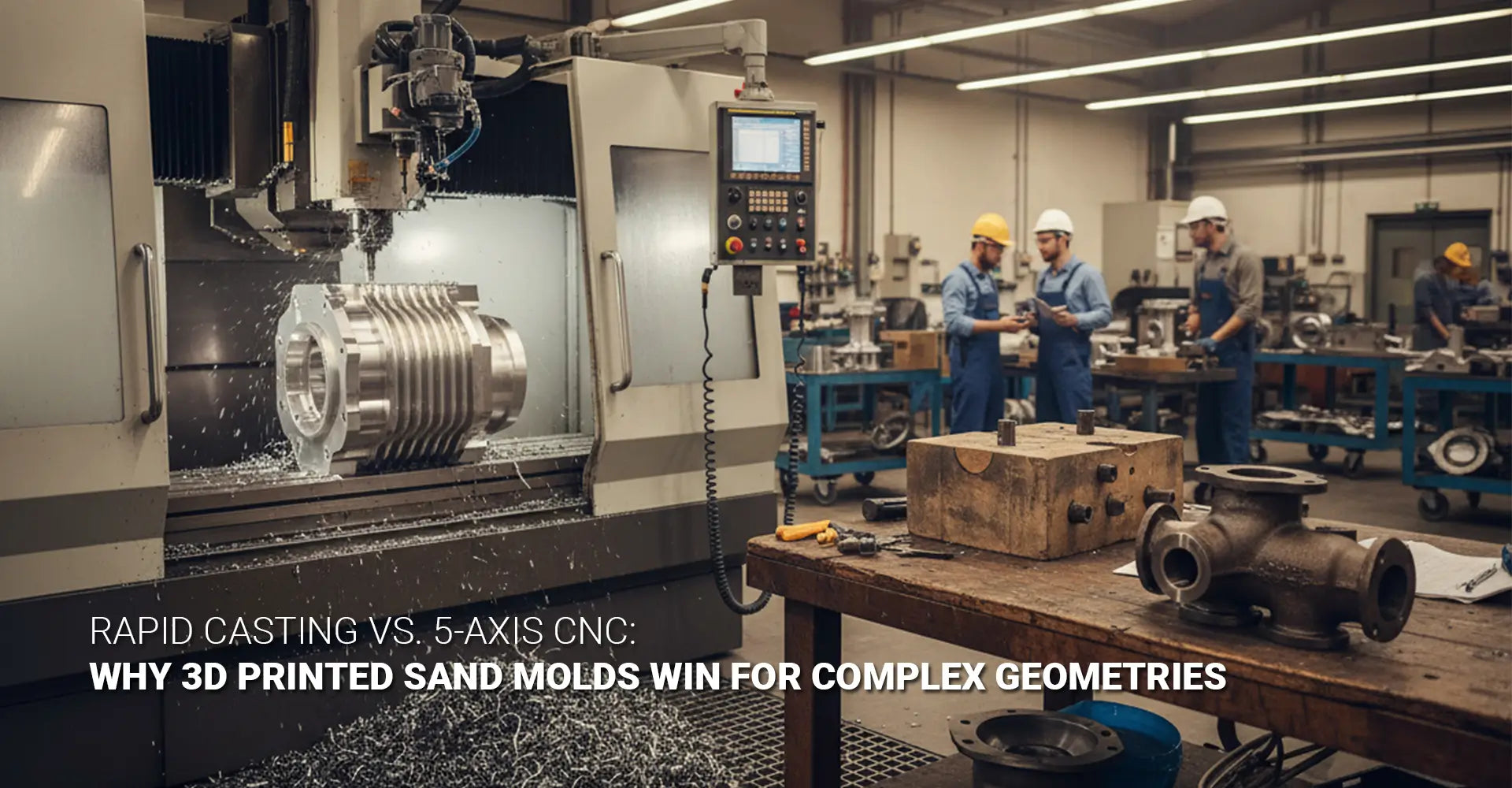
Rapid Casting vs. CNC Machining: Is 3D Printed Sand Casting the Smarter Choice for Complex Metal Parts?
You just opened the 5-axis CNC quote. The number is big — maybe $10,000, $12,000, or more. And now you're wondering: Is there a better way?
For engineers and buyers dealing with complex metal parts like pump housings, manifolds, and valve bodies, that sticker shock is all too common. But here's the good news: machining from solid stock is not your only option. In fact, for many complex geometries, it might not even be the right option.

⚡ Quick Answer — What You Need to Know Right Now
For complex geometries like pump housings and manifolds with internal passages, rapid casting typically costs 30–70% less than 5-axis CNC machining.
Here's a fast snapshot of why:
| Factor | 5-Axis CNC Machining | Rapid Casting (3D Printed Sand) |
|---|---|---|
| Tooling required? | No hard tooling, but heavy programming | No hard tooling at all |
| Programming time | 20–40 hours CAM for complex parts | None — mold printed from CAD directly |
| Material waste | 70–80% removed as chips | Near-net shape — minimal waste |
| Internal passages | Machined out (slow, expensive) | Cast in — no extra cost |
| Lead time | 4–6 weeks (complex parts) | 2–3 weeks first article |
| Typical cost (pump housing example) | ~$12,700 | ~$4,500 |
| Best for | Simple prismatic parts, tight tolerances | Complex geometry, small batches |
Still reading? Good. Let's walk through exactly why this cost gap exists — and how to decide which process is right for your next part.
This guide breaks down the rapid casting vs CNC cost comparison in plain language. Whether you're prototyping a manifold or sourcing a small batch of pump housings, you'll walk away with a clear decision framework. No jargon. No fluff.
Table of Contents
- Why Does 5-Axis CNC Cost So Much for Complex Parts?
- What Is Rapid Casting — And How Does 3D Printed Sand Change the Cost Equation?
- Pump Housing Cost Breakdown — Rapid Casting vs. CNC, Head to Head
- Casting vs. CNC — How Do You Know Which One Wins for Your Part?
- Conclusion
Why Does 5-Axis CNC Cost So Much for Complex Parts?
Most engineers know that CNC machining is expensive for complex parts. But fewer know exactly where the money goes. And if you don't know where the cost comes from, you can't challenge it.
The truth is: 5-axis CNC machining charges you for time, not just material. And complex parts eat time at every single stage.
💡 At a Glance — The 3 Hidden Cost Drivers in CNC Machining
The three biggest cost drivers for complex CNC parts are programming time, fixture setups, and massive material waste. Together, they can push a $3,000 part into $12,000+ territory.
| Cost Driver | What It Means | Typical Impact |
|---|---|---|
| CAM Programming | Engineer writes toolpaths for every surface | 20–40 hours per complex part |
| Fixturing & Setups | Part repositioned for every new angle | 3–6 setups for complex geometry |
| Material Removal | Chips = wasted metal you already paid for | 70–80% of billet discarded |

When you're dealing with casting vs machining complex geometry, the economics shift fast. Here's a deeper look at each driver:
First, the programming burden. A simple bracket might take 2–3 hours to program. But a pump housing with curved internal passages and compound angles? That's 20–40 hours of CAM work — at $75–$150/hour for a skilled CAM engineer. That's $1,500 to $6,000 before a single chip is cut.
Second, the fixturing problem. Complex parts don't sit still. To machine every surface and angle, the part must be repositioned — sometimes 4, 5, or 6 times. Each setup requires custom fixtures, alignment checks, and re-probing. Each one adds hours and cost.
Third, the material waste problem. This one surprises people. To create an internal passage by machining, you start with a solid block of metal and remove everything that isn't the part. For complex geometries, 70–80% of the raw material ends up as chips on the floor. You pay for the full billet. You keep 20–30% of it.
That's not a machining flaw — it's just how subtractive manufacturing works. But it means that the more complex your part, the worse the economics of CNC machining become.
What Is Rapid Casting — And How Does 3D Printed Sand Change the Cost Equation?
Most people think of casting as something that requires expensive metal tooling, months of lead time, and large production runs. That used to be true. It isn't anymore.
Rapid prototyping technology — specifically 3D printed sand molds — has completely changed the casting economics for small batches and complex parts. Here's the short version of how it works.
💡 At a Glance — Rapid Casting vs. Traditional Casting
Traditional casting needs $5,000–$15,000 in tooling and 8–12 weeks lead time. Rapid casting using 3D printed sand molds eliminates tooling entirely — your CAD file goes directly to a printed mold in 24–72 hours.
| Factor | Traditional Sand Casting | Rapid Casting (3D Printed Sand) |
|---|---|---|
| Tooling cost | $5,000–$15,000 | $0 |
| Tooling lead time | 8–12 weeks | 0 weeks |
| Mold production | Weeks | 24–72 hours |
| Minimum quantity | 50–500+ parts | 1 part |
| Design changes | Expensive (retool) | Free (reprint mold) |

So what exactly is 3D printed sand casting? It's a form of additive manufacturing casting where a large-format 3D printer (called a binder jet printer) uses a binder agent to glue sand grains together, layer by layer, into a precise mold cavity. The process is also sometimes called lost foam casting in its general family of tooling-free approaches, though the sand binder jet method is now the most common for industrial rapid work.
Once the mold is printed, it works exactly like a traditional sand mold — metal is poured in, it solidifies, and you break the mold away to reveal the casting.
Here's what makes this a genuine game-changer for manifold rapid prototyping and other complex work:
- No hard tooling. There are no aluminum patterns to machine. No wooden patterns to carve. Your CAD model IS the tooling.
- Complexity is essentially free. Internal passages, curved surfaces, undercuts — these are all just geometry to a 3D printer. The mold cost doesn't increase because your part is complex.
- Near net shape casting means less machining after. The casting comes out close to final shape, so you only machine the surfaces that truly need tight tolerance.
- Design changes cost almost nothing. Adjust the CAD file, reprint the mold. No retooling fees. No delays.
For small batch metal parts — typically 1 to 100 pieces — this process removes the biggest barrier to casting: the upfront tooling investment.
Pump Housing Cost Breakdown — Rapid Casting vs. CNC, Head to Head?
Let's stop talking theory and look at real numbers. A pump housing with internal curved passages is one of the most common parts where engineers debate casting vs. machining. It's also one of the clearest examples of where casting wins.
Here's the same part, quoted two ways.
💡 At a Glance — The Numbers Side by Side
The same pump housing costs $12,700 via 5-axis CNC and $4,500 via rapid casting — a 64% cost reduction. The internal passages are the reason.
| Cost Item | 5-Axis CNC Route | Rapid Casting Route |
|---|---|---|
| Programming / Mold | $8,500 (20–40 hrs CAM) | $1,200 (3D printed sand mold) |
| Material / Casting | $4,200 (solid billet, mostly wasted) | $1,800 (casting + poured metal) |
| Machining / Finishing | $0 (machined complete) | $1,500 (finish-machine critical surfaces only) |
| Total | $12,700 | $4,500 |
| Lead time | 4–6 weeks | 2–3 weeks |
Why is the gap so large? It comes down to one thing: internal passages.
In CNC machining, internal curved passages are among the most expensive features to produce. They require:
- Long-reach tooling with limited rigidity
- Multiple approach angles — meaning multiple 5-axis setups
- Very slow cutting speeds to avoid chatter and tool breakage
- Extra programming time for every internal surface
In rapid casting, internal passages are just part of the mold geometry. The 3D printer creates the internal sand cores at the same time as the outer mold shell. The complexity costs almost nothing extra. The metal fills the void. The passage is cast in.
What about the $1,500 finishing cost on the casting route? That's real, and it's intentional. Near net shape casting — where the part comes out of the mold close to final dimensions — still needs finish machining on tight-tolerance surfaces. For a pump housing, that means:
- Bearing bores (need ±0.02mm)
- Flange mounting faces (need flatness)
- Seal grooves (need surface finish)
Everything else — the complex curved body, the internal passage walls, the external ribs — those stay as-cast. The result: casting handles the complexity, CNC handles the precision. Together, they cost far less than CNC trying to do both.
The complex metal casting cost advantage is not marginal. At 64% savings, it's the kind of number that changes how you spec parts.
Casting vs. CNC — How Do You Know Which One Wins for Your Part?
Here's the honest answer: casting doesn't win every time. CNC machining is still the right choice for certain parts. The key is knowing which process fits your specific geometry, tolerance requirements, and quantity.
This section gives you a clear decision framework — so you can make that call before you request a quote.
💡 At a Glance — The Decision Matrix
Ask three questions: Does the part have internal passages or complex geometry? What quantity do you need? How tight are your critical tolerances? The answers almost always point clearly to one process.
| Question | Answer → Casting | Answer → CNC |
|---|---|---|
| Geometry type? | Internal passages, curved surfaces, organic shapes | Simple prismatic, flat faces, external features only |
| Quantity? | 1–100 pieces | 1–10 simple pieces OR 500+ (hard tooling amortized) |
| Critical tolerances? | ±0.5mm or looser on most surfaces | ±0.05mm or tighter across the whole part |
| Material waste concerns? | Expensive alloy (Inconel, stainless) | Cheap billet (mild steel, common aluminum) |
Casting wins when your part has:
- Internal passages or cavities (pump housings, manifolds, valve bodies) — this is the single biggest indicator
- Curved external surfaces requiring multi-axis programming
- Thin walls that would require delicate, slow machining from solid
- Expensive alloys where 70–80% material waste is financially painful
- Quantities under 50 pieces where hard tooling can't be amortized
CNC wins when your part has:
- Simple prismatic geometry — blocks, brackets, plates with drilled holes
- Extremely tight tolerances across the entire part (±0.05mm or less throughout)
- Very small features (fine threads, small holes) that don't cast cleanly
- Quantities of 1–5 pieces where even mold printing adds unnecessary cost
And the best answer is often: both. The investment casting alternatives conversation has evolved significantly — today, the smartest approach for many complex parts is the hybrid route:
- Cast the complex shape using 3D printing and sand mold technology — capturing internal passages, curved surfaces, and near-net geometry
- Finish-machine only the critical surfaces — bearing bores, seal faces, mounting holes — using CNC
This approach gives you complexity and precision. At a total cost that's typically 30–50% lower than machining from solid. It's how experienced manufacturing engineers approach pump housing manufacturing and similar complex part families.
One more consideration: lead time. Rapid casting delivers a first article in 2–3 weeks. Complex 5-axis CNC parts — after programming, fixturing design, and machine scheduling — often take 4–6 weeks. For prototype iterations, that time difference compounds quickly.
Conclusion
Let's bring it all together. Here are the three questions to ask before you quote your next complex metal part:
Question 1: Does the part have internal passages, curved surfaces, or complex geometry? If yes — it's a strong casting candidate. These features add almost no cost to a 3D printed sand mold, but they add thousands to a CNC job.
Question 2: What quantity do you need? Under 50 pieces? Rapid casting wins — no tooling to amortize, mold cost is low. Over 500 pieces? Re-evaluate with hard tooling. Between 50–500? Compare both with real quotes.
Question 3: What are your critical tolerances? If only 2–3 surfaces need tight tolerance — cast the whole part, finish-machine those surfaces only. That's the hybrid approach, and it's almost always the most cost-effective path.
✅ Key Takeaways
- Rapid casting vs CNC cost gaps of 30–70% are common for complex geometries
- 3D printed sand molds eliminate tooling cost and compress lead time to 2–3 weeks
- Internal passages are the clearest signal that casting will outperform machining
- The hybrid approach — cast near-net, finish-machine critical surfaces — delivers both complexity and precision
- For small batch metal parts (1–100 pieces), rapid casting removes the biggest traditional barrier: upfront tooling investment
Ready to Get a Quote? Here's What to Prepare:
- 3D CAD model in STEP format — internal passages must be fully modeled
- Material specification (e.g., A356 aluminum, 316 stainless, ductile iron)
- Quantity needed (1–100 is the sweet spot for rapid casting)
- Critical dimensions — which surfaces need tight tolerance for finish machining
- Post-casting requirements — heat treatment, surface finish, pressure testing
A good rapid casting supplier will return a sand mold cost, casting cost, finishing recommendation, and lead time — usually within 2–3 business days of receiving your STEP file.
🔗 External Resources & Further Reading
[Rapid casting vs CNC cost][^1]
[Complex metal casting cost][^3]
[Pump housing manufacturing][^4]
[Manifold rapid prototyping][^5]
[^1]: Peer-reviewed research comparing rapid investment casting (RIC), conventional investment casting (CIC), and CNC machining (MP) for aluminum die manufacturing. RIC demonstrated the lowest total cost (PKR 124,685.50) versus CIC (PKR 422,600.35) and machining (PKR 330,252.70), with labor costs reduced to 60.47% versus 81.39% for conventional casting. RIC also showed lowest global warming potential, fossil fuel depletion, and acidification impacts. This study is from *Results in Engineering* (Volume 27, September 2025), a peer-reviewed open access journal [citation:4]
[^2]: Industry publication detailing how 3D printed sand cores enabled consolidation of 14+ conventional cores into a single-piece core, eliminating tooling design, fabrication, storage, and maintenance costs for the life of the part. The toolingless 3D printed sand process removes draft angle constraints, enables tighter dimensional tolerances, reduces secondary machining requirements, and allows complex internal geometries impossible with conventional core boxes. Published in *Casting Source*, an American Foundry Society publication [citation:10]
[^3]: Comprehensive comparison table of five metal casting methods with cost ratings: sand casting (★★★★☆ for low volume, ★★☆☆☆ for high volume), investment casting (★★☆☆☆ for low volume, ★★★☆☆ for high volume), and die casting (★☆☆☆☆ for low volume, ★★★★★ for high volume). Includes detailed cost drivers for complex parts, expert tips on evaluating complexity vs production volume trade-offs, and how 3D printing reduces tooling costs for low-volume complex castings like pump housings and engine blocks.
[^4]: Patent detailing a two-stage molding method for pump housings that eliminates core fabrication and core removal steps—reducing manufacturing cost by simplifying production and minimizing defective products. Covers core-less casting approach for complex internal geometries with volute casing and inlet/outlet ports, using locator protrusions and grooves to prevent secondary casting intrusion. From USPTO/Google Patents database.
[^5]: Ricoh case study demonstrating system-level redesign of an inkjet manifold using aluminum binder jetting, reducing valve units while maintaining four segregated internal areas for ink flow. The RDwAM methodology (Revolutionising Design with AM) focuses on eliminating subsystems rather than simply replacing parts—directly applicable to complex manifold rapid prototyping workflows