Swiss CNC vs. Conventional Milling: Which Machine Actually Gets Small Precision Parts Right?
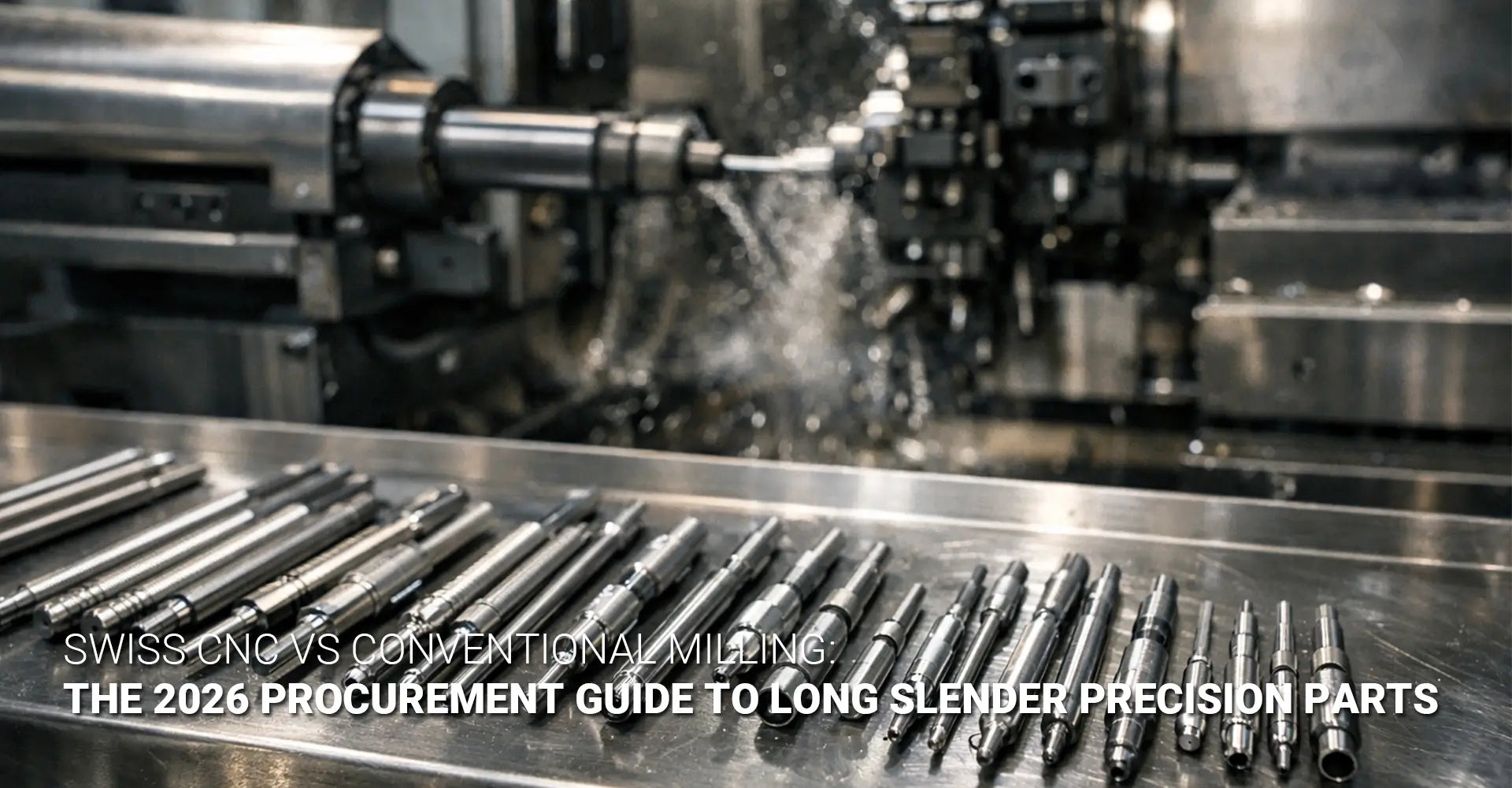
Swiss CNC vs. Conventional Milling: Which Machine Actually Gets Small Precision Parts Right?
Are you spending more money than you should — just because you chose the wrong machine? Many procurement managers make that mistake every day. They default to conventional milling for small, slender parts. Then they wonder why costs climb, lead times stretch, and parts keep failing inspection. This article cuts straight to the answer — so you can make the right call, fast.

Quick Answer: Swiss CNC vs. Conventional Milling at a Glance
Swiss CNC wins when your parts are ≤20mm in diameter, have an L/D ratio greater than 5:1, and require complex multi-face features in a single setup. Conventional milling wins for large diameters, simple geometry, and low-volume prototypes.
| Factor | Swiss CNC | Conventional Milling |
|---|---|---|
| Best diameter range | ≤20mm (up to ~32mm) | >20mm |
| Long, slender parts (L/D >5:1) | ✅ Excellent | ❌ Poor |
| Multi-feature single setup | ✅ Yes | ❌ Rarely |
| Per-part cost (high volume) | ✅ 18–22% lower | Higher |
| Tolerance capability | ±0.0002 in (5 microns) | ±0.001 in (25 microns) |
| Setup time | Longer (6–8 hrs) | Shorter (2–4 hrs) |
| Best volume range | 5,000–10,000+ pieces/year | Low to mid volume |
| Lights-out production | ✅ Common | ❌ Limited |
This table answers most searches instantly. But if you need the full picture — keep reading.
Knowing which machine to use is only the start. The real cost comes when you choose wrong and don't realize it until parts are out of tolerance, or you're paying for three separate machining operations. So let's walk through exactly why conventional milling fails small precision parts — and how Swiss CNC changes the math completely.
Table of Contents
- Why Do Conventional Mills Struggle with Small-Diameter Parts?
- How Does a Swiss CNC Machine Actually Work?
- What Does the Cost and ROI Math Really Look Like?
- When Should You Choose Swiss — And When Should You Stick with Conventional?
- Conclusion
Why Do Conventional Mills Struggle with Small-Diameter Parts?
Most manufacturers don't start with the wrong machine on purpose. They start with what they have. Conventional CNC mills and lathes are workhorses — great for many jobs. But for small diameter precision parts, they run into a fundamental problem very quickly.
The Fast Answer: Two Failure Modes That Kill Margins
Deflection bends your part during cutting. Secondary operations multiply your cost after cutting. Conventional machines struggle with both on small, slender components.
Key failure modes at a glance:
- ❌ Deflection — A 2mm shaft with 20mm of unsupported length bends under cutting force. You get tapered diameters, poor surface finish, and parts that don't meet print.
- ❌ Multiple setups — Milling, turning, drilling, and tapping on separate machines means more handling, more queue time, more chances for error.
- ❌ Tolerance stack-up — Every time a part moves between machines, alignment errors compound. What was ±0.001 in on machine one becomes a reject on machine three.
- ❌ Higher scrap rates — More setups mean more opportunities for out-of-tolerance parts to slip through — or get caught too late.
Why This Matters More Than You Think
Let's be specific. On a conventional lathe, a 2mm diameter pin with a 20mm length sticks out of the chuck with 20mm of unsupported bar. Cutting forces — even light ones — deflect that bar like a fishing rod. The result? Tapered diameters, chatter marks, and surface finishes that don't meet spec.
Now add the secondary operation elimination problem. If that same pin needs a milled flat, a cross-hole, and a thread, you're looking at three separate machines. Three setups. Three queues. Three chances for a handling error to damage a finished surface. By the time the part reaches inspection, you've already spent far more than your quote assumed.
For high-volume precision components in industrial machinery, this isn't a minor inefficiency. It's a margin killer that compounds with every batch.
How Does a Swiss CNC Machine Actually Work?
Understanding the Swiss CNC machine starts with one key insight: it reverses the geometry of cutting. Instead of holding the workpiece still and moving the tool, a Swiss type lathe moves the bar stock through a fixed support — called a guide bushing — right at the cutting zone.
The Core Principle in Plain English
On a Swiss machine, the guide bushing supports the bar stock at the exact point of cutting. Unsupported length is virtually zero. Deflection is eliminated. This is how sub-0.01mm tolerances become routine — not exceptional.
How it works, step by step:
- Bar stock feeds through the sliding headstock — the headstock moves, not just the tool.
- The guide bushing holds the bar right at the cutting edge, millimeters from where material is removed.
- Because support is immediate, cutting forces have nowhere to cause deflection.
- Live tooling (milling, drilling, tapping) operates on the same part — simultaneously or in sequence — without removing it from the machine.
- A sub-spindle catches the part for back-working, completing rear features without a second setup.
What This Means in Practice for Complex Parts
This is where bar fed machining on a Swiss platform separates itself completely from conventional equipment. Modern Swiss-type lathes with C-axis spindle indexing and live tooling can perform turning, milling, cross-drilling, threading, tapping, grooving, and knurling — all in one continuous, uninterrupted cycle.
Consider pin connector manufacturing as an example. A connector pin requiring multiple turned diameters, a milled flat, a cross-hole, and a thread would require three separate machines in a conventional setup. On a Swiss machine, that part runs start to finish without ever leaving the machine. The result is not just faster — it's more accurate. There is no tolerance stack-up between operations. What you program is what you get, every time, across thousands of parts.
This is precisely why CNC turning services built around Swiss platforms are increasingly specified for complex small-diameter components across demanding industries.
What Does the Cost and ROI Math Really Look Like?
Here is where procurement managers often get confused. Swiss CNC machines have a higher hourly rate. Setup takes longer — typically 6–8 hours versus 2–4 hours for conventional equipment. So at first glance, the quote looks expensive. But that comparison is incomplete — and often wrong.
The Number That Changes Everything
Swiss machining reduces per-part costs by 18–22% for high-volume small components. This comes from ~40% faster cycle times and ~15% lower scrap rates — not from a cheaper machine rate.
Where the savings actually come from:
- ✅ Single setup completion — No secondary operations, no inter-machine handling cost
- ✅ Faster cycle time — All operations run simultaneously or in tight sequence
- ✅ Lower scrap rate — Fewer handling steps means fewer damaged or misaligned parts
- ✅ Lights-out production — Swiss machines run unattended overnight, turning floor time into free production hours
- ✅ Reduced inspection burden — Fewer setups means fewer potential failure points to check
A Real-World Example: From Three Machines to One Cycle
Take a small stainless steel connector component used in automotive precision assemblies. In a conventional workflow, this part moves through:
- CNC lathe — Turned outer diameter and bore
- Vertical machining center — Milled flat and cross-hole
- Bench drill / tapping machine — Thread formed
Each step carries setup cost, queue time, handling risk, and inspection. Total process time: days. Total handling events: 6+.
On a Swiss platform with single setup machining, that same part runs in one cycle. The sub-spindle handles the back end. Live tooling handles the milled flat, cross-hole, and thread. The part drops complete into a bin. Total process time: minutes per part. Total handling events: 1.
The break-even point: For most small-diameter, multi-operation components, Swiss becomes cost-competitive around 5,000 pieces per year. Above 10,000 pieces annually, it is almost always the financially smarter choice — even accounting for the longer setup time.
For businesses evaluating a full CNC machining service partner, this total-cost-of-ownership comparison is the most important number to request.
When Should You Choose Swiss — And When Should You Stick with Conventional?
Not every part belongs on a Swiss machine. Choosing wrong in either direction costs money. Here is the honest decision framework — with no bias toward either platform.
The One-Minute Decision Guide
If your part is ≤20mm diameter, longer than it is wide, and needs features on multiple faces — Swiss wins. If your part is large, simple, or low-volume with no secondary operations — conventional wins.
Swiss CNC wins when:
- ✅ Diameter is ≤20mm (up to ~32mm maximum bar capacity)
- ✅ L/D ratio exceeds 5:1 (long, slender parts)
- ✅ Part requires multiple operations: turning + milling + drilling + threading
- ✅ Annual volume exceeds 5,000–10,000 pieces
- ✅ Tolerance requirement is ±0.0002 in (5 microns) or tighter
- ✅ Material is bar-friendly: stainless steel, aluminum, brass, titanium, Inconel, or engineering plastics
Conventional milling wins when:
- ✅ Diameter exceeds 32mm (part won't fit through guide bushing)
- ✅ Part geometry is simple with few or no secondary features
- ✅ Volume is low — under 500 pieces with no repeat orders
- ✅ Part is prismatic (more block-shaped than shaft-shaped)
Material Versatility and the 5 Questions to Ask Your Machining Partner
Swiss platforms handle a wide range of precision turned components across materials. Stainless steel (303, 304, 316, 17-4 PH) covers corrosion-resistant applications. Aluminum and brass suit weight-sensitive and electrical components. Titanium and Inconel serve high-performance aerospace and medical demands — though both require specialized tooling and cooling strategies.
Before committing to a Swiss machining partner, ask these five questions:
- "What is your bar diameter capacity?" — For parts under 20mm, Swiss is standard. Confirm they have the right bar capacity for your specific dimensions.
- "Do you have live tooling and sub-spindle capability?" — Required for complex multi-face parts.
- "Can you provide Cpk data for similar small-diameter parts?" — Process capability data tells you if they can actually hold your tolerance, not just claim it.
- "How is your setup fee structured for repeat orders?" — A good partner amortizes setup over the run, reducing per-part cost at volume.
- "Do you offer lights-out or unattended overnight production?" — This is a key indicator of Swiss-focused operational maturity.
For companies sourcing custom CNC milling services alongside turning work, a partner with both capabilities allows better part routing — Swiss for slender turned components, milling centers for larger prismatic features — all under one roof.
Conclusion
The Bottom Line: Swiss CNC vs. Conventional Milling Comes Down to Total Cost, Not Hourly Rate
Here is what this article has shown:
- Conventional milling fails small, slender parts because of deflection, tolerance stack-up, and the hidden cost of secondary operations.
- Swiss CNC eliminates those problems through the guide bushing principle — zero unsupported length, one continuous cycle, one setup.
- The ROI math favors Swiss at volumes above 5,000–10,000 pieces per year for complex small-diameter parts — delivering 18–22% per-part cost reduction through faster cycles and lower scrap.
- The decision is not always Swiss — large diameters, simple geometry, and very low volumes still belong on conventional equipment.
- The right question to ask is not "which machine is cheaper per hour?" It is "what is the total cost per finished, ready-to-assemble part?"
For procurement managers sourcing small-diameter, high-complexity components in 2026, Swiss CNC is increasingly not just the precision choice. It is the financially smarter one.
Ready to evaluate your part family? Audit your current small-diameter components against the Swiss criteria checklist above. If the L/D ratio exceeds 5:1, volume exceeds 5,000 pieces annually, and secondary operations are currently required — you likely have a strong candidate for Swiss migration.
📎 Recommended External Resources
[Swiss CNC vs conventional milling][^1]
[Swiss type lathe][^2]
[Sliding headstock][^3]
[Guide bushing][^4]
[small diameter precision parts][^5]
[single setup machining][^6]
[^1]: ENCY CAD/CAM software article explaining Swiss machining technology, comparing sliding-headstock lathes with guide bushing support to conventional lathes, with applications in medical, aerospace, electronics, and watchmaking industries [reference:0]
[^2]: MatterHackers guide to Swiss lathes covering guide bushing and sliding headstock features, tolerances down to a few micrometers, and applications in medical devices, aerospace, electronics, and automotive precision components [reference:1].
[^3]: Production Machining (industry publication) — explains that the sliding headstock is the defining feature of Swiss-type lathes, enabling bar stock to be fed through a guide bushing past stationary tools, ideal for parts with high length-to-diameter ratios like medical bone screws.
[^4]: Sheldon Precision (precision machining shop) — details how the guide bushing supports the workpiece extremely close to cutting tools, reducing deflection to near zero and allowing heavy cuts while maintaining precise dimensions on long, slender parts.
[^5]: FZE Manufacturing has expanded its CNC Swiss machining capabilities, utilizing sliding headstock design to produce components with diameters as small as one millimeter and tolerances within 0.0005 inches for medical, aerospace, and defense sectors[reference:0].
[^6]: The SELICA SS-20AS CNC Swiss-type lathe features both a main spindle and sub-spindle, enabling complete front and back machining of complex parts in a single setup with a rigid gang tooling layout for minimal tool change time[reference:1].