Don't Default to Metal for Every Spare Part: A Procurement Manager's Comparison Chart for 316L, 17-4PH, and PA12-CF 3D Printing?
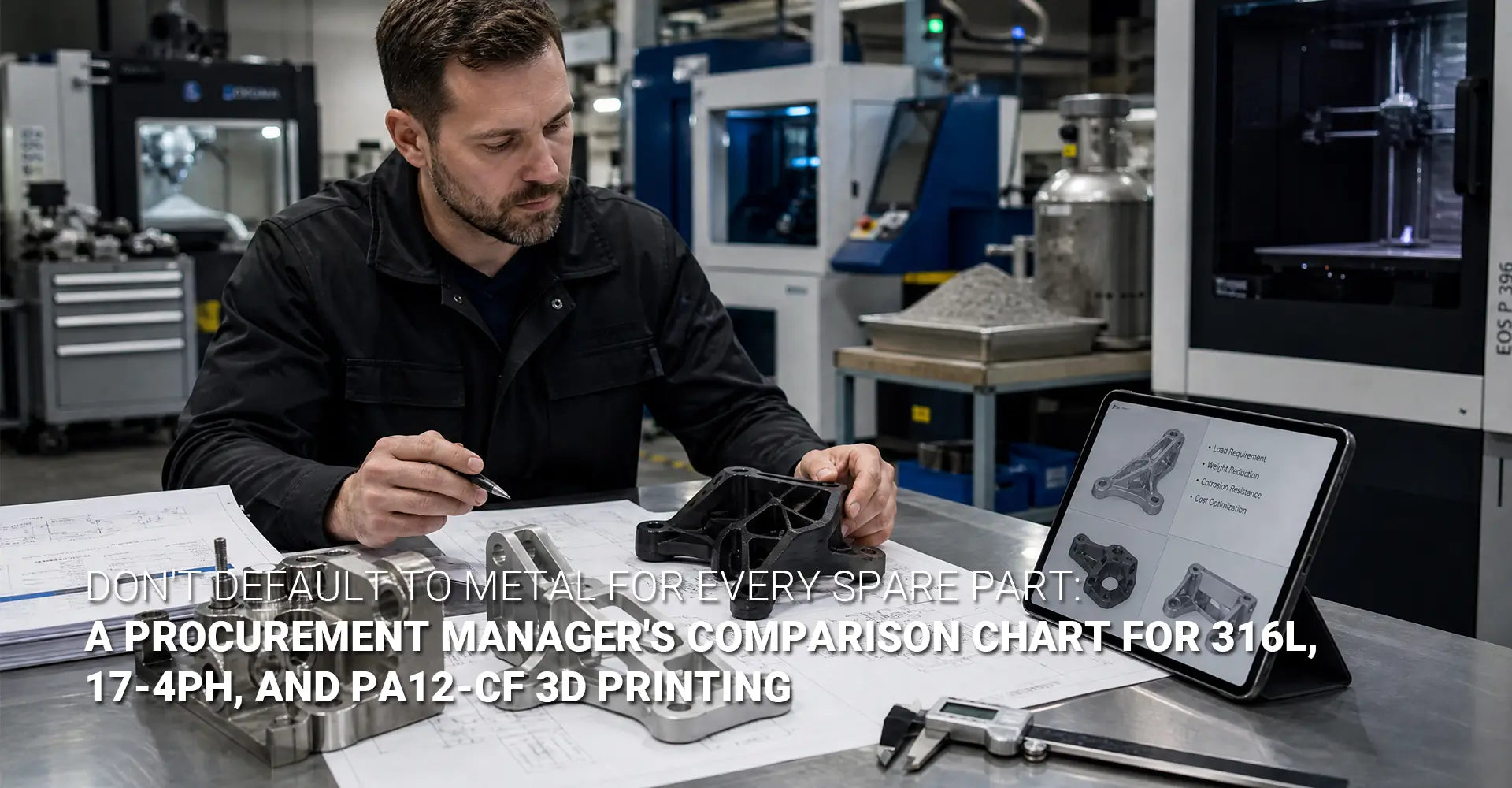
Don't Default to Metal for Every Spare Part: A Procurement Manager's Comparison Chart for 316L, 17-4PH, and PA12-CF 3D Printing?
Many procurement teams pick stainless steel for every structural spare part without a second thought. It feels like the safe choice. But that habit can quietly add cost, weight, and lead time to parts that never needed metal's full strength in the first place. This guide walks through three common materials used in an industrial 3D printing service. They are 316L stainless steel, 17-4PH stainless steel, and PA12-CF. By the end, you will have a clear framework for matching the material to the job, instead of matching the job to old habits.

Quick Answer: PA12-CF typically delivers around 70% of 316L's strength. Yet it costs roughly 20% as much and weighs only one-sixth as much too. That trade-off works well for industrial spare parts 3D printing when the part does not face heavy loads, high heat, or corrosion risk. However, for gears, fasteners, and high-load components, metal is still the safer pick. The table below breaks down the numbers so you can decide quickly, without reading the whole article first.
| Material | Tensile Strength | Density | Best For | Approx. Cost/Part (0.5 kg bracket) |
|---|---|---|---|---|
| 316L Stainless Steel | 467–634 MPa | ~7.96 g/cm³ | Corrosion resistance, food-contact parts | $450–$850 |
| 17-4PH Stainless Steel | 1,365–1,372 MPa | ~7.75 g/cm³ | High-load structural parts, gears, fasteners | Higher than 316L, varies by process |
| PA12-CF | 69–76 MPa | ~1.20 g/cm³ | Guards, brackets, sensor mounts, panels | $45–$85 |
Now that you have the headline numbers, let's dig into what they actually mean for your next sourcing decision. Below, we compare each material one at a time, covering strength, weight, and typical use cases. Then, we line them up side by side so you can see exactly where the trade-offs happen, and where they don't. By the time you reach the end, you should be able to answer the material question for almost any spare part on your list.
Table of Contents
- How Strong Does 316L Stainless Steel Really Need to Be?
- When Does a Part Actually Need 17-4PH's Extra Strength?
- Can This Lightweight Composite Replace Metal on Non-Critical Parts?
- What Does the Cost and Decision Math Look Like Side by Side?
- Conclusion
How Strong Does 316L Stainless Steel Really Need to Be?
316L stainless steel 3D printing is often the default choice for industrial spare parts, and it earns that reputation honestly. This alloy resists corrosion well, handles moisture, and holds up in washdown or chemical environments. Because of this, many buyers reach for it out of habit, even for parts that will never see a drop of water or a corrosive chemical. So it helps to know exactly what you are paying for before you specify it again on your next purchase order.
Quick Answer: 316L parts made through metal 3D printing typically reach an ultimate tensile strength of 467 to 634 MPa, depending on the printing process used. Elongation at break runs 55 to 58%, which means the material bends and stretches a lot before it snaps. Density sits around 7.96 g/cm³, making it one of the heavier options on this list, and one of the more expensive ones too.
Let's dig deeper into where 316L truly shines. Its ductility is exceptional, so it absorbs shock and impact without cracking. This makes it a strong fit for food-contact parts, marine components, and chemical fittings, where both strength and corrosion resistance matter at the same time. On the industrial machinery side, 316L is also a common pick for parts that sit near washdown stations or outdoor equipment exposed to weather. That said, its weight and cost add up fast. It is not always the most practical option for parts that never touch moisture or chemicals in the first place. Does your part spend its whole life indoors, bolted to a dry frame? If so, ask whether it truly needs 316L's corrosion resistance before you sign off on it.
When Does a Part Actually Need 17-4PH's Extra Strength?
If 316L is the corrosion-resistant workhorse, then 17-4PH metal additive manufacturing is the strength specialist of the group. This alloy is built for parts that carry real mechanical load, not just parts that need to resist rust. Because of its high strength, it often gets specified for gears, fasteners, and structural components that see repeated stress cycles over years of use.
Quick Answer: 17-4PH reaches an ultimate tensile strength of 1,365 to 1,372 MPa when solution-treated and aged, nearly double 316L's strength. Yield strength lands around 1,227 to 1,234 MPa, also close to double 316L's figure. However, elongation at break drops to just 10 to 13%, meaning 17-4PH is far more brittle than 316L, and less forgiving of sudden shock loads.
Diving deeper, this strength-versus-brittleness trade-off matters a lot in real-world use. A part made from 17-4PH can carry a much heavier load before it fails. But it also has less room to flex before it cracks under stress. That makes it well suited for high-load structural components, gears, and fasteners, where stiffness matters more than shock absorption. On the other hand, sudden impacts or heavy vibration can turn low ductility into a real liability over time. So before you specify 17-4PH, ask a simple question. Does your part actually need that extra strength? Or is it just following the same "go with metal" habit that drives so many procurement decisions?
Can This Lightweight Composite Replace Metal on Non-Critical Parts?
Here's where the real savings opportunity shows up. PA12-CF carbon fiber nylon is a composite material reinforced with chopped carbon fiber. It has become a serious contender for parts that don't need metal's full strength. Because it weighs so little, it opens the door to a smarter approach for structural bracket additive manufacturing. That includes everything from cable trays to sensor housings.
Quick Answer: PA12-CF typically reaches an ultimate tensile strength of 69 to 76 MPa through FDM printing, roughly one-tenth of 17-4PH and one-eighth of 316L. Flexural strength comes in around 114 MPa, which gives it solid stiffness for bracket-style parts that need to hold their shape. Density sits at only about 1.20 g/cm³. That means it weighs roughly one-sixth as much as either stainless steel option, and the savings add up fast across a full assembly.
Digging deeper, the raw tensile number only tells half the story here. When you factor in weight, PA12-CF becomes far more competitive. This brings us to the strength-to-weight ratio comparison that matters most for mobile equipment and robotic arms. It also matters for any application where every gram counts against total payload. Printing PA12-CF successfully does require the right setup. You need an all-metal hotend running above 280°C, a heated bed between 100 and 120°C, and an enclosure to stop warping. You also need dry filament, since nylon absorbs moisture quickly from the surrounding air. For buyers exploring 3D printing plastics as an alternative to metal, PA12-CF is one of the strongest options on the market today. Just remember its temperature ceiling sits around 105°C, so it is not suited for parts near motors, engines, or ovens.
What Does the Cost and Decision Math Look Like Side by Side?
Now let's put the numbers together so you can make a real decision, not just an educated guess. This is where the metal vs composite 3D printing cost gap becomes impossible to ignore. A simple framework here can save your team real money on the next purchase order.
Quick Answer: A typical 0.5 kg industrial bracket made from 316L through SLM (selective laser melting) costs roughly $450 to $850 per part. That figure includes both material and processing time. The same bracket printed in PA12-CF through FDM costs only about $45 to $85. That's an 80 to 90% cost reduction for parts that don't need metal's strength or corrosion resistance to do their job well.
Diving deeper, the SLM vs FDM/SLS cost per part difference comes down to both material price and process complexity. PA12-CF filament runs $80 to $150 per kilogram. By comparison, 316L stainless steel powder and processing runs $100 to $450 or more per kilogram. Metal printing costs more largely because it requires specialized equipment, support removal, and often a heat treatment step afterward. To decide which material fits your part, run through this short checklist before you place the order:
- Check the service temperature. Above 105°C, metal is the only real choice, since PA12-CF will soften and lose strength.
- Check the load type. High tensile or impact loads point toward 17-4PH; moderate loads with weight limits point toward PA12-CF; corrosion resistance needs point toward 316L.
- Check your budget sensitivity. If the part is non-critical and cost matters, PA12-CF is usually the smarter buy for your team.
- Check the part's failure consequence. If a failure would stop a production line or create a safety issue, lean toward metal even if the load seems moderate.
This is often called the 60% rule, since roughly 60% of typical industrial machinery 3D printed components — machine guards, cable trays, light brackets, enclosure panels, and sensor mounts — can switch to PA12-CF without any real performance loss. Parts that should stay in metal include high-load shafts, bearing housings, threaded inserts, and anything operating above 105°C on a regular basis. If your team is weighing a non-critical metal replacement for an upcoming part, this is the checklist to run through before the purchase order goes out the door. For teams still validating fit before full production, rapid prototyping in PA12-CF is a low-risk way to test a part's real-world performance. It lets you check fit before switching an entire product line over to a new material.
It also helps to loop in your supplier early in this process, since they can flag issues your team might miss. Ask them how many similar parts they have already converted from metal to composite. Ask to see test data too, instead of marketing claims alone. A good supplier will walk you through load testing, temperature testing, and dimensional checks before your first production run ships. This extra step costs little time up front. But it can prevent a costly redesign later if the part does not perform as expected in the field.
Conclusion: Choosing the Right Material Without Overpaying for Metal
Metal is not always the safer choice, and it certainly isn't always the cheaper one. As this comparison shows, PA12-CF can match a surprising amount of stainless steel's practical performance while cutting cost and weight dramatically for the right parts. That said, metal still earns its place on parts that face heavy loads, high heat, or corrosion. So 316L and 17-4PH aren't going anywhere anytime soon.
Before your next order, ask what the part actually needs to do in real service conditions. Then match the material to that requirement, instead of defaulting to whatever has always been used on past projects. Running the numbers first is the fastest way to trim cost from your spare parts budget. It beats simply assuming metal is required. A quick five-minute review against the checklist above can save hundreds of dollars per part across a full production run.
If you're ready to explore which material fits your next part, Hotean's 3D printing services can help. Our team can compare options, test fit, and validate performance before you commit to full production.
Explore related resources:
[Industrial 3D printing service][^1]
[316L stainless steel 3D printing][^2]
[17-4PH metal additive manufacturing][^3]
[PA12-CF carbon fiber nylon][^4]
[metal vs composite 3D printing cost][^5]
[^1]: Protolabs (UK/Europe) – DMLS metal 3D printing service with ISO 9001:2015 and ISO 13485 certifications. 316L stainless steel achieves ultimate tensile strength of 565–586 MPa, yield stress of 379–386 MPa, and elongation of 75–78%[reference:0]. Lead times of 7 days or less for functional metal prototypes and end-use production parts[reference:1].
[^2]: Engineering.com article (US) covering Unionfab's industrial metal 3D printing expansion. Deploys 100+ industrial metal 3D printing systems including four-laser and six-laser SLM systems with multi-laser platforms increasing printing efficiency by up to 40% while reducing manufacturing costs by approximately 30%[reference:12]. Supports 316L stainless steel along with 17-4PH, aluminum alloys, titanium, and Inconel[reference:13]. Lead times reduced from 30+ days to as fast as 5 days for low-volume metal parts[reference:14].
[^3]: Greene Group Industries (US-based) – PureForm metal 3D printing platform using MIM powder and photopolymer binder. Supports 17-4PH stainless steel with 50-micron feature resolution, 100-micron walls, and post-sinter secondary processes. Parts comply with MPIF-35 standards[reference:0][reference:1].
[^4]: Polymaker Wiki (US-based) – Fiberon™ PA12-CF10 technical specifications. 10% carbon fiber reinforced long-chain copolyamide with low moisture sensitivity, Warp-free™ technology, nozzle temperature 280–300°C, annealing at 100°C for 16 hours. Outperforms standard PA12 in strength and heat resistance[reference:8][reference:9][reference:10][reference:11].
[^5]: RapidDirect's comprehensive 2026 cost breakdown shows metal powders for SLM run **$200–500+ per kg**, while composites cost **2–5× more than metals** and **8–12× more than plastics**. The guide covers material costs across six processes (FDM, SLA, SLS, MJF, SLM, PolyJet) and explains that post-processing—not machine time—is often the dominant cost driver[reference:0][reference:1].