Stop Managing 5 Vendors: Is Full-Service Sheet Metal Fabrication the Smarter Way to Build Complex Assemblies?
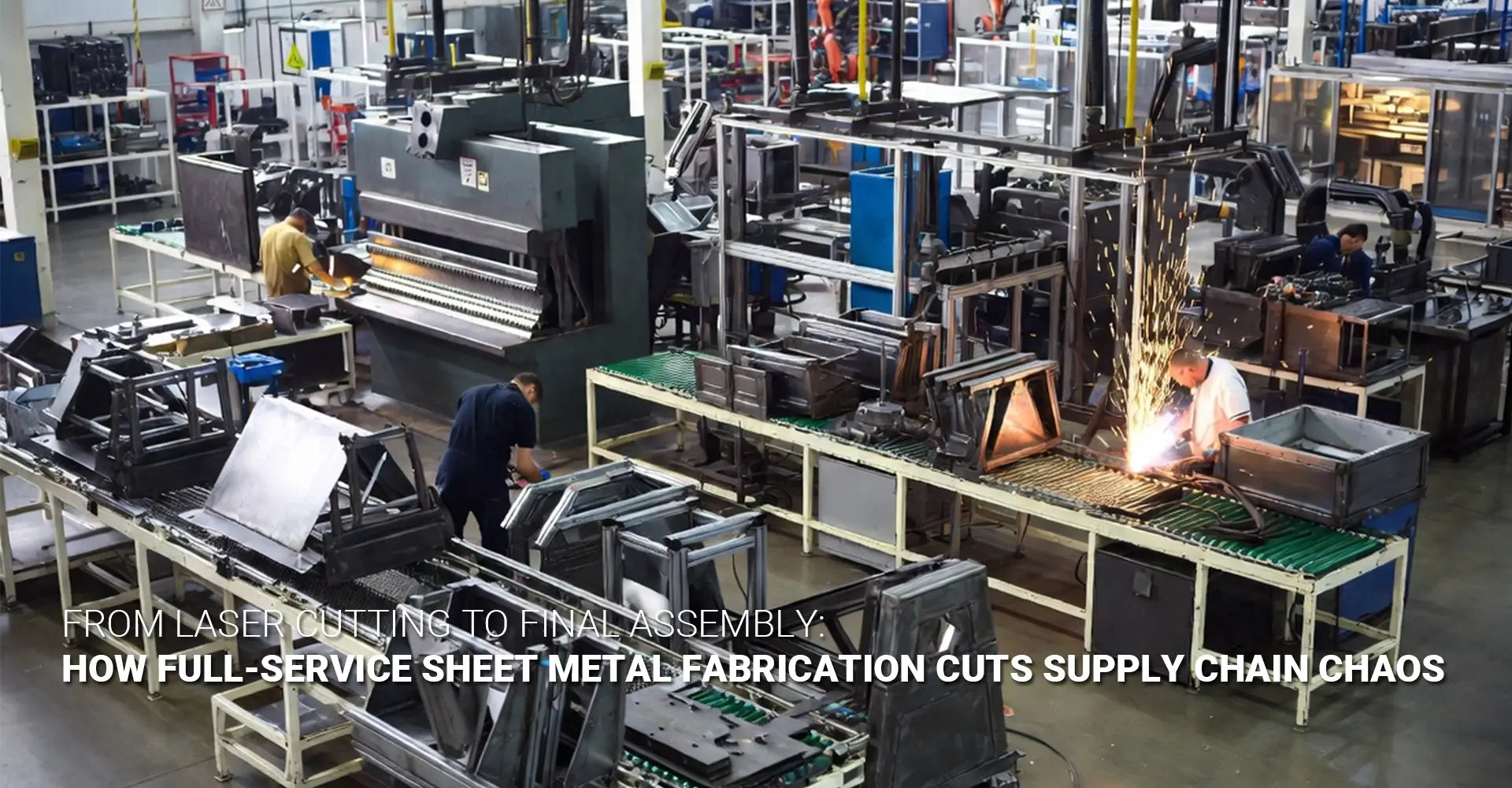
Stop Managing 5 Vendors: Is Full-Service Sheet Metal Fabrication the Smarter Way to Build Complex Assemblies?

You just received the finished parts from three different suppliers. Then, you try to assemble them. They don't fit. Now, Supplier A blames Supplier B. Supplier B blames Supplier C. And you? You're stuck in the middle — paying for expedited rework and watching your launch date disappear.
This is a story procurement teams know all too well. Managing multiple vendors for a single assembly creates chaos. It drives up costs. Most importantly, it wastes time that your business simply doesn't have.
The Quick Answer (Read This First)
Full-service sheet metal fabrication means one supplier handles every step — from raw sheet metal to finished, ready-to-ship assembly — under a single roof. This includes laser cutting, forming, welding, finishing, and final assembly. The result: fewer vendors, lower total costs, faster lead times, and zero blame games.
Key Takeaways at a Glance:
| Pain Point | Fragmented Vendors | Full-Service Partner |
|---|---|---|
| Quality accountability | Shared (no one owns it) | Single supplier owns it all |
| Lead time | Adds up at every handoff | Direct station-to-station |
| Hidden costs | 20%+ in admin, logistics, audits | Consolidated, transparent pricing |
| Fit & tolerance | Each vendor works independently | Same shop cuts, welds, and finishes |
| Inventory management | You manage it | Kanban systems available |
So, is bundling everything under one roof the right call for your business? Furthermore, does it actually save money — or does it just trade five markups for one bigger one? This article breaks down everything you need to know. By the end, you'll have a clear framework to decide whether full service sheet metal fabrication is the right move for your next project.
Table of Contents
- The Procurement Nightmare — When "Perfect Parts" Still Don't Fit Together
- What Does "Full Service" Actually Mean in Sheet Metal Fabrication?
- The Real Cost of Fragmentation — How Multiple Vendors Drain Your Budget
- Is Full-Service Sheet Metal Fabrication Always the Right Choice?
- Conclusion
- FAQ
The Procurement Nightmare — When "Perfect Parts" Still Don't Fit Together?
You've done everything right. You sourced your laser cutting from a specialist. You sent welding to a certified shop. You contracted a dedicated finisher for powder coating. Each part, on its own, passes inspection. Then, you bring them together for final assembly — and nothing lines up.
This scenario is not rare. In fact, it is one of the most common and costly problems in sheet metal fabrication services today. When multiple vendors each work to their own tolerances, their own workflows, and their own quality standards, small variations compound. The result is a finished assembly that doesn't work — despite every individual part being "correct."
The Core Problem in One Paragraph
When you split fabrication across multiple vendors, no single supplier owns the outcome. Each party optimizes for their own process. No one is responsible for how the parts interact. This gap — between individual part quality and assembly-level performance — is where projects fail, budgets blow up, and launch timelines collapse.
The three most common failure points in multi-vendor sheet metal sourcing:
- Dimensional drift — Each vendor holds tolerances independently. Small variations at each step stack up into a misaligned final assembly.
- Surface damage in transit — Parts are packaged, shipped, and unpacked between vendors. Every handoff is a chance for scratches, dents, or contamination.
- Accountability gaps — When something goes wrong, every vendor points at the previous one. You spend weeks chasing answers instead of fixing the problem.
The True Cost of the Blame Game
Let's follow a real-world scenario. A procurement team orders custom sheet metal parts from four vendors: a laser cutter, a press brake shop, a MIG welder, and a powder coater. Each step introduces a queue. Each queue adds days. Each transition adds risk.
Then, the powder-coated parts arrive at the welding shop — and the coating is chipped from transit. The welder says, "That's not our problem." The coater says, "We packaged them correctly." You now have three choices: re-coat (cost + time), ship damaged parts (quality risk), or delay the entire order (missed deadline).
Meanwhile, the hidden admin costs are piling up:
- Staff time spent issuing four separate purchase orders
- Quality audits at each vendor location
- Expedited freight when timelines slip
- Re-inspection after each handoff
Research consistently shows that managing multiple suppliers adds 20% or more in hidden overhead costs — costs that never appear on any single invoice but devastate your total project budget. This is exactly the problem that full-service sheet metal fabrication is designed to solve.
What Does "Full Service" Actually Mean in Sheet Metal Fabrication?
The phrase "full service" gets used loosely in manufacturing. Some shops call themselves full service if they offer three processes. Others genuinely mean it — covering every step from raw material to packed, labeled assembly. So, before you choose a partner, you need to know exactly what to look for.
True metal fabrication and assembly under one roof means the supplier never outsources your work to an outside vendor. Every operation — cutting, forming, joining, finishing, and assembling — happens in-house, on the same quality system, inspected by the same team.
What Full Service Covers: A Clear Checklist
A genuine full-service sheet metal fabricator handles all of the following in-house:
✅ Cutting — Laser cutting, CNC punching, plasma cutting ✅ Forming — Press brake bending, roll forming, stamping ✅ Joining — MIG welding, TIG welding, spot welding, hardware insertion ✅ Finishing — Deburring, grinding, powder coating, painting, plating ✅ Assembly — Mechanical sub-assembly, hardware installation, final fit-check ✅ Value-Add — DFM review, material sourcing, Kanban inventory management
If a supplier sends any of these steps outside their facility, they are not truly full service. That gap creates the same coordination risks you were trying to avoid.
Going Deeper: Value-Add Services That Change the Game
Beyond the core fabrication steps, the best turnkey sheet metal manufacturing partners offer services that most procurement teams don't even think to ask for — until they've experienced the pain of not having them.
Design for Manufacturability (DFM) Review
Before a single piece of metal is cut, a skilled full-service partner reviews your drawings and flags problems. They identify features that are difficult to form, tolerances that are unnecessarily tight, or designs that could be simplified without affecting function. This single step can eliminate costly rework before it ever starts. It is especially valuable for teams using rapid prototyping to validate designs quickly before full production.
Material Sourcing Support
Full-service shops buy metal in volume. They have established supplier relationships. As a result, they can often source material faster and cheaper than a buyer working independently. This is particularly useful when lead times for specific alloys are long or when material costs are volatile.
Kanban Inventory Management
For ongoing production runs, top-tier partners offer inventory partnership. Your supplier monitors stock levels, maintains pre-built bins, and replenishes automatically. Your production line never stops waiting for parts. This moves the supplier relationship from transactional to truly strategic.
The Real Cost of Fragmentation — How Multiple Vendors Drain Your Budget?
Here is a belief that costs procurement teams significant money: "If I find the cheapest specialist for each process, I'll get the lowest total cost." It sounds logical. In practice, it is almost always wrong.
Integrated manufacturing solutions exist precisely because the math of fragmented sourcing doesn't work the way buyers expect. Yes, you might save $0.15 per part on laser cutting. But then you spend more than that difference on purchase orders, quality audits, coordination calls, and shipping between vendors.
The Numbers Don't Lie
Industry data shows that managing multiple suppliers adds 20% or more in hidden costs — including procurement staff time, quality audits, inbound inspection, expedited freight, and rework due to inter-vendor misalignment.
Furthermore, documented case studies show:
- 32% per-part cost reduction achieved by consolidating fabrication and finishing under one supplier
- Lead time cut by more than half when parts no longer queue at multiple vendor locations
- Defect rates dropped significantly when the same team that cuts a part also welds and finishes it
These savings don't come from getting a single larger markup. They come from removing waste — wasted time, wasted logistics, wasted staff effort, and wasted material from rework.
Lead Time Is Where the Damage Really Shows
Many buyers focus on unit price. However, lead time is often where the real damage occurs.
Think about how queuing works in a multi-vendor chain. Your parts finish laser cutting on Monday. They ship to the welder on Tuesday. But the welder's queue doesn't start until Thursday. Welding finishes Friday. Parts ship to the coater Saturday. The coater's queue starts the following Wednesday. And so on.
Each vendor adds their own queue time. Five vendors can easily mean 3–4 weeks of pure waiting — not processing, just waiting in line.
In contrast, with sheet metal welding and finishing under one roof:
- Parts move directly from laser cutting to forming — same day
- Welding begins immediately after forming — no transit, no queue reset
- Finishing starts as soon as welding is complete — same facility, same schedule
- Assembly follows finishing with zero shipping between steps
One fabricator delivered 35 complex information kiosks — from design to finished assembly — in just 6 weeks. That timeline was only possible because every step happened in-house, without a single external handoff.
For industries where speed is critical — such as industrial machinery manufacturing — this lead time advantage is not a nice-to-have. It is a competitive necessity.
Is Full-Service Sheet Metal Fabrication Always the Right Choice?
Here is an honest answer that most vendors won't give you: no, full service is not the right fit for every single project. Understanding when it makes sense — and when it doesn't — is what separates good procurement decisions from great ones.
Contract manufacturing services built around the full-service model deliver their greatest value for specific types of work. Knowing your project profile helps you choose correctly.
When Full Service Wins (And When It Doesn't)
Full-service sheet metal fabrication delivers maximum ROI when:
- Your part requires three or more processes (e.g., cutting + welding + powder coating)
- You are building a multi-component assembly with tight fit requirements
- You are currently managing three or more vendors for a single product
- You have experienced blame-game delays or assembly failures in the past
- You need ongoing production with stable inventory management
Specialized shops may still be the better choice when:
- Your part only needs one process (e.g., laser cutting only, no further work)
- You require ultra-specialized coatings, such as aerospace CARC or Nadcap-certified anodizing
- You are working with exotic alloys that require highly niche metallurgical expertise
The key is total cost of acquisition — not unit price. When you account for coordination overhead, quality risk, lead time impact, and your team's management effort, full service wins for complex assemblies in the vast majority of cases.
The Self-Assessment Framework
Before you contact a potential partner, answer these six questions honestly. They will tell you whether outsourcing sheet metal fabrication to a full-service provider is the right move for your project.
1. How many processes does your part require? If the answer is three or more, full service will almost certainly save you time and money.
2. Does your part become part of a larger assembly? If yes, fit and tolerance consistency across processes is critical. One shop, one standard.
3. How many vendors are you currently using for this product? Three or more vendors is a strong signal that consolidation will reduce cost and risk.
4. Have you experienced assembly failures or rework due to vendor misalignment? If yes, you've already paid the price of fragmentation. It's time to eliminate that risk.
5. Does your production volume justify an inventory partnership? For automotive suppliers and other high-volume manufacturers, Kanban systems that keep the line running can be worth more than any per-part price saving.
6. Do you need consistent surface finishing across all components? When the same shop that welds your part also applies the surface finish, you eliminate transit damage and ensure color, texture, and coating thickness are uniform across every component.
If you answered "yes" to three or more of these questions, a full-service partner is very likely the right choice. The next step is knowing what to ask when you evaluate them.
Five questions to ask any potential full-service partner:
- "Do you perform cutting, forming, welding, finishing, and assembly entirely in-house?"
- "Can you show completed complex assemblies you've built from start to finish?"
- "What does your quality system look like between processes — one inspection standard or separate checks?"
- "Do you offer DFM review before quoting, to flag design issues early?"
- "Can you support Kanban or inventory management for ongoing production runs?"
A strong partner will answer all five with confidence — and with examples. Precision sheet metal fabrication at the assembly level requires more than equipment. It requires a quality culture that runs consistently across every station, every shift, and every order.
Conclusion
Managing five vendors to build one assembly is not a procurement strategy. It is a coordination tax — paid in time, money, and stress, every single project cycle.
Here is what this article has shown:
- Fragmented sourcing adds 20%+ in hidden costs through logistics, audits, admin overhead, and rework
- Multi-vendor lead times compound because every handoff resets the queue clock
- Accountability disappears when no single supplier owns the full assembly outcome
- Full-service fabrication solves all three problems by keeping every process under one roof, one quality system, and one accountable team
- Supply chain consolidation sourcing — moving from multiple vendors to a single integrated partner — is the procurement decision that delivers the clearest measurable ROI for complex assemblies
The most sophisticated procurement teams no longer optimize for lowest price per process. They optimize for total cost of acquisition — and that almost always means choosing a full-service partner.
Your next step is simple. Gather your complete assembly drawings. Include overall dimensions, material specs, finish requirements, and volume expectations. Submit them to a qualified full-service fabricator and ask for DFM feedback alongside your consolidated quote. That single conversation can show you exactly how much you've been leaving on the table.
Frequently Asked Questions
Q: What exactly counts as "full service" sheet metal fabrication? Full service means one supplier handles every step from raw material to finished assembly in-house. This includes laser cutting, CNC punching, press brake forming, MIG/TIG/spot welding, grinding, deburring, powder coating, painting or plating, and final assembly. Leading full-service providers also offer DFM review, material sourcing, and Kanban inventory management.
Q: How does one supplier eliminate the blame game? When a single team manages every process and a single quality system inspects every stage, there is no one else to point at. If a part fails, one supplier is accountable for fixing it — immediately, without negotiation.
Q: Does bundling all processes actually save money? Yes — when executed properly. Hidden costs of multi-vendor management typically add 20% or more to total project cost. Documented case studies show up to 32% per-part cost reduction after consolidation. The savings come from removed overhead, not combined markups.
Q: Doesn't one shop doing everything take longer than specialists working in parallel? No — total lead time is almost always shorter. Parts move station-to-station without queuing at multiple vendor facilities. One fabricator completed 35 complex kiosk assemblies in 6 weeks — a timeline impossible with multiple vendor handoffs.
Q: What if I need 5,000 parts with a very specific powder coat finish? Quality depends on the specific shop. Top full-service providers maintain in-house finishing lines with rigorous quality control. They also eliminate a critical risk: coating damage in transit between a separate coater and the assembly shop.
Q: How do I know if my part is a good candidate? Your part is an excellent candidate if it requires multiple processes, is part of a larger assembly, or if you're currently managing three or more vendors for it. Simple single-process parts may still work fine with a specialist shop.
Q: Do full-service shops handle Kanban and inventory management? Many advanced full-service fabricators do. One documented example involves a manufacturer running production of 8,000–10,000 parts regularly, where the fabricator monitors inventory and maintains Kanban bins to keep the customer's line running without interruption.
Recommended External Resources
[Full service sheet metal fabrication][^1]
[sheet metal fabrication services][^2]
[custom sheet metal parts][^3]
[metal fabrication and assembly][^4]
[turnkey sheet metal manufacturing][^5]
[integrated manufacturing solutions][^6]
[^1]. An expert article outlines the significant advantages of partnering with a full-service sheet metal fabrication company, highlighting how in-house capabilities from design to powder coating lead to reduced costs, improved communication, and faster production timelines.
[^2]. A comprehensive technical guide provides an in-depth look at modern sheet metal fabrication services, covering the entire manufacturing lifecycle from CAD design and CNC cutting technologies to various forming, joining, and post-processing techniques.
[^3]. A detailed technical resource provides essential design guidelines for custom sheet metal parts, covering critical factors such as bend radius, feature proximity to bends, and material relief strategies to ensure high-quality, manufacturable components.
[^4]. An informative guide explores the end-to-end metal fabrication and assembly process, detailing how integrated services—from waterjet cutting and powder coating to final assembly—provide cost-effective and customizable solutions for various industrial applications.
[^5]. A strategic industry article details the time and cost-saving advantages of turnkey sheet metal manufacturing, explaining how consolidating design, fabrication, and assembly under one roof streamlines the supply chain and ensures consistent quality.
[^4]. A comprehensive guide explores the benefits of integrated manufacturing solutions, highlighting how holistic contract manufacturing support—from initial product conception to high-volume production—helps companies scale efficiently while focusing on their core business operations.