
Can You Really Heat Treat Aluminum Die Castings Without Destroying Them?
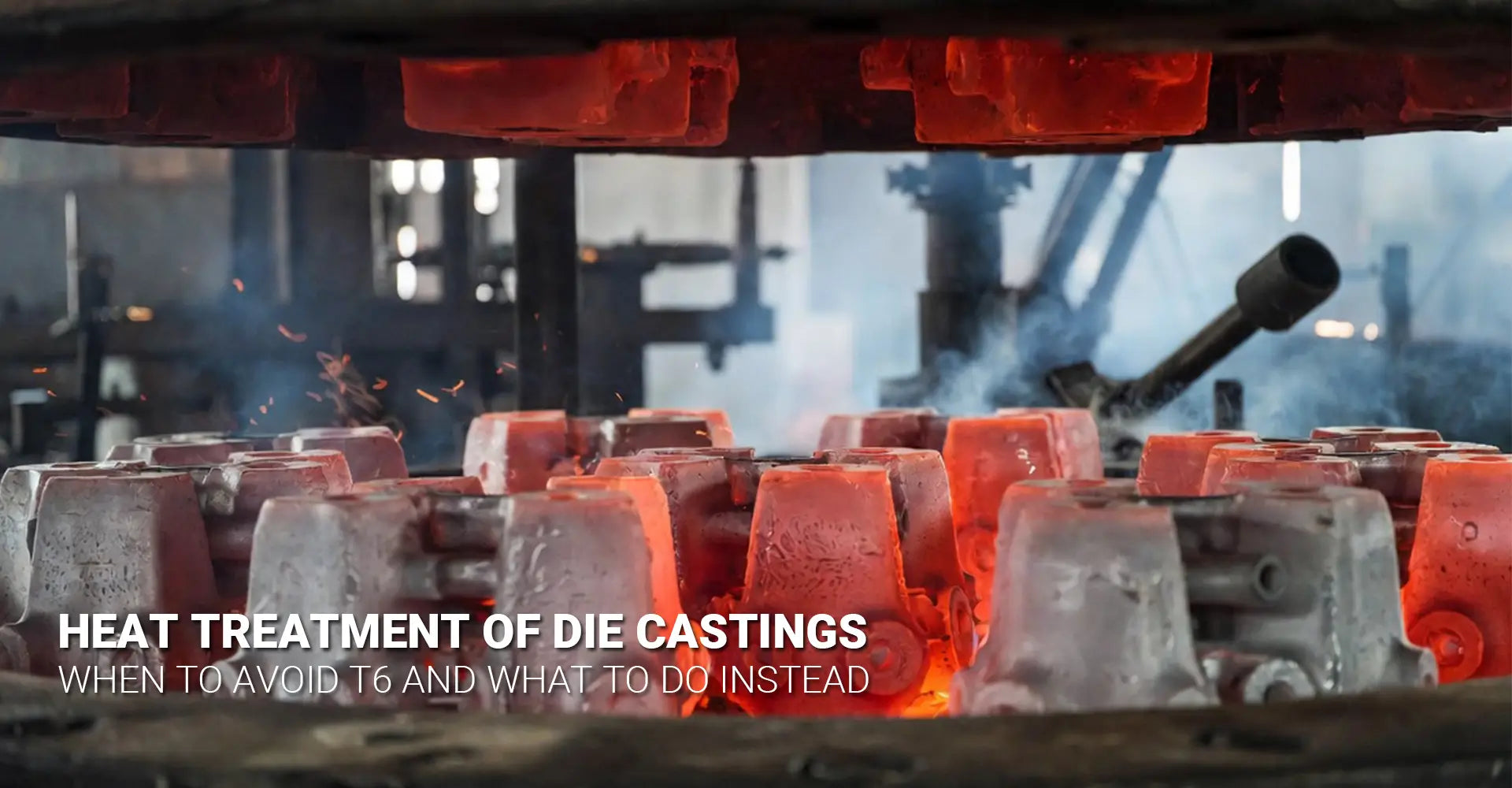
Can You Really Heat Treat Aluminum Die Castings Without Destroying Them?

Every year, thousands of engineers face the same costly surprise: they specify heat treatment of die castings expecting stronger parts, only to receive blistered, swollen rejects instead. This isn't a supplier mistake or process failure—it's a fundamental materials science conflict that most purchasing specifications ignore. Standard aluminum die castings and T6 heat treatment are physically incompatible, yet this mismatch costs manufacturers millions in scrapped parts, delayed production, and emergency redesigns. Moreover, understanding this limitation becomes critical when designing components for demanding applications in sectors like automotive manufacturing and industrial machinery, where material performance directly impacts safety and reliability.
Quick Answer: The Core Problem
| Problem | Root Cause | Solution |
|---|---|---|
| Surface blistering during heat treatment | Trapped air expands at high temperatures | Use vacuum die casting or avoid T6 entirely |
| Weakened structure after thermal processing | Solution heat treatment porosity interaction | Specify self-aging alloys instead |
| Inconsistent mechanical properties | Gas pockets create variable strength zones | Choose T5 aging or as-cast alternatives |
| Scrap rates exceeding 30% | Incompatible process combination | Match thermal cycle to casting method |
Standard die castings contain trapped air that expands violently during heat treatment, causing surface blisters and permanent damage. The high-speed injection process that makes die casting economical also creates microscopic gas porosity throughout the part. When heated to T6 solution temperatures (900-1000°F), this trapped air expands while the aluminum softens, rupturing the surface. However, several proven alternatives exist: vacuum die casting eliminates the porosity, self-aging aluminum alloy compositions achieve strength without heat treatment, and modified thermal cycles like T5 provide moderate improvements safely.
Understanding why die casting blistering happens—and more importantly, what alternatives actually work—requires looking beyond surface-level material specifications. The conflict between porosity and heat treatment isn't new, but recent metallurgical developments have created viable paths forward. Therefore, this guide walks through the physics of the blistering problem, explains why T6 fails on conventional castings, and provides a decision framework for matching your strength requirements to the appropriate casting process. Additionally, we'll examine how these considerations affect surface finish quality and compare performance with other methods like investment casting. By the end, you'll know exactly which approach fits your application without risking expensive failures.
Table of Contents
- Why Do Die Castings Blister During Heat Treatment?
- How Does T6 Heat Treatment Actually Work?
- Is T6 Compatible With Standard Die Casting Methods?
- What Are Your Proven Alternatives to T6 Treatment?
- Conclusion
Why Do Die Castings Blister During Heat Treatment?
Picture this common scenario: you've invested in precision machining, sent finished parts for T6 strengthening, and they return covered in surface bubbles. What looked like a straightforward metallurgical upgrade turned into a complete batch loss. This pattern repeats across industries because the failure mechanism operates at a microscopic level that specifications rarely address directly. In fact, aluminum die casting defects related to thermal processing represent one of the most expensive quality issues in manufacturing today.
The Core Mechanism Explained
Blistering occurs when trapped gas inside the casting expands faster than the weakened aluminum can contain it. During standard high-pressure die casting, molten metal enters the die cavity at speeds exceeding 100 feet per second. Consequently, this violent injection creates turbulence that folds air into the liquid aluminum as tiny pockets—typically measuring 10-100 microns. While invisible and harmless at room temperature, these gas pockets become destructive when exposed to heat treatment temperatures.

The Physics Behind the Failure
At 900°F (the typical T6 heat treatment aluminum die casting solution temperature), three things happen simultaneously. First, gas expansion causes trapped air to increase in volume by approximately 300-400% following the ideal gas law. Second, matrix softening occurs as the aluminum alloy approaches its solidus temperature, losing mechanical strength. Third, pressure buildup develops when the expanding gas exerts outward force with nowhere to escape.
Consequently, the weakened metal yields to internal pressure, creating visible surface blisters, dimensional distortion, or complete structural failure. This isn't a gradual degradation—it typically occurs within the first 15-30 minutes of solution treatment. Furthermore, even small amounts of porosity (2-3% by volume) can trigger catastrophic blistering because the gas expansion multiplies the effective void volume significantly.
How Does T6 Heat Treatment Actually Work?
Understanding the Process
T6 heat treatment remains the gold standard for maximizing aluminum strength, but its effectiveness depends entirely on starting with sound, porosity-free material. The process involves three distinct stages, each serving a specific metallurgical purpose. Therefore, understanding these stages helps explain why shortcuts or compromises inevitably deliver disappointing results.
The Three-Stage Transformation
Solution heat treatment (Stage 1) heats the casting to 900-1000°F for several hours, dissolving strengthening elements like copper, magnesium, and silicon into the aluminum matrix. This creates a supersaturated solid solution at elevated temperature. Quenching (Stage 2) then rapidly cools the part—usually in water or polymer solution—freezing the supersaturated condition at room temperature. Finally, artificial aging (Stage 3) reheats to 300-400°F for 4-12 hours, allowing controlled precipitation of strengthening compounds throughout the aluminum grains.
Why High Temperatures Are Non-Negotiable
The solution stage requires temperatures near the alloy's solidus point specifically because only at these extreme conditions do alloying elements fully dissolve. Lowering the temperature to avoid blistering defeats the entire purpose—you get neither complete dissolution nor adequate strengthening. This is why "modified T6" at reduced temperatures delivers disappointing results: the fundamental metallurgy requires those high temperatures to work properly.
Additionally, the quench rate must be rapid (typically 100-200°F per second) to prevent premature precipitation during cooling. Any slowdown allows coarse precipitates to form, reducing final strength by 30-50%. Therefore, the entire T6 sequence demands precise control without compromise—a requirement that fundamentally conflicts with the presence of gas porosity.
Is T6 Compatible With Standard Die Casting Methods?
The Fundamental Conflict
No—conventional high-pressure die casting and full T6 heat treatment are metallurgically incompatible. This definitive answer contradicts many supplier claims and outdated specifications, but the physics doesn't allow compromise. Every standard die casting contains some degree of gas porosity; every T6 cycle heats those gas pockets to expansion temperatures. Consequently, attempting to combine these processes results in predictable failure rather than exceptional components.
Why the Process Creates Porosity
Standard die casting prioritizes speed and cost-effectiveness, injecting molten aluminum at 50-150 feet per second under pressures exceeding 10,000 psi. While this fills complex geometries quickly, the turbulent flow pattern inevitably entraps air. Additionally, the rapid cooling rates prevent dissolved gases from escaping before solidification. Even with optimal gating design and venting, some porosity remains—typically 2-8% by volume in critical sections.
Attempted Workarounds That Fail
Some suppliers attempt "gentle T6" cycles with slower heating rates or lower peak temperatures (750-850°F instead of 900°F+). These modifications reduce blistering risk but also reduce strengthening effectiveness by 40-60%. Others try over-aging at longer times to compensate, which improves strength slightly but sacrifices ductility and dimensional stability.
Ultimately, these compromises deliver neither reliable processing nor specified mechanical properties. Moreover, the variability in porosity distribution means that even "successful" heat treatment produces inconsistent results—some areas achieve partial strengthening while others remain weak or develop subsurface defects invisible to inspection.
What Are Your Proven Alternatives to T6 Treatment?
Strategic Approaches That Actually Work
Rather than fighting the porosity-heat treatment conflict, successful engineers select processes that eliminate the conflict entirely. Four distinct approaches have proven effective across industries, each with specific cost-performance trade-offs. Therefore, matching your requirements to the right alternative to T6 casting method becomes essential for both technical success and economic viability.
Option A: Vacuum Die Casting
This method removes air from the die cavity before injection, reducing porosity to near-permanent-mold levels. Modern vacuum die casting systems evacuate the die to 50-100 millibar absolute pressure immediately before metal injection. Without atmospheric air present, gas porosity drops from typical 5-8% to under 0.5%. These low-porosity castings survive full T6 heat treatment reliably.
However, vacuum die casting adds significant cost: specialized dies with sealing systems, longer cycle times, and higher per-part processing costs. Therefore, it makes economic sense primarily for high-value components like aerospace brackets, automotive control arms, or medical device housings where T6 strength justifies the investment. Nevertheless, when maximum as-cast strength combined with heat treatment capability is required, vacuum processing remains the only reliable path.
Option B: Self-Aging High-Strength Alloys
New aluminum alloys achieve excellent mechanical properties without any heat treatment through controlled precipitation during natural aging. Compositions like Silafont-36, Magsimal-59, and similar proprietary alloys contain carefully balanced silicon, magnesium, and trace elements that precipitate strengthening phases at room temperature over 5-10 days.
These alloys typically deliver:
- Tensile strength: 320-380 MPa (comparable to T6-treated A356)
- Yield strength: 220-280 MPa
- Elongation: 8-15% (superior to most T6 conditions)
- Dimensional stability: Excellent, with minimal thermal distortion risk
Moreover, they maintain die casting's productivity advantages while eliminating heat treatment entirely. The trade-off lies in material cost—these proprietary alloys cost 15-30% more than standard A380—but save the entire thermal processing expense and scrap risk. Furthermore, components made from self-aging alloys show superior surface quality since they avoid the scaling and discoloration common with thermal processing.
Option C: T5 Artificial Aging Only
When moderate strengthening suffices, T5 treatment provides 20-40% improvement without solution heating. This simplified process heats castings directly to aging temperature (300-400°F) for 2-8 hours without the dangerous 900°F+ solution stage. Because temperatures stay below the critical gas expansion threshold, blistering risk drops dramatically.
T5 works well for applications requiring:
- Dimensional stability improvement
- Modest hardness increases (15-25 HB)
- Stress relief from casting operations
- Improved machinability through precipitation
While T5 never matches full T6 ultimate strength, it offers a practical middle ground for brackets, housings, and structural components where extreme loads aren't expected. Additionally, T5 processing costs roughly 40-60% less than full T6 treatment while maintaining faster turnaround times.
Option D: As-Cast Performance Optimization
Sometimes the smartest choice involves designing for as-cast properties rather than chasing heat-treated strength. Standard die casting alloys like A380 and ADC12 deliver:
- Tensile strength: 310-330 MPa
- Yield strength: 160-170 MPa
- Excellent pressure tightness
- Superior surface finish
Many applications actually benefit from as-cast properties: lower yield strength means better impact absorption, higher ductility prevents brittle fracture, and eliminating thermal processing reduces dimensional variation. Design optimization—adding ribs, increasing section thickness strategically, or incorporating geometry-based strengthening—often achieves required performance without any post-casting treatment. Furthermore, as-cast parts maintain the best surface finish quality since they avoid heat treatment oxidation and scaling.
Conclusion
The conflict between die casting porosity and T6 heat treatment isn't a process control problem to be solved—it's a fundamental materials science limitation to be designed around. Standard die castings cannot survive full solution heat treatment because the physics of gas expansion in softened aluminum doesn't allow it. However, this limitation doesn't condemn die castings to inferior strength.
Vacuum processing, self-aging alloys, modified thermal cycles, and intelligent design optimization all provide paths to high-performance components without the blistering risk. Smart specification begins with matching your actual strength requirements to the appropriate manufacturing route rather than defaulting to "die casting + T6" from outdated reference guides.
By understanding why the conflict exists and which alternatives work reliably, you'll avoid costly surprises and deliver parts that meet both performance and production requirements. Whether your application demands aerospace-grade strength, automotive durability, or industrial machinery reliability, the right combination of alloy selection and thermal processing strategy exists—you just need to choose based on physics rather than assumptions.
Frequently Asked Questions
Q: I specified T6 heat treatment for my aluminum die castings and they came back blistered. What went wrong?
A: Your supplier attempted T6 on conventional die castings containing gas porosity. Standard high-pressure die casting traps microscopic air pockets throughout the part during the violent injection process. When heated to T6 solution temperatures (900-1000°F), this trapped air expands dramatically while the aluminum matrix softens, creating internal pressure that ruptures the surface as visible blisters. This isn't a supplier error—it's the predictable result of applying a high-temperature thermal process to a material with internal porosity. Conventional die castings physically cannot survive full T6 treatment without specialized vacuum processing to eliminate the porosity beforehand.
Q: Some suppliers claim they can provide T6 heat treated aluminum die castings. How is this possible?
A: Genuine T6-capable die castings require one of three special conditions. First, vacuum die casting evacuates air from the die cavity before injection, reducing gas porosity to levels that survive solution heating. Second, squeeze casting or semi-solid processes use fundamentally different metal delivery methods that minimize air entrapment. Third, some suppliers offer "modified T6" at reduced temperatures (750-850°F instead of 900°F+), which reduces blistering but also cuts strengthening effectiveness by 40-60%. If you see "T6 die casting" claims without explicit mention of vacuum processing or specialized methods, request detailed process specifications immediately. Standard atmospheric die casting cannot deliver true T6 properties reliably.
Q: Does this mean die castings are always weaker than sand or permanent mold castings?
A: Not anymore—though historically yes, because die castings couldn't be heat treated while sand castings could achieve T6 strength. However, recent metallurgical advances have closed this gap. Self-aging aluminum alloys like Silafont-36 and Magsimal-59 achieve 320-380 MPa tensile strength in the as-cast condition without any heat treatment, matching or exceeding T6-treated traditional alloys. These compositions use controlled precipitation during natural aging (5-10 days at room temperature) to develop strength equivalent to thermally processed material. Additionally, they maintain superior ductility (8-15% elongation) compared to T6 conditions. Therefore, die castings using advanced alloys now compete directly with heat-treated alternatives while preserving die casting's productivity advantages.
Q: Can I use artificial aging only (T5) instead of full T6 to avoid blistering?
A: Yes—T5 treatment is significantly safer for die castings because it skips the dangerous solution heating stage. T5 heats parts directly to aging temperature (300-400°F) for 2-8 hours without first raising them to 900°F+. At these lower temperatures, trapped gas expands minimally and the aluminum retains structural integrity, drastically reducing blister risk. T5 typically improves yield strength by 20-40% and enhances hardness by 15-25 HB while also providing stress relief and dimensional stability. However, T5 never matches full T6 ultimate tensile strength since it doesn't dissolve and redistribute alloying elements. Use T5 when you need moderate strengthening, better machinability, or dimensional stability rather than maximum load-bearing capacity.
Q: How do I specify the right process for my die cast component?
A: Follow this decision framework based on your actual performance requirements. If you need maximum strength, fatigue resistance, and ductility comparable to wrought aluminum, specify vacuum die casting designed for full T6 heat treatment—but expect 30-50% higher tooling and processing costs. If you need high strength without extreme fatigue demands, specify self-aging alloys like Silafont-36 which achieve 320-380 MPa tensile strength as-cast with no thermal processing. If you need moderate strengthening, stress relief, or improved hardness, specify T5 artificial aging which provides 20-40% improvement safely. If dimensional consistency and pressure tightness matter more than ultimate strength, standard die casting with as-cast properties may suffice—consider design optimization (ribs, section thickness, geometry) to meet load requirements. Never specify "T6" for standard atmospheric die castings regardless of supplier assurances unless they explicitly confirm vacuum processing capability.
Q: Will heat treatment affect the surface finish of my die cast parts?
A: Yes, significantly. Thermal processing at T6 temperatures (900-1000°F) inevitably creates surface oxidation, scaling, and discoloration that requires additional finishing operations. The high-temperature exposure forms aluminum oxide layers that appear dull gray or dark, compromising the naturally smooth, bright finish that die castings provide. Consequently, T6-treated parts typically require chemical cleaning, mechanical finishing, or coating to restore acceptable appearance. In contrast, T5 aging at lower temperatures (300-400°F) produces minimal surface degradation, while self-aging alloys maintain the best as-cast surface quality with no thermal exposure. If cosmetic appearance matters, choosing non-thermal strengthening methods preserves the inherent surface advantages of the die casting process.
Q: How does the cost compare between vacuum die casting and self-aging alloys?
A: Both approaches add cost compared to standard die casting, but in different ways. Vacuum die casting requires specialized tooling with evacuation systems, increasing die costs by $15,000-$40,000 depending on complexity, plus 20-30% longer cycle times reduce productivity. However, material costs remain standard. Self-aging alloys use conventional die casting equipment with no capital investment, but the proprietary alloy compositions cost 15-30% more per pound than standard A380 or ADC12. For low-volume, high-value parts (under 10,000 pieces annually), self-aging alloys typically prove more economical. For high-volume production exceeding 50,000 pieces yearly, vacuum die casting's tooling investment amortizes effectively. Between these volumes, detailed cost modeling accounting for scrap rates, heat treatment expenses, and quality requirements determines the optimal choice.
Recommended External Resources
[^1]This page from the North American Die Casting Association (NADCA ) provides comprehensive standards and guidelines for high-integrity die casting processes, including detailed sections on heat treatment and temper designations for various casting methods
[^2] This peer-reviewed article published in Engineering Failure Analysis explores the technical causes of blister formation in aluminum die castings, specifically focusing on how casting defects like cold flakes and porosity expand during heat treatment to form surface blisters.
[^3] This scientific article investigates how solution heat treatment influences porosity growth in aluminum alloys, explaining the mechanisms where internal gas pressure and diffusion at high temperatures lead to the expansion of previously undetectable micro-pores.
[^4]This comprehensive technical guide details various aluminum die casting defects, categorizing them into internal and superficial types while providing in-depth analysis of their root causes, such as gas porosity and shrinkage, along with practical prevention strategies.