How Do You Stop Chips From Destroying Your Deep Cavity Cuts?
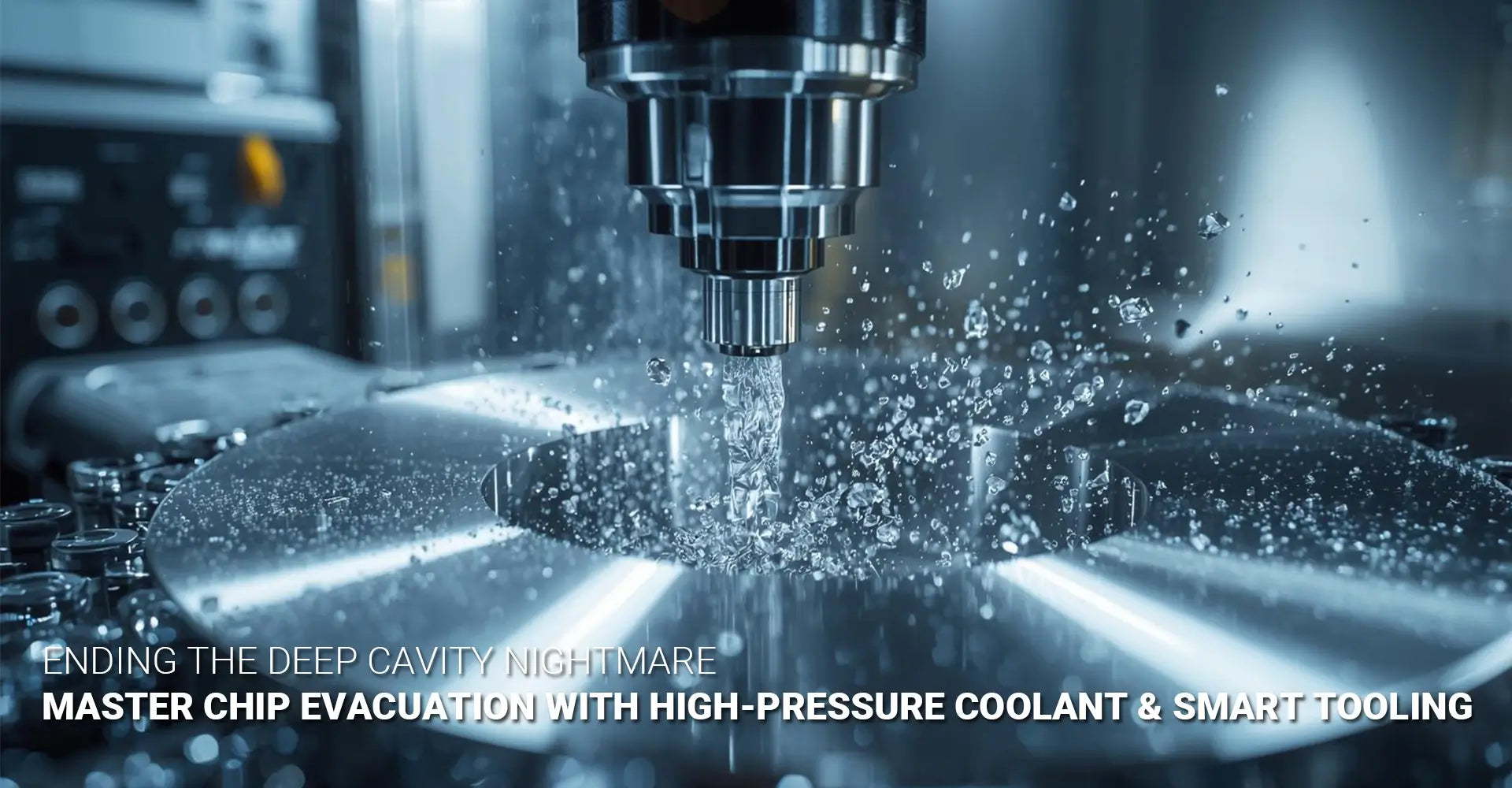
How Do You Stop Chips From Destroying Your Deep Cavity Cuts?

Every machinist has faced this nightmare: you're halfway through cutting a deep pocket when the machine sounds change. The tool bogs down, surface finish deteriorates, and suddenly you hear the sickening crack of a broken end mill. When you inspect the cavity, you find it packed with chips that have nowhere to go. This scenario costs shops thousands in broken tools, scrapped parts, and lost production time. However, the problem isn't random bad luck—it's a technical challenge with proven solutions.
Quick Answer: Your Deep Cavity Chip Evacuation Checklist
Stop wasting time and money on broken tools. Here's what actually works:
- High-pressure coolant (1000+ PSI) physically blasts chips out of confined spaces and breaks up long stringy chips before they pack
- Internal coolant tool holders deliver coolant directly to cutting edges where it matters most, not just flooding the part exterior
- Helical interpolation and peck cycles create programmed escape routes for chips instead of trapping them at the bottom
- Chip-breaking end mill geometries produce smaller, manageable chips that evacuate easily through flutes
- Combining all three approaches (pressure + tooling + programming) solves 90% of deep cavity problems regardless of material
The solution isn't complicated, but it requires understanding why chips get trapped in the first place.
Table of Contents
- Why Do Chips Get Trapped in Deep Cavities?
- Can High-Pressure Coolant Really Solve Chip Evacuation Problems?
- What Toolholder Should You Use for Deep Cavity Machining?
- Which Programming Techniques Prevent Chip Packing?
- How Do You Choose the Right Solution for Your Job?
- What Results Can You Actually Expect?
- Conclusion
Why Do Chips Get Trapped in Deep Cavities?
Understanding CNC deep cavity chip evacuation starts with physics, not just better equipment. When you machine a pocket deeper than three times the tool diameter, you create a confined space where chips have limited escape routes. Consequently, gravity works against you, coolant can't reach the cutting zone effectively, and chips begin accumulating faster than they exit.
The Core Problem Explained Simply
Deep cavities fail because of three connected issues. First, chips generate tremendous heat in the small cutting zone, and without proper cooling, they weld to the tool or workpiece. Second, trapped chips get re-cut multiple times, creating even more heat and smaller particles that pack tighter. Third, this buildup causes tool deflection, which produces poor surface finish and eventually catastrophic tool failure.
The Three Failure Modes That Destroy Your Parts
Thermal damage occurs when chips can't carry heat away from the cutting zone. Accordingly, temperatures spike above 400°F in steel and 300°F in aluminum, which softens cutting edges and causes rapid wear. The tool dulls prematurely, requiring more cutting force, which generates even more heat in a destructive cycle.
Chip welding happens when hot chips momentarily bond to the freshly cut surface or the tool itself. Subsequently, the rotating tool picks up these welded chips and drags them through the cut, creating scratches and poor surface finish. In materials like stainless steel or titanium, this welding effect is particularly severe due to their work-hardening properties.
Tool breakage is the final failure mode. As chips pack into the cavity, they create back-pressure on the tool's flutes. This prevents new chips from evacuating, increases cutting forces dramatically, and causes the tool to deflect or snap. In fact, studies show that chip evacuation failures cause 40% of all premature tool failures in deep pocket machining.
Material-specific challenges compound these problems. Aluminum produces long, stringy chips that tangle and pack easily, especially in 6061 and 7075 alloys commonly used in aerospace and automotive applications. Steel creates smaller but abrasive chips that generate more heat. Meanwhile, titanium combines the worst of both worlds: tough chips that resist breaking and extreme heat generation that accelerates tool wear.
When your depth-to-diameter ratio exceeds 3:1, standard flood coolant simply cannot reach the cutting zone effectively. Therefore, chips accumulate faster than they escape, and failure becomes inevitable without intervention. The deeper you cut, the more critical proper chip evacuation solutions become for maintaining quality and preventing expensive downtime.
Can High-Pressure Coolant Really Solve Chip Evacuation Problems?
Standard coolant systems operate between 100-300 PSI, which works fine for shallow cuts and face milling. However, high pressure coolant deep milling requires a completely different approach. When you increase pressure to 1000 PSI or higher, coolant transforms from a passive lubricant into an active chip evacuation tool that forcibly removes material from the cut zone.
What Happens at 1000+ PSI
High-pressure coolant accomplishes three critical tasks simultaneously. First, it breaks long chips into smaller segments by hitting them with enough force to fracture them as they form. Second, it flushes chips upward out of the cavity against gravity, creating a constant flow that prevents accumulation. Third, it penetrates the cutting zone to deliver cooling exactly where temperatures peak, which extends tool life dramatically.

Pressure vs. Flow: Understanding What You Actually Need
Many shops mistakenly believe that more flow (gallons per minute) solves deep cavity problems. In reality, pressure determines whether coolant can reach the cut zone and break chips, while flow determines how much heat you can remove and how many chips you can carry away. Consequently, you need both, but pressure is the critical factor for chip evacuation.
For most deep cavity work, aim for these specifications:
- Aluminum and soft materials: 800-1200 PSI with 3-5 GPM flow
- Steel and cast iron: 1000-1500 PSI with 4-6 GPM flow
- Stainless steel and titanium: 1200-2000 PSI with 5-8 GPM flow
- Extremely deep cavities (10xD or more): 1500+ PSI regardless of material
System components required for effective high-pressure delivery include a dedicated pump (not your machine's standard coolant pump), pressure-rated hoses and fittings, rotary unions that maintain pressure while the spindle turns, and properly sealed toolholders. Additionally, you'll need adequate filtration to remove chips from the coolant before recirculation, as high-pressure systems are more sensitive to contamination.
ROI considerations matter for smaller shops. A complete high-pressure coolant system costs $8,000-$25,000 depending on specifications. However, if you regularly machine deep cavities, the investment pays back quickly through reduced tool costs, lower scrap rates, and faster cycle times. One shop reported saving $30,000 annually in tool costs alone after installing a 1500 PSI system for deep pocket machining in industrial machinery components.
If you cannot justify a high-pressure system immediately, you can still improve chip evacuation significantly. Start by ensuring your current coolant is properly aimed at the cut zone rather than flooding the part generally. Then, upgrade to internal coolant tooling (discussed next) which works even at standard pressures. Finally, optimize your programming to give chips more opportunities to escape.
The pressure threshold of 1000 PSI represents the point where coolant becomes forceful enough to actively manage chips rather than just cooling and lubricating. Below this pressure, you're fighting chip evacuation problems with inadequate tools. Above it, you gain control over one of machining's most persistent challenges.
What Toolholder Should You Use for Deep Cavity Machining?
Your coolant system's pressure means nothing if the coolant never reaches the cutting edges. This is where internal coolant tool holder technology becomes critical for deep cavity success. Unlike flood coolant that sprays from external nozzles, internal coolant travels through the toolholder and tool itself, delivering coolant precisely where heat and chips are generated.
Comparing Your Toolholder Options
Different toolholder types offer dramatically different chip evacuation performance. Understanding these differences helps you select the right tool for your application and budget.
| Toolholder Type | Coolant Delivery | Pressure Rating | Deep Cavity Performance | Cost Range |
|---|---|---|---|---|
| Standard ER Collet | External flood only | N/A | Poor - coolant never reaches cut zone | $30-$80 |
| ER Collet with Side Ports | Through collar to exterior | 300-500 PSI | Fair - leaks pressure, coolant doesn't reach tip | $80-$150 |
| Hydraulic with Internal Coolant | Through holder to tool tip | 1000-1500 PSI | Excellent - sealed delivery, high grip force | $200-$400 |
| Dedicated Internal Coolant (Shrink/Milling Chuck) | Sealed path to cutting edges | 1500-2000+ PSI | Outstanding - zero pressure loss | $250-$500 |

Why Dedicated Internal Coolant Holders Win
Sealed design makes the critical difference in deep cavity work. Standard ER collets with side coolant ports leak pressure at multiple points—where the collet meets the holder, where the tool enters the collet, and through the coolant passages themselves. Therefore, you might pump in 1000 PSI but only 400 PSI actually reaches the tool tip. Dedicated internal coolant holders eliminate these leaks through precision-machined seals and integrated coolant channels.
Pressure handling capability differs dramatically between toolholder types. A standard ER collet system might survive 500 PSI temporarily, but the seals degrade quickly. Meanwhile, hydraulic and shrink-fit holders designed for internal coolant use O-rings, sealing surfaces, and materials engineered specifically for continuous high-pressure operation. Consequently, they maintain performance over thousands of hours without seal replacement.
Precision and balance affect your surface finish and tool life, especially at higher RPMs common in aluminum work. Dedicated internal coolant holders are manufactured to tighter runout specifications (typically 0.0001" TIR or better) compared to standard ER collets. Additionally, they balance coolant flow symmetrically around the tool axis, preventing vibration that would occur with uneven coolant pressure.
Selecting the Right Holder for Your Application
For shallow cavities (less than 3xD), standard ER collets with flood coolant work adequately. You don't need the investment in internal coolant unless you're pushing speeds and feeds aggressively.
For medium-depth cavities (3-6xD), upgrade to ER collets with side ports at minimum. This provides some coolant delivery advantage. However, if your material is difficult to machine or you need long tool life, consider hydraulic holders with internal coolant as the better investment.
For deep cavities (6xD and beyond), dedicated internal coolant holders become essential rather than optional. The performance difference is too significant to ignore. Moreover, through spindle coolant (TSC) systems require these holders to function properly, as they're specifically designed to handle the pressure and flow from spindle-mounted rotary unions.
Specific product considerations include compatibility with your machine's spindle taper (CAT40, CAT50, BT40, HSK, etc.), clearance around the holder for chip evacuation, and availability of the tool sizes you regularly use. Additionally, verify that replacement seals are readily available and affordable, as seal maintenance becomes part of your regular tooling costs with high-pressure systems.
When selecting holders for CNC machining services that involve deep cavity work, prioritize holders that can grow with your capabilities. Even if you don't have high-pressure coolant today, buying holders rated for 1500+ PSI means you won't need to replace them when you upgrade your coolant system later.
The toolholder is the critical interface between your machine's capabilities and the actual cutting process. Investing in proper internal coolant tooling delivers immediate results in tool life and part quality, making it one of the highest-ROI upgrades you can make for deep cavity machining.
Which Programming Techniques Prevent Chip Packing?
Even with perfect coolant pressure and tooling, poor programming can still cause chip evacuation failures. Fortunately, modern CAM software provides several powerful strategies that proactively manage chips before they become problems. These techniques are often free to implement since they require no new equipment—just smarter toolpaths.
Four Essential Programming Strategies
Helical interpolation revolutionizes how you create deep holes and cavities. Instead of plunging straight down (which traps chips underneath the tool), the cutter moves downward in a controlled corkscrew motion. This creates continuous space along the flute channels where chips can escape upward as the tool spirals down. Additionally, helical entry distributes cutting forces across the entire cutting edge rather than concentrating them at the tool tip, which reduces deflection and extends tool life.
Peck milling cycle provides periodic chip evacuation for operations where helical entry isn't practical. The tool cuts downward for a specified depth (typically 0.5-1.5 times the tool diameter), then retracts fully out of the cavity. This retraction allows chips to fall free and coolant to flush the cavity before the next peck. While this increases cycle time by 15-30%, it prevents the catastrophic failures that cost far more in scrapped parts and broken tools.
Ramping strategies offer a middle ground between full helical interpolation and aggressive plunging. The tool enters the material at a shallow angle (typically 2-5 degrees), which reduces axial cutting forces and creates an escape path for chips. For rectangular pockets, linear ramping works well. For circular features, use circular or spiral ramping to maintain consistent chip loads throughout the entry move.
Chip-thinning toolpaths control chip formation through intelligent stepover and feed rate adjustments. By increasing stepover slightly while reducing feed per tooth, you create thinner chips that break more easily and evacuate faster. This technique is particularly valuable in aluminum, where standard parameters often produce long stringy chips that tangle. Modern CAM systems can calculate chip-thinning parameters automatically based on your tool geometry and material.
Implementing These Techniques in Your CAM Software
For helical interpolation, set your pitch angle between 2-5 degrees depending on material hardness. Softer materials like aluminum allow steeper pitches (faster penetration), while harder materials require gentler angles. Set your helix radius to 60-70% of the tool diameter to maintain good chip evacuation without excessive cutting forces. Most CAM packages include helical entry options in their drilling and boring cycles—enable these instead of using straight plunge entries.
For peck milling cycles, calculate your peck depth based on the flute length available for chip storage. A good starting point is one times the tool diameter for roughing and 0.5 times diameter for finishing. Set a brief dwell time (0.5-1.0 seconds) at the bottom of each peck to ensure coolant reaches the cutting zone before the tool retracts. Program a rapid retract to 0.1" above the cavity surface, pause briefly for chip clearing, then rapid back down to the previous depth before cutting resumes.
Specific parameter recommendations vary by material and tool. For aluminum, use aggressive peck cycles every 1-1.5xD with rapid retracts. For steel, reduce peck depth to 0.75-1.0xD and allow longer dwell times for coolant penetration. For stainless steel, where work hardening is a concern, never dwell at the bottom without cutting—either continue advancing or retract immediately. Meanwhile, chip breaking techniques in titanium often require specialized variable-pitch end mills combined with conservative peck depths of 0.5xD.
Programming workflow tips can save significant time when creating deep cavity operations. First, create your rough and finish operations separately, as roughing benefits from aggressive peck cycles while finishing often works better with helical ramping for superior surface finish. Second, use simulation to verify that chips have clear exit paths—if your simulation shows chips packing in corners, adjust your toolpath lead-in and lead-out moves. Third, program a final cleanup pass at full depth with a light radial engagement (10-20% of tool diameter) to remove any chip-welded material from the cavity walls.
When programming custom CNC milling services, these techniques become even more critical because you're often dealing with one-off or low-volume parts where you cannot afford to iterate through multiple test cuts. Getting the programming right the first time prevents expensive mistakes and maintains profitability on complex jobs.
The key insight is that chip evacuation begins in the CAM system, not on the machine. By programming intelligent toolpaths that give chips multiple opportunities to escape, you prevent problems before they start rather than trying to overcome them with brute force coolant pressure alone.
How Do You Choose the Right Solution for Your Job?
With multiple chip evacuation strategies available, selecting the optimal approach requires matching your specific situation to the right combination of techniques. The best solution depends on your cavity depth, material properties, production volume, and available budget. Fortunately, you can achieve excellent results by implementing solutions progressively rather than requiring everything at once.
Decision Framework: Matching Problems to Solutions
Start by evaluating your cavity's depth-to-diameter ratio. If you're cutting less than 3xD, focus primarily on programming techniques like helical entry and chip-thinning toolpaths. Standard flood coolant handles chip evacuation adequately at these depths. Between 3-6xD, add internal coolant toolholders even if your coolant pressure remains standard—the improved coolant delivery makes a significant difference. Beyond 6xD, you need the complete solution: high-pressure coolant, internal tooling, and optimized programming working together.
Material properties influence which strategies matter most. Soft, gummy materials like aluminum and copper alloys produce long stringy chips that require aggressive chip breaking. Therefore, prioritize high coolant pressure and specialized chip-breaking end mill geometries. Harder materials like steel and cast iron create smaller chips but generate more heat, making coolant penetration to the cutting zone critical—upgrade toolholders before investing in higher pressure. Difficult materials like stainless steel and titanium demand all solutions implemented simultaneously because they combine chip control challenges with extreme heat generation.
Budget-Conscious Alternatives When High-Pressure Isn't Available
Many smaller shops cannot immediately justify $15,000-$25,000 for a complete high-pressure coolant system. Fortunately, you can still achieve dramatically improved results through strategic partial upgrades.
Zero-cost improvements start with programming. Implement helical interpolation for all deep hole operations immediately—this requires no equipment investment, just CAM programming time. Similarly, add peck cycles to deep pocket roughing operations, accepting a 20-25% cycle time increase in exchange for eliminating tool breakage and scrap parts. These changes alone can reduce deep cavity failures by 50-60%.
Low-cost upgrades ($500-$2000) focus on tooling improvements. Replace standard ER collet holders with dedicated internal coolant holders for your most commonly used deep cavity tools. Even at standard coolant pressure (200-300 PSI), internal delivery provides far better chip evacuation than flood coolant. Additionally, invest in variable-helix and variable-pitch end mills designed specifically for deep cavity work—these tools incorporate chip-breaking geometries that work with standard coolant systems.
Medium-cost solutions ($2000-$8000) include through-spindle coolant (TSC) retrofit kits if your machine supports them. TSC systems deliver coolant through the spindle to the tool, eliminating external hoses and providing more consistent pressure than floor-mounted coolant systems. While not as powerful as dedicated high-pressure pumps, TSC at 500-700 PSI significantly outperforms standard flood coolant for deep cavity work.
Air and MQL alternatives work for certain applications, particularly in aluminum and other non-ferrous materials. High-volume air blast (90+ PSI at 30+ CFM) can push chips out of cavities up to 5xD deep, though it provides no cooling benefit. Minimum quantity lubrication (MQL) combines air blast with micro-droplets of cutting oil, offering both chip evacuation and some lubrication. However, these approaches don't match liquid coolant performance in steel and harder materials where heat generation is significant.
Incremental Upgrade Path for Growing Capabilities
Phase 1: Programming optimization (Month 1) - Implement helical interpolation, peck cycles, and chip-thinning strategies across all deep cavity operations. Document cycle time changes and track tool life improvements. This establishes your baseline and demonstrates ROI for future investments.
Phase 2: Toolholder upgrades (Months 2-3) - Replace holders for your most critical deep cavity tools with internal coolant versions. Start with tools you use most frequently or those that fail most often. Track cost savings from reduced tool breakage and improved part quality.
Phase 3: Coolant system enhancement (Months 4-6) - If your machine supports TSC, retrofit it for better coolant delivery. If not, improve your flood coolant with higher-flow pumps and better-aimed nozzles. This mid-level investment bridges the gap until you can justify high-pressure systems.
Phase 4: High-pressure coolant (Year 2+) - Once you've documented substantial savings from previous phases, build the business case for a complete high-pressure system. Your tracked data on tool life improvements, reduced scrap, and faster cycle times provides concrete ROI justification.
Scenario-Based Recommendations
Production machining (1000+ parts annually): Invest in the complete solution immediately. High-pressure coolant, premium internal coolant holders, and optimized programming pay back within 6-12 months through reduced cycle times, virtually eliminated tool breakage, and consistent part quality. The cost of even one production delay often exceeds the investment in proper chip evacuation equipment.
Job shop work (varied, low-volume parts): Focus on versatile solutions that work across multiple applications. Priority should be internal coolant toolholders (which help every deep cavity job) and programming expertise (which costs nothing per part). Add high-pressure coolant only after you've established consistent demand for deep cavity work that justifies the investment.
Prototype and R&D machining: Programming techniques provide the best ROI since you're often making just one or a few parts. The time invested in creating optimal toolpaths pays off through eliminated failures and faster development cycles. Use internal coolant tooling if available, but don't delay prototype work waiting for perfect equipment.
Difficult materials (titanium, Inconel, hardened steel): Compromise is not an option with these materials. You need high-pressure coolant (1200+ PSI minimum), premium toolholders, specialized cutting tools, and expert programming. Attempting deep cavity machining in difficult materials without proper chip evacuation equipment results in 100% failure rates.
When working with various metals and plastics, recognize that some materials are far more forgiving than others. Aluminum allows you to achieve acceptable results with mid-level equipment, while stainless steel and titanium demand the full solution.
The right solution isn't always the most expensive one—it's the one that matches your specific needs while providing clear ROI. Start with the highest-impact, lowest-cost improvements (programming), then progressively upgrade equipment as your workload and budget justify it.
What Results Can You Actually Expect?
Real-world data provides the most compelling evidence for chip evacuation solutions. One aerospace manufacturer faced exactly the problems we've discussed throughout this guide: broken tools, poor surface finish, and scrapped parts when machining deep pockets in 7075 aluminum for aircraft structural components. Their solution and results demonstrate what's achievable with the right approach.
Case Study: 10xD Cavity in Aerospace Aluminum
The original problem was severe. The company needed to machine 4" deep pockets in 7075-T6 aluminum plates using a 0.375" diameter end mill—a depth-to-diameter ratio of 10.67:1. Their initial approach used standard flood coolant, ER collet toolholders, and straight plunge entries followed by conventional pocket clearing. Consequently, tools broke every 3-5 parts, cycle time averaged 47 minutes per cavity, and roughly 15% of parts were scrapped due to poor surface finish or dimensional errors.
Initial conditions measured:
- Tool life: 3-5 parts before failure
- Cycle time: 47 minutes per cavity
- Scrap rate: 15% (primarily due to surface finish failures)
- Annual tool cost: $23,000 for this operation alone
- Surface finish: 85-125 µin Ra (specification required ≤63 µin Ra)

The Implemented Solution
Rather than implementing one change, they adopted a comprehensive three-part approach that addressed chip evacuation systematically.
Equipment upgrades included:
- 1200 PSI high-pressure coolant system with through-spindle delivery
- Hydraulic toolholders with sealed internal coolant channels rated for 1500 PSI
- 3-flute variable helix end mills with chip-breaking edge geometry designed specifically for deep aluminum cavities
Programming changes incorporated:
- Helical interpolation entry at 3-degree helix angle, eliminating straight plunging entirely
- Dynamic milling toolpaths with 8% radial engagement for roughing, replacing conventional pocketing
- Chip-thinning enabled with 12% stepover and optimized feed rates calculated for thin chip formation
- Semi-finishing pass at 50% depth to break up any chip welding before final finishing pass
Process parameters optimized:
- Spindle speed: 12,000 RPM (increased from 8,000 RPM)
- Feed rate: 180 IPM (increased from 95 IPM)
- Coolant pressure: 1200 PSI delivered through tool center
- Coolant flow: 5.5 GPM at cutting zone
Measurable Results After Implementation
The improvements were dramatic and financially significant. Tool life increased by 800%, with individual end mills completing 40-45 cavities before replacement instead of 3-5. Cycle time dropped to 31 minutes per cavity, a 34% reduction that increased capacity significantly. Most importantly, scrap rate fell to less than 2%, virtually eliminating quality-related losses.
Final performance metrics:
- Tool life: 40-45 parts per tool (800% improvement)
- Cycle time: 31 minutes per cavity (34% reduction)
- Scrap rate: <2% (87% reduction)
- Annual tool cost: $2,800 (88% cost reduction)
- Surface finish: 28-45 µin Ra (consistently better than specification)
- Dimensional accuracy: +/- 0.0008" (improved from +/- 0.002")
Financial impact was substantial. Tool costs dropped by $20,200 annually for this single operation. Increased throughput added capacity equivalent to 3.5 additional production hours per week without adding equipment or staff. Reduced scrap saved approximately $18,000 annually in material costs. Together, these improvements delivered $40,000+ in annual savings, providing complete ROI on the $22,000 invested in coolant and tooling upgrades within seven months.
Lessons Learned and Best Practices
Several critical insights emerged from this implementation that apply broadly to deep cavity machining challenges.
No single solution dominates. The company's initial attempts to solve the problem included trying higher coolant pressure alone (modest improvement), then trying better tooling alone (moderate improvement). Only when they combined high-pressure coolant, proper toolholders, AND optimized programming did they achieve transformational results. This reinforces that deep pocket machining problems require integrated solutions rather than single-point fixes.
Programming changes deliver the fastest ROI. Before any equipment arrived, they implemented helical interpolation and dynamic milling toolpaths. These changes alone reduced tool breakage by approximately 40% and improved surface finish noticeably—all with zero equipment investment. Therefore, programming optimization should always be your first step, regardless of available budget.
Coolant pressure matters, but delivery matters more. Early testing with high-pressure coolant through standard ER collets showed disappointing results. Only after upgrading to sealed internal coolant holders did the full benefit of high pressure become apparent. The pressure at the pump means nothing if it doesn't reach the cutting edges.
Material removal rates can increase, not just survive. Many shops approach deep cavity machining conservatively, reducing feeds and speeds hoping to prevent failures. This implementation proved the opposite: with proper chip evacuation, you can increase material removal rates substantially while simultaneously improving tool life and part quality. Fear-based conservative programming costs money in cycle time without providing real benefits.
Maintenance requirements change with high-pressure systems. The company established a routine seal inspection and replacement schedule for toolholders (every 500 hours of cutting time). They also upgraded coolant filtration to 10-micron filters, as high-pressure systems are more sensitive to contamination. These maintenance costs are minimal compared to the operational savings but must be planned for.
This case study demonstrates what's achievable when chip evacuation problems are approached systematically rather than as isolated challenges. The same principles apply whether you're machining aerospace aluminum, automotive steel parts, or industrial components in difficult materials.
Conclusion
Deep cavity chip evacuation isn't an unsolvable problem—it's an engineering challenge with proven solutions. Throughout this guide, we've established that successful deep pocket machining requires a three-part integrated approach rather than any single magic bullet.
High-pressure coolant systems operating at 1000+ PSI provide the force necessary to physically remove chips from confined spaces, break long stringy chips into manageable segments, and deliver cooling exactly where temperatures peak. This pressure threshold represents the difference between coolant as a passive lubricant and coolant as an active chip evacuation tool.
Internal coolant toolholders with sealed delivery ensure that your coolant system's pressure actually reaches the cutting edges where it matters. Standard flood coolant or leaky ER collet systems waste most of your coolant's potential, regardless of pump pressure. Dedicated internal coolant holders represent one of the highest ROI upgrades available for deep cavity work.
Intelligent programming techniques including helical interpolation and strategic peck cycles create proactive chip escape paths rather than trapping chips at the bottom of cavities. These CAM strategies often cost nothing to implement but deliver immediate improvements in tool life and part quality. Moreover, they work with any coolant system, making them the logical starting point for any chip evacuation improvement initiative.
Your Action Plan for Better Deep Cavity Machining
Start with programming changes today—these require zero capital investment and deliver immediate results. Implement helical interpolation for all deep hole drilling operations and add peck milling cycles to deep pocket roughing toolpaths. Document your tool life improvements and cycle time changes to build your business case for equipment upgrades.
Next, upgrade your toolholders for your most critical deep cavity operations. Even if you currently lack high-pressure coolant, internal coolant holders improve performance at standard pressures and prepare you for future coolant system upgrades. Focus on tools you use most frequently or those that fail most often.
Finally, when your workload and documented savings justify it, invest in high-pressure coolant systems that complete your chip evacuation solution. The 1000-1500 PSI range handles most applications effectively, while extremely deep cavities or difficult materials may require 1500+ PSI capability.
Remember the fundamental principle: controlling chips means controlling heat, tool life, surface finish, and ultimately profitability. Every chip that packs into a cavity represents wasted energy, accelerated tool wear, and increased failure risk. By addressing chip evacuation systematically through pressure, delivery, and programming, you eliminate one of machining's most persistent and expensive problems.
Whether you're running high-volume production or one-off prototype parts, the principles remain constant. Deep cavities demand respect through proper technique and equipment—provide them, and you'll achieve results that were previously impossible with consistent quality and profitability.
Additional Resources and Further Reading
[CNC deep cavity chip evacuation][^1]
[High pressure coolant deep milling][^2]
[Internal coolant tool holder][^3]
[Deep pocket machining problems][^4]
[Chip breaking techniques][^5]
---
[^1]: Explore this link to learn effective techniques for optimizing chip evacuation in CNC deep cavity machining.
[^2]: Discover how high pressure coolant can enhance deep milling efficiency and tool life.
[^3]: Explore this link to understand how internal coolant tool holders can enhance tool life and improve machining efficiency.
[^4]: This resource will provide insights into challenges faced in deep pocket machining and effective strategies to overcome them.
[^5]: Explore this link to understand various chip breaking techniques that enhance machining efficiency and tool life.