
How Does CNC Turning with Live Tools Cut Your Production Time in Half?
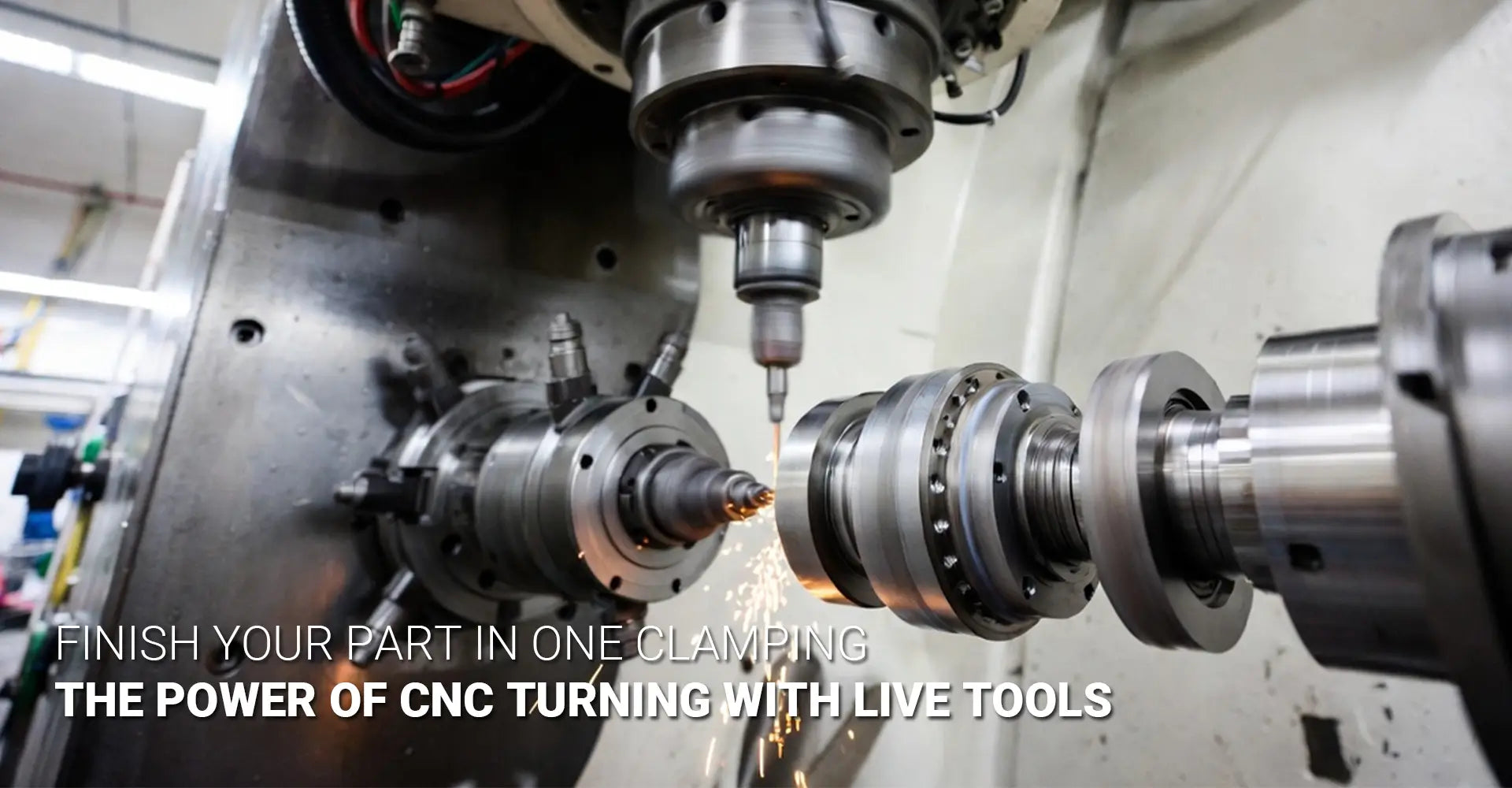
How Does CNC Turning with Live Tools Cut Your Production Time in Half?

Manufacturers face a constant battle against time and cost. Moreover, traditional machining workflows force parts to travel between multiple machines, creating bottlenecks that drain profitability. Consequently, a turned shaft waits hours for milling, a hydraulic fitting sits in queue for drilling, and your production schedule stretches from days into weeks. However, there's a better way. By combining turning and milling in a single setup, CNC turning with live tools eliminates the costly "machine-to-machine shuffle" that plagues conventional manufacturing.
Quick Facts: What You Need to Know Right Now
Key Benefits of Live Tooling Technology:
1. Complete parts in one clamping instead of 2-3 separate operations
2. Reduce total lead time by 40-60% through elimination of queue times between machines
3. Improve alignment accuracy by keeping parts referenced to one coordinate system
4. Lower work-in-process inventory and handling costs significantly
5. Perfect for complex rotational parts: shafts, fittings, valve bodies, and precision components
6. Works across volumes: from prototypes to medium production runs (1-5,000 pieces)
This immediate value proposition explains why smart manufacturers are rethinking their approach to CNC machining service operations.
Throughout this guide, you'll discover exactly how live tooling works, calculate the real savings for your specific parts, and determine whether your components are candidates for this approach. Furthermore, you'll learn what questions to ask potential suppliers to maximize your return on investment. Let's start by examining the hidden costs of traditional multi-machine workflows.
Table of Contents
1. What Is the Real Cost of Moving Parts Between Machines?
2. How Do Live Tools Work on a Turning Center?
3. What Can You Actually Machine with Live Tooling?
4. Where Does the Money Actually Get Saved?
5. Is Your Part Right for Live Tooling Machining?
6. How Do You Choose the Right Mill-Turn Partner?
7. Conclusion
What Is the Real Cost of Moving Parts Between Machines?
The Traditional Workflow Problem
Traditional manufacturing separates operations by machine type. First, your part gets roughed and finished on a CNC turning center. Then, it moves to a milling machine for secondary features. Finally, it might visit a drill press or tapping center for holes. Each transfer seems logical, but the cumulative impact devastates your efficiency.
The Hidden Timeline Nobody Talks About
Breaking Down the Real Production Time:
Actual cutting time: 15-20 minutes per part
Queue time between operations: 2-48 hours (varies by shop load)
Setup and alignment time: 20-45 minutes per operation, multiplied by number of operations
Part handling and movement: 10-15 minutes between each machine transfer
Inspection checkpoints: 5-10 minutes after each operation
Total throughput per part: Often 2-5 days for just 30 minutes of actual metal cutting
This timeline reveals the shocking truth about reducing part handling inefficiencies.
The Compounding Cost Factors
Each machine transfer introduces multiple cost layers beyond obvious labor. Therefore, let's examine the complete financial impact. Work-in-process inventory ties up capital that could fund other initiatives. Additionally, each handling event risks dropped parts, cosmetic damage, or misalignment during re-chucking. Furthermore, tolerance stack-up occurs when features reference different datums across machines.
Quality issues multiply accordingly. When perpendicularity between a turned surface and milled flat spans two setups, errors accumulate from both operations. Moreover, tracking becomes complicated—which operator, which machine, which shift created a defect? Finally, scheduling complexity increases exponentially with each additional operation, creating a planning nightmare for production managers.
How Do Live Tools Work on a Turning Center?
Understanding the Technology Integration
A live tooling lathe transforms a conventional turning center into a multi-tasking powerhouse. Essentially, the machine adds powered cutting tools to the turret alongside standard turning tools. Meanwhile, the main spindle gains C-axis capability, allowing precise rotational positioning like a fourth axis on a machining center.
Core System Components Explained
What Makes Live Tooling Possible:
C-axis indexing: The main spindle positions rotationally with precision, typically to 0.001 degrees
Powered tool holders: Small motors built into the turret drive milling cutters, drills, and taps
Y-axis capability (on advanced models): Vertical tool movement expands the working envelope beyond the standard X-Z plane
Synchronized multi-axis programming: CAM software coordinates all movements simultaneously for complex toolpaths
Sub-spindle (optional): Allows parts to transfer internally for backside operations without manual intervention
This integration creates what the industry calls a mill turn machine.
How It Actually Works in Production
During operation, the part rotates in the main chuck while turning tools create cylindrical features. Then, without releasing the part, the spindle positions rotationally via C-axis. Subsequently, a powered tool in the turret engages to mill flats, drill cross holes, or tap threads at any angle around the part's circumference.
The machine coordinates all axes through a single program. Consequently, what once required three different machines, three setups, and three separate programs now runs continuously from raw material to finished part. Although the turning center with C-axis costs more than a basic lathe, the operational efficiency creates measurable value that quickly justifies the investment.
What Can You Actually Machine with Live Tooling?
Moving from Concept to Real Applications
Theory matters little without practical applications. Therefore, let's explore specific features that manufacturers complete using this technology. These capabilities directly address common bottlenecks in producing complex rotational parts for industrial machinery and precision assemblies.
Common Features Completed in One Setup
Typical Operations Performed with Live Tools:
Keyways and flats on shafts: Milled directly without transferring to a separate mill
Hex drives and special profiles: Created rotationally using the C-axis for indexing
Cross-drilled holes: Hydraulic passages, pin holes, and intersecting bores machined perpendicular to the axis
Radial bolt patterns: Holes drilled around the circumference with perfect angular spacing
Face milling operations: Pocketing, facing, and contouring on part ends
Thread milling: Non-standard pitches or left-hand threads that taps can't produce
Engraving and marking: Part numbers, logos, or identification milled directly
Off-center machining: Features located anywhere around the part's diameter
These capabilities enable complete part machining without human intervention between operations.

Real-World Part Examples
Consider a hydraulic manifold fitting. Initially, the part requires turning for threaded ports and sealing surfaces. Subsequently, it needs cross-drilled passages at precise angles for fluid flow. Finally, mounting holes must align perfectly with the hydraulic ports. On a live tooling lathe, all features are created sequentially in one clamping, guaranteeing alignment.
Similarly, imagine a drive shaft for industrial equipment. The shaft needs turning for bearing journals and shoulders. Additionally, it requires a milled keyway for torque transmission. Furthermore, cross-drilled holes for lubrication must align with specific shaft positions. Traditional manufacturing would need three operations across two or three machines. However, CNC turning and milling integration completes everything in one setup.
Valve bodies present another compelling case. These components combine internal turned bores with external milled surfaces and drilled ports. Moreover, angular relationships between features are critical for proper assembly and function. Single-setup machining eliminates the cumulative tolerancing errors that plague multi-operation workflows.
For manufacturers working with various CNC metals and plastics, this capability opens new design possibilities while simplifying production.
Where Does the Money Actually Get Saved?
Beyond the Hourly Rate Comparison
Many purchasing managers initially hesitate when they see mill-turn hourly rates exceed basic lathe rates. However, this narrow comparison misses the complete financial picture. Therefore, let's calculate the total cost per finished part rather than just machine time.
Real Numbers from a Typical Project
Cost Breakdown: 100-Piece Batch of Complex Shafts
Traditional two-operation approach:
Turning operation: 100 parts × 15 min × $65/hr = $1,625
Setup for milling: 45 min × $75/hr = $56
Milling operation: 100 parts × 12 min × $75/hr = $1,500
Additional handling labor: 100 parts × 5 min × $35/hr = $292
Subtotal direct costs: $3,473
Single-setup live tooling approach:
Combined operation: 100 parts × 22 min × $95/hr = $3,483
Setup time: 60 min × $95/hr = $95
Subtotal direct costs: $3,578
At first glance, live tooling appears slightly more expensive. However, this calculation ignores the substantial hidden costs and strategic benefits that drive real profitability.
The Hidden Value Factors
Additional savings and benefits:
Eliminated queue time: Parts complete in 1 day instead of 3-5 days, enabling faster invoicing and cash flow
Reduced WIP inventory: $8,000 average inventory × 15% annual carrying cost × 60% time reduction = $720 annual savings
Lower scrap rate: Single-datum machining improves first-pass yield by 2-5%, saving $175-435 per batch
Improved scheduling flexibility: One operation instead of two reduces planning complexity and enables faster response to urgent orders
Quality consistency: Guaranteed feature alignment eliminates costly rework from misalignment between operations
Reduced floor space: Fewer machines needed for equivalent output capacity
When these factors are included, the break-even point for secondary operation elimination often occurs within the first 50-100 pieces for medium-complexity parts.
The Intangible Competitive Advantages
Beyond direct cost savings, single setup machining delivers strategic benefits. Customers increasingly value shorter lead times, especially for prototypes and short-run production. Moreover, the ability to quote and deliver complete parts faster than competitors wins business.
Quality traceability improves dramatically. Instead of tracking parts through multiple operations across different machines and operators, each part has a single program and single setup. Consequently, if issues arise, root cause analysis becomes straightforward.
Furthermore, engineering changes implement faster. A design modification that affects both turned and milled features requires updating one program instead of coordinating changes across multiple operations and machines.
Is Your Part Right for Live Tooling Machining?
Evaluating Your Components
Not every part benefits equally from live tooling technology. Therefore, understanding which characteristics make ideal candidates helps you prioritize conversion opportunities. Additionally, this evaluation prevents wasting time on parts better suited for traditional workflows.
Ideal Part Characteristics Checklist
Your part is likely a strong candidate if it has:
Primarily rotational geometry: The dominant features are turned (cylinders, tapers, threads, grooves)
Multiple secondary features: Requires 2-5 milling, drilling, or tapping operations after turning
Critical angular relationships: Features must align rotationally or perpendicular to turned surfaces
Medium complexity: More than simple cross-drilling but less than full 3D contouring
Reasonable size: Fits within mill-turn working envelope (typically up to 12-20" diameter, 30-40" length)
Appropriate volumes: From prototypes to medium production (1-5,000 pieces per run)
Standard materials: Works with metals and plastics machinable on both turning and custom CNC milling services
This multi-axis turning capability shines brightest when feature complexity and alignment requirements are moderate to high.

Decision Criteria Guidelines
Calculate your part's "queue-to-cut ratio." If your component spends more time waiting between operations than actual cutting time, it's almost certainly a candidate for consolidation. For example, a part with 30 minutes of combined machining time but 48 hours of elapsed time through traditional workflow screams for single-setup processing.
Conversely, certain parts still benefit from dedicated machines. Components requiring heavy milling stock removal (removing several cubic inches of material) may exceed the power capacity of turret-mounted live tools. Similarly, parts needing large diameter milling cutters (over 3-4 inches) might not fit within the turret's tool pocket constraints.
Additionally, extremely simple parts with only one or two quick secondary operations might not justify the programming complexity. A shaft needing only a single center-drilled hole might process faster on a basic lathe followed by a quick drill press operation than the setup and programming time for mill-turn.
Hybrid Strategies for Complex Parts
Smart manufacturers often employ hybrid approaches. Live tooling handles 80-90% of features in one setup, while only highly specialized operations (such as deep hole drilling or heavy face milling) go to dedicated machines. This strategy still captures most of the lead time and handling benefits while acknowledging machine capability limits.
For parts with both primary and secondary rotational axes (such as crankshafts or complex housings), advanced mill-turn machines with sub-spindles and Y-axis capability expand possibilities even further.
How Do You Choose the Right Mill-Turn Partner?
Evaluating Supplier Capabilities
Selecting a machine shop with live tooling equipment is just the starting point. However, the real value comes from programming expertise, process knowledge, and commitment to leveraging the technology fully. Therefore, asking the right questions during supplier evaluation ensures you actually realize the benefits.
Critical Questions for Potential Suppliers
What to ask before placing orders:
What specific mill-turn models do you operate? Machine capability varies significantly between entry-level and advanced systems
Can you share examples of similar parts you've completed in single setups? Request case studies with documented time and cost improvements
What CAM software do you use for mill-turn programming? Advanced packages like Mastercam, NX, or Esprit indicate serious capability
How do you verify perpendicularity and alignment of milled features to turned surfaces? Their inspection process reveals quality commitment
What's your typical lead time advantage versus traditional workflows? Quantify the actual improvement you can expect
Do you offer design-for-manufacturing consultation? The best partners help optimize parts for single-setup production
What's your experience with my industry and material types? Relevant expertise reduces trial-and-error on your dime
Can you handle both prototype and production volumes? Flexibility matters for product development cycles
These questions separate shops with mill-turn equipment from shops with mill-turn expertise.
Programming Expertise Makes the Difference
The most sophisticated mill-turn machine delivers mediocre results without skilled programming. Consequently, evaluating the shop's CAM capabilities and programmer experience is crucial. Ask to see sample programs or simulation videos of complex parts.
Additionally, inquiry about their tool library and fixturing capabilities. Live tooling requires specialized cutters, holders, and often custom work-holding solutions. Shops that have invested in comprehensive tooling infrastructure demonstrate commitment to the technology.
Furthermore, discuss their approach to first-article inspection. How do they verify that all features meet print tolerances when created in one setup? Their inspection methodology should leverage the single-datum advantage while thoroughly validating all dimensions.
The Value of Early Involvement
The best mill-turn partnerships begin during design. When suppliers review prints before quoting, they can suggest feature modifications that enhance single-setup manufacturability. For instance, relocating a hole pattern by a few degrees might enable better tool clearance, reducing cycle time and cost.
Similarly, material selection impacts feasibility. Some materials machine beautifully in both turning and milling modes, while others present challenges. Early supplier input prevents costly redesigns after committing to a design.
Request information about their quality systems and certifications. ISO 9001, AS9100, or industry-specific certifications indicate process maturity. Additionally, check their track record with on-time delivery and their policies for handling engineering changes during production.
Conclusion
CNC turning with live tools represents a fundamental shift in how manufacturers approach complex rotational parts. By consolidating turning and milling operations into a single setup, this technology eliminates the costly delays, quality risks, and handling expenses that plague traditional multi-machine workflows.
The financial case is compelling. When you calculate total cost per finished part—including setup time, queue delays, handling labor, WIP inventory, and quality improvements—single-setup machining often delivers 20-40% cost reduction along with dramatically shorter lead times. Moreover, the strategic advantages of faster delivery, better quality consistency, and simplified scheduling create competitive differentiation that wins business.
Therefore, manufacturers should systematically evaluate their current multi-operation parts to identify consolidation candidates. Parts with rotational primary geometry plus multiple secondary features represent the sweet spot where live tooling delivers maximum value. Additionally, working with capable mill-turn partners who offer programming expertise and design collaboration ensures you fully realize the technology's potential.
The machining industry continues evolving toward integrated, single-setup processing. Consequently, companies that adapt their design practices and supplier relationships around this capability will capture efficiency gains while competitors struggle with outdated workflows. The question isn't whether to adopt this approach, but rather how quickly you can identify opportunities and implement changes that measurably improve your cost and delivery performance.
Recommended Resources
[CNC turning with live tools][^1]
[mill turn machine][^2]
[reducing part handling][^3]
[complete part machining][^4]
[turning center with C-axis][^5]
[secondary operation elimination][^6]
---
[^1]: Explore this link to understand how CNC turning with live tools enhances precision and efficiency in machining.
[^2]: Discover the capabilities of mill turn machines and how they integrate milling and turning processes for improved productivity.
[^3]: Explore this link to discover effective strategies that can streamline your manufacturing process and reduce costs.
[^4]: Learn about complete part machining to understand how it can enhance precision and efficiency in your production line.
[^5]: Explore this link to understand how a turning center with C-axis enhances machining capabilities and efficiency.
[^6]: Discover the advantages of secondary operation elimination in streamlining production and reducing costs.