
Not a Drop Gets In: How Smart Sheet Metal Folding Design Keeps Custom IP65 Enclosures Dry in Heavy Rain?
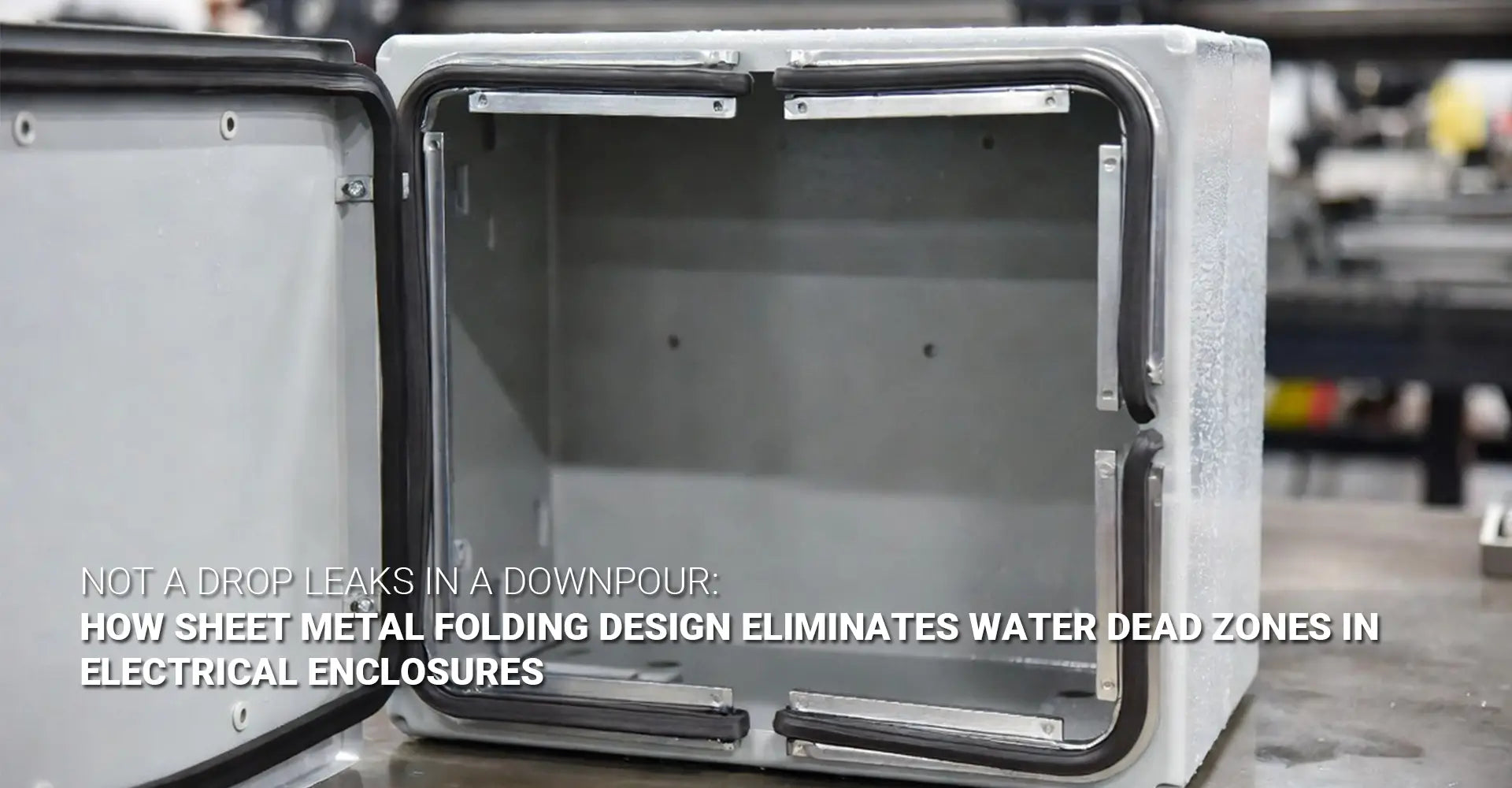
Not a Drop Gets In: How Smart Sheet Metal Folding Design Keeps Custom IP65 Enclosures Dry in Heavy Rain?
Outdoor electrical enclosures fail every day. And most of the time, the gasket is not the problem. The real problem is the geometry — the shape of the enclosure itself. Water finds every flat surface, every straight edge, and every exposed hinge. Then it pools, pressurizes, and creeps right past the seal. The result? Corroded terminals, tripped breakers, and costly downtime that nobody budgeted for.

The good news is that this problem is completely solvable — and the solution does not require exotic materials or expensive processes. It requires three things working together: a rain-deflecting overhang, a labyrinth seal, and a properly applied foam gasket. Together, these three layers stop water before it ever reaches the critical seal zone.
Here is the exact system, explained layer by layer, so you can specify it correctly and stop water ingress for good.
Table of Contents
- What Are "Water Dead Zones" — and Why Do Standard Enclosures Leak There?
- What Does a Rain-Deflecting Overhang Actually Do?
- How Does a Labyrinth Seal Stop Wind-Driven Water?
- PU Foam Gasket vs. Rubber Strip — Which One Actually Seals a Custom Sheet Metal IP65 Enclosure?
- Conclusion & Waterproofing Checklist
What Are "Water Dead Zones" — and Why Do Standard Enclosures Leak There?
Most people assume that outdoor electrical enclosure waterproofing is simply a matter of adding a gasket and closing the lid. Unfortunately, that assumption is exactly why so many enclosures leak. The real failure happens before the water ever touches the gasket. It happens at what engineers call "water dead zones" — areas in the enclosure design where water naturally collects, pressurizes, or channels directly toward the seal line.
Quick Reference: The Top 4 Water Dead Zone Locations on a Standard Sheet Metal Enclosure
- Flat horizontal lid surfaces — Water pools on top and sits directly above the gasket groove, building hydrostatic pressure.
- Straight vertical door edges — Rain runs straight down the face and flows directly into the gap between door and frame.
- Exposed hinge points — Hinges act as open scoops that funnel water inward toward the interior.
- Unsealed cable entry points — Even a well-gasketed door fails if conduit entries are not properly sealed.
So why does this matter so much? Because standard enclosures rely on a single flat gasket compressed between two mating flanges. That gasket works perfectly in a lab. But in the field, wind-driven rain does not fall straight down — it hits the enclosure laterally at pressure. When water pools on a flat surface directly above the gasket line, even a small amount of wind pressure turns that pooled water into a pressurized column pushing against the seal.
Moreover, flat edges with no drip break allow water to travel by capillary action — clinging to the metal surface and wicking inward. A standard 3mm neoprene strip cannot resist that combination of hydrostatic pressure and capillary flow indefinitely.
This is why water resistant box fabrication cannot be achieved through gasket selection alone. The geometry of the enclosure must actively deflect water away from the seal zone before any gasket is asked to do its job. That starts with the first line of defense: the rain-deflecting overhang.
What Does a Rain-Deflecting Overhang Actually Do for an Outdoor Electrical Enclosure?
The rain-deflecting overhang — also called a drip shield or drip lip — is the first and most important structural element of any rainproof enclosure design. It is a simple formed flange at the top of the enclosure door or lid that physically intercepts rainfall before it reaches the seal zone.
Quick Spec Reference: Rain-Deflecting Overhang Dimensions
Parameter Recommended Value Purpose Overhang projection 15–20 mm Throws water clear of the door face Downward return lip 10 mm minimum Breaks capillary action along the underside Material gauge 1.5–2.0 mm Prevents deflection under wind load Redirects driving rain by ~90% Reduces load on seal and gasket
So how is this overhang made? In practice, it is formed in a single brake-press operation during the fabrication of the door or cabinet top. The sheet metal is bent outward at a slight downward angle — typically 5 to 10 degrees below horizontal — to create the projection. Then a second bend turns the edge downward to form the return lip.
That return lip is critical. Without it, water that reaches the underside of the overhang clings to the metal by surface tension and tracks inward toward the frame. The downward return lip interrupts that path. Water collects at the tip and drips straight down — away from the enclosure. This is exactly how sheet metal fabrication geometry solves a problem that gasket material alone cannot fix.
Additionally, for enclosures in high-wind environments or coastal locations, the overhang can be extended to 25mm with a 15mm return lip for extra protection. The additional forming cost is minimal — typically one extra bend per part — and the water exclusion improvement is significant.
Finally, it is worth noting that the overhang must align with the door hinge layout. On side-hinged doors, a continuous top overhang is standard. On front-opening enclosures with a full perimeter door, the overhang wraps three sides: top and both vertical edges. The bottom edge typically uses a raised threshold design instead.
How Does a Labyrinth Seal Stop Wind-Driven Water From Reaching the Gasket?
Once the overhang has deflected the bulk of the rain, there is still a second threat: wind-driven water that approaches the enclosure at an angle or from below. This is where labyrinth seal sheet metal design becomes essential. A labyrinth seal is not a material — it is a geometry. It is a series of alternating ridges and grooves formed into the mating flanges of the door and frame. Water must travel up, over, and around each ridge to reach the gasket. Every direction change reduces water pressure and causes droplets to fall out of the airstream.
Labyrinth Seal Comparison: Which Design for Which Application?
Seal Type Clearance Direction Changes Best For Water Stopped Simple Gasket Groove N/A 0 Indoor/dry locations ~60% of spray Two-Step Labyrinth 2–3 mm 2 Standard IP65 outdoor ~99% of spray Three-Step Labyrinth 2–3 mm 3 Coastal / high-wind / IP66 ~99.9% of spray
How does a two-step labyrinth actually block capillary action? The key is the 2–3mm clearance combined with the opposing fold geometry. Water traveling by capillary action requires continuous contact with a metal surface. When the path reverses direction — requiring water to flow upward against gravity — capillary action cannot sustain that movement. The water simply stops and drips away before reaching the gasket.
For standard IP65 sheet metal fabrication, a two-step labyrinth is sufficient. It reduces water reaching the gasket to approximately 1% of what a flat flange would allow — meaning the gasket only handles residual moisture, not direct spray. This dramatically extends gasket service life and reduces the risk of ingress from seal wear.
A three-step labyrinth is reserved for more demanding applications: marine environments, enclosures near industrial washdown areas, or cases where the specification calls for IP66. The additional fold adds one more brake-press operation per mating flange, increasing forming time slightly. However, for industrial machinery applications where enclosures face pressure washing or salt spray, the upgrade is strongly recommended.
One critical point: a labyrinth seal requires both mating flanges to be parallel within approximately 0.5mm per 300mm of flange length. For large enclosures (over 800mm in any dimension), stiffening ribs must be added to the flange to maintain this tolerance after welding. Without flatness control, the labyrinth clearances become inconsistent and the seal loses effectiveness. This is a detail many fabricators overlook — and it is one of the most common reasons large IP65 cabinets fail water ingress testing.
PU Foam Gasket vs. Rubber Strip — Which One Actually Seals a Custom Sheet Metal IP65 Enclosure?
With the overhang and labyrinth in place, the third and final layer is the gasket. But not all gaskets are equal. Procurement managers often default to stick-on rubber because it is familiar and easy to specify. However, for custom sheet metal enclosures produced by fabrication (not high-volume stamping), PU foam gasket sealing consistently outperforms stick-on rubber — often by a wide margin.
The reason comes down to one word: flatness. Fabricated sheet metal flanges are not perfectly flat. Welding introduces heat distortion. Brake-press bending leaves slight spring-back variations. A stick-on rubber strip follows the theoretical geometry of the part — but the actual fabricated flange may deviate by 0.3–0.8mm at corners and weld zones. That deviation creates gaps. Gaps create leak paths. And leak paths mean a failed IP65 test.
PU Foam vs. Stick-On Rubber: Quick Decision Guide
Factor PU Foam (Foamed-in-Place) Stick-On Rubber Strip Conforms to flange imperfections ✅ Yes — flows into every contour ❌ No — follows nominal geometry Corner sealing ✅ Continuous, no joints ❌ Risk of gap at mitered corners Production volume ✅ Small-to-medium runs ✅ High-volume stamped parts IP65 reliability on fabricated parts ✅ High ⚠️ Variable Long-term adhesion ✅ Bonded in place ⚠️ Can peel at edges over time Re-openable after cure ✅ Compresses and recovers ✅ Compresses and recovers

So how does foamed-in-place gasket application actually work? The process uses an automated dispensing system — typically a 4- or 6-axis robot or a gantry-mounted dispensing head. The two-component polyurethane foam is mixed at the nozzle tip and dispensed as a liquid bead directly onto the flange. It flows into every surface variation, corner radius, and weld imperfection. As it cures, it expands slightly to fill any remaining gaps, then stabilizes as a closed-cell foam with consistent compression characteristics.
The result is a seamless, continuous gasket with no joints, no corners, and no adhesive edges to peel. When the door closes, the foam compresses uniformly around the full perimeter. This is how electrical control cabinet IP65 ratings are reliably achieved on fabricated parts — not by specifying a premium rubber compound, but by using a sealing method that conforms to the real part, not the ideal drawing.
For gasketless sealing approaches (where very tight labyrinth tolerances replace the gasket entirely), the design requirements are significantly more demanding — typically requiring CNC-machined mating surfaces and much tighter forming tolerances. For most automotive or industrial electrical applications, the combination of a two-step labyrinth plus PU foam provides the best balance of cost, reliability, and IP65 compliance.
It is also worth noting that water ingress protection in CNC machining service contexts — such as machined aluminum enclosures — can use similar PU foam dispensing methods, with the added advantage that machined flanges are flatter and more consistent than formed sheet metal flanges.
Conclusion: Your Outdoor Enclosure Waterproofing Checklist
Water does not need a large gap to cause serious damage. A 0.5mm gap sustained over hours of driving rain is enough to ruin a control system. The good news is that the three-layer system described in this article — overhang, labyrinth, foam gasket — is proven, cost-effective, and manufacturable with standard sheet metal equipment.
Here is a printable checklist to use when specifying or reviewing your next outdoor enclosure:
✅ Outdoor Enclosure IP65 Waterproofing Checklist
Geometry & Structure
- [ ] Rain-deflecting overhang formed at top (15–20mm projection, 10mm return lip)
- [ ] Overhang angle: 5–10° downward to direct water clear of door face
- [ ] No flat horizontal surfaces adjacent to the door/lid seal line
- [ ] Hinge points recessed or shielded — not exposed to direct rain
- [ ] Raised threshold at bottom edge (not flat floor flush with exterior)
Labyrinth Seal
- [ ] Two-step labyrinth minimum for standard IP65 outdoor use
- [ ] Three-step labyrinth specified for coastal, marine, or IP66 applications
- [ ] Flange clearances: 2–3mm between opposing folds
- [ ] Flange flatness: within 0.5mm per 300mm (add stiffening ribs for large enclosures)
- [ ] Labyrinth grooves formed in both mating flanges (door and frame)
Gasket
- [ ] PU foamed-in-place gasket specified for fabricated (non-stamped) enclosures
- [ ] Continuous bead — no splices or corner joints
- [ ] Dispensed by automated system — not hand-applied
- [ ] Compression ratio: 25–30% of uncompressed foam height at full close
Validation
- [ ] IP65 water jet test completed per IEC 60529 (12.5mm nozzle, 12.5 L/min, 3m distance)
- [ ] Test report from accredited laboratory (UL, TÜV, Intertek) — not a self-certification
- [ ] Cable entries sealed separately (glands rated IP65 minimum)
- [ ] Corrosion protection specified separately from IP rating (powder coat, stainless, or aluminum)
5 Questions to Ask Your Sheet Metal Fabricator
- "Can you show me an IP65 enclosure you have built and water-tested — with the test report?"
- "What labyrinth seal geometry do you use, and how do you control flange flatness on large parts?"
- "Is your PU foam applied by automated dispensing or by hand?"
- "How do you handle flange distortion from welding on enclosures over 600mm wide?"
- "Do you design and fabricate the drip shield as an integral part of the door, or as a separate welded component?"
If your fabricator cannot answer these questions with confidence and documentation, consider that a red flag — not a starting point for negotiation.
External Links for Further Reference
[Custom sheet metal enclosures][^1]
[labyrinth seal sheet metal][^2]
[water resistant box fabrication][^3]
[IP65 sheet metal fabrication][^4]