3D Printing vs Injection Molding Cost: When Does a $10,000 Mold Actually Save You Money?
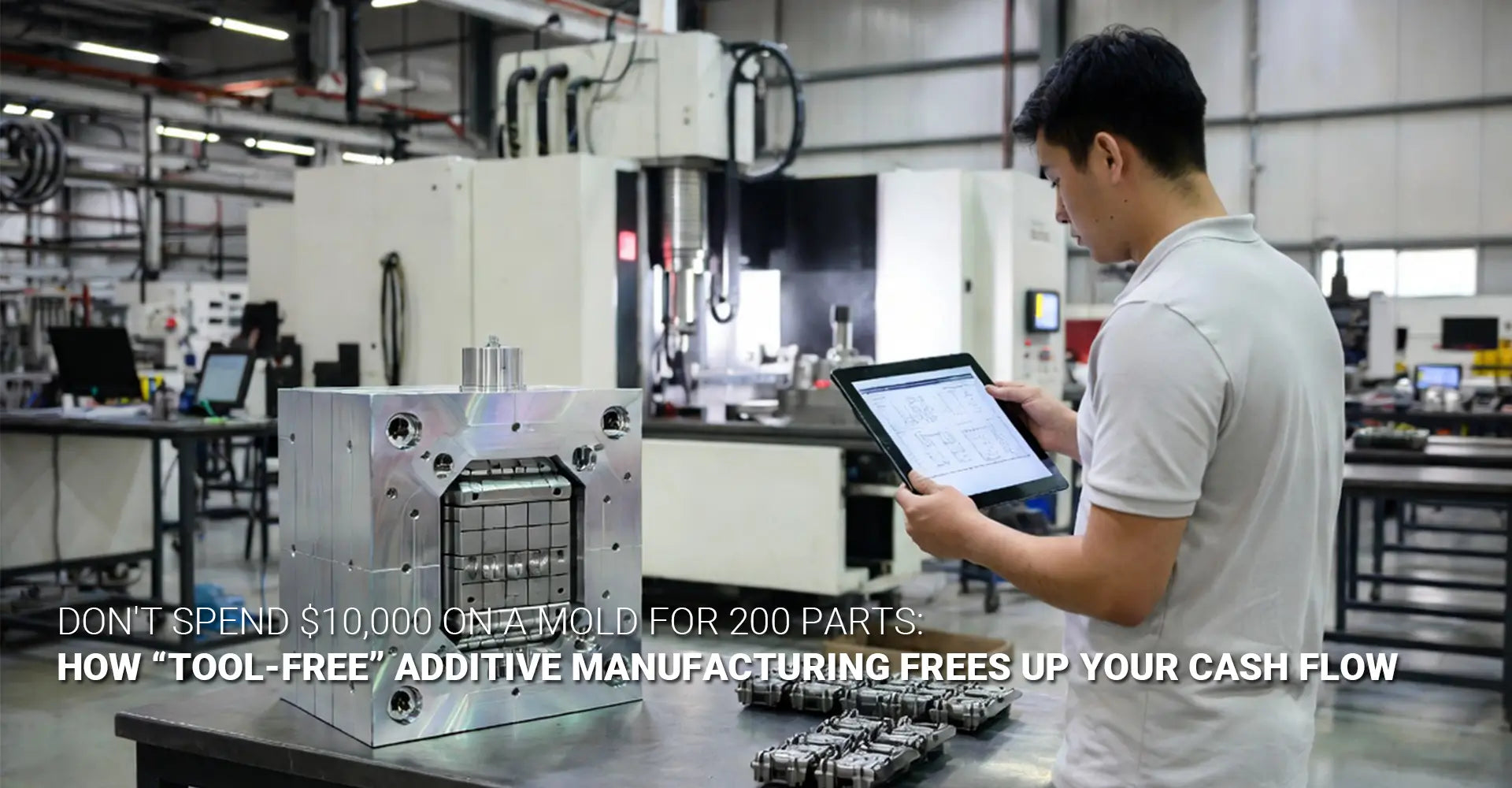
3D Printing vs Injection Molding Cost: When Does a $10,000 Mold Actually Save You Money?
Imagine this: you need 200 plastic enclosures. Your supplier hands you a quote — $10,000 for the mold alone, before a single part is made. Do you sign off? Or is there a smarter path? The answer depends on one number most buyers never calculate: your break-even quantity. Get it wrong, and you'll either overpay for a mold you didn't need — or overpay per part because you avoided one you should have ordered.
Quick Answer: The Break-Even at a Glance
For most industrial plastic enclosures, SLS 3D printing is cheaper below 500–1,500 parts. Above that, injection molding wins.
| Quantity | Winner | Why |
|---|---|---|
| Under 200 parts | ✅ SLS 3D Printing | Zero mold cost dominates |
| 200 – 1,000 parts | ⚖️ Evaluate carefully | Depends on part size and complexity |
| 1,000 – 1,500 parts | ⚖️ Borderline | Run both quotes |
| 1,500+ parts | ✅ Injection Molding | Per-part savings outweigh mold cost |
Key takeaway: If your annual volume is under 1,000 units, always get an SLS quote before calling a mold maker. You will very likely save money — and weeks of time.
So how exactly does each process structure its costs? And what does the math look like for a real industrial part? Let's break it down — section by section — so you can make a confident, numbers-backed decision for your next project.
Table of Contents
- How SLS Changes the Math for Small Batches
- What Does Injection Molding Really Cost at Low Volumes?
- The Break-Even Graph — Where Exactly Do the Two Lines Cross?
- Beyond Break-Even — Lead Time, Design Changes, and Inventory Risk
- When Does Injection Molding Still Win — Even at Low Quantities?
- Conclusion
- FAQ
The $10,000 Decision — How Many Parts Actually Justify Opening a Mold?
Every injection molding project starts with the same uncomfortable conversation: the mold bill. Before your supplier makes a single part, you write a check — typically between $5,000 and $15,000 for a standard industrial enclosure mold, and often more. That money buys you a block of machined steel (or aluminum) that will sit in a factory until your parts run. For buyers focused on 3D printing vs injection molding cost, this upfront payment is the single biggest variable in the entire equation.
Key Takeaway
Here is the core rule for mold amortization quantity:
- Under 500 parts: The mold cost per unit is enormous. A $10,000 mold spread across 200 parts adds $50 per part in hidden cost before production even starts.
- 500–1,500 parts: The mold starts to amortize. Whether it beats additive depends on part complexity.
- Over 1,500 parts: The mold is fully justified. Per-part costs drop sharply, and injection molding wins clearly.
Rule of thumb: If your annual quantity is under 1,000 units, get an SLS quote first. You'll likely save money and skip weeks of lead time.
The math is straightforward. Total injection molding cost = mold cost + (per-part price × quantity). A $10,000 mold with a $2/part production cost gives you:
- 200 parts: $10,000 + $400 = $10,400 total ($52/part)
- 500 parts: $10,000 + $1,000 = $11,000 total ($22/part)
- 1,500 parts: $10,000 + $3,000 = $13,000 total ($8.67/part)
- 5,000 parts: $10,000 + $10,000 = $20,000 total ($4/part)
Meanwhile, SLS charges the same per-part rate regardless of quantity. That flat cost line is exactly what makes it so powerful at low volumes — and so expensive at high ones. For industrial machinery components and similar applications where design changes are frequent and volumes are controlled, this distinction becomes financially critical.
Zero Tooling Cost — How SLS Changes the Math for Small Batches?
SLS (Selective Laser Sintering) operates on a completely different cost logic. There is no mold, no minimum order quantity, and no upfront tooling fee. You send a digital file. The machine builds the part layer by layer. You pay only for the material used and the machine time. This is the core proposition of additive manufacturing vs traditional manufacturing — and for small batches, it completely upends the conventional cost model.
Key Takeaway
Here is what zero tooling cost means in practice:
- ✅ Order 10 parts today. Then order 50 more next month. No penalties.
- ✅ Change the design between batches. Update the file. No retooling fee.
- ✅ Produce complex geometry — internal channels, organic shapes, undercuts — without extra mold cost.
- ✅ Skip minimum order quantities entirely.
"With SLS, you own nothing except the digital file. For low volumes, the 'asset' argument for mold ownership is often a trap."
The "per-part penalty" of additive manufacturing appears only at scale. SLS nylon (PA12) typically runs $18–$35 per part for a palm-sized enclosure, depending on volume and geometry. That rate stays roughly flat whether you order 10 or 500 parts.
Contrast that with injection molding's steep cost curve that only flattens after the mold is paid off. For surface finish requirements in functional industrial parts, SLS produces a slightly grainy nylon surface — perfectly adequate for most enclosures and housings, though different from the smooth finish of a polished mold. The key question is always: does your application require a Class A cosmetic finish, or just a robust, functional enclosure? For most industrial and B2B applications, SLS delivers.
Explore Hotean's 3D printing services to understand how zero-tooling production integrates into your procurement workflow.
What Does Injection Molding Really Cost at Low Volumes?
Injection molding is not inherently expensive. In fact, at high volumes, it is the cheapest manufacturing method on earth for plastic parts. The problem is its cost structure: heavy upfront, cheap per-part. That structure rewards you at scale and punishes you at low volume. Understanding low-volume injection molding cost is essential for any procurement manager making a build-or-buy decision.
Key Takeaway
The two-part cost structure of injection molding:
| Cost Type | Amount | Notes |
|---|---|---|
| Mold (steel) | $8,000 – $20,000+ | One-time upfront payment |
| Mold (aluminum) | $3,000 – $6,000 | Lower durability, faster to cut |
| Per-part cost | $1 – $5 | Drops with volume and material |
| Lead time (mold) | 4 – 8 weeks | Before first part ships |
| Design change fee | $500 – $5,000+ | Per revision to the mold |
Critical insight: The mold is not optional. You pay it whether you make 50 parts or 50,000. That is the key risk at low volumes.
Mold material matters significantly. A steel mold lasts 100,000–500,000+ shots and costs more upfront. An aluminum mold (also called soft tooling) costs 3,000–$6,000, lasts 5,000–20,000 shots, and is cut in 1–2 weeks instead of 4–6. For a per-part cost comparison at volumes under 2,000 units, aluminum tooling is frequently the smarter financial choice.
For automotive components and similar precision applications, mold grade, surface finish, and dimensional stability may justify the higher steel mold cost. But for most industrial enclosures with moderate tolerance requirements, aluminum soft tooling dramatically shifts the break-even point in favor of injection molding at lower quantities than most buyers expect.
The Break-Even Graph — Where Exactly Do the Two Lines Cross?
The break-even point is the quantity at which the total cost of SLS equals the total cost of injection molding. Below that point, SLS is cheaper. Above it, injection molding wins. The exact crossover depends on mold cost, per-part SLS price, and production volume — and it varies for every part. But for a standard industrial enclosure, the data tells a consistent story. This is the heart of the SLS prototyping volume breakeven question every engineer and buyer should answer before committing.
Key Takeaway
Break-even zones for a typical palm-sized industrial plastic enclosure:
- 🟢 Under 200 parts → SLS wins clearly. No mold + fast turnaround = significant savings.
- 🟡 200–1,000 parts → Evaluate by complexity. Simple parts may favor injection earlier; complex geometry favors SLS longer.
- 🔴 1,500+ parts → Injection molding wins. Per-part cost advantage fully overcomes mold investment.
Real Example — 150×100×50mm Industrial Electronics Enclosure
Let's use real numbers for plastic enclosure production — a common palm-sized electronics housing:
| Route | Mold Cost | Per-Part Cost | Total at 200 Parts |
|---|---|---|---|
| SLS (PA12) | $0 | $22/part | $4,400 |
| Injection Molding | $8,000 | $2/part | $8,400 |
| Savings with SLS | — | — | $4,000 (48%) |
At 200 parts, SLS saves 48% — nearly half the total spend. Now extend the same math to 1,500 parts:
| Route | Mold Cost | Per-Part Cost | Total at 1,500 Parts |
|---|---|---|---|
| SLS (PA12) | $0 | $22/part | $33,000 |
| Injection Molding | $8,000 | $2/part | $11,000 |
| Savings with Injection | — | — | $22,000 (67%) |
The crossover is clear. The break-even on this specific part falls at approximately 400 parts — the quantity at which the $8,000 mold is fully offset by the $20/part savings in production cost. For 3D printing for production parts, the SLS route makes clear financial sense below this threshold.
Beyond Break-Even — Lead Time, Design Changes, and Inventory Risk?
Cost per part is not the only number that matters. In real procurement decisions, time to first part, flexibility for design revisions, and inventory carrying costs all add up. When you factor these in, the total cost of ownership shifts — sometimes dramatically — in favor of additive manufacturing, even when the raw per-part cost suggests injection molding is close. Cash flow additive manufacturing is a real advantage that doesn't always appear in the initial quote comparison.
Key Takeaway
Three hidden costs that favor SLS:
| Factor | SLS (Additive) | Injection Molding |
|---|---|---|
| Design change cost | $0 — update the file | $500–$5,000+ per mold revision |
| Lead time | 3–7 business days | 4–8 weeks for mold + parts |
| Inventory risk | Print on demand — zero overstock | Minimum order quantities create excess stock |
Cash flow advantage: With SLS, you pay per batch as orders arrive. With injection molding, you pay $8,000–$20,000 before your first sale. For startups and new product launches, that capital difference is not trivial.
The Bridge Tooling Strategy
This is where the concept of bridge tooling vs additive becomes strategically important. Bridge tooling means using SLS to produce your first 100–500 parts while a mold is being cut for higher volume. You validate the design, begin selling, generate revenue — then transition to injection molding once volume justifies it.
The advantage: you delay the mold investment until you're certain the design is final and volumes are real. A design change after the mold is cut costs thousands. A design change in SLS costs nothing — just update the file and print again. For teams doing rapid iteration on enclosures, brackets, or housings, this flexibility is worth more than the per-part premium.
Learn more about 3D printing plastics and materials to understand which nylon grades and polymer options work best for bridge tooling applications.
When Does Injection Molding Still Win — Even at Low Quantities?
SLS is not always the answer. There are specific scenarios where injection molding is the only practical choice — regardless of quantity. A balanced per-part cost comparison must include these cases. Choosing SLS when injection molding is the correct tool will result in parts that fail to meet spec, not just parts that cost more.
Key Takeaway
Cases where injection molding wins — even at low volumes:
- 🔴 Transparent parts — SLS produces opaque, grainy surfaces. Clear enclosures need injection molding (PC, PMMA).
- 🔴 Tight tolerances (±0.05mm or better) — SLS holds ±0.2–0.3mm typically. Precision fits may require injection.
- 🔴 Parts beyond SLS build envelope — most SLS machines top out around 300×300×400mm. Larger parts need injection or other methods.
- 🔴 Specific commodity plastics — polypropylene (PP) living hinges, LDPE soft-touch parts, or ABS with proprietary fillers are not available in SLS.
- 🔴 Very high volume (10,000+ parts/year) — SLS per-part cost becomes prohibitive at true mass production volumes.
For 90% of rigid industrial enclosures, covers, brackets, and housings made of nylon-like materials, SLS is fully capable. The material question is often the deciding factor: SLS nylon (PA12) offers mechanical properties close to injection-molded nylon, with slightly lower elongation at break and a characteristic surface texture.
For food-contact parts, optical components, or applications requiring extreme chemical resistance, injection molding retains a clear material advantage. For everything else — especially during early production phases — SLS nylon holds up well under functional load. The smart approach is to evaluate your specific tolerance, material, and surface finish requirements, not assume injection molding is the only "serious" manufacturing method.
Conclusion
The Bottom Line
The decision between SLS 3D printing and injection molding is not about which process is better. It is about which process is cheaper and faster at your specific volume, for your specific part. Here is what the data consistently shows:
✅ Choose SLS when:
- Your quantity is under 1,000 parts per year
- Your design is still evolving
- You need parts in days, not weeks
- Cash flow matters more than long-term per-part cost
- You're launching a new product and need to validate before scaling
✅ Choose Injection Molding when:
- Your quantity is reliably above 1,500 parts per year
- The design is locked and validated
- Your material requires commodity plastics or optical clarity
- Long-term per-part cost is the primary driver
✅ Consider the Hybrid Bridge Tooling path when:
- You need 1,000–3,000 parts per year
- SLS for the first 200 parts → aluminum mold for the rest
- Delay capital outlay until design is proven and revenue is flowing
The smart procurement manager in 2026 doesn't ask "should I 3D print or mold?" They ask: "at what volume does each become cheaper for my specific part?" Then they let the numbers decide.
Don't commit to a mold until you've run the full cost model — mold cost + (per-part price × quantity) — for both options. The lower number wins. Always.
FAQ
Q1: What is the actual break-even quantity for SLS vs. injection molding?
For most industrial plastic enclosures (palm-sized), the break-even point falls between 500 and 1,500 parts, depending on part size, material, and mold cost. Under 200 parts, SLS wins clearly. Above 1,500 parts, injection molding wins clearly. Between those points, always run both quotes.
Q2: I only need 500 parts. My supplier says "the mold is an asset." Is that true?
Only if the mold saves you money. A $10,000 mold amortized over 500 parts adds $20 per part to your cost. If SLS costs $25/part, the difference is just $5 — and SLS gives you zero lead time for the mold, free design changes, and no minimum orders. For 500 parts, the "asset" argument rarely holds. Run the total cost calculation: mold + (per-part × quantity). Compare both. The lower number is your answer.
Q3: What is bridge tooling, and when should I use it?
Bridge tooling means using SLS to produce your first 100–500 parts while injection mold tooling is being built. You validate the design, sell initial units, generate revenue, and avoid paying for a mold before you know the design is final. Use bridge tooling when: your annual volume will eventually exceed 1,500 parts, but you're not there yet — or when your design is still being refined.
Q4: How does part size affect the break-even point?
Larger parts shift break-even toward lower quantities for SLS. A large enclosure requires a more expensive mold ($20,000–$40,000), which takes many more parts to amortize. A tiny clip may have a $2,000–$4,000 mold that breaks even at just 200 parts. Always get quotes for your specific part size — generalizations are unreliable.
Q5: Can SLS replace injection molding for production parts?
Yes, for many applications. SLS nylon (PA12) has mechanical properties close to injection-molded nylon. It is used for functional housings, brackets, connectors, and enclosures in production environments. Limitations include: no transparency, slightly grainy surface, and higher per-part cost at volume. For 90% of rigid industrial plastic parts, SLS is fully production-capable.
Q6: What is the smartest approach if I need 2,000 parts per year?
Consider a hybrid path: SLS the first 200 parts to validate the design and start selling, then cut an aluminum mold for the remaining 1,800. Aluminum molds cost $3,000–$6,000 (vs. $10,000+ for steel) and produce up to 20,000 shots. The aluminum mold amortizes over 1,800 parts at roughly $2–$4/part, and per-part injection cost is low. Total cost is often lower than either pure SLS or pure steel injection molding.
Q7: How does SLS improve cash flow compared to injection molding?
Injection molding requires $8,000–$20,000 upfront before a single part ships. SLS lets you order 50 parts for roughly $1,000, sell them, then order 50 more. No large capital outlay. No cash tied up for 6–8 weeks while the mold is being cut. For startups and small businesses, this pay-as-you-produce model aligns spending with revenue — which is often more valuable than long-term per-part savings.
Q8: Are there parts that cannot be made with SLS?
Yes. Injection molding is required for: transparent parts (PC, PMMA), very thin walls under 0.8mm, commodity plastics like polypropylene or LDPE, parts requiring Class A cosmetic surface finish, and true mass production (10,000+ parts/year) where SLS per-part cost becomes prohibitive.
Q9: How do I get an accurate cost comparison for my specific part?
Send the following to both an SLS service provider and an injection molder:
- STEP file of your 3D CAD model
- Material specification (e.g., SLS: PA12 GF; Injection: ABS or Nylon 6)
- Annual quantity (e.g., 500 parts)
- Surface finish requirements
- Required lead time
Compare total cost (mold + parts) — not just per-part price. Add 20% to injection quotes to account for likely design changes. That is the real comparison.
Q10: What is the bottom line for my next low-volume plastic enclosure project?
For quantities under 1,000 parts, always get an SLS quote before committing to a mold. Zero mold cost + fast turnaround + design flexibility makes SLS the default winner for most low-volume industrial parts. Even at 2,000 parts, consider bridge tooling. In 2026, the right question isn't "should I print or mold?" — it's "at what quantity does each become cheaper for my specific part?" Let the numbers decide.
External Links Recommendation
[3D printing vs injection molding cost][^1]
[SLS prototyping volume breakeven][^2]
[low‑volume injection molding cost][^3]
[3D printing for production parts][^5]