Die Casting Supplier for Kitchen Appliances: How Do Cast-In Inserts Protect Stand Mixer Motor Bearings?
Die Casting Supplier for Kitchen Appliances: How Do Cast-In Inserts Protect Stand Mixer Motor Bearings?
If you buy parts for kitchen appliances, you already know that aluminum die casting for kitchen appliances is a smart choice. It is light. It is affordable. And it can hold complex shapes, like ribs, bosses, and mounting points, in one shot. But there is one weak spot that many buyers do not think about until it shows up as a warranty claim. That weak spot is the bearing seat inside a stand mixer motor. When a bearing sits directly in soft aluminum, repeated loads and heat can slowly wear the bore larger. This guide walks you through how cast-in steel or bronze inserts fix that problem. It also shows you how to pick a supplier who can build the part right the first time.
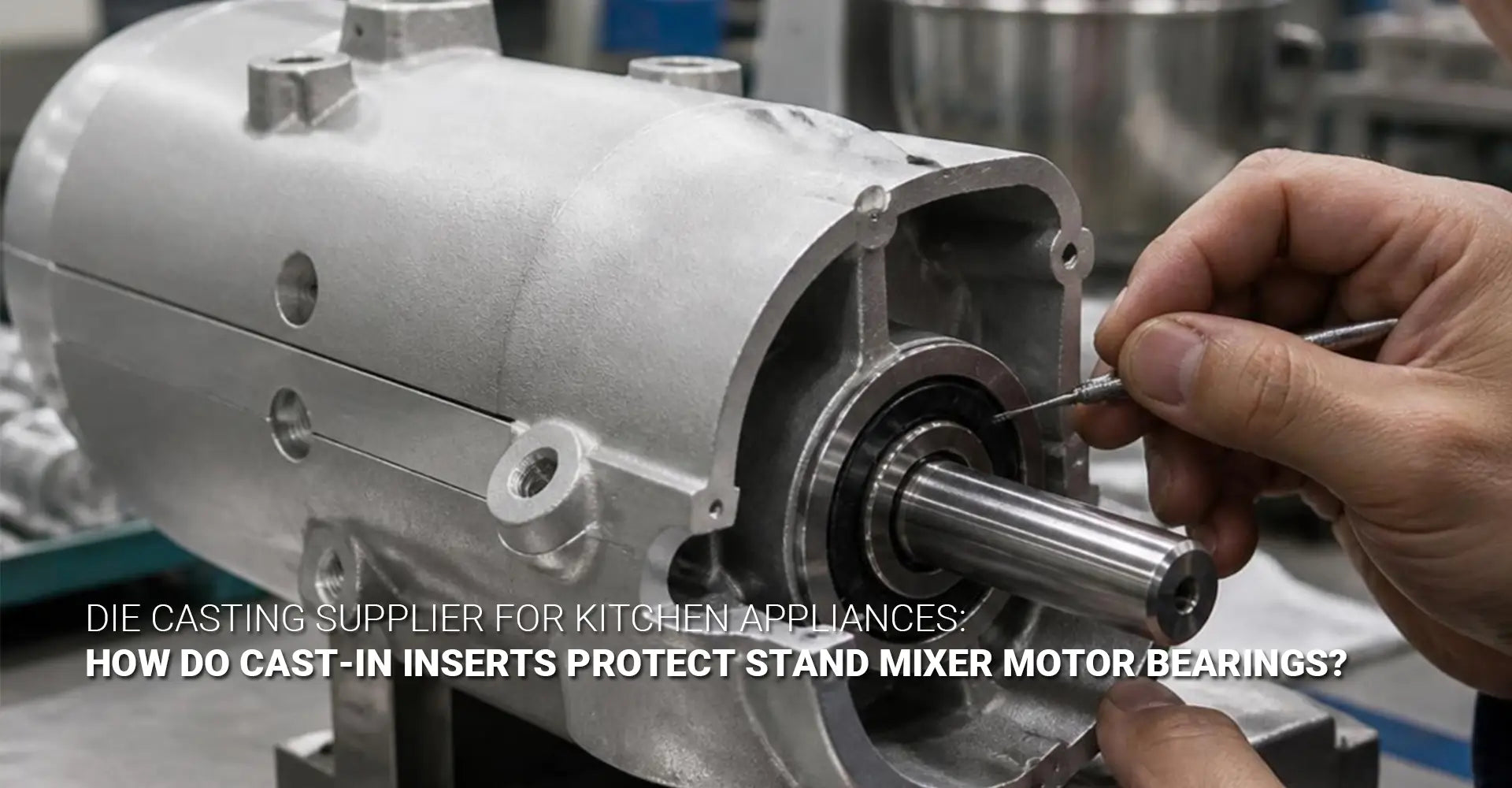
Quick answer: A cast-in insert is a steel or bronze sleeve placed inside the die before aluminum is injected around it. This protects the stand mixer motor end cover from bearing bore wear and keeps the motor shaft aligned. It can also reduce the number of parts your team needs to assemble later.
Finding a die casting supplier kitchen appliance teams can trust starts with a few basic questions, not a spec sheet. Why do bearing seats wear out in the first place? What is insert die casting, really? And should you choose a steel sleeve or a bronze one? Once you can answer those, requesting custom die casting kitchen appliance parts turns into a much simpler conversation. Let's walk through each question, one at a time.
Table of Contents
- Why Do Stand Mixer Motor Bearing Seats Wear Out So Fast?
- What Is Insert Die Casting, and How Does It Protect Motor End Covers?
- Steel or Bronze Insert: Which One Suits Your Motor End Cover?
- How Do You Choose a Die Casting Supplier for Kitchen Appliance Motor Parts?
Why Do Stand Mixer Motor Bearing Seats Wear Out So Fast?
A stand mixer motor spins fast, and it often runs for long stretches while dough or batter pushes back against the beater. That load travels straight into the bearing, and then into the bearing seat around it. Over time, this steady pressure can cause real damage, even on a well-made part.
In short: repeated loads, heat, and vibration slowly enlarge an unreinforced aluminum bearing bore. Once that happens, the motor starts to run rough.

So what actually happens inside the housing? Here is the short version:
- Repeated bearing loads slowly stretch and enlarge an unreinforced aluminum bore.
- Heat from motor operation can loosen the fit between the bearing's outer ring and the aluminum housing.
- Vibration and frequent on-off cycling add stress that plain aluminum was never built to absorb.
- Once the bearing loses its snug fit, the motor can develop noise, vibration, shaft runout, and weaker performance during daily use.
This problem shows up most often on stand mixer die casting parts that run at higher speeds or carry heavy mixing loads. A dough hook working through thick bread dough is a good example. Some buyers still use the older term motor end shield die casting for this same part, but the wear problem is the same no matter what name you use. If you want to see how a supplier builds these motor housings from the ground up, our stand mixer fabrication page walks through the process.
One more note before you move on: be careful with big life-extension claims. It is tempting for a sales page to promise a bore lasts three times longer with an insert. That kind of number only means something when it comes from real endurance testing on your specific part, under your specific load. Ask your supplier for test data, not just a slogan.
What Is Insert Die Casting, and How Does It Protect Motor End Covers?
Once you understand why bearing seats fail, the fix becomes much easier to picture. Insert die casting solves the wear problem by giving the bearing a harder surface to sit in, right from the start. That beats trying to repair the damage later.
Quick definition: Insert die casting is a process where a supplier places a pre-made steel or bronze sleeve inside the die, then injects molten aluminum around it. The metal solidifies around the sleeve, creating one solid piece instead of two parts joined together after the fact.
This is different from a standard motor end cover casting process, where the whole part is one grade of aluminum with no reinforcement at all. With insert die casting, a supplier positions the steel or bronze sleeve on a locating pin inside the die. The die closes, and molten aluminum flows in and locks around the sleeve as it cools and sets.
The result is a part that keeps the light weight and complex shape you expect from aluminum motor housing die casting. It also gains a wear-resistant bearing seat exactly where it matters most. Because the sleeve becomes part of the casting itself, this method can also cut down on separate assembly steps. Nobody needs to press a bushing into the bore after the part is already made.
If you want a closer look at how a full-service partner handles insert placement, gating, and cooling for parts like this one, our die casting page breaks the process down step by step. A supplier who offers insert casting alongside standard casting can usually give you more design options too, since they can mix and match methods based on your load, budget, and volume.
Steel or Bronze Insert: Which One Suits Your Motor End Cover?
Picking a sleeve material is not a guessing game, even though it can feel that way at first. It comes down to load, speed, heat, and cost, and both steel and bronze have a real place in appliance motor design.
Short answer: steel usually suits high-load, high-cycle motors, while bronze can work well where friction behavior or built-in corrosion resistance matters more than raw wear resistance. Confirm your choice with load and RPM data before you commit.
Here is a simple side-by-side comparison to guide the conversation with your supplier:
| Factor | Steel Sleeve Insert | Bronze Sleeve Insert |
|---|---|---|
| Wear resistance | Strong, good for heavy loads | Good, depends on the alloy |
| Bearing-seat stability | Suits rigid, high-cycle designs | Suits controlled-friction needs |
| Corrosion protection | May need a coating or plating step | Can offer solid resistance on its own |
| Typical cost | Often lower for high-volume runs | Can run higher, depending on grade |
| Best fit | High-load, high-speed motors | Specific friction or fit needs |
Notice that steel often needs a protective coating to guard against corrosion, and that is where a strong finishing process really matters. If corrosion resistance is a concern for your part, it is worth asking your supplier about their surface finish options before you lock in a material choice.
Do not pick a sleeve by material name alone, though. Insert geometry, the fit between the sleeve and the bore, bearing type, and operating temperature all play a role too. A capable insert die casting manufacturer will walk through your load and RPM numbers with you before recommending steel or bronze, rather than defaulting to whatever they already have in stock. Some buyers work with a separate cast-in bushing supplier for the sleeves themselves, then hand the finished blanks over to a casting partner. Still, many appliance makers find it simpler, and often cheaper, to source both the insert and the casting from one team.
Design details matter just as much as material choice. A good engineering team will look at a handful of small features before they ever cut steel for tooling:
- Retention features. Grooves, knurling, or small undercuts on the outside of the sleeve help stop it from spinning or pulling loose once the part is in use.
- Wall thickness around the sleeve. Enough aluminum needs to surround the insert so the metal can flow well and the housing stays rigid under load.
- Thermal behavior. Steel, bronze, and aluminum expand at different rates as they heat up, so the fit needs to stay tight across the motor's normal operating temperature range.
- Gating and venting. Poor flow patterns near the insert can shift it out of place or trap gas right next to the bearing seat, which weakens the part where it matters most.
None of these details are hard to fix once you know to ask about them. The trouble comes when a supplier has never dealt with insert casting before and skips this review entirely.
How Do You Choose a Die Casting Supplier for Kitchen Appliance Motor Parts?
Once you know what you need, the next step is finding a supplier who can actually build it. Not every die casting shop has real, hands-on experience with cast-in inserts, so it pays to ask before you sign a purchase order.
Quick checklist: ask about insert die casting experience, DFM support, sleeve retention methods, and in-house machining and inspection before you approve any tooling.
Before you commit, bring this short list of questions into your supplier conversation:
- Do you have hands-on experience with insert die casting for steel or bronze sleeves?
- Will you review shaft alignment, bearing-seat tolerances, and sleeve retention during DFM?
- How do you keep the insert from shifting while the aluminum is injected?
- Can you supply prototype samples before tooling gets approved?
- What machining can you do in-house after casting, such as bore finishing?
- How do you check concentricity, bore size, and sleeve depth on finished parts?
- Can you handle high-volume insert loading if your program grows later?
A general aluminum die casting supplier for appliance motors may only offer standard casting, so it is worth confirming insert capability directly rather than assuming it comes standard. If your parts are specific to mixers, a die casting supplier for stand mixers who already understands motor end cover geometry can save you a full round of redesign work. For buyers sourcing a wider range of appliance parts, working with one kitchen appliance die casting supplier for motor housings, brackets, and covers can also simplify your supply chain quite a bit. You can see the full range of parts a supplier like this can support on our kitchen appliances page.
Many appliance brands also prefer an OEM stand mixer parts manufacturer who can carry a part from prototype through full production, rather than switching vendors between stages. That kind of continuity tends to reduce tooling rework and cut down on communication gaps as the design gets locked in.
Building a Motor End Cover That Holds Up Under Real Use
Bearing wear does not have to be part of your stand mixer's story. Once you understand why plain aluminum bores wear out, how insert die casting works, and how to weigh steel against bronze, you are in a strong position to brief a supplier correctly. That beats hoping they figure it out on their own.
From there, the sourcing conversation really comes down to proof: sample parts, clear DFM notes, and honest answers to your checklist questions. A supplier who welcomes those questions is usually one worth working with.
If you are ready to move forward, gather your 3D model, motor RPM, bearing specification, expected load, and target volume before you reach out. Sending a custom motor end cover die casting quote request with that information already attached will get you a faster, more accurate response than a bare part number ever could.
Recommended Resources
[cast-in inserts die casting][^1]
[motor end cover insert][^6]
[^1]: NADCA Product Specification Standards for Die Castings (2021) – Section 3.4 defines cast-in inserts as a method for integrating bearing surfaces, internal threads, or unique features into die castings, and notes the added costs from reduced cycle time due to insert loading and preheating requirements.
[^2]: Dynacast's detailed article on Injected Metal Assembly (IMA), a type of insert molding using molten zinc alloy to join similar or dissimilar components with production rates up to 1,000 parts per hour, providing stronger joints than welding or soldering with no secondary operations required.
[^3]: A technical article from DuPont (Germany/Switzerland) explaining how Vespel® polyimide insulating sleeves prevent **electrical erosion** in EV motor bearings—a primary wear mechanism in modern VFD-driven motors[reference:0][reference:1].
[^4]: US Patent 6,380,645 for a **cast motor end shield** featuring an embedded **steel insert ring** at the bearing opening. The steel insert provides a durable bearing surface that prevents wear that would occur if bearings contacted the softer aluminum casting directly[reference:4][reference:5].
[^5]: A technical article from DuPont (Germany/Switzerland) explaining how Vespel® polyimide insulating sleeves prevent **electrical erosion** in EV motor bearings—a primary wear mechanism in modern VFD-driven motors[reference:0][reference:1].
[^6]: US Patent 6,380,645 for a **cast motor end shield** featuring an embedded **steel insert ring** at the bearing opening. The steel insert provides a durable bearing surface that prevents wear that would occur if bearings contacted the softer aluminum casting directly[reference:4][reference:5].