How Does Hard Turning Compare to Grinding for Hardened Steel Parts?
How Does Hard Turning Compare to Grinding for Hardened Steel Parts?

Finishing hardened steel parts has always presented a challenge for manufacturers. Traditionally, most shops rely on grinding to achieve the tight tolerances and smooth surfaces required for critical components. However, there's an alternative approach gaining traction that could change how you think about machining high-hardness materials. Hard turning offers a different path forward, one that combines speed, flexibility, and cost savings in ways that grinding simply cannot match.
Quick Answer: What You Need to Know
Key Takeaways:
- Process difference: Hard turning uses CBN inserts on CNC lathes to finish hardened steel (HRC 45-68) in single setups
- Cost savings: Reduced equipment investment, faster changeovers, and eliminated secondary operations drive down expenses
- Quality delivery: Achieves IT6-IT7 tolerances with 0.4-0.8 µm surface finish for most industrial applications
- Best applications: Automotive shafts, bushings, and aftermarket components with complex contours
- Success factors: Requires rigid machine tools and consistent material hardness for optimal results
Transition to Deeper Content
Now that you understand the basics, let's explore the details that will help you decide whether hard turning makes sense for your operation. Furthermore, we'll examine the technical capabilities, cost structures, and application requirements that separate successful implementations from disappointing results. By the end of this article, you'll have a clear framework for evaluating this alternative finishing method.
Table of Contents
- What Separates Hard Turning from Traditional Grinding?
- Where Do the Real Savings Come From with Hard Turning?
- Can Hard Turning Achieve the Same Precision as Grinding?
- Which Parts Work Best for Hard Turning Services?
- Conclusion
What Separates Hard Turning from Traditional Grinding?
Understanding the fundamental differences between these two processes is essential. Therefore, let's break down what actually happens during each operation and why those differences matter to your bottom line.
The Core Process Distinction
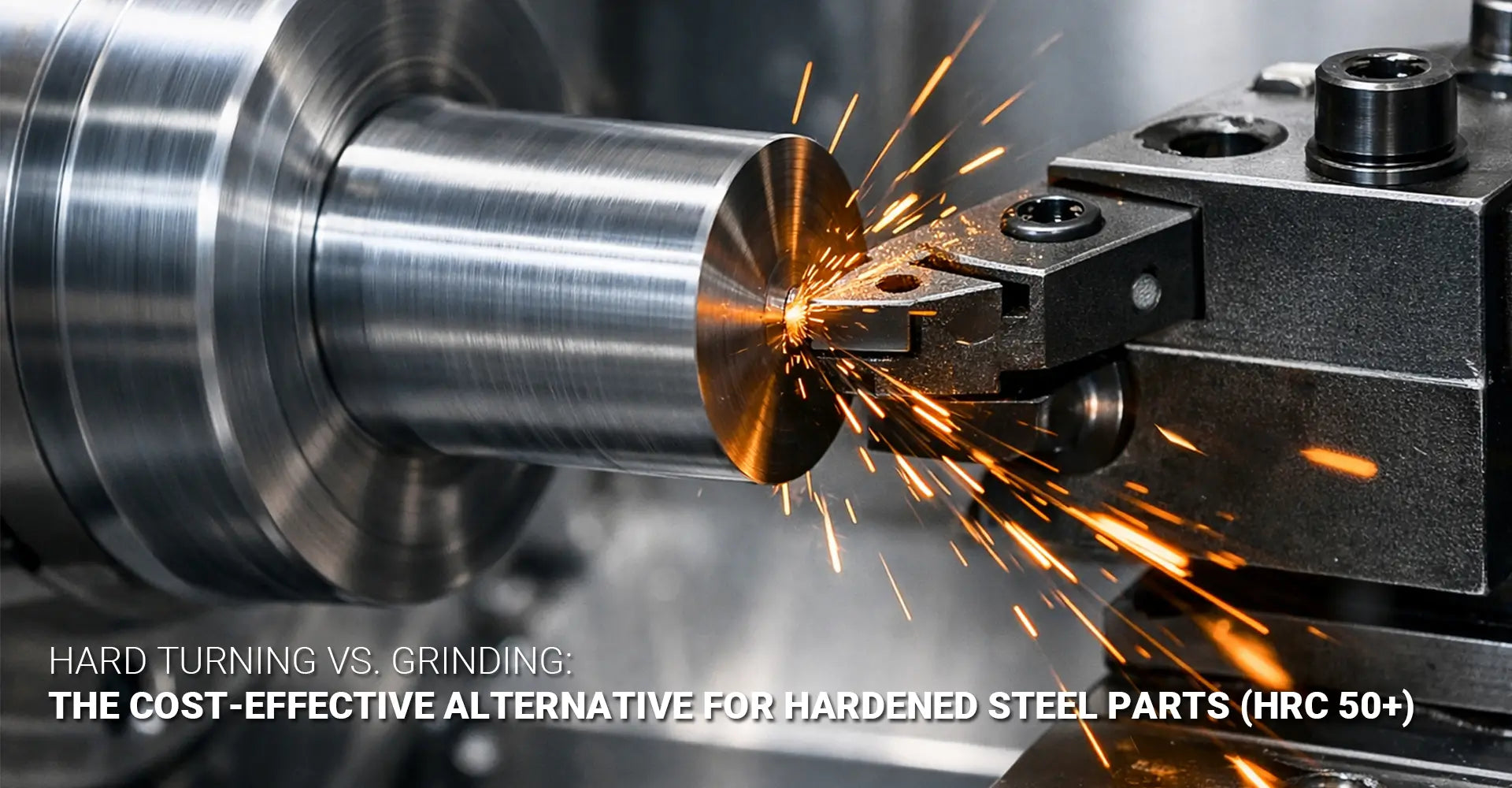
Hard turning uses CBN cutting tools on CNC lathes to shear material from hardened workpieces (HRC 45-68) in continuous operations. Meanwhile, grinding relies on abrasive wheels through friction-based material removal on separate machines. This distinction affects everything from setup time to equipment investment.
Technical Mechanics and Workflow Integration
Hard turning represents a fundamental shift in how we approach finishing operations. Instead of treating finishing as a separate, specialized step, hard turning services integrate the process directly into your primary machining workflow. Consequently, parts can move from rough turning through heat treatment and back to the same machine for finish operations.
The technology behind this capability centers on CBN inserts for hardened steel. These polycrystalline cubic boron nitride cutting tools maintain their hardness and edge sharpness even when cutting materials above HRC 60. In contrast, traditional carbide tools would fail immediately at these hardness levels. Additionally, ceramic inserts offer another option for certain applications, though CBN remains the gold standard for most hard turning work.
Grinding takes a completely different approach. Rather than using a defined cutting edge, grinding wheels contain thousands of tiny abrasive particles bonded together. These particles chip away microscopic amounts of material through friction and heat. Moreover, grinding typically requires dedicated equipment separate from your primary machining centers. This means extra handling, additional setup time, and another queue in your production flow.
The process philosophy differs dramatically as well. Grinding evolved as a specialized finishing operation performed after all other machining and heat treatment steps. Hard turning, on the other hand, treats hardened material as just another cutting operation. This perspective shift enables single setup finishing, where multiple operations occur without removing the part from the machine. As a result, you eliminate cumulative positioning errors and reduce total cycle time.
Where Do the Real Savings Come From with Hard Turning?
Cost considerations drive most manufacturing decisions. Therefore, understanding the complete financial picture helps you make informed choices about which process fits your needs.
Multi-Factor Cost Advantages
Key savings areas include lower equipment costs (CNC lathe vs. cylindrical grinder), single-setup operations eliminating handling time, faster changeovers between part designs, and dry machining reducing coolant expenses. However, the hard turning vs grinding cost comparison goes deeper than these headline numbers.
Detailed Financial Breakdown
Let's start with capital equipment. A cylindrical grinder capable of holding tight tolerances typically costs significantly more than a rigid CNC lathe equipped for hard turning. Furthermore, grinders require specialized foundations to minimize vibration, adding to installation costs. CNC lathes suitable for hard turning may already exist in your shop, requiring only tooling upgrades and process development.
Labor costs tell an equally compelling story. Consider a typical ground shaft: the part goes through rough turning, gets sent to heat treatment, returns to your facility, waits in queue for the grinder, requires careful setup and alignment, and finally gets ground to final dimensions. Each transfer point adds handling time and introduces potential errors. Machining HRC 50+ parts through hard turning eliminates most of these steps. The part stays on the lathe through finish operations, dramatically reducing touch time.
Changeover time matters more than many shops realize. When switching between part numbers, a grinder requires wheel changes, dressing operations, and extensive setup verification. A CNC lathe running hard turning operations needs only a tool change and program selection. Consequently, hard turning excels in environments producing multiple part numbers in smaller batches.
Coolant systems represent another hidden cost center. Grinding generates tremendous heat, requiring elaborate flood coolant systems. These systems need constant maintenance, periodic replacement, and proper disposal of used fluid. Many hard turning operations run dry or with minimal mist lubrication. As a result, you avoid purchasing coolant, maintaining filtration systems, and managing hazardous waste disposal.
Lead time reduction provides indirect but substantial savings. Shorter cycle times mean faster order fulfillment, reduced work-in-process inventory, and improved cash flow. Additionally, eliminating the wait for grinder availability removes a common bottleneck in many production schedules. These factors combine to create a more responsive, efficient operation overall
Can Hard Turning Achieve the Same Precision as Grinding?
Quality concerns often prevent manufacturers from exploring alternatives to established processes. Nevertheless, modern hard turning capabilities might surprise you with their accuracy and surface finish quality.
Achievable Quality Standards
Quality capabilities include IT6-IT7 tolerances and 0.4-0.8 µm (16-32 µin) surface finishes suitable for bearing seats, seal surfaces, and functional interfaces on hardened steel components. These specifications cover the vast majority of industrial machinery and automotive applications.
Understanding Precision Parameters and Limitations
Precision hard turning IT6 tolerances represent geometric accuracy within 0.009-0.015mm for typical shaft diameters. This level of precision meets requirements for most bearing fits, shaft seals, and mating surfaces. Importantly, achieving these results depends heavily on machine tool rigidity. The lathe must resist cutting forces without deflection or vibration. Modern rigid-bed CNC lathes with appropriately sized spindles and properly maintained ways can deliver this stiffness consistently.
Cutting parameters significantly influence surface finish quality. Speed, feed rate, nose radius, and insert geometry all interact to determine final surface texture. Generally, higher cutting speeds and fine feeds with large nose radii produce better finishes. However, excessive speed can generate harmful white layer formation on the part surface. This metallurgically altered zone exhibits brittleness and reduced fatigue life. Proper parameter selection balances surface finish requirements against metallurgical integrity.
White layer prevention requires attention to several factors. Lower feed rates reduce mechanical stress at the cutting edge. Sharp tool edges minimize plastic deformation. Adequate tool clearance prevents rubbing. When properly controlled, hard turning produces surfaces with favorable compressive residual stresses that actually enhance fatigue performance compared to ground surfaces.
Machine condition plays a crucial role in result consistency. Worn ways, loose gibs, or damaged spindle bearings will sabotage even the best cutting tools and programs. Consequently, successful hard turning operations maintain their equipment meticulously and address any developing issues immediately.
That said, grinding still holds advantages in specific situations. When absolute surface finish below 0.2 µm is required, grinding remains the better choice. Similarly, correcting significant geometric errors from heat treatment distortion often requires grinding's ability to remove more material without generating excessive heat. Additionally, parts with extremely tight roundness requirements may benefit from grinding's continuous contact around the entire circumference.
Which Parts Work Best for Hard Turning Services?
Matching process capabilities to part characteristics determines success or failure. Therefore, let's examine which components make ideal candidates for hard turning and which should probably stay with grinding.
Ideal Component Characteristics
Ideal candidates include automotive shafts, bushings, aftermarket wear parts, components with complex contours or discontinuous surfaces, medium-volume production batches, and parts requiring single-setup operations for multiple features. Understanding why these characteristics favor hard turning helps you evaluate your specific components.

Detailed Application Analysis
Hard turning automotive components represents one of the strongest applications for this technology. Transmission shafts, steering components, suspension parts, and driveline elements often feature complex profiles with shoulders, grooves, and varying diameters. Hard turning machines these features in one setup after heat treatment, maintaining perfect concentricity between all diameters. In contrast, grinding each feature separately introduces cumulative errors and requires multiple setups.
Aftermarket parts machining particularly benefits from hard turning's quick changeover capability. Replacement part manufacturers typically run smaller batches across many part numbers. The ability to switch between jobs quickly without extensive setup allows these shops to maintain competitive pricing while offering broad catalogs. Furthermore, aftermarket parts often require matching original equipment specifications without justifying dedicated grinding equipment for each part family.
Bushings and bearing housings make excellent hard turning candidates when they contain internal features. A part with an external ground diameter and an internal bore that needs finishing presents challenges for grinding. Hard turning can finish both surfaces in one setup, ensuring perfect alignment between them. Additionally, interrupted surfaces like keyways or oil grooves that would damage grinding wheels pose no problems for rotating cutting tools.
Complex contours demonstrate hard turning's versatility clearly. Consider a shaft with multiple tapers, radii, and profile changes. Grinding this part requires dressing the wheel to match each contour section, changing wheel shapes, or multiple setups. Hard turning simply follows the programmed tool path, producing the complete profile in one pass. This capability becomes especially valuable when part designs include ergonomic contours or weight-reduction profiles.
Production volume considerations matter significantly. Very high-volume production often justifies dedicated grinding equipment with specialized fixtures and automation. Conversely, prototype and one-off parts may not require the precision that hard turning offers. The sweet spot sits in the middle: medium-volume production of 50 to 5,000 pieces where setup time matters but dedicated equipment cannot be justified.
Part size and configuration do impose some limitations. Extremely large diameter parts may exceed lathe capacity or generate cutting forces beyond what the machine can handle. Non-rotational parts obviously don't suit turning operations at all. Very long, slender shafts may deflect under cutting forces, though steady rests can address this challenge in many cases.
Material consistency affects results directly. Hard turning performs best when hardness stays uniform throughout the part. Large hardness variations cause unpredictable tool wear and inconsistent surface finish. Parts with case hardening work well because the hard layer remains relatively uniform. Through-hardened parts also succeed when heat treatment produces consistent results.
Conclusion
Hard turning offers substantial advantages for finishing hardened steel components in the right applications. The cost savings come from multiple sources: lower equipment investment, reduced setup and handling time, faster changeovers, and eliminated coolant systems. Quality capabilities match grinding for most industrial requirements, delivering IT6-IT7 tolerances and appropriate surface finishes for functional surfaces.
Success depends on matching your specific needs to process capabilities. Parts with complex contours, discontinuous surfaces, and medium production volumes make ideal candidates. Applications in automotive and aftermarket manufacturing particularly benefit from hard turning's flexibility and efficiency. However, ultra-fine surface finish requirements or very high volumes may still favor traditional grinding.
The key lies in honest evaluation of your requirements. Consider your part geometry, production volumes, quality specifications, and existing equipment. Many shops find that hard turning handles 70-80% of their hardened part finishing needs, reserving grinding for truly specialized applications. This balanced approach optimizes both cost and quality across your entire operation.
If you're looking to explore whether hard turning fits your manufacturing needs, evaluate your current hardened steel components against the criteria discussed here. The technology has matured significantly, offering reliable results when properly applied. Moreover, starting with a pilot project on well-suited parts helps build confidence and process knowledge before expanding to broader applications.
Recommended Resources
[Hard turning services][^1]
[Hard turning vs grinding][^2]
[CNC lathe for hard turning][^3]
[CBN inserts for hardened steel][^4]
[CBN tooling for high-hardness materials][^5]
---
[^1]: Explore this link to understand how hard turning services can enhance precision and efficiency in manufacturing.
[^2]: This resource will clarify the distinctions between hard turning and grinding, helping you choose the right machining process.
[^3]: Explore this link to discover top CNC lathes designed specifically for hard turning, enhancing precision and efficiency.
[^4]: Learn about CBN inserts and their advantages for machining hardened steel, ensuring better tool life and performance.
[^5]: Explore this link to understand how CBN tooling enhances machining efficiency and precision for tough materials.