Can Your CNC Design Actually Be Made, or Will Undercuts Stop Production?
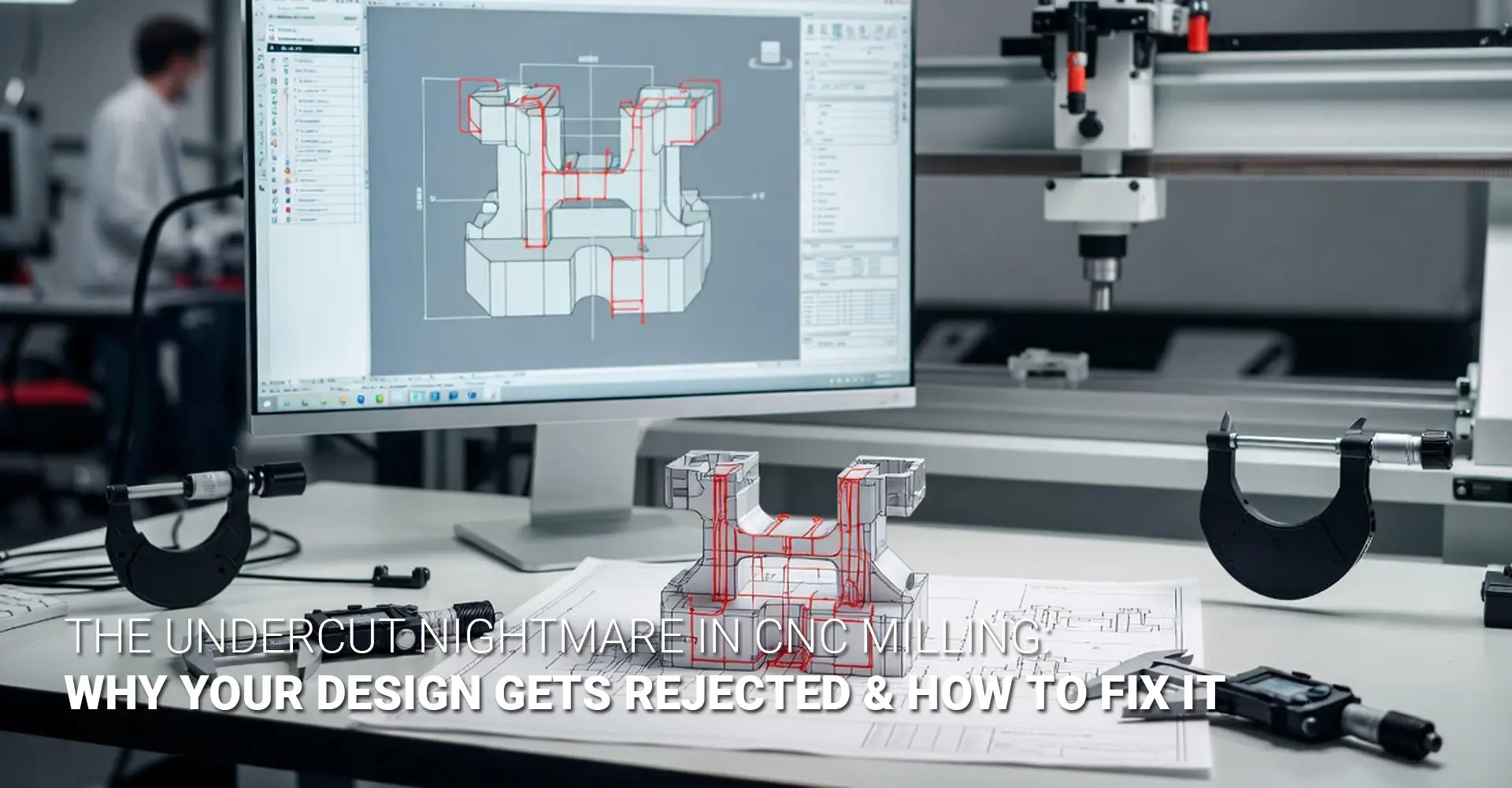
Can Your CNC Design Actually Be Made, or Will Undercuts Stop Production?

You've spent hours perfecting your CAD model. Every dimension is exact, every surface is smooth, and the design meets all functional requirements. However, when you submit it to the machine shop, you receive frustrating feedback: "This undercut can't be machined economically." Suddenly, your project timeline extends by weeks, and costs triple. This scenario happens daily in machine shops worldwide, yet most designers don't learn about CNC undercut design challenges until it's too late.
Key Takeaways at a Glance
| Problem | Why It Happens | Best Solution |
|---|---|---|
| Internal T-slots rejected | Standard tools can't reach inside | Split into two parts with external profiles |
| Dovetail grooves too expensive | Specialty tools are slow and fragile | Redesign as separate key and slot assembly |
| Undercut features add weeks to lead time | Requires multiple setups and custom tooling | Challenge the feature requirement early |
| Quotes come back 3x higher than expected | Machining undercuts burns time and breaks tools | Use fasteners, pins, or adhesive joints instead |
Bottom Line: Most undercuts don't need to be machined at all. Instead, they signal an opportunity to redesign one complex part into two simple components that assemble together, cutting both cost and production time dramatically.
Why This Matters More Than You Think
Undercuts aren't just a minor manufacturing inconvenience. Rather, they represent a fundamental clash between what looks good on screen and what's physically possible with rotating cutting tools. Understanding this distinction separates designers who get their parts made quickly from those who face endless revision cycles. Moreover, the principles you'll learn here apply whether you're working on industrial machinery, automotive components, or electronics manufacturing projects.
Table of Contents
- What Makes an Undercut Impossible for Standard CNC Mills?
- Why Don't Specialty Tools Solve the Undercut Problem?
- How Can Splitting One Part into Two Save Your Project?
- When Should You Actually Machine an Undercut vs. Redesign?
What Makes an Undercut Impossible for Standard CNC Mills?
The Physical Reality of Rotating Tools
Imagine trying to carve the inside of a bottle through its narrow neck using only a straight stick. That's essentially what happens when a CNC mill encounters an undercut. The cutting tool must spin on a vertical axis, which means it approaches your workpiece from directly above.
The Simple Truth About Undercuts
Quick Answer: An undercut is any internal cavity where the opening is narrower than the space inside. Since a CNC tool spins on a vertical axis, the tool's body blocks access to material "behind" the opening. Consequently, features like internal T-slots, dovetails, or recessed grooves become physically unreachable with standard end mills.
The Deep Dive Into Tool Access Limitations
When you're working with CNC machining services, understanding machining undercuts becomes critical to your design success. Here's why even advanced machines struggle with these features.
Standard 3-axis CNC mills move tools in X, Y, and Z directions. Therefore, every cut must have a clear vertical path from above. When your design includes an internal feature where material "hangs over" the opening, the tool shank—which is always wider than the cutting edges—physically cannot fit through the opening to reach the cavity below.
Consider these commonly rejected features:
- Internal T-slots: The top opening is narrower than the wide section below
- Dovetail grooves facing inward: The angled walls prevent straight tool access
- Recessed shoulders on internal threads: The tool would need to cut "sideways" into the recess
- Snap-fit hooks facing toward the center: The overhang blocks tool entry from above
Even 4-axis and 5-axis machines, which can rotate the part or tilt the tool, still face severe limitations. The tool holder and spindle assembly add considerable bulk above the cutting edges. Thus, deep internal undercuts remain problematic regardless of machine sophistication.
Additionally, as the cavity depth increases, the tool must extend further from its holder. This creates another problem: deflection. Long tools bend under cutting forces, producing poor surface finishes and dimensional inaccuracy. For Design for Manufacturing CNC applications, this combination of access limitations and deflection issues makes deep undercuts especially troublesome.
Why Don't Specialty Tools Solve the Undercut Problem?
The Promise vs. Reality of Specialized Cutters
Many designers discover T-slot cutters and lollipop end mills, then assume their undercut problems are solved. Unfortunately, these tools rarely provide the solution they expect for production work.
The Hard Truth About Specialty Tooling
The Reality: Specialty undercut tools have long, thin necks that make them extremely fragile. Therefore, they must run at very slow speeds, which increases machining time by 5-10x compared to standard tools. Additionally, they cost $150-400 each and break frequently, making them suitable only for prototypes or very high-value parts.

Understanding T-Slot Cutter Limitations
When machinists talk about T-slot cutter limitations, they're referring to fundamental physics that no amount of money or advanced tooling can overcome. Let's break down the economic reality:
Rigidity Issues: A standard end mill might have a length-to-diameter ratio of 3:1 or 4:1. In contrast, an undercut tool often exceeds 10:1 or even 15:1. This extended reach creates a weak, flexible structure that vibrates during cutting. Consequently, feed rates must drop to 10-20% of normal speeds to prevent tool breakage.
Cost Comparison: Here's what the numbers actually look like for machining a simple T-slot feature:
| Approach | Tool Cost | Machining Time | Setup Time | Total Cost |
|---|---|---|---|---|
| Standard end mill (if possible) | $25 | 15 minutes | 20 minutes | $85 |
| T-slot cutter | $250 | 90 minutes | 45 minutes | $520 |
| Two-part assembly | $50 (two standard tools) | 25 minutes total | 35 minutes | $165 |
Furthermore, dovetail tool challenges compound these issues. Dovetail cutters must remove material at an angle while maintaining extreme precision. The angled cutting forces push the tool sideways, which means even slower feed rates and more frequent tool replacement.
Multiple Setup Requirements: Machining an undercut typically requires flipping the part and re-indicating its position with extreme precision. Each setup adds 30-60 minutes and introduces potential for alignment errors. For projects involving custom CNC milling services, these setup hours translate directly into higher costs.
Surface Finish Compromises: The vibration from long, weak tools produces visible chatter marks on the finished surface. While this might be acceptable for hidden internal features, it becomes problematic when undercuts appear in visible or functionally critical areas.
How Can Splitting One Part into Two Save Your Project?
Rethinking the Problem Entirely
The most powerful solution to undercut challenges doesn't involve better tools or more expensive machines. Instead, it requires a fundamental shift in thinking: convert the internal, unmachinable feature into external profiles on separate components.
The Assembly Design Breakthrough
The Game-Changer: Instead of machining a T-slot inside a block, machine a simple straight slot in one part and a separate T-shaped key as another part. Both profiles are now on the outside of their respective components, making them fast and easy to mill. Then, slide the key into the slot and secure with screws—the assembly achieves the same locking function without the undercut.
Real-World Case Study: Mounting Bracket Transformation
Let's examine how splitting parts to avoid undercuts transformed an actual manufacturing challenge. A client needed a mounting bracket for an automotive application with specific retention features.
Original Design (Rejected):
- Single 6061 aluminum block: 4" x 3" x 1.5"
- Internal dovetail groove: 0.5" deep, 1.2" wide at base, 0.8" opening
- Function: Secure a sliding adjustment mechanism
- Quoted price: $485 per unit
- Lead time: 3 weeks
- Required: Custom dovetail cutter, two setups, extensive quality inspection
Redesigned Assembly (Approved):
- Part A: Base plate with open dovetail profile machined on top surface
- Part B: Separate dovetail key with mounting holes
- Assembly method: Two precision dowel pins for alignment, two M6 socket head cap screws for clamping
- Final price: $195 per unit (60% reduction)
- Lead time: 5 days
- Required: Only standard end mills, single setup per part
Engineering Benefits Beyond Cost: The multi-component assembly design actually improved the final product in several ways:
- Material Selection: The base could use cost-effective 6061-T6 aluminum, while the key used harder 7075-T6 for better wear resistance
- Surface Treatment: Each component received optimized finishing (anodizing on base, dry film lubricant on key)
- Serviceability: The wear component (key) could be replaced without discarding the entire assembly
- Tolerance Management: Critical mating surfaces were easier to inspect and measure separately
Assembly Integrity: Properly designed joints create extremely rigid connections. The dowel pins provided precise alignment to within 0.002", while the cap screws generated sufficient clamping force to prevent any movement under operational loads. Testing showed the assembly withstood 125% of the original single-part design's rated load.
Design Strategies for Converting Undercuts
When you encounter unmachinable features CNC milling can't handle economically, follow this conversion process:
Step 1 - Identify the Function: Don't think about the geometric feature itself. Instead, ask what it needs to accomplish. Does it locate, retain, guide, or lock another component?
Step 2 - Sketch External Equivalents: Draw how you could achieve that same function using profiles on the outside of parts. For example, an internal groove that retains a shaft becomes two half-round blocks that clamp around the shaft.
Step 3 - Design the Joint: Consider alignment features (dowel pins, pilots, datum surfaces) and fastening methods (screws, rivets, adhesives, press fits). The joint must maintain the required tolerances and strength.
Step 4 - Optimize for Manufacturing: Make each component as simple as possible. Avoid creating new manufacturability problems while solving the undercut issue. Every surface should have clear tool access.
When Should You Actually Machine an Undercut vs. Redesign?
Making Smart Decisions Based on Your Situation
Not every undercut demands immediate redesign. However, knowing when to accept the cost versus when to rethink your approach saves significant time and money.
Your Practical Decision Framework
Decision Checklist:
Machine the undercut if:
- You need only 1-5 prototypes where tooling costs amortize across few units
- The feature is shallow (less than 2x tool diameter) allowing for more rigid tooling
- You have a high-value application that justifies premium costs (aerospace, medical devices)
- Assembly introduces unacceptable risks (contamination, strength reduction, complexity)
Redesign the assembly if:
- You need 25+ units where recurring machining costs accumulate quickly
- The undercut is deep or complex requiring extreme tool extension
- Lead time matters and you can't wait for specialty tooling and multiple setups
- The part will be in production long-term, making upfront redesign investment worthwhile
Advanced Considerations and Alternative Processes
Sometimes the decision isn't simply "machine vs. redesign." Other manufacturing processes might offer viable alternatives:
Wire EDM (Electrical Discharge Machining): For conductive materials like metals, wire EDM can create internal profiles that milling cannot. The thin wire (typically 0.010"-0.012" diameter) "burns" through material using electrical sparks. This process excels at:
- Through-slots with complex internal profiles
- Very deep, narrow features
- Hardened materials that would destroy milling cutters
However, wire EDM requires a through-hole for the wire to pass through. Therefore, it cannot create completely enclosed internal cavities. Additionally, the process is slow (typically 1-3 square inches per hour) and expensive for thick sections.
Additive Manufacturing: For electronics manufacturing applications and prototypes, 3D printing eliminates undercut concerns entirely. Technologies like SLS (Selective Laser Sintering) or DMLS (Direct Metal Laser Sintering) build parts layer by layer, making internal complexity essentially free.
The trade-offs include:
- Surface finish typically rougher than CNC machining (50-200 microinches Ra)
- Dimensional accuracy usually ±0.005" or looser
- Limited material options compared to machining
- Higher per-unit costs for production quantities beyond 100 units
Hybrid Approaches: Increasingly, manufacturers combine processes. For instance, 3D print a complex internal manifold structure, then CNC machine the critical external mounting surfaces to tight tolerances. This leverages each process's strengths while minimizing weaknesses.
The Value of Early Collaboration
Regardless of which path you choose, the single most important factor is timing. Engage with manufacturing engineers during the concept phase, not after finalizing your design. A 15-minute conversation early can prevent a 3-week delay later.
Ask your machining partner these specific questions:
- "Can you achieve this feature with standard tooling?"
- "What would it cost to machine as-designed versus as an assembly?"
- "Are there alternative processes better suited to this geometry?"
Most shops appreciate designers who ask these questions. It demonstrates you value manufacturability and are willing to collaborate for the best outcome.
Conclusion
Three Key Strategies to Master CNC Undercut Design
Understanding why undercuts fail represents the first step toward better design outcomes. Rotating cutting tools have physical limitations that no amount of advanced machinery can completely overcome. However, recognizing these constraints early transforms them from obstacles into design opportunities.
Specialty tooling isn't the solution many designers hope for. While T-slot cutters and dovetail mills exist, their fragility, slow operation, and high costs make them viable only for specific low-volume applications. For production work, these tools create more problems than they solve.
Multi-component assembly design isn't a compromise—it's often the superior solution. By converting internal, unmachinable features into external profiles on separate parts, you gain advantages beyond manufacturability. You can optimize materials, improve serviceability, enhance surface treatments, and frequently reduce both cost and lead time simultaneously.
Manufacturability doesn't limit creativity. Rather, it channels design thinking toward solutions that actually reach production and perform reliably in the real world. The most successful designers don't fight manufacturing constraints—they embrace them as creative parameters that lead to better products.
Take Action on Your Current Designs
Review your active projects right now. Identify any internal grooves, recessed features, or overhanging profiles that might qualify as undercuts. Then, sketch how you could split those parts into simpler components that assemble together. You'll often discover the redesigned version isn't just easier to manufacture—it's functionally superior.
Before submitting your next design for quotes, ask yourself: "Can a standard end mill reach every surface that needs machining?" If the answer is no, you've likely found an undercut that deserves reconsideration.
Manufacturing success comes from designing with the shop floor in mind, not as an afterthought. Start that practice today, and watch your designs move from concept to production faster and more economically than ever before.
Recommended Resources
[T-slot cutter limitations][^1]
[CNC undercut design][^2]
[Dovetail tool challenges][^3]
[Undercut feature solutions][^4]
[Splitting parts to avoid undercuts][^5]
[CNC milling tool deflection][^6]
---
[^1]: Understanding T-slot cutter limitations can help you optimize your CNC machining processes and avoid common pitfalls.
[^2]: Exploring CNC undercut design resources can enhance your skills in creating complex parts and improve your machining efficiency.
[^3]: Explore this link to understand the typical challenges faced with Dovetail tools and effective solutions to enhance your workflow.
[^4]: This resource will provide insights into effective strategies for addressing undercut feature problems in your projects.
[^5]: Learn how splitting parts can enhance your machining process by preventing undercuts, leading to better results and efficiency.
[^6]: Understanding CNC milling tool deflection is crucial for improving machining accuracy and efficiency. Explore this link for in-depth insights.
Ready to discuss your specific design challenges? Contact our engineering team to review your CAD models and explore the most cost-effective manufacturing approach for your application.