Aluminum or Steel Tooling: Which One Actually Saves You Money on 5,000 Parts?
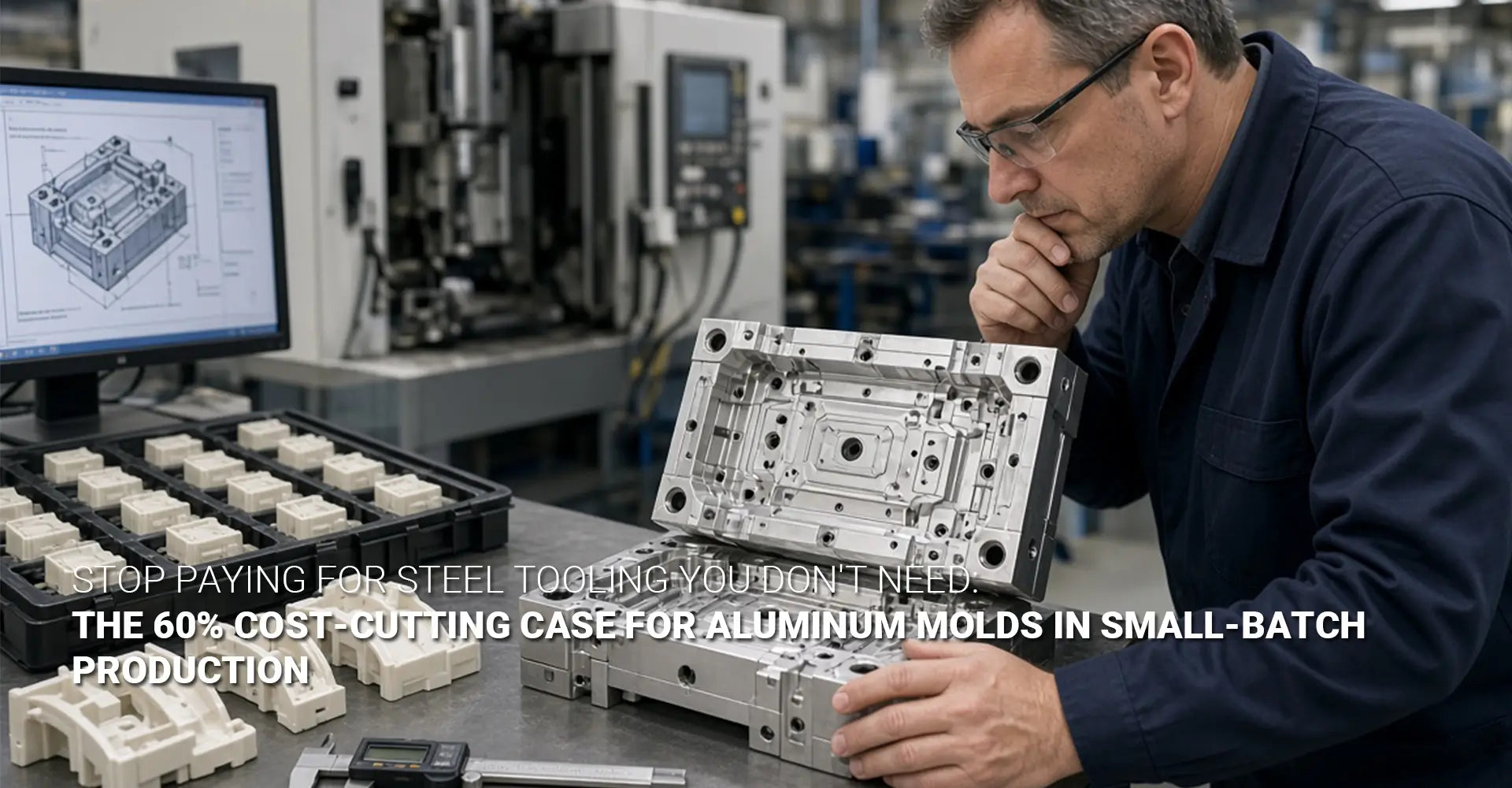
Aluminum or Steel Tooling: Which One Actually Saves You Money on 5,000 Parts?
If you are ordering 1,000 to 10,000 parts, a steel mold quote can feel like sticker shock. Most shops quote steel by default, even when your order does not need it. That habit costs buyers thousands of dollars and weeks of time on projects that were never big enough to justify it in the first place.
That is where rapid tooling services step in. They use aluminum molds instead of steel, and they can cut your cost and your wait time by a wide margin, without cutting corners on part quality. A procurement manager sourcing 5,000 brackets does not need the same tool as a company molding 500,000 units a year, yet both often get quoted the same way. This guide breaks down exactly when aluminum wins, when steel still makes sense, and how to make the right call for your next order, using real numbers instead of guesswork.

Quick Answer: Aluminum tooling typically costs 30–60% less than steel and ships in 5–15 days instead of 8–12 weeks. It works well for 100 to 10,000 parts, and sometimes further. Steel only pulls ahead once your yearly volume passes about 50,000 pieces and the program runs several years. For most short run plastic parts, aluminum is the smarter buy, both on price and on speed to market.
So how do you know which tool fits your project? Let's walk through the numbers, the trade-offs, the materials involved, and the exact volume where the answer flips from aluminum to steel. By the end, you will have a clear checklist to bring to your next supplier conversation.
Table of Contents
- Why Do Procurement Teams Overpay for Steel Tooling on Small Orders?
- What Makes Rapid Aluminum Tooling a Bridge Between Prototype and Production?
- How Much Do You Actually Save on Cost, Time, and Cooling?
- At What Part Volume Does Steel Finally Make Sense?
- Conclusion: What Should You Ask Your Tooling Supplier Before You Order?
Why Do Procurement Teams Overpay for Steel Tooling on Small Orders?
Most tooling shops quote steel first, no matter how many parts you actually need. It is the default answer, built into standard quoting templates, and it rarely gets questioned. That habit costs buyers real money on small and mid-size orders, often without anyone noticing until the invoice arrives.
Steel molds are built for millions of cycles. Automakers and appliance makers use them because they run the same part for years, sometimes decades, at massive scale. So when a supplier quotes steel for a 5,000-part order, you are paying for capacity you will never come close to using. The result is a mold engineered for a million-unit program, sitting in a warehouse instead of your budget, doing far less work than it was designed for.
In short: a steel quote on a low volume order is often the wrong tool for the job, not the safe choice it appears to be. Buyers assume steel means "safe" and aluminum means "risky," but the opposite is often true for smaller runs.
Here is what that overpay actually looks like in practice:
- Cost: Steel tooling runs $20,000–$100,000+, depending on part complexity and cavity count.
- Lead time: Steel takes 8–12 weeks before your first part is even molded, which can push back your entire launch schedule.
- Design lock-in: Once steel is cut, changes are slow and expensive, sometimes requiring a partial or full re-cut.
- Idle capacity: A steel mold rated for 500,000 cycles that only ever produces 8,000 parts wastes most of its value.
Here is the deeper issue, and it is one most buyers do not think about until it is too late. Steel tooling forces you to lock in your design before it is fully proven in the market. If your part needs a tweak after the first few thousand units ship, you are stuck paying for rework on a $50,000 tool, plus the downtime while it gets re-cut. That is a heavy bet to place before your design has been validated by real customers or real testing.
The injection molding tooling cost you pay upfront should match the risk you are actually taking on. For most new products, that risk is still high, because the design has not yet survived contact with the market. A mold built for CNC machining precision at production scale simply is not the right starting point for a design that might still change. Locking in steel tooling too early is one of the most common, and most expensive, mistakes procurement teams make.
What Makes Rapid Aluminum Tooling a Bridge Between Prototype and Production?
Rapid aluminum tooling sits between a 3D-printed prototype and a full production steel mold. It is often called bridge tooling, because it bridges the gap between testing your design and mass producing it, letting you move forward without betting your whole budget on one unproven design.
Here is how it works. Instead of steel, the mold cavity is CNC-machined from an aluminum injection mold block, usually 7075 aluminum mold stock or a similar aircraft-grade alloy such as QC-10. Both materials are strong enough to handle real injection pressure, yet soft enough to machine far faster than steel. That difference in machinability is a big part of why the lead time drops so much, since less time on the CNC machine means fewer days between your purchase order and your first shipped part.
The parts that come out of an aluminum mold are not test pieces or rough mockups. They go through the exact same injection molding process, using the exact same engineering resins as production parts. That means your team gets real, functional parts to test, with the same shrink rates, the same wall behavior, and the same fit and finish customers will eventually receive. Compared to a 3D-printed prototype, an aluminum-molded part matches the material properties, surface finish, and mechanical strength your customer will actually experience, which is something a printed part simply cannot replicate.
This is exactly why this approach works so well for teams moving from rapid prototyping toward full prototype to production tooling. You validate your design with real, injection-molded parts, gather feedback from testing or early customers, and only then commit to the bigger steel investment once the design has proven itself. A few technical notes worth knowing before you order:
- Surface finish reaches up to Ra 0.8μm, which is smooth enough for most industrial and enclosure-style parts.
- Standard tolerances run ±0.05–0.10mm, tighter than most buyers expect from a tool built this fast.
- If cosmetics matter, SPI-A2 diamond-buffed finishes are also available for consumer-facing parts.
- More than 100 resins are compatible, including ABS, polycarbonate, polypropylene, POM, and liquid crystal polymer.
- Design changes between shots are far cheaper, since aluminum can be re-machined in days, not weeks.
Because the tolerances and finish options are so close to production quality, many buyers choose to run their entire pilot batch, and sometimes their full first production order, straight off the aluminum tool.
How Much Do You Actually Save on Cost, Time, and Cooling?
The value of aluminum tooling comes down to three things: cost, time, and cooling. Each one compounds on the others, so together they add up to a much bigger advantage than any single number suggests. Let's take each one in turn, with the specific figures buyers should expect to see on a real quote.
Cost. A simple single-cavity aluminum mold typically runs $1,500–$15,000, depending on part size and geometry. That is 30–60% less than a steel mold built for the same part. On more complex geometries, with tighter tolerances or side actions, the gap widens even further, sometimes cutting total mold cost by 40–65% compared to an equivalent steel tool.
Lead time. This is where aluminum really pulls ahead, and where most buyers feel the biggest impact on their schedule. Simple molds can ship in 5–7 business days from design approval. Even standard multi-cavity aluminum tools are usually ready in 7–15 business days, start to finish. Compare that to the 8–12 week wait for steel, and you can see why so many procurement teams now default to quick turn injection molding for early production runs and time-sensitive launches.
Cooling. Aluminum conducts heat roughly four to five times better than steel. That means the mold cools faster between shots, which shortens your cycle time on every single part, run after run, over the life of the tool. Faster cooling also reduces the need for complex internal cooling channels, which keeps the tool simpler to design, cheaper to build, and easier to maintain in the first place.
Here is what those three savings look like when placed side by side:
| Factor | Aluminum Tooling | Steel Tooling |
|---|---|---|
| Mold cost (single cavity) | $1,500–$15,000 | $20,000–$100,000+ |
| Lead time | 5–15 business days | 8–12 weeks |
| Cycle cooling | Faster, fewer channels needed | Slower, complex channels common |
| Typical part life | 100–10,000+ parts | 100,000–1,000,000+ parts |
Put together, these three factors are why soft tooling injection molding has become the default starting point for teams in industrial machinery and consumer goods alike. You get production-grade parts, fast, without tying up capital in a tool sized for a much bigger run than you actually need this year.
At What Part Volume Does Steel Finally Make Sense?
Every mold material has a sweet spot. Knowing yours is the single most useful thing a buyer can walk away with from this entire guide, because it turns a subjective debate into a simple math problem.
Aluminum molds handle low volume injection molding extremely well, generally in the 100 to 10,000 part range. Many tools can push past 10,000 parts, sometimes reaching 50,000 or more, depending entirely on the resin and part geometry involved. Non-abrasive materials like ABS or polypropylene are gentle on the mold cavity, so tool life stretches further with less wear. Glass-filled or highly abrasive resins wear the cavity faster, so expect a shorter working life, often in the 1,000–5,000 part range, when those tougher materials are involved.
So where does the rapid aluminum tooling vs steel mold decision actually flip? The general rule is this: if your total program volume stays under 5,000 to 10,000 parts, aluminum wins on cost every single time, with no real trade-off. Steel only becomes the cheaper option once your annual volume climbs past roughly 50,000 pieces and the program is expected to run three or more years at that pace. Below that line, you are simply paying for steel's durability without ever putting it to use.
It also helps to think in ranges rather than one hard cutoff, since real projects rarely fall neatly on one side of a line:
- Under 5,000 parts total: Aluminum is almost always the right call, full stop.
- 5,000–10,000 parts, one-time run: Aluminum still wins on total cost, even with moderate resin wear.
- 10,000–50,000 parts per year: This is a gray zone. Run the break-even math with your actual resin and cavity count before deciding.
- 50,000+ parts per year, multi-year program: Steel usually becomes the better long-term investment.
This threshold matters just as much for automotive parts as it does for consumer products. A bracket or housing ordered for a low volume test fleet almost never justifies steel tooling, even though automotive parts often carry tighter tolerance expectations than typical consumer goods. The material choice depends on volume and lifespan, not on the industry label attached to the part.
Conclusion: What Should You Ask Your Tooling Supplier Before You Order?
For most orders between 1,000 and 10,000 parts, rapid aluminum tooling is the practical default, not a compromise. It cuts your upfront cost by 30–60%, gets you parts in days instead of months, and still delivers production-grade quality your customers and your engineering team can trust. You get to test your design with real parts, generate early revenue, and prove out demand, all before committing to a much larger steel investment further down the road.
Before you sign a tooling quote, ask your supplier these questions, and expect specific numbers back, not vague reassurance:
- What is the break-even quantity where steel becomes cheaper than aluminum for my specific part?
- What resin am I running, and how many shots can this mold realistically deliver before it wears out?
- What is the actual lead time to my first shipped part, not just the mold build itself?
- Can this aluminum tool be re-machined if I need a design change mid-run?
- What tolerance and surface finish can I expect, and does that match my part's real requirements?
A supplier who answers clearly, with real numbers pulled from past projects, is one you can trust with your next order. If they can't, or if they push steel without asking about your volume first, that's a sign to keep shopping around.
Recommended Reading
[press brake bending without tooling][^1]
[flexible sheet metal manufacturing][^2]
[low volume injection molding][^3]
[bridge tooling][^4]
[rapid aluminum tooling vs steel mold][^5]
[^1]: A practical guide from Approved Sheet Metal (US-based fabricator) detailing how to create offset bends without custom tooling using the "lazy offset" technique—a press brake bending method that prioritizes offset height over a strict 90-degree angle, eliminating the need for expensive custom offset tooling[reference:0][reference:1].
[^2]: Prima Power's official press release (Italy-based manufacturer) presenting the eP 1030 servo-electric press brake, designed for flexible production with modular adaptability—operating as a standalone solution or integrated into robotic cells and **flexible manufacturing lines** for evolving product mix and batch size variability[reference:5][reference:6].
[^3]: Hansen Plastics (US-based) explains low volume injection molding as a strategy for bridge production, pilot runs, and validation builds—delivering production-grade parts without full-scale tooling investment, with tooling options engineered for short runs and volumes typically ranging from pilot quantities to early production[reference:0][reference:1].
[^4]: Xometry (US-based manufacturing platform) defines bridge tooling as a transitional molding service that bridges the gap between initial product development and high-volume production. Benefits include speed to market, mold validation, ideal for low-mid volume trials, and lower investment than production tools—with tool life typically exceeding 50,000 shots[reference:6][reference:7]
[^5]: An Uptive Manufacturing (US-based) technical breakdown from an engineer with 27 years of injection molding experience. Aluminum molds cost **30% to 50% less upfront** than steel molds because aluminum cuts easily and causes less CNC tool wear. Aluminum conducts heat **up to five times faster** than tool steel—a part taking **40 seconds to cool in steel may take only 25 seconds in aluminum**—directly reducing hourly press costs [9†L20-L34]. Aluminum tools are ideal for **10,000 to 100,000 shots** (SPI Class 104 & 105), while hardened steel handles **1,000,000+ shots** (SPI Class 101) [9†L37-L44].