
Which Milling Direction Gives You the Best Surface Finish?
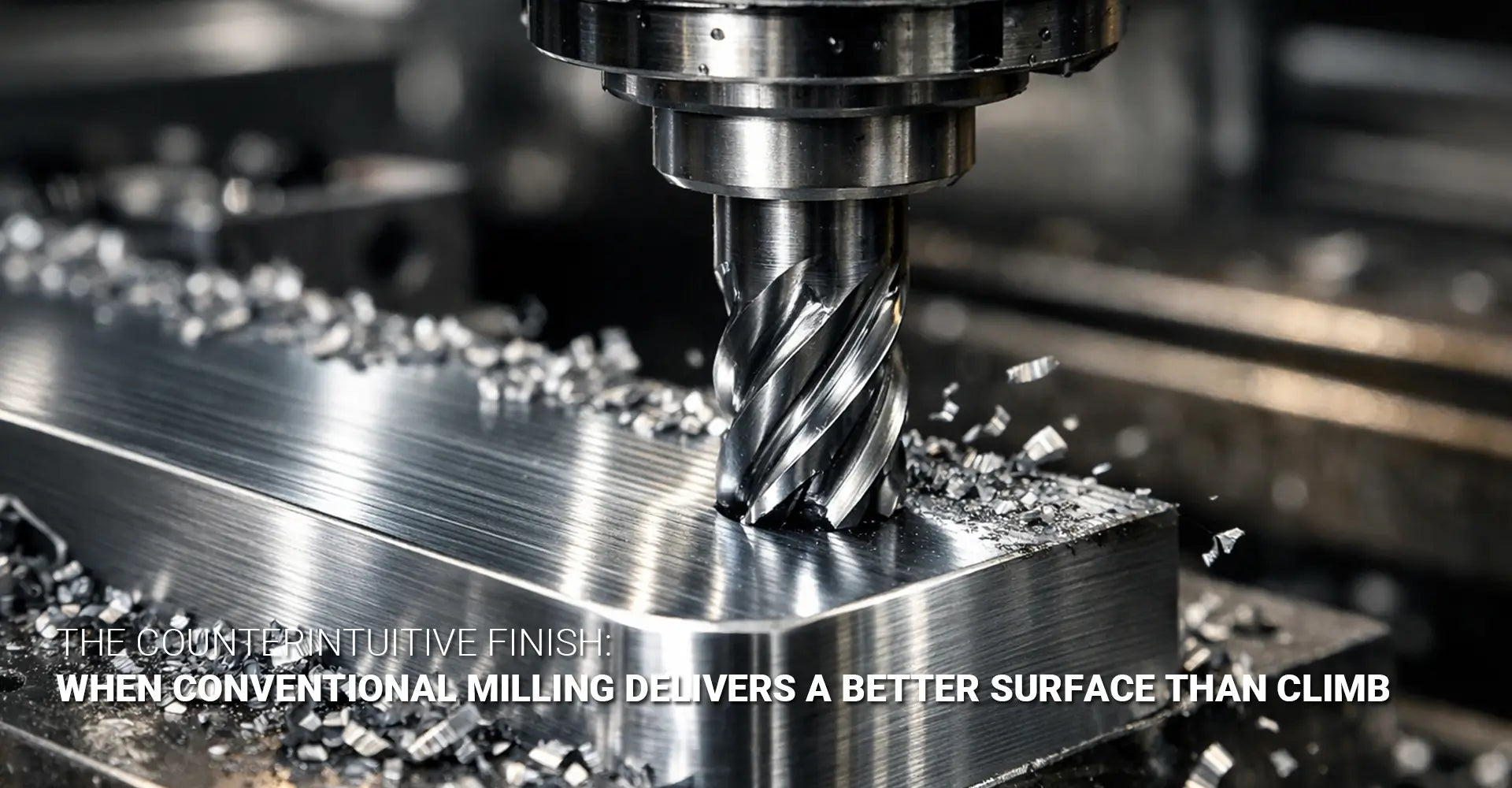
Which Milling Direction Gives You the Best Surface Finish?

Every machinist has heard the golden rule: climb milling is king. However, this common wisdom doesn't always hold true when you're chasing that perfect finish. Understanding when to break the rules can mean the difference between a mediocre surface and one that meets your tightest specifications.
Quick Answer: What You Need to Know Right Now
The Bottom Line on Milling Direction:
- Climb milling typically provides better finishes on rigid machines with tight tolerances
- Conventional milling can deliver superior results on thin walls, flexible workpieces, or machines with backlash
- The best choice depends on your specific setup, material, and part geometry
- Both methods have distinct force profiles that affect tool deflection differently
When to Use Each Method:
- Choose climb milling for: Rigid setups, hardened materials, and general production work
- Choose conventional milling for: Thin walls, machines with backlash, and delicate features
The truth is, selecting between climb vs conventional milling finish methods requires understanding your unique situation. Moreover, the right choice can dramatically improve your surface finish quality and reduce scrap rates. Therefore, let's explore the mechanics behind each approach so you can make informed decisions.
Table of Contents
- Why Do Machinists Prefer Climb Milling for Most Jobs?
- How Do Cutting Forces Differ Between the Two Methods?
- When Does Conventional Milling Produce Better Finishing Results?
- What Settings Should You Adjust for Conventional Milling Finish Passes?
- Conclusion
Why Do Machinists Prefer Climb Milling for Most Jobs?
Walk into any machine shop and you'll hear the same advice repeated over and over: use climb milling whenever possible. This recommendation has solid reasoning behind it. In fact, most production environments consider climb milling the default choice for good reason.
The Main Benefits at a Glance:
Climb milling offers several advantages that make it the go-to choice for most machining operations. First, it produces lower cutting forces compared to conventional milling. Second, chips flow away from the cutting area more cleanly. Third, tools last longer because they engage the material more favorably. Finally, you typically get better surface quality on properly maintained, rigid machines.
The widespread adoption of climb milling stems from its performance in high-volume production settings. When your custom CNC milling services need to maintain consistent quality across hundreds or thousands of parts, climb milling delivers predictable results. Additionally, this method reduces work hardening in difficult materials like stainless steel and titanium.
The mechanics explain why climb milling works so well. As the cutter tooth enters the material, it starts with maximum chip thickness and gradually reduces to zero. Consequently, the cutting edge slices cleanly through the material rather than rubbing or pushing. This action creates less heat and friction, which extends tool life significantly.
Furthermore, the chip evacuation in climb milling is naturally superior. Because chips flow behind the cutter, they don't interfere with the fresh surface you just created. In contrast, poor chip management can scratch or mar your finish. Therefore, for general-purpose machining on well-maintained equipment, climb milling remains the best milling direction for surface finish in most scenarios.
How Do Cutting Forces Differ Between the Two Methods?
Understanding the physics behind each milling method is crucial for making smart decisions. The force direction and magnitude create fundamentally different behaviors that affect your final results.
The Core Difference Explained:
In climb milling, the cutter tooth starts with maximum chip thickness and works its way down to zero. Conversely, conventional milling begins with zero chip thickness and builds up to maximum. This seemingly small difference creates completely different force profiles throughout the cut.
Let's break down what happens in each scenario. During climb milling tool engagement, the cutting forces initially push the tool away from the workpiece wall. As the tooth rotates through the cut, these forces change direction. However, because the tooth enters at maximum thickness, it immediately begins cutting rather than rubbing.
In conventional milling, the tooth first contacts the workpiece at its thinnest point. Initially, this causes some rubbing before actual cutting begins. Then, as the tooth rotates deeper into the material, the chip thickness increases. The cutting forces push the workpiece and tool apart at first, but then pull them together as the tooth exits.
These different force patterns significantly impact tool deflection in finish milling operations. On a perfectly rigid machine with no backlash, climb milling's force profile generally produces less deflection. Nevertheless, real-world machines aren't perfectly rigid. Machine beds flex slightly, spindles have some runout, and ball screws contain backlash.
When you factor in these real-world imperfections, conventional milling's initial "pushing away" force can actually become an advantage. The force takes up any backlash in your machine's drive system at the start of the cut. Consequently, the subsequent pulling forces work against a pre-loaded system, resulting in more consistent positioning throughout the cut.
Additionally, chatter reduction with milling direction becomes a critical consideration. Climb milling can sometimes excite resonant frequencies in the machine-tool-workpiece system. Meanwhile, conventional milling's gradually increasing chip load can dampen these vibrations in certain setups, particularly when machining thin or flexible parts.
When Does Conventional Milling Produce Better Finishing Results?
The assumption that climb milling always produces superior finishes needs serious questioning. In several common scenarios, conventional milling actually delivers better results for your final pass.
Key Scenarios Where Conventional Wins:
Thin-walled parts represent the most common situation where conventional milling excels. Similarly, machines with measurable backlash benefit from conventional milling's force profile. Tall, unsupported features also respond better to conventional milling. Finally, certain materials prone to work hardening show improved finishes with conventional approaches.

Consider what happens when you're finishing the side wall of a pocket in industrial machinery components. If the remaining wall is thin or the pocket is deep, the wall has limited rigidity. During climb milling, the cutting forces pull the tool into the wall. This pulling action causes the thin wall to flex toward the cutter, resulting in chatter marks and an inconsistent surface.
In contrast, conventional milling initially pushes the tool and workpiece apart. As the tooth rotates through the cut, the forces pull them back together. This "push-pull" action actually helps stabilize flexible parts. The workpiece deflects away during initial engagement, then returns to its neutral position as the tooth exits. Therefore, you end up with a more consistent finish on delicate features.
The conventional milling advantages become even more apparent when dealing with machine backlash. Older machines or those with worn ball screws contain some amount of free play in the drive system. When you use climb milling on such machines, the cutting forces can pull the table in the direction of feed. This pulling action takes up backlash unpredictably, causing dimensional inconsistencies and poor surface quality.
However, conventional milling's initial cutting forces push against the direction of feed. This action immediately loads the ball screw against its nut, taking up any backlash at the start of the cut. Subsequently, the cut proceeds with the drive system under constant load, producing more predictable and consistent results.
For automotive applications requiring precise tolerances on components like transmission housings or engine blocks, understanding these mechanics becomes critical. The choice between methods can determine whether parts meet specification or become scrap.
Moreover, materials that work-harden easily present another scenario favoring conventional milling. The gradual chip thickness increase in conventional milling can reduce the tendency for work hardening compared to climb milling's immediate maximum engagement. This characteristic proves particularly valuable when machining austenitic stainless steels or certain nickel alloys.
What Settings Should You Adjust for Conventional Milling Finish Passes?
Switching to conventional milling for your finish pass isn't simply reversing your toolpath direction. Instead, you need to optimize several parameters to achieve the best results with this method.
Critical Adjustments for Success:
Tool sharpness becomes absolutely essential when using conventional milling for finishing. Additionally, you should reduce your stepover to just 3-5% of the tool diameter. Furthermore, maintaining adequate feed rates prevents rubbing. Finally, ensuring a positive depth of cut guarantees clean shearing action rather than burnishing.
Let's start with tool condition. Conventional milling's initial engagement at zero chip thickness means the tool must be extremely sharp. A dull tool will simply rub and burnish the surface rather than cutting cleanly. Therefore, use a fresh tool or one with minimal wear when attempting conventional milling finish passes. Coated tools with sharp cutting edges work particularly well for this application.
The stepover percentage requires careful attention in peripheral milling techniques. While climb milling can handle stepovers of 10-40% of the tool diameter, conventional finishing works best with much lighter cuts. Aim for 3-5% of your tool diameter as a starting point. For example, with a 12mm end mill, use a stepover of just 0.36-0.6mm for the finish pass.
This light stepover minimizes the initial impact and rubbing at the point of engagement. Consequently, the tool enters more gradually and cuts more cleanly. However, don't reduce the stepover so much that you're barely touching the material. An excessively light cut can cause rubbing rather than cutting, defeating your purpose.
Feed rate management presents another critical factor. Many machinists mistakenly slow down their feed rate when switching to conventional milling. In reality, maintaining a purposeful feed rate helps the tool bite cleanly into the material. If you feed too slowly, the tool spends more time rubbing at the engagement point, generating excessive heat and potentially degrading your finish.
As a guideline for CNC finishing strategies, use 70-90% of the feed rate you would use for climb milling with the same tool. For instance, if your climb milling feed rate is 1000mm/min, try 700-900mm/min for conventional milling. Monitor the cut carefully and adjust based on the sound and chip formation you observe.
Depth of cut also plays a crucial role. Never attempt a conventional milling finish pass with zero or minimal axial depth. The tool must actually cut the material, not just rub against it. Even for a finish pass, maintain at least 0.1mm depth of cut. This positive engagement ensures the cutting edge shears material cleanly rather than burnishing it.
In electronics manufacturing where precision components require exceptional surface quality, these parameter adjustments can make the difference between acceptable and exceptional results. Take time to document your successful settings for different materials and part geometries.
Finally, consider tool selection carefully. Finishing end mills with high helix angles (40-45°) work well for conventional milling because they create a more gradual engagement. Similarly, tools with variable pitch designs can help reduce chatter tendency. The investment in quality tooling pays dividends in surface finish quality and consistency.
Conclusion
The choice between climb and conventional milling for finishing operations isn't about following rigid rules. Rather, it's about understanding how cutting forces, machine condition, and part geometry interact to affect your results. Climb milling deserves its reputation as the go-to method for most applications, especially on rigid, well-maintained machines.
However, don't dismiss conventional milling for finish passes. When you're dealing with thin walls, flexible workpieces, or machines with backlash, conventional milling can deliver superior surface quality and dimensional accuracy. The key lies in recognizing when each method provides the best solution for your specific situation.
Start by evaluating your machine's condition, particularly its backlash and overall rigidity. Then consider your workpiece geometry and material properties. With this information, you can make an informed decision about which milling direction to use. Furthermore, don't hesitate to test both approaches on scrap material before committing to production.
Remember that modern CAM software makes it easy to program different milling directions for different operations. You might rough and semi-finish with climb milling to benefit from its efficiency and tool life, then switch to conventional milling for the final pass on critical surfaces. This hybrid approach often delivers the best overall results.
Ultimately, successful finishing requires understanding the tools, techniques, and principles at your disposal. By mastering both climb and conventional milling, you'll have the flexibility to achieve excellent surface finishes regardless of the challenges your parts present.
Recommended Resources
[climb vs conventional milling finish][^1]
[CNC Milling Surface Roughness][^2]
[CNC finishing strategies][^3]
[Milling Techniques for Precision][^4]
[Chatter reduction with milling direction][^5]
[Effect of Milling Direction on Tool Deflection][^6]
---
[^1]: Exploring the differences between climb and conventional milling can enhance your machining techniques and improve surface quality.
[^2]: Understanding CNC Milling Surface Roughness is crucial for achieving desired finishes in machining processes.
[^3]: Explore this link to discover effective CNC finishing strategies that enhance precision and surface quality in machining.
[^4]: This resource will provide insights into advanced milling techniques that ensure high precision in manufacturing processes.
[^5]: Understanding chatter reduction techniques can significantly improve machining efficiency and product quality.
[^6]: Exploring this topic can help optimize machining strategies and enhance tool performance.