Are You Paying to Machine Away Material You Don't Need?
Are You Paying to Machine Away Material You Don't Need?
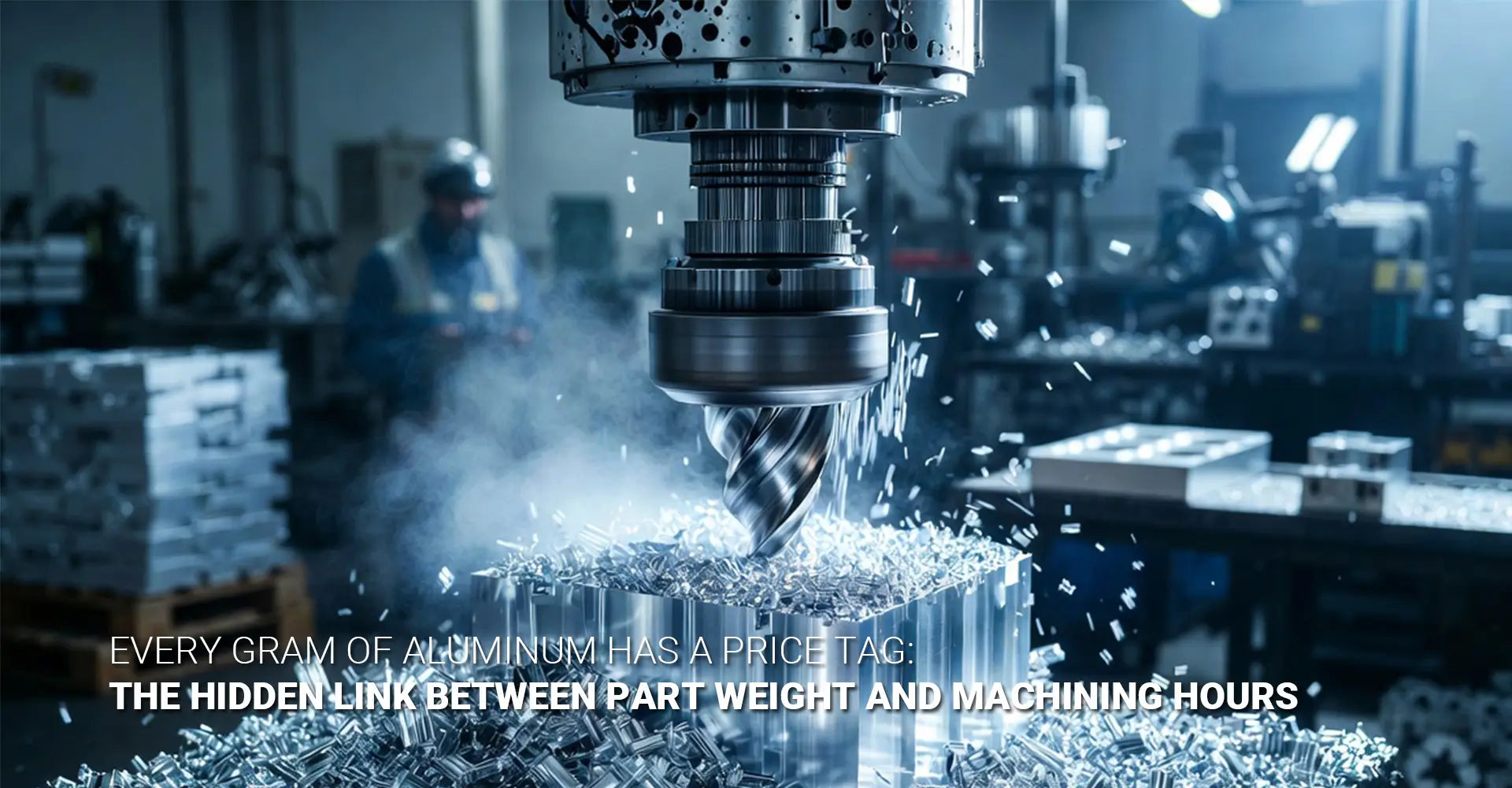
Every procurement manager faces the same challenge when sourcing custom aluminum parts: balancing quality, speed, and cost. However, most focus on the wrong metric. They compare aluminum machining cost per gram and negotiate material prices, while the real expense sits hidden in plain sight—the machine time spent cutting away excess metal you never needed in the first place.

Quick Answer: Where Your Money Really Goes
Aluminum costs pennies per gram. Machining time costs dollars per minute.
When you receive a quote for a 500g part machined from a 2,000g block, you're essentially paying a premium to remove 1,500g of chips. At typical shop rates of $60-$120 per hour, that chip removal time—not the raw material—drives 85-90% of your total cost. Understanding this fundamental truth is the first step toward smarter procurement decisions in custom aluminum prototyping.
Most engineers and buyers don't realize that design for manufacturing aluminum principles can reduce quotes by 20-40% without changing a single functional requirement. Therefore, this guide reveals exactly how excess material translates to excess cost, and more importantly, what you can do about it before submitting your next RFQ.
Table of Contents
- Why Does Starting with a Heavier Block Cost You More Money?
- What Are the Warning Signs of an Expensive Design?
- How Can You Remove Material Without Losing Strength?
- What Does a $20 Savings Actually Look Like in Practice?
Why Does Starting with a Heavier Block Cost You More Money?
Walk into any CNC shop and you'll hear the same complaint: clients obsess over material costs while ignoring the elephant in the room. The reality is that aluminum stock is remarkably affordable. Consequently, many designers treat it as if weight doesn't matter, adding thick walls and solid features "just to be safe."
The Real Cost Driver: Machine Time, Not Material
Here's the math that changes everything: A typical CNC machining service charges $60-$120 per hour for machine time. At the midpoint of $90/hour, every minute of cutting adds $1.50 to your part cost. Meanwhile, 6061 aluminum bar stock costs roughly $0.15-$0.30 per cubic inch.
Consider this scenario:
- Material cost for 1,500g of chips: ~$2.50
- Machining cost to remove those chips at 45 minutes: ~$67.50
The material represents less than 4% of the cost. Nevertheless, buyers continue negotiating pennies on material while leaving dollars on the table in machining time.
Understanding Material Removal Rate and Your Bill
The concept of material removal rate CNC shops use is straightforward: it measures how many cubic inches (or cubic centimeters) of metal the machine can cut per minute. For aluminum, typical MRR ranges from 2-8 cubic inches per minute, depending on:
- Tool diameter and geometry
- Spindle power and rigidity
- Coolant delivery
- Material grade (6061 cuts faster than 7075)
However, here's the critical insight: cost per cubic centimeter machining remains constant regardless of whether that material becomes part of your finished component or ends up as chips in the recycle bin. When your stock material vs finished part ratio hits 3:1 or 4:1, you're paying premium prices for waste removal.
Additionally, the "chip ratio" reveals design inefficiency instantly. If you start with a 2kg block and finish with a 500g part, you've created 1.5kg of expensive chips. Industry veterans at machining forums like r/Machinists consistently flag this as the number one avoidable cost driver.
What Are the Warning Signs of an Expensive Design?
As a procurement professional, you don't need an engineering degree to spot costly design decisions. Instead, you need to recognize specific red flags that signal excessive chip removal cost before the PO goes out.
Three Critical Red Flags in Your Drawings
Deep pockets with narrow slots force machinists to use long, small-diameter tools that cut slowly and break easily. A 0.25" endmill removing material from a 3" deep pocket might achieve only 20% of the normal material removal rate.
Uniform wall thickness everywhere indicates the designer didn't consider where strength is actually needed. A part with 10mm walls throughout likely needs that thickness in only 30-40% of its geometry.
Sharp internal corners require tiny tools or secondary EDM operations. A 1mm internal radius demands a 2mm diameter tool, while a 3mm radius allows an 6mm tool that cuts four times faster.
Reading a DFM Report Like a Pro
When you receive DFM for aluminum prototypes feedback from your supplier, look for these specific callouts:
Feature complexity analysis should identify any geometry requiring tools smaller than 3mm diameter. These features disproportionately increase cycle time. Furthermore, the report should quantify the impact: "Changing this corner radius from 1mm to 3mm saves 8 minutes of machining—approximately $12 per part."
Stock-to-part ratio appears in quality DFM reports. Ask your industrial machinery parts supplier directly: "What's the weight ratio between starting stock and finished part?" Ratios above 3:1 deserve scrutiny.
Machine hour breakdown reveals where time goes. A transparent supplier provides estimates like: "Roughing operations: 35 minutes. Finishing passes: 18 minutes. Setup and tool changes: 12 minutes." This visibility helps you understand which design changes would reduce CNC machining time most effectively.
Moreover, if your current supplier doesn't provide this level of DFM feedback as standard practice, that's a red flag about the partnership itself. Leading prototyping shops include cycle time reduction aluminum analysis in their quoting process because it benefits both parties.
How Can You Remove Material Without Losing Strength?
The most common objection to lightweighting is understandable: won't removing material compromise the part's integrity? Actually, the opposite is often true—thoughtful material reduction can improve performance while cutting costs.
Three Proven Lightweighting Strategies
Pocketing removes material from non-critical flat areas where stress levels remain low. For instance, a large mounting plate might need full thickness only around bolt holes and edges. Therefore, pocketing the center section to 30-40% of the original thickness eliminates unnecessary mass.
Ribbing adds stiffness with minimal weight by creating I-beam-like cross-sections. A flat wall deflects easily under load. However, adding perpendicular ribs increases bending resistance dramatically—often achieving 80% of solid wall stiffness at 15% of the weight.
Tapered walls match thickness to actual stress distribution rather than using uniform dimensions. Parts rarely experience uniform loading. Consequently, variable wall thickness optimizes the lightweighting cost trade-off by placing material only where physics demands it.
Applying DFM Principles Without Engineering Expertise
You don't need finite element analysis software to start. Instead, ask these questions during design review:
"Which surfaces never touch anything or carry any load?" Those areas are prime candidates for pocketing.
"Where does this part mount or interface with other components?" Keep full material at those locations.
"What direction do forces act?" Material perpendicular to load paths contributes little to strength.
For automotive applications, manufacturers routinely use these principles to remove 40-60% of material from brackets, housings, and structural components. The parts meet all performance requirements while cutting both weight and cost.
Additionally, many sheet metal fabrication techniques offer alternatives worth considering. A formed sheet metal part sometimes achieves better strength-to-weight ratios than a heavily pocketed machined component—at a fraction of the cost.
Remember: optimization isn't about making parts weaker. It's about eliminating excess safety factor that provides zero functional benefit while adding substantial cost. A part designed to withstand 10,000 lbs when it will only see 2,000 lbs in service is simply over-engineered.
What Does a $20 Savings Actually Look Like in Practice?
Theory only matters when it translates to real dollars saved. Therefore, let's examine an actual case study from a recent prototype run to see how these principles work in practice.
The Numbers: Before and After DFM
Original Design Specifications:
- Solid block construction with minimal pocketing
- Uniform 8mm wall thickness throughout
- 1mm internal corner radii
- Starting stock: 2.1 kg aluminum block
- Finished part weight: 680g
- Machining time: 2.0 hours
- Cost at $60/hour shop rate: $120 per part
Optimized Design Changes:
- Strategic pocketing reduced non-structural areas to 4mm thickness
- Ribbing replaced solid bosses in three locations
- Internal corner radii increased to 3mm where function allowed
- Variable wall thickness (4-8mm based on load paths)
- Starting stock: 1.1 kg (near-net stock size)
- Finished part weight: 580g (15% lighter)
- Machining time: 1.2 hours
- Cost at $60/hour shop rate: $72 per part
Result: $48 savings per part—a 40% cost reduction
Breaking Down What Changed
The engineering team made four specific modifications that drove the savings:
First, they converted solid bosses to ribbed structures in mounting areas. This change alone removed 180g of material that would have become chips, saving approximately 15 minutes of machining time.
Second, pockets were added to both sides of the main body. The top surface was reduced from 8mm to 4mm thickness except at fastener locations. The bottom surface received similar treatment. These operations eliminated roughly 220g of stock material.
Third, internal corner radii increased from 1mm to 3mm in eight locations where assembly clearances permitted. This allowed the machinist to use 6mm endmills instead of 2mm tools, doubling the material removal rate in those features.
Fourth, wall thickness varied from 4mm to 8mm based on a quick FEA analysis showing actual stress distribution. Areas experiencing less than 20% of peak stress were thinned to minimum practical thickness.
Importantly, these changes required zero additional engineering cost since they were implemented during the initial design phase. The optimization added approximately three hours to the CAD work but eliminated 40 minutes of machining time per part.
Scaling the Impact
For a 50-piece prototype run, the total savings reached $2,400 ($48 × 50 units). That figure represents real budget that could be redirected to additional testing, upgraded materials, or simply returned to the project's bottom line.
Moreover, these same principles scale to production. If this part moved to low-volume production at 500 units annually, the yearly savings would hit $24,000. Over a typical 3-5 year product lifecycle, we're discussing six-figure cost avoidance from a few hours of thoughtful design review.
Industry data consistently shows that cycle time reduction aluminum optimization delivers 20-40% savings on typical parts. Poorly conceived designs with excessive stock-to-part ratios can see 50%+ reductions when properly optimized.
The key insight: these savings compound across every unit you produce. A $20 per-part reduction seems modest until you multiply it across hundreds or thousands of units. Furthermore, the optimization cost is essentially zero when integrated into normal design workflow rather than treated as an expensive afterthought.
Conclusion
Success in custom aluminum prototyping procurement comes from a fundamental mindset shift: you're not buying aluminum—you're buying intelligent material removal. The actual metal in your finished part represents a trivial portion of the total cost. Therefore, focusing negotiations on material pricing while ignoring design efficiency leaves the majority of potential savings unrealized.
The evidence is clear. When you partner with suppliers who provide comprehensive DFM analysis rather than simply accepting whatever geometry you submit, costs drop by 20-40% on average. The cheapest quote isn't always the best value if it comes from a shop that rubber-stamps expensive designs without feedback.
Before sending your next design to quote, ask yourself: "Where can I remove material without compromising function?" That single question, applied consistently, can save thousands of dollars per project. Every gram of aluminum you don't need to machine away is money that stays in your budget for other priorities.
Ultimately, procurement excellence in this space requires choosing partners who understand that their job isn't just running machines—it's helping you avoid paying for unnecessary material removal in the first place. The $20 per-part savings discussed throughout this guide isn't theoretical. It's the real, measurable result of applying basic DFM principles before chips start flying.
Your next prototype quote represents an opportunity. The question is whether you'll pay for design intelligence or simply pay for machine time to remove material you never needed.
Recommended Resources
[Custom aluminum prototyping][^1]
[aluminum machining cost per gram][^2]
[material removal rate CNC][^3]
[design for manufacturing aluminum][^4]
[reduce CNC machining time][^5]
[lightweighting cost trade-off][^6]
[^3]: CNCCookbook's complete guide to Material Removal Rate (MRR), including the formulas for milling, turning, and grinding, optimization strategies, and how MRR directly impacts cycle times and shop profitability. This resource explains the MRR triangle: Radial Depth of Cut × Axial Depth of Cut × Feed Rate.
[^5]: An in-depth technical guide on G-code optimization techniques for CNC machining, explaining how dynamic feed adjustments, chip load analysis, and balancing tool pressure can reduce cycle times by 20–70%, directly improving throughput and lowering cost per part. The resource also details common inefficiencies hidden in NC programs, such as poor lead‑ins/exit motions and unnecessary rapid moves, and outlines six key optimization strategies applicable to aerospace, automotive, and medical manufacturing.[reference:0]
[^6]: A guest editorial that quantifies the cost‑saving potential of lightweighting with high‑strength steel, including a step‑by‑step calculation showing how doubling material strength from Grade 50 to Grade 100 reduces part weight by 29% and lowers part cost by 16.4%, with additional freight savings. The article addresses perceived barriers (higher material cost, supply chain concerns) and demonstrates that the increased per‑unit price of advanced steel is offset by using thinner sections, yielding a better bottom line.[reference:1]