Rapid Tooling Services Cost Too High? Here's How MUD Insert Tooling Saves You 40%
Rapid Tooling Services Cost Too High? Here's How MUD Insert Tooling Saves You 40%
Tooling bills are climbing. You need a new plastic enclosure. Your mold builder sends a quote — and it's $15,000. Again. Sound familiar? Many buyers pay full custom mold prices every single time, even when they don't need to. The truth is, a smarter approach exists. It's called the MUD (Master Unit Die) insert system — and it could cut your rapid tooling services cost by up to 40%.

Quick Answer — What Is MUD Insert Tooling and How Much Does It Save?
A MUD system splits your mold into two parts: a reusable steel frame (bought once) and swappable core/cavity inserts (bought per part). Instead of paying $12,000–$20,000 for a full custom mold every time, you pay only $6,000–$10,000 for the inserts. That's a typical saving of $5,000–$10,000 per tool — or roughly 30–50% off your tooling bill.
So why aren't more buyers using this method? Most simply don't know to ask for it. This article walks you through exactly how MUD insert tooling works, when to use it, and how to spec it with your mold builder — so you stop overpaying.
Table of Contents
- The $10,000 Mistake — Are You Paying for Steel You Don't Actually Need?
- What Is a MUD (Master Unit Die) System and How Does It Work?
- The 40% Savings Math — Where Does the Money Actually Go?
- When Is MUD Insert Tooling Your Best Bet?
- Conclusion
The $10,000 Mistake — Are You Paying for Steel You Don't Actually Need?
Most buyers assume every new part needs a brand-new mold — frame and all. That assumption is costing them thousands. Conventional injection molding cost reduction strategies often focus on cycle time or material cost. But the real money is lost upfront, at the tooling stage, before a single part is made.
Key Takeaway: What Buyers Typically Overpay For
- The heavy outer mold base (guide pins, ejector plates, sprue bushings)
- Custom machining of the frame for every new part
- Long lead times caused by building the entire mold from scratch each time
- Storage and maintenance of multiple large, fully custom mold bases
Here's the thing: the outer frame doesn't touch your plastic. It's purely structural. Yet most buyers pay full price to machine a new one every time they need a new part shape.
A conventional full mold has two distinct cost components. First, there's the mold base — the outer steel frame that houses everything. It includes guide pins, bushings, the ejector system, and the sprue bushing. This is a precision-engineered, heavy steel structure. Second, there are the core and cavity inserts — the shaped steel surfaces that actually form your part geometry. The inserts sit inside the frame and are what your plastic actually contacts during injection.
When you order a full custom mold, you pay for both — every single time. But here's the insight smart buyers use: if the frame doesn't change, why are you buying a new one? You shouldn't be. And with a MUD system, you don't have to.
What Is a MUD (Master Unit Die) System and How Does It Work?
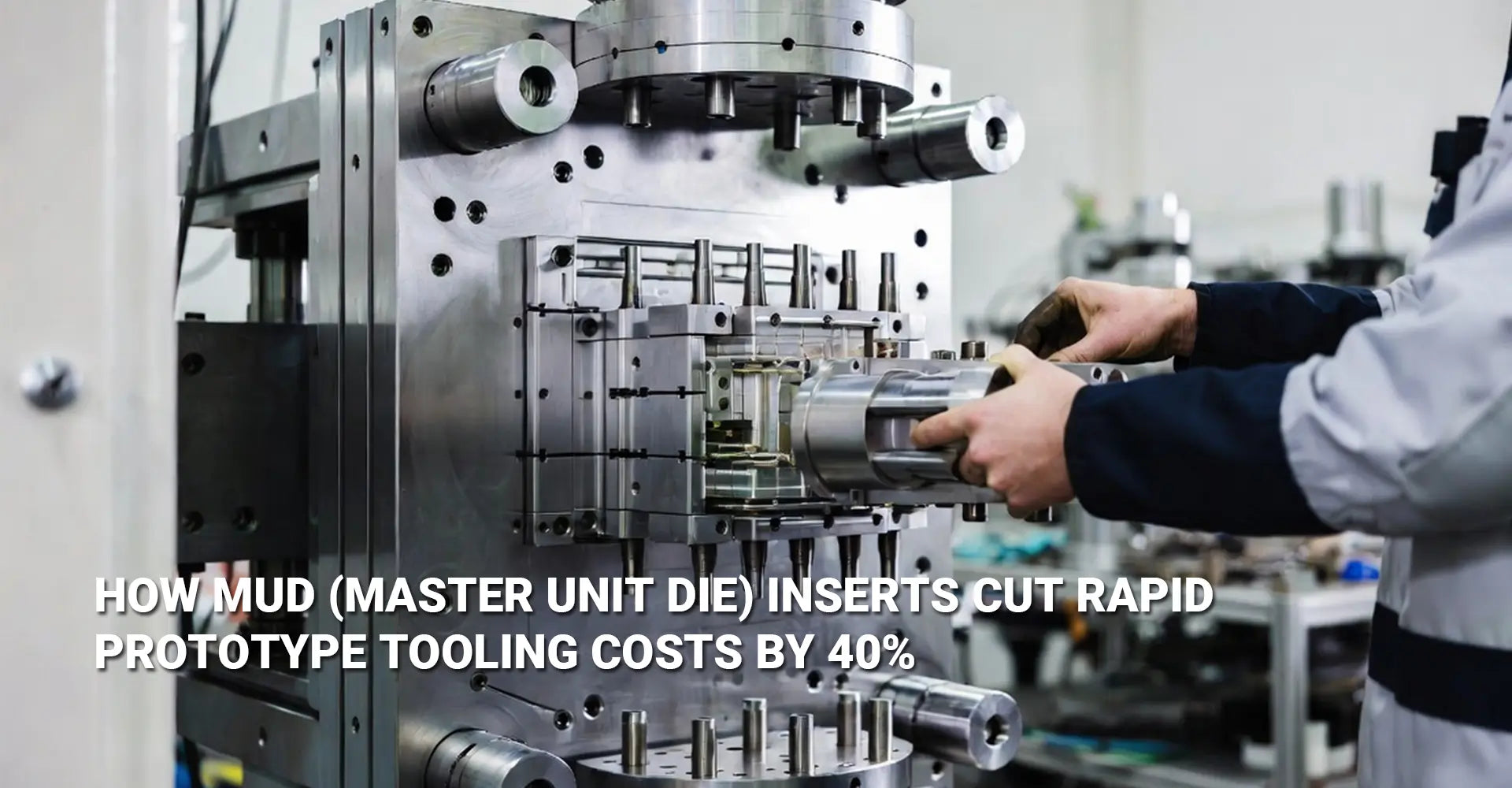
The MUD mold base concept is simple. You buy the frame once. Then, for every new part, you only buy the inserts. The frame stays on your molder's machine. The inserts swap in and out in minutes. It's the printer-and-ink-cartridge model applied to injection molding.
How a MUD System Works — Step by Step:
- Your molder owns (or purchases) a standard MUD frame from a supplier like DME or Hasco
- For your part, they machine only the core and cavity inserts to your geometry
- The inserts drop into the standard frame on the injection molding machine
- Parts are produced exactly as they would be with a full custom mold
- When you need a new part variation, only a new insert set is machined — the frame stays
Let's go deeper. Standard MUD frames are available from major tooling suppliers — DME and Hasco are the two most common. These frames come in standardized sizes, typically accommodating parts up to 150mm × 200mm (roughly 6" × 8"). This covers the vast majority of small-to-medium plastic enclosures, brackets, covers, and housings.
The inserts themselves can be machined from two materials, depending on your volume needs. Aluminum insert tooling is the go-to choice for prototype and low-volume production — it's faster to machine, less expensive, and delivers first parts in as little as 2–3 weeks. For higher volumes or abrasive materials (like glass-filled nylon), tool steel inserts (P20 or H13) are used instead. Either way, the insert fits into the same standard frame — and the part quality is identical to what a full custom mold would produce.
This approach is also called a quick change mold system in many manufacturing environments — because swapping inserts for a new part variation takes minutes, not weeks.
The 40% Savings Math — Where Does the Money Actually Go?
Numbers don't lie. Let's look at exactly where the savings come from when you switch from a full custom mold to a replaceable insert mold approach.
Cost Comparison Table
Tooling Type Typical Cost Range Full Custom Mold (Frame + Core/Cavity) $12,000 – $20,000+ MUD Insert Only (Core/Cavity) $6,000 – $10,000 Savings Per Tool $5,000 – $10,000 (30–50%)
The savings are clear on a single tool. But the real power of prototype tooling savings shows up when you're building multiple part variations. Imagine you're producing a plastic enclosure that comes in three sizes. With full custom molds, you're looking at $36,000–$60,000 in tooling. With MUD inserts sharing one standard frame, that drops to $18,000–$30,000 — saving $18,000–$30,000 across just three parts.
Beyond the money, consider the time saved. A full custom mold typically requires 6–8 weeks to build — frame machining, insert machining, fitting, and trial. A MUD insert, with the frame already available, can be built and trialed in 2–3 weeks. That's weeks of faster time-to-market. For rapid prototyping projects and bridge production scenarios, that speed advantage is often just as valuable as the cost savings.
The savings compound further when you factor in storage. A standard MUD frame takes up a fraction of the floor space of multiple full custom mold bases. For operations running many SKUs — like industrial machinery component suppliers or automotive parts manufacturers — this adds up to real operational savings over time.
When Is MUD Insert Tooling Your Best Bet?
MUD insert tooling isn't the right answer for every situation. But for a well-defined set of use cases, it's the single smartest tooling decision you can make. Here's how to know if it applies to your project.
MUD Insert Tooling Ideal Use Case Checklist:
- ✅ Low-volume production — typically 500 to 10,000 parts per run
- ✅ Prototype-to-bridge tooling — getting production-quality parts before committing to a high-volume mold
- ✅ Family molds — multiple similar parts sharing the same frame
- ✅ Small-to-medium part size — fits within a 150mm × 200mm envelope
- ✅ Multiple part variations — different hole patterns, boss heights, or cutout locations
Let's talk about each scenario in more detail.
Low volume injection molding tooling is where MUD shines brightest. If you're making 500–10,000 parts, you almost certainly don't need the durability of a fully custom, hardened steel mold base. A MUD frame with steel inserts handles production runs up to approximately 100,000 cycles — far more than most low-volume programs require.
Prototype-to-bridge production is another prime use case. Many product teams use CNC machining or 3D printing for early prototypes, then need injection-molded parts for functional testing or limited launch quantities before committing to a high-volume tool. A MUD insert gives you production-representative parts at prototype-level tooling cost.
The family mold base application is particularly powerful. Say you have five enclosure variants — same basic footprint, different internal features. One MUD frame. Five insert sets. You swap inserts in minutes between runs. Compare that to five separate full custom molds, and the decision is obvious.
Now, the trade-offs. Size is the primary limitation. Most standard MUD frames max out at around 150mm × 200mm. Larger parts require custom frames — and at that point, a full custom mold may make more sense anyway. Volume is the other factor. For very high-volume production — 500,000 parts or more — a fully custom mold with optimized cooling channels and a heavy-duty frame may deliver better long-term cost per part. But for the overwhelming majority of industrial and commercial plastic parts, MUD hits the sweet spot.
How to specify MUD tooling with your mold builder:
- Ask: "Can this part be run in a standard MUD base?"
- Specify: "Inserts only — use your existing MUD frame"
- Confirm the frame standard: DME or Hasco (so inserts are compatible)
- Ask whether aluminum or steel inserts are appropriate for your volume and material
Conclusion
Here's the single most important thing to take away from this article: you don't need to buy a new mold base for every new part. The outer frame doesn't touch your plastic. You're paying for it anyway — and you don't have to.
The standard mold base in a MUD system is a one-time investment. Every insert you buy after that is 40% cheaper than the equivalent full custom mold. Lead times drop from 6–8 weeks to 2–3 weeks. Part quality stays the same. And when you need a new variation, you swap inserts — not molds.
Your action items:
- Ask your molder: "Can this part run in a standard MUD base with insert-only tooling?"
- For parts under 150mm × 200mm, the answer is almost always yes
- Request separate quotes: full custom mold vs. MUD insert only — then compare
- For prototype and bridge programs, always explore aluminum insert tooling first
"Stop paying for a full mold base you already own. Ask for insert-only tooling — and keep the difference."
Whether you're in industrial machinery, automotive components, or any sector relying on injection-molded plastic parts, MUD insert tooling is the procurement team's most underused cost lever. Use it.
External Links & Further Reading
[Rapid tooling services cost][^1]
[MUD mold base][^2]
[insert tooling][^3]
[Injection molding cost reduction][^5]
[^1]: A detailed guide explaining the cost structure of rapid tooling, comparing it with 3D printing and traditional molds. It highlights how soft tooling (aluminum/P20 steel) and shared mold bases (MUD systems) can reduce upfront tooling costs by **30% to 50%** or more, and includes a break-even analysis to help determine the best approach for low-volume production[reference:0].
[^2]: An overview of the DME MUD (Master Unit Die) Quick-Change system, a standardized mold base designed for rapid changeovers. The page outlines its key benefits, including lower tooling build costs (paying only for A&B inserts), reduced processing costs with changeovers under five minutes, improved speed to market, and enhanced supply chain flexibility[reference:1].
[^3]: A comprehensive guide to MUD (Master Unit Die) insert systems, explaining how interchangeable inserts fit into a reusable master frame to reduce tooling costs by **50–70%** compared to dedicated full molds. Includes detailed cost breakdowns ($2,000–$15,000 per insert vs. $15,000–$100,000+ for full molds), lead time comparisons (1–3 weeks vs. 4–8 weeks), insert material options (aluminum for <50k shots, steel for up to 500k+ shots), and frame series specifications (08/09, 84/90, 10/12, 11/14)[reference:0][reference:1].
[^4]: An industry blog post clearly distinguishing family injection molds (multiple cavities producing different parts in a single cycle) from multi-cavity molds. It highlights that family molds reduce tooling costs by consolidating multiple parts into one mold base but notes higher defect rates due to filling imbalances, increased manual labor for part separation, and why some shops avoid building them[reference:2].
[^5]: This article from igus outlines three design-led strategies for reducing injection molding costs: simplifying part geometry to avoid expensive undercuts, avoiding complex thick-walled areas that increase cycle time, and selecting the right material to balance performance with price[reference:2][reference:3][reference:4].