Can You Really Get Custom Fixtures Delivered in 48 Hours When Your Production Line Stops?
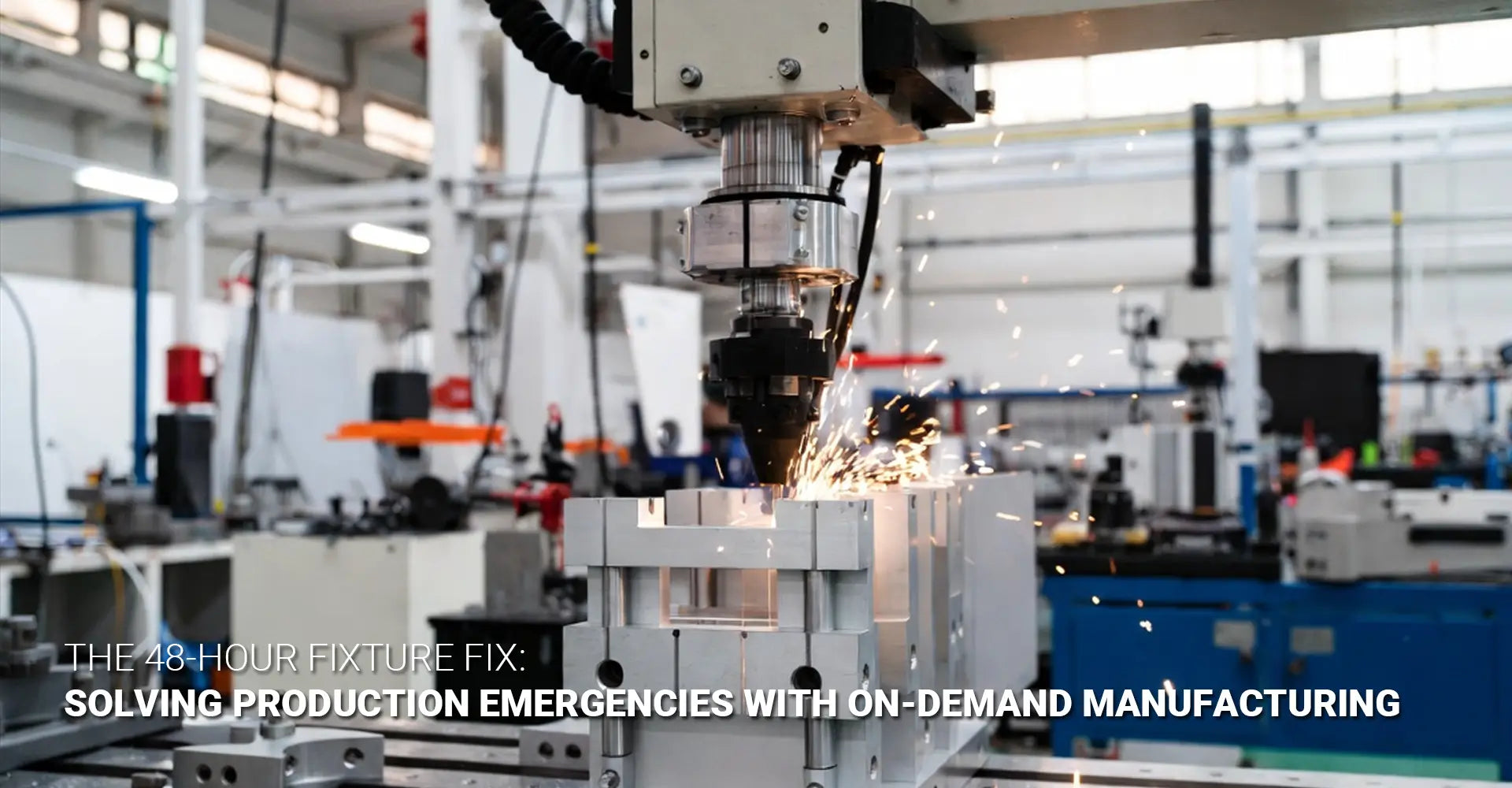
Can You Really Get Custom Fixtures Delivered in 48 Hours When Your Production Line Stops?

Picture this: It's Monday morning, and your assembly line just ground to a halt. A critical fixture cracked under pressure, and your entire production schedule is now in jeopardy. Traditional tooling suppliers quote you 3-4 weeks for a replacement. Meanwhile, every hour of downtime is costing you thousands of dollars in lost production, idle labor, and potentially missed customer deliveries. What if there was a better way? What if you could get that custom fixture delivered to your factory floor in just 48 hours?
Quick Answer: What You Need to Know Right Now
Key Takeaways:
- Rapid tooling on demand services can deliver custom jigs and fixtures in 48 hours, compared to traditional 3-4 week lead times
- Digital platforms provide instant quotes versus the typical 3-5 day waiting period for traditional shops
- Cost premium ranges from 20-40% higher, but this saves thousands in production downtime costs
- The process works through automated workflows and distributed manufacturing networks across the country
- Quality assurance is maintained through digital inspection reports, material certifications, and ISO 9001 standards
- Same technology works for single emergency parts or small batches of 5-50 identical components
Why This Matters to Your Bottom Line
The manufacturing landscape has changed dramatically in recent years. Thanks to advances in digital manufacturing for automation, what once seemed impossible is now becoming standard practice. Companies are no longer held hostage by long lead times when equipment fails. Instead, they're turning to on-demand solutions that combine speed, quality, and cost-effectiveness. Let's explore how this works and when you should use it.
Table of Contents
- What Actually Happens When Your Production Line Goes Down Without Backup Tooling?
- How Does the 48-Hour Timeline Actually Work From Upload to Delivery?
- What Do You Need to Provide to Get an Online CNC Machining Quote Instantly?
- When Should You Use Emergency Fixture Fabrication vs. Traditional Tooling Suppliers?
- Conclusion
What Actually Happens When Your Production Line Goes Down Without Backup Tooling?
The True Cost of Standing Still
When a fixture breaks on your production floor, the clock starts ticking immediately. However, many plant managers underestimate just how quickly costs accumulate during unplanned downtime. Beyond the obvious lost production output, there's a cascading effect that impacts every area of your operation.
The Numbers Don't Lie
According to industry research, the average manufacturing facility experiences downtime costs between $260,000 to $520,000 per hour depending on the industry sector. For automotive manufacturers, these numbers can climb even higher due to just-in-time delivery commitments and complex supply chain dependencies. Traditional tooling lead times of 2-4 weeks mean potential losses ranging from $45 million to $90 million for a single broken fixture.

The Ripple Effect Across Your Organization
The impact of production line downtime extends far beyond the immediate manufacturing floor. First, your skilled labor force sits idle, yet you're still paying their wages and benefits. Moreover, supervisors scramble to reassign workers to other areas, disrupting workflows across multiple departments. Additionally, your planning team must reschedule orders, potentially pushing back deliveries to multiple customers.
Furthermore, your sales team faces difficult conversations with clients about delayed shipments. Consequently, some customers may impose penalty fees for late deliveries, directly hitting your profit margins. In severe cases, prolonged delays can damage long-term customer relationships, resulting in lost future business that's difficult to quantify but devastating to growth.
Your procurement team also feels the pressure as they rush-order materials that were scheduled for the now-halted production run. Similarly, your quality assurance processes get compressed when production finally resumes, increasing the risk of defects. Therefore, what started as a single broken fixture becomes a company-wide crisis affecting nearly every department.
How Does the 48-Hour Timeline Actually Work From Upload to Delivery?
Breaking Down the Impossible
At first glance, delivering custom jigs and fixtures 48 hour seems physically impossible. After all, traditional processes involve multiple handoffs, manual quoting, material sourcing, machine scheduling, production, inspection, and shipping. However, on-demand manufacturing platforms have completely reimagined this workflow by digitizing and parallelizing every step.
Hour-by-Hour: The 48-Hour Breakdown
| Timeframe | Activity | Traditional Process |
|---|---|---|
| Hour 0-1 | CAD upload and automated DFM analysis | Email exchange begins |
| Hour 1-2 | Instant quote generation and order confirmation | Waiting for quote |
| Hour 2-4 | Digital work order sent to nearest hub with capacity | Still waiting for quote |
| Hour 4-8 | Material pulled and machine programming completed | Quote received, negotiation |
| Hour 8-24 | CNC machining service production begins | Purchase order processing |
| Hour 24-36 | Quality inspection with digital documentation | Waiting for production slot |
| Hour 36-40 | Packaging and handoff to expedited carrier | Material ordering |
| Hour 40-48 | Overnight delivery to your facility | Still sourcing materials |
The Technology Behind the Speed
The secret to this incredible turnaround lies in sophisticated software systems working behind the scenes. As soon as you upload your CAD file, artificial intelligence instantly analyzes your design for manufacturability. Specifically, the system checks for common issues like impossible internal corners, insufficient wall thickness, or tolerances that exceed standard tooling capabilities.
Simultaneously, the platform calculates the exact machining time required based on material selection and complexity. Then, it queries a network of manufacturing facilities across the country to find the shop closest to your location with available machine capacity. Importantly, this all happens in seconds, not days.
Once you approve the quote, the digital work order automatically routes to the selected facility. Meanwhile, the logistics system has already reserved space on an overnight carrier for delivery. Therefore, by the time the machining begins, your delivery is essentially pre-scheduled. This parallel processing eliminates the sequential delays that plague traditional manufacturing.
For parts requiring multiple operations, facilities equipped with both custom CNC milling services and CNC turning capabilities can complete complex fixtures without transferring to multiple shops. As a result, even intricate designs maintain the 48-hour commitment.
What Do You Need to Provide to Get an Online CNC Machining Quote Instantly?
Demystifying the Digital Submission Process
Getting an online CNC machining quote instantly requires proper preparation, but it's far simpler than you might think. Unlike traditional RFQ processes that involve lengthy forms and multiple follow-up calls, digital platforms streamline everything into a straightforward upload process.
Your Essential Checklist
To receive an instant quote and maintain the 48-hour timeline, prepare the following:
Design Files (Choose One):
- 3D CAD files in STEP (.stp) or IGES (.igs) format work best
- Native files like SolidWorks (.sldprt) or Inventor (.ipt) are also accepted
- Alternatively, detailed 2D drawings with complete dimensions and views
Technical Specifications:
- Material selection (aluminum 6061, steel 4140, stainless 304/316, etc.)
- Required tolerances (standard ±0.005" or tighter if needed)
- Surface finish requirements (as-machined, bead blasted, anodized)
- Quantity needed (even a single prototype is acceptable)
Delivery Details:
- Your facility address for accurate shipping cost calculation
- Any specific delivery time windows or dock restrictions
Understanding Automated Design Feedback
Once you upload your file, the magic happens almost instantly. The platform's Design for Manufacturability (DFM) analysis examines your part within seconds. Specifically, it identifies potential issues that could delay production or increase costs unnecessarily.
For example, the system might highlight an internal corner with too small a radius. Since CNC cutting tools are round, perfectly sharp internal corners are impossible without additional EDM operations. Therefore, the system suggests a minimum radius that can be achieved with standard tooling, saving both time and money.
Similarly, if your design specifies extremely tight tolerances on features that don't require such precision, the system will flag these. After all, tolerances tighter than ±0.005" require additional inspection time and may necessitate grinding operations. Consequently, relaxing non-critical tolerances where possible helps maintain the 48-hour deadline while reducing costs.
The platform also checks for features that are difficult or impossible to machine. For instance, undercuts that can't be reached by standard tooling will trigger a warning. Likewise, walls that are too thin might deflect during machining, causing dimensional inaccuracies. By catching these issues immediately, you can adjust your design before placing the order, ensuring perfect parts arrive on schedule.
Moreover, many platforms offer material substitution suggestions. If you've specified an exotic alloy that requires special sourcing, the system might recommend a more readily available alternative with similar properties. Therefore, you maintain performance characteristics while ensuring availability doesn't delay your order.
When Should You Use Emergency Fixture Fabrication vs. Traditional Tooling Suppliers?
Making the Strategic Decision
Not every tooling need requires the speed of emergency fixture fabrication. Understanding when to use rapid on-demand services versus traditional suppliers can optimize both your costs and your operational resilience. Therefore, let's examine the scenarios where each approach makes the most sense.
Scenario Comparison Framework
| Situation | Rapid On-Demand | Traditional Supplier |
|---|---|---|
| Production line stopped | ✓ Best choice | Downtime too costly |
| Prototype fixture testing | ✓ Best choice | Overkill for testing |
| High-volume production (1000+ units) | Possible but costly | ✓ Better economics |
| Complex assembly with 50+ components | Good for initial sets | ✓ Better for final tooling |
| Seasonal equipment preparation | ✓ Excellent fit | Risk of delays |
| Established relationship and design | Either works well | ✓ Slight edge on cost |
Production Emergencies: When Speed is Non-Negotiable
When your production line stops unexpectedly, the calculation is straightforward. If your downtime costs exceed $10,000 per hour, then paying a 20-40% premium for fast turnaround tooling becomes an obvious choice. In fact, the return on investment is typically realized within the first few hours of resumed production.
Consider a real example from an industrial machinery manufacturer. Their welding fixture cracked during a high-volume production run, halting an assembly line producing $50,000 worth of finished goods per day. Traditional tooling would have taken three weeks, resulting in over $1 million in lost production. Instead, they uploaded their CAD file to an on-demand platform at 9 AM on Monday, received their quote by 9:15 AM, and had a replacement fixture installed by Wednesday afternoon. Total downtime: 56 hours instead of 504 hours. The premium they paid for rapid service was less than $800, while they saved nearly $1 million in lost production.
Prototype and Testing Scenarios
On-demand manufacturing for tooling shines when you're developing new fixtures or testing design improvements. Traditional shops often require minimum orders or charge setup fees that make single prototypes expensive. Furthermore, the long lead times mean you might wait a month to discover your design needs modifications, then wait another month for the revised version.
With rapid services, you can order a single prototype fixture on Monday, test it on your production line by Wednesday, identify any needed changes, and have the revised version by the following Monday. This rapid iteration cycle compresses what might take three months into three weeks. Consequently, your production line gets optimized faster, and you avoid committing to flawed fixture designs.
Small Batch Production Runs
On-demand manufacturing for tooling excels when you need multiple identical components but not in massive quantities. For example, if you're setting up six workstations with identical clamping fixtures, ordering 24 clamping arms through a rapid service makes perfect sense. You'll receive all components simultaneously, complete your installation quickly, and avoid the inventory carrying costs of ordering excess parts from a traditional supplier with high minimums.
Additionally, this approach provides flexibility for future expansion. If you later decide to add two more workstations, simply reorder the exact same components with the same quick turnaround. There's no need to maintain large inventories of spare fixture components "just in case."
Building Operational Resilience
Smart manufacturers are increasingly viewing rapid tooling not just as an emergency backup but as a strategic component of their maintenance and operations strategy. By identifying critical fixtures that would cause significant downtime if they failed, you can create a "rapid response" plan.
This means having CAD files ready to upload, knowing which platform you'll use, and having purchasing authority pre-approved for emergency orders. Some companies even run "fire drills" by ordering a non-critical fixture through rapid services just to validate the process and build confidence in the timeline.
Production Line Downtime Solutions
When viewed holistically, production line downtime solutions should include both preventive and reactive strategies. Preventive strategies include regular fixture inspection, maintaining spare critical components, and predictive maintenance programs. However, despite best efforts, unexpected failures still occur.
That's where reactive strategies become essential. Having established relationships with rapid tooling providers, maintaining digital files of all critical fixtures, and training your team on the emergency ordering process ensures minimal disruption when failures happen. Moreover, documenting which fixtures are critical versus those where longer lead times are acceptable helps prioritize your emergency response resources.
Cost-Benefit Analysis Example
Let's examine a practical scenario. Suppose your fixture costs $2,500 through a traditional supplier with a 15-day lead time. The same fixture costs $3,200 through a rapid service with 48-hour delivery. At first glance, you're paying a $700 premium, representing a 28% cost increase.
However, if your production downtime costs $15,000 per day (a conservative estimate for many manufacturers), then waiting 13 additional days costs you $195,000 in lost production. Suddenly, that $700 premium delivers a 27,757% return on investment. Even if your downtime costs are much lower, say $2,000 per day, you still save $25,300 by choosing the rapid option.
This calculation becomes even more favorable when you factor in secondary costs like expedite fees to customers, overtime pay to make up lost production, and potential penalty clauses in contracts. Therefore, in true emergency situations, rapid tooling isn't expensive; it's the most economical choice available.
Conclusion
The question posed at the beginning of this article—"Can you really get custom fixtures delivered in 48 hours when your production line stops?"—has a definitive answer: Yes, absolutely. However, the more important insight is that this capability represents a fundamental shift in how manufacturers should think about tooling and operational resilience.
Rapid tooling on demand is no longer an experimental service or an unreliable last resort. Instead, it has matured into a proven, quality-assured solution that combines digital platforms, distributed manufacturing networks, and automated workflows to deliver what traditional processes cannot: speed without sacrificing quality.
The manufacturers who thrive in today's competitive environment aren't just those who avoid breakdowns; they're the ones who recover fastest when the unexpected happens. By understanding when to use rapid services versus traditional suppliers, maintaining digital-ready CAD files, and establishing relationships with on-demand platforms before emergencies strike, you transform from reactive crisis management to proactive operational resilience.
Consider your own facility right now. Which fixtures, if they failed tomorrow, would halt your most critical production lines? Do you have current CAD files for those components? Have you identified which rapid tooling provider you would use? These simple preparedness steps can mean the difference between a minor disruption and a costly catastrophe.
The technology exists today to get that critical fixture delivered in 48 hours. The only question remaining is: Will you wait for an emergency to discover this capability, or will you prepare now to ensure your production line never stays down longer than absolutely necessary?
Recommended Resources
External Links:
[Rapid tooling on demand][^1]
[Custom jigs and fixtures 48 hour][^2]
[Emergency fixture fabrication][^3]
[Fast turnaround tooling][^4]
[Custom CNC Fixtures][^5]
[On-Demand Tooling Services][^6]
---
[^1]: Explore this link to understand how rapid tooling on demand can enhance production efficiency and reduce lead times.
[^2]: Discover the process and advantages of getting custom jigs and fixtures quickly, which can significantly improve your manufacturing workflow.
[^3]: Explore this link to understand how emergency fixture fabrication can save time and resources in critical situations.
[^4]: Discover the advantages of fast turnaround tooling to enhance efficiency and reduce production time in your projects.
[^5]: Explore this link to understand how Custom CNC Fixtures can enhance precision and efficiency in your manufacturing processes.
[^6]: Discover how On-Demand Tooling Services can streamline your production and reduce lead times, making your operations more agile.
Learn More About Our Capabilities:
Explore how our advanced manufacturing services can support your production needs, from emergency situations to planned upgrades. Whether you need precision components or complete fixture assemblies, our digital platform and distributed network deliver the speed and quality your operations demand.